Borders of Canada
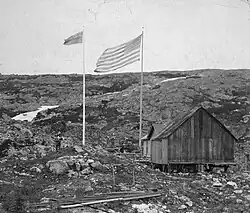
The borders of Canada include:
- To the south and west: An international boundary with the United States, forming the longest shared border in the world, 8,893 km (5,526 mi);[2] (Informally referred as the 49th parallel north which makes up the boundary at parts.[3]
- To the east: A maritime boundary with the Kingdom of Denmark, at the self-governing country of Greenland; and a smaller land-based border on divided Hans Island.
- To the southeast: A short maritime border with France, at the overseas islands of Saint Pierre and Miquelon.[4]
- To the north: The far northern situated areas of the Queen Elizabeth Islands extend well into the Arctic[5] and form portions of the basis of historical Canadian sovereignty claims into the Arctic region.[6] More recent Canadian claims (as of 2022) reportedly extend to a portion of the Russian Federation.[7]
See also
- Geography of Canada
- Arctic Council
- Arctic cooperation and politics
- Canada–United States relations
- List of areas disputed by Canada and the United States
- Exclusive economic zone of Canada
- Canada–France Maritime Boundary Case
- Territorial claims in the Arctic
References
- ^ "Alaska-Yukon boundary". Library of Congress.
- ^ "Field Listing: Land Boundaries". The World Factbook. Central Intelligence Agency. 31 May 2007. Archived from the original on 2007-06-13.
- ^ "1846 U.S.-Canadian border established". History.com. Retrieved May 14, 2024.)
- ^ Limits in the Seas No. 57 | Territorial Sea Boundary: Canada - St.-Pierre and Miquelon (PDF). U.S. Department of State. 1974.
- ^ "Canada and the Circumpolar Regions". Canada's partnerships and priorities by world region. www.international.gc.ca. Foreign Affairs, Trade and Development Canada. May 6, 2024. Retrieved May 14, 2024.
- ^ "Arctic and Northern Policy Framework: Safety, security, and defence chapter". www.rcaanc-cirnac.gc.ca. Crown-Indigenous Relations and Northern Affairs Canada. September 10, 2019. Retrieved May 14, 2024.
- ^ Breum, Martin (December 21, 2022). "Canada extends its Arctic Ocean seabed claim all the way to Russian waters". www.arctictoday.com. The Arctic Business Journal. Retrieved May 14, 2024.
External links

Wikimedia Commons has media related to International borders of Canada.