859
| Years |
|---|
| Millennium |
| 1st millennium |
| Centuries |
| Decades |
| Years |
| 859 by topic |
|---|
| Leaders |
|
| Categories |
|
| Gregorian calendar | 859 DCCCLIX |
| Ab urbe condita | 1612 |
| Armenian calendar | 308 ԹՎ ՅԸ |
| Assyrian calendar | 5609 |
| Balinese saka calendar | 780–781 |
| Bengali calendar | 265–266 |
| Berber calendar | 1809 |
| Buddhist calendar | 1403 |
| Burmese calendar | 221 |
| Byzantine calendar | 6367–6368 |
| Chinese calendar | 戊寅年 (Earth Tiger) 3556 or 3349 — to — 己卯年 (Earth Rabbit) 3557 or 3350 |
| Coptic calendar | 575–576 |
| Discordian calendar | 2025 |
| Ethiopian calendar | 851–852 |
| Hebrew calendar | 4619–4620 |
| Hindu calendars | |
| - Vikram Samvat | 915–916 |
| - Shaka Samvat | 780–781 |
| - Kali Yuga | 3959–3960 |
| Holocene calendar | 10859 |
| Iranian calendar | 237–238 |
| Islamic calendar | 244–245 |
| Japanese calendar | Ten'an 3 / Jōgan 1 (貞観元年) |
| Javanese calendar | 756–757 |
| Julian calendar | 859 DCCCLIX |
| Korean calendar | 3192 |
| Minguo calendar | 1053 before ROC 民前1053年 |
| Nanakshahi calendar | −609 |
| Seleucid era | 1170/1171 AG |
| Thai solar calendar | 1401–1402 |
| Tibetan calendar | ས་ཕོ་སྟག་ལོ་ (male Earth-Tiger) 985 or 604 or −168 — to — ས་མོ་ཡོས་ལོ་ (female Earth-Hare) 986 or 605 or −167 |
Year 859 (DCCCLIX) was a common year starting on Sunday of the Julian calendar.
Events
By place
Europe
- January 15 – Battle of St. Quentin: Frankish forces, led by Humfrid, defeat King Louis the German at Saint-Quentin (Northern France). Humfrid is enfeoffed with the County of Autun, and appointed Margrave of Burgundy, by King Charles the Bald.
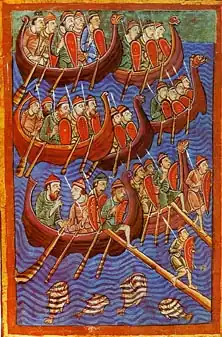
- Summer – The Viking chieftains Hastein and Björn Ironside (a son of Ragnar Lodbrok) begin an expedition, and sail from the Loire River with a fleet of 62 ships, to raid cities and monasteries in the Mediterranean Sea.[1]
- Viking raiders invade the Kingdom of Pamplona (Western Pyrenees), and capture King García Íñiguez I, somewhere in the Andalusian heartland. They extort a ransom, rising to around 70,000 gold dinars.[2]
- The Russian city of Novgorod is first mentioned in the Sofia Chronicles.
- Winter – The weather is so severe that the Adriatic Sea freezes, and Italy is covered in snow for 100 days.[3]
Iberian Peninsula
- Battle of Albelda: King Ordoño I of Asturias, and his ally García Íñiguez I, defeat the Muslims under Musa ibn Musa al-Qasawi at Albelda.
- Viking raiders burn the mosques of Seville and Algeciras in al-Andalus (modern Spain).[4]
Africa
- The University of Al Karaouine is founded in Fes (modern Morocco), by Fatima al-Fihri (recognized by the Guinness Book of World Records as the oldest still-operating university in the world).
China
- September 7 – Emperor Xuān Zong (Li Yi) dies after a 13-year reign. He is succeeded by his eldest son Yi Zong, as ruler of the Tang dynasty.
Syria
- 859 Syrian coast earthquake. It affected the Mediterranean coast of Syria[5] It caused almost the complete destruction of Latakia and Jableh, major damage at Antioch and led to many deaths.[6]
Births
- Al-Hadi ila'l-Haqq Yahya, first Zaydi Imam of Yemen (d. 911)[7]
- Ali ibn Isa al-Jarrah, vizier of the Abbasid Caliphate (d. 946)
- Odo I, king of the West Frankish Kingdom (or 860)
- Rudolph I, king of Burgundy (d. 912)
- Tannet of Pagan, king of Burma (d. 904)
Deaths
- September 7 – Xuān Zong, emperor of the Tang dynasty (b. 810)
- December 13 – Angilbert II, archbishop of Milan
- Dhul-Nun al-Misri, Egyptian scholar and Sufi (b. 796)
- Immo, bishop of Noyon (approximate date)
- Lu Shang, chancellor of the Tang dynasty (b. 789)
- Máel Gualae, king of Munster (Ireland)
References
- ^ Haywood, John (1995). The Historical Atlas of the Vikings, pp. 58–59. Penguin Books: ISBN 0-14-051328-0
- ^ Martínez Díez 2007, p. 25.
- ^ Yanko-Hombach, Valentina (2006). The Black Sea Flood Question. Springer. p. 638. ISBN 1402047746.
- ^ Rucquoi, Adeline (1993). Histoire médiévale de la Péninsule ibérique. Paris: Seuil. p. 85. ISBN 2-02-012935-3.
- ^ Antonopoulos, J. (1980). "Data from investigation of seismic Sea waves events in the Eastern Mediterranean from 500 to 1000 A.D.". Annals of Geophysics. 33 (1). doi:10.4401/ag-4701.
- ^ Ambraseys, N. (2009). Earthquakes in the Mediterranean and Middle East: A Multidisciplinary Study of Seismicity up to 1900 (First ed.). Cambridge University Press. pp. 243–244. ISBN 978-1-316-34785-0.
- ^ Madelung, W. (2004). "al-Ḥādī Ila 'l-Ḥaḳḳ". In Bearman, P. J.; Bianquis, Th.; Bosworth, C. E.; van Donzel, E. & Heinrichs, W. P. (eds.). The Encyclopaedia of Islam, Second Edition. Volume XII: Supplement. Leiden: E. J. Brill. pp. 334–335. ISBN 978-90-04-13974-9.
Sources
- Martínez Díez, Gonzalo (2007). Sancho III el Mayor Rey de Pamplona, Rex Ibericus (in Spanish). Madrid: Marcial Pons Historia. ISBN 978-84-96467-47-7.