In general relativity, the Ernst equation[1] is an integrable non-linear partial differential equation, named after the American physicist Frederick J. Ernst.[2][3]
The Ernst's equation
The Ernst's equation governing the complex scalar function  is given by[4]

where  is the two-dimensional gradient operator with axisymmetry; for instance, if
  , then
![{\displaystyle \Re (Z)\left[{\frac {1}{\rho }}{\frac {\partial }{\partial \rho }}\left(\rho {\frac {\partial Z}{\partial \rho }}\right)+{\frac {\partial ^{2}Z}{\partial ^{2}z}}\right]=\left({\frac {\partial Z}{\partial \rho }}\right)^{2}+\left({\frac {\partial Z}{\partial z}}\right)^{2}.}](./ec1069c9693cc0894e7440353da8d92c91efe96a.svg)
and if  (with
(with  ), then[5]
![{\displaystyle \Re (Z)\left[{\frac {\partial ^{2}Z}{\partial ^{2}t}}-{\frac {1}{\rho }}{\frac {\partial }{\partial \rho }}\left(\rho {\frac {\partial Z}{\partial \rho }}\right)\right]=\left({\frac {\partial Z}{\partial t}}\right)^{2}+\left({\frac {\partial Z}{\partial \rho }}\right)^{2}.}](./b30658ecd9a23ff2edf1aaba5dc76bbf7905878f.svg)
where  is the real part of
  . If is a solution of the Ernst's equation, then
  (so is
  ) is also a solution where
  is an arbitrary real constant. The transformation
  belongs to the so-called Ehler's transformation.
Often, one introduces
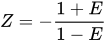
so that we have

The Ernst equation is derivable from the Lagrangian density

For its Lax pair and other features see e.g. [6][7] and references therein.
Usage
The Ernst equation is employed in order to produce exact solutions of the Einstein's equations in the general theory of relativity.
References
- ^ Weisstein, Eric W, Ernst equation, MathWorld--A Wolfram Web.
- ^ Ernst, F. J. (1968). New formulation of the axially symmetric gravitational field problem. Physical Review, 167(5), 1175.
- ^ "Biography of Frederick J. Ernst". Archived from the original on 2018-01-04. Retrieved 2017-05-09.
- ^ Chandrasekhar, S. (1998). The mathematical theory of black holes (Vol. 69). Oxford university press.
- ^ Chandrasekhar, S. (1986). Cylindrical waves in general relativity. Proceedings of the Royal Society of London. A. Mathematical and Physical Sciences, 408(1835), 209-232.
- ^ Harrison, B. Kent (30 October 1978). "Bäcklund Transformation for the Ernst Equation of General Relativity". Physical Review Letters. 41 (18). American Physical Society (APS): 1197–1200. Bibcode:1978PhRvL..41.1197H. doi:10.1103/physrevlett.41.1197. ISSN 0031-9007.
- ^ Marvan, M. (2004). Recursion operators for vacuum Einstein equations with symmetries. Proceedings of the Conference on Symmetry in nonlinear mathematical physics. Proceedings of the Institute of Mathematics of the National Academy of Sciences of Ukraine. Vol. 50. Kyiv, Ukraine. pp. 179–183. arXiv:nlin/0401014.
|
|---|
Special
relativity | | Background |
- Principle of relativity (Galilean relativity
- Galilean transformation)
- Special relativity
- Doubly special relativity
|
|---|
Fundamental
concepts | |
|---|
| Formulation |
- Lorentz transformation
- Textbooks
|
|---|
| Phenomena |
- Time dilation
- Mass–energy equivalence (E=mc2)
- Length contraction
- Relativity of simultaneity
- Relativistic Doppler effect
- Thomas precession
- Ladder paradox
- Twin paradox
- Terrell rotation
|
|---|
| Spacetime | |
|---|
|
|---|
General
relativity | | Background | |
|---|
Fundamental
concepts | |
|---|
| Formulation |
- ADM formalism
- BSSN formalism
- Einstein field equations
- Linearized gravity
- Post-Newtonian formalism
- Raychaudhuri equation
- Hamilton–Jacobi–Einstein equation
|
|---|
| Phenomena |
- Gravitational waves: astronomy
- detectors (LIGO and collaboration
- Virgo
- LISA Pathfinder
- GEO)
- Hulse–Taylor binary
- Other tests: precession of Mercury
- lensing (together with Einstein cross and Einstein rings)
- redshift
- Shapiro delay
- frame-dragging / geodetic effect (Lense–Thirring precession)
- pulsar timing arrays
|
|---|
Advanced
theories |
- Brans–Dicke theory
- Kaluza–Klein
- Quantum gravity
|
|---|
| Solutions |
- Cosmological: Friedmann–Lemaître–Robertson–Walker (Friedmann equations)
- Lemaître–Tolman
- Kasner
- BKL singularity
- Gödel
- Milne
- Spherical: Schwarzschild (interior
- Tolman–Oppenheimer–Volkoff equation)
- Reissner–Nordström
- Axisymmetric: Kerr (Kerr–Newman)
- Weyl−Lewis−Papapetrou
- Taub–NUT
- van Stockum dust
- discs
- Others: pp-wave
- Ozsváth–Schücking
- Alcubierre
- Ellis
- In computational physics: Numerical relativity
|
|---|
|
|---|
| Scientists | |
|---|
 Category |