List of polyhedral stellations
In three-dimensional space, a stellation extends facets of a polyhedron to form a new figure. Usually, this is achieved by extending faces or edges and planes of a polyhedron, until they generate new vertices that bound a newly formed figure.
This article mainly lists various stellations belonging to uniform polyhedra, such as those of the regular Platonic solids and the semiregular Archimidean solids. It also lists stellations featuring unbounded vertices.
Background
Star polytopes

Experimentation with star polygons and star polyhedra since the fourteenth century AD led the way to formal theories for stellating polyhedra:
- 14th c. AD: Thomas Bradwardine was the first to detail studies of star polygons by extending the sides of polygons.[2]
- 15th – 16th c.: Charles de Bovelles became the first to study star polyhedra.[3]
- 1509: Luca Pacioli publishes Divina proportione, featuring woodcut illustrations by Leonardo da Vinci of various polyhedra, including "elevated" polyhedra that have been augmented by attaching pyramids to faces, as showcased with the stellated octahedron.[4][a]
- 1568: Wenzel Jamnitzer publishes Perspectiva Corporum Regularium, with ink engravings on paper of different polyhedra, such as figures closely resembling the great stellated dodecahedron[7][8] and the great dodecahedron,[9][10] both stellations of the regular dodecahedron.
It was in 1619 that the first mathematical description of a stellation was given, by Johannes Kepler in his landmark book, Harmonices Mundi: the process of extending the edges (or faces) of a figure until new vertices are generated, which collectively form a new figure.[11][12][b] Using this method, Kepler was able to discover the small stellated dodecahedron and the great stellated dodecahedron[13][14][15] (the latter, a solid Jamnitzer previously studied).[8] In 1809, Louis Poinsot rediscovered Kepler's star figures and discovered a further two, the great icosahedron and great dodecahedron;[16] he achieved this by experimenting assembling regular star polygons and convex regular polygons (i.e. pentagons, pentagrams and equilateral triangles) on vertices of the regular icosahedron and dodecahedron.[17] Three years later, Augustin-Louis Cauchy proved, using concepts of symmetry, that these four stellations are the only regular star-polyhedra,[18][19] eventually termed the Kepler–Poinsot polyhedra.
Stellation process
Coxeter et al. (1938) details, for the first time, all stellations of the regular icosahedron with specific rules proposed by J. C. P. Miller.[20] Generalizing these (Miller's rules) for stellating any uniform polyhedron yields the following:[21]
- The faces must lie in face-planes, i.e., the bounding planes of the regular solid.
- All parts composing the faces must be the same in each plane, although they may be quite disconnected.
- The parts included in any one plane must be symmetric about corresponding point groups, without or with reflection. This secures polyhedral symmetry for the whole solid.
- All parts included in planes must be "accessible" in the completed solid (i.e. they must be on the "outside").
- Cases where the parts can be divided into two sets, each giving a solid with as much symmetry as the whole figure, are excluded from consideration; combination of enantiomorphous pairs having no common part (which actually occurs in just one case) are included.
These rules are ideal for stellating smaller uniform solids, such as the regular polyhedra; however, when assessing stellations of other larger uniform polyhedra, this method can quickly become overwhelming. (For example, there are a total of 358,833,072 stellations to the rhombic triacontahedron using this set of rules.)[22] To address this, Pawley (1973) proposed a set of rules that restrict the number of stellations to a more manageable set of fully supported stellations that are radially convex,[23][24] such that an outward ray from the center of the original polyhedro (in any direction) crosses the stellation surface only once[25] (that is to say, all visible parts of a face are seen from the same side).[c]
In the 1948 first edition of Regular Polytopes, H. S. M. Coxeter describes the stellation process as the reciprocal action to faceting,[28] identifying the four Kepler-Poinsot polyhedra as stellations and facetings of the regular dodecahedron and icosahedron.[29][30] He specifies the construction of a star polyhedron as a stellation of its core (with congruent face-planes), or by faceting its case — the former requires the addition of solid pieces that generate new vertices, while the latter involves the removal of solid pieces, without forming any new vertices.[31][d]
Lists
Lists for polyhedral stellations contain non-convex polyhedra; some of the most notable examples include:[e]
- the regular Kepler-Poinsot polyhedra (W20, W21, W22, and W41/C7)
- the regular compound polyhedra (W19, W2/C3, W24/C47, W25/C22, UC9) as well as
- compound dual polyhedra made of either Platonic solids or Kepler-Poinsot polyhedra (W19, W47, W61, W43, and the great icosahedron and great stellated dodecahedron compound)
Examples of stellations that topologically do not fit into standard definitions of uniform polyhedra are listed further down (i.e. stellations of hemipolyhedra).[33]
| Image | Name | Stellation core | Refs. | Notes |
|---|---|---|---|---|
 |
Great dodecahedron | Regular dodecahedron | W21 |
*, ¶
|
 |
Great stellated dodecahedron | W22
| ||
 |
Small stellated dodecahedron | W20
|
*
| |
 |
Great icosahedron | Regular icosahedron | W41,C7
| |
 |
Compound of two tetrahedra | Regular octahedron | W19
|
† (‡), ¶
|
 |
Compound of five tetrahedra | Regular icosahedron | W24,C47 |
†
|
 |
Compound of ten tetrahedra | W25,C22
| ||
 |
Compound of five octahedra | W2,C3
| ||
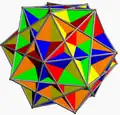 |
Compound of five cubes | Rhombic triacontahedron | ||
 |
Compound of cube and octahedron | Cuboctahedron | W43
|
‡, ¶
|
 |
Compound of dodecahedron and icosahedron | Icosidodecahedron | W47
| |
 |
Compound of great icosahedron and great stellated dodecahedron | W61
|
‡
| |
 |
Compound of great dodecahedron and small stellated dodecahedron | Rhombic triacontahedron | ||
 |
Small triambic icosahedron | Regular icosahedron | W1,C2 |
¶
|
 |
Final stellation of the icosahedron | W13,C8
| ||
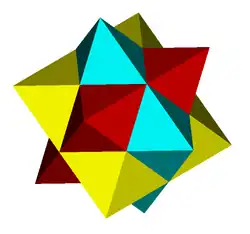 |
First stellation of the rhombic dodecahedron | Rhombic dodecahedron |
- KEY
* Kepler-Poinsot polyhedron (star polyhedron with regular facets)
† Regular compound polyhedron (vertex, edge, and face-transitive compound)
‡ Compound of dual regular polyhedra (Platonic or Kepler-Poinsot)
¶ First/outermost stellation of polyhedron
"Refs." (references) such as indexes found in Coxeter et al. (1999) using the Crennells' illustration notation (C), and Wenninger (1989) (W).
"Stellation core" describes a stellated regular (Platonic), semi-regular (Archimedean), or dual to a semi-regular (Catalan) figure.
Enumerations
The table below is adapted from research by Robert Webb, using his program Stella.[37] It enumerates fully supported stellations and stellations per Miller's process, of the regular Platonic solids as well as the semi-regular Archimedean solids and their Catalan duals. In this list, the elongated square gyrobicupola and its dual polyhedron are not included (these are sometimes considered a fourteenth Archimedean and Catalan solid, respectively). The base polyhedron stellation core is included as a zeroth convex stellation (following the Crennells' indexing), with stellation totals the sum of chiral and reflexible stellations.[f]
| Stellation totals of convex polyhedra by group symmetry (Td, Oh, Ih) [37] | |||||
|---|---|---|---|---|---|
| ▼ | Polyhedron | Cell types | Fully supported stellations | Miller stellations | |
| P L A T O N I C | Tetrahedron | 1 | 1[22] | 1[38] | |
| Cube | 1 | 1[22] | 1[38] | ||
| Octahedron | 2 | 2[39] | 2[38] | ||
| Dodecahedron | 4 | 4[39] | 4[40] | ||
| Icosahedron | 11 | 18[39][21] | 59[41] | ||
| A R C H I M E D E A N | Truncated tetrahedron | 4 | 6 | 10 | |
| Cuboctahedron | 8 | 13 | 21 | ||
| Truncated octahedron | 9 | 18 | 45 | ||
| Truncated cube | 9 | 18 | 45 | ||
| Rhombicuboctahedron | 48 | 18827 | ? (128723453647 reflexible) | ||
| Truncated cuboctahedron | 49 | 22632 | ? (317650001638 reflexible) | ||
| Snub cube | 274 | 299050957776 | ? | ||
| Icosidodecahedron | 41 | 847 | 70841855109 | ||
| Truncated icosahedron | 45 | 1117 | 3082649548558 | ||
| Truncated dodecahedron | 45 | 1141 | 2645087084526 | ||
| Rhombicosidodecahedron | 273 | 298832037395 | ? | ||
| Truncated icosidodecahedron | 294 | 1016992138164 | ? | ||
| Snub dodecahedron | 1940 | ? (579 reflexible) | ? | ||
| C A T A L A N | Triakis tetrahedron | 9 | 21[39][42] | 188 | |
| Rhombic dodecahedron | 4 | 4[39][43] | 5 | ||
| Tetrakis hexahedron | 10 | 1762[39] | 143383367876 | ||
| Triakis octahedron | 32 | 3083[39] | 218044256331 | ||
| Deltoidal icositetrahedron | 32 | 1201 | 253811894971 | ||
| Disdyakis dodecahedron | 292 | ? (14728897413 reflexible) | ? | ||
| Pentagonal icositetrahedron | 69 | 72621[39] | ? | ||
| Rhombic triacontahedron | 29 | 227[44][39] | 358833098[g] | ||
| Pentakis dodecahedron | 253 | 71112946668 | ? | ||
| Triakis icosahedron | 241 | 13902332663 | ? | ||
| Deltoidal hexecontahedron | 226 | 7146284014 | ? | ||
| Disdyakis triacontahedron | 2033 | ? (~ 1012 reflexible) | ? | ||
| Pentagonal hexecontahedron | 536 | 30049378413796 | ? | ||
"Cell types" are sets of symmetrically equivalent stellation cells, where "stellation cells" are the minimal 3D spaces enclosed on all sides by the original polyhedron's extended facial planes.
"?" denotes an unknown total number of stellations; however, the number of reflexible stellations are sometimes known for these (where chiral stellations are excluded).
Stellations of the octahedron
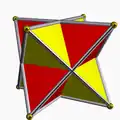
The stella octangula (or stellated octahedron), is the only stellation of the regular octahedron.[38] This stellation is made of self-dual tetrahedra, as the simplest regular polyhedral compound:[46]
| Figure | Stellation |
|---|---|
Regular octahedron
|
Stellated octahedron
stella octangula |
 |
 |
Different from the larger, regular self-dual polyhedral enantiomorphisms (such as in the compound of five cubes), the tetrahedron is the only Platonic solid to generate a stellation (and regular polyhedron compound) from a single intersecting copy of itself.[h] Like the cube, the regular tetrahedron does not generate stellations when extending its faces, since all are adjacent (this yields only one possible convex hull).[38]
Stellations of the icosahedron

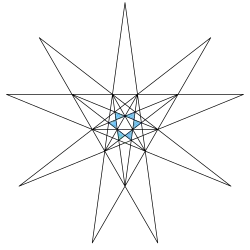
Coxeter et al. (1938) details stellations of the regular icosahedron with (aformentioned) rules proposed by J. C. P. Miller. The following table lists all such stellations per the Crennells' indexing, as found in Coxeter et al. (1999). In this list (press "show" to open the table), the regular icosahedron (or snub octahedron) stellation core is indexed as "1', where cells (du Val notation) correspond to the internal congruent spaces formed by extending face-planes of the regular icosahedron, and face diagrams the lines of intersection from extended polyhedral edges that are used in the stellation process:
| Stellations of the regular icosahedron | ||||||
|---|---|---|---|---|---|---|
| Crennell | Cells | Faces | Figure | Face diagram | ||
| A | 0 | 
|
 | |||
| B | 1 | 
|
 | |||
| C | 2 | 
|
 | |||
4
|
D | 3 4 | 
|
 | ||
5
|
E | 5 6 7 | 
|
 | ||
| F | 8 9 10 | 
|
 | |||
| G | 11 12 | 
|
 | |||
| H | 13 | 
|
 | |||
9
|
e1 | 3' 5 | 
|
 | ||
10
|
f1 | 5' 6' 9 10 | 
|
 | ||
11
|
g1 | 10' 12 | 
|
 | ||
12
|
e1f1 | 3' 6' 9 10 |  |
 | ||
13
|
e1f1g1 | 3' 6' 9 12 | 
|
 | ||
14
|
f1g1 | 5' 6' 9 12 |  |
 | ||
15
|
e2 | 4' 6 7 |  |
 | ||
16
|
f2 | 7' 8 | 
|
 | ||
17
|
g2 | 8' 9'11 |  |
 | ||
18
|
e2f2 | 4' 6 8 |  |
 | ||
19
|
e2f2g2 | 4' 6 9' 11 |  |
 | ||
20
|
f2g2 | 7' 9' 11 | 
|
 | ||
21
|
De1 | 4 5 | 
|
 | ||
| Ef1 | 7 9 10 | 
|
 | |||
23
|
Fg1 | 8 9 12 | 
|
 | ||
24
|
De1f1 | 4 6' 9 10 |  |
 | ||
25
|
De1f1g1 | 4 6' 9 12 |  |
 | ||
| Ef1g1 | 7 9 12 | 
|
 | |||
27
|
De2 | 3 6 7 | 
|
 | ||
28
|
Ef2 | 5 6 8 | 
|
 | ||
29
|
Fg2 | 10 11 | 
|
 | ||
| De2f2 | 3 6 8 | 
|
 | |||
31
|
De2f2g2 | 3 6 9' 11 |  |
 | ||
32
|
Ef2g2 | 5 6 9' 11 |  |
 | ||
| f1 | 5' 6' 9 10 | 
|
 | |||
34
|
e1f1 | 3' 5 6' 9 10 | 
|
 | ||
35
|
De1f1 | 4 5 6' 9 10 |  |
 | ||
36
|
f1g1 | 5' 6' 9 10' 12 |  |
 | ||
37
|
e1f1g1 | 3' 5 6' 9 10' 12 | 
|
 | ||
38
|
De1f1g1 | 4 5 6' 9 10' 12 |  |
 | ||
39
|
f1g2 | 5' 6' 8' 9' 10 11 |  |
 | ||
40
|
e1f1g2 | 3' 5 6' 8' 9' 10 11 |  |
 | ||
41
|
De1f1g2 | 4 5 6' 8' 9' 10 11 |  |
 | ||
42
|
f1f2g2 | 5' 6' 7' 9' 10 11 |  |
 | ||
43
|
e1f1f2g2 | 3' 5 6' 7' 9' 10 11 |  |
 | ||
44
|
De1f1f2g2 | 4 5 6' 7' 9' 10 11 |  |
 | ||
45
|
e2f1 | 4' 5' 6 7 9 10 | 
|
 | ||
46
|
De2f1 | 3 5' 6 7 9 10 |  |
 | ||
| Ef1 | 5 6 7 9 10 | 
|
 | |||
48
|
e2f1g1 | 4' 5' 6 7 9 10' 12 |  |
 | ||
49
|
De2f1g1 | 3 5' 6 7 9 10' 12 |  |
 | ||
50
|
Ef1g1 | 5 6 7 9 10' 12 |  |
 | ||
51
|
e2f1f2 | 4' 5' 6 8 9 10 | 
|
 | ||
52
|
De2f1f2 | 3 5' 6 8 9 10 |  |
 | ||
53
|
Ef1f2 | 5 6 8 9 10 |  |
 | ||
54
|
e2f1f2g1 | 4' 5' 6 8 9 10' 12 |  |
 | ||
55
|
De2f1f2g1 | 3 5' 6 8 9 10' 12 |  |
 | ||
56
|
Ef1f2g1 | 5 6 8 9 10' 12 |  |
 | ||
57
|
e2f1f2g2 | 4' 5' 6 9' 10 11 |  |
 | ||
58
|
De2f1f2g2 | 3 5' 6 9' 10 11 |  |
 | ||
59
|
Ef1f2g2 | 5 6 9' 10 11 |  |
 | ||
Wenninger (1989) includes a subset of these as formal stellations, primarily based on illustrative methods of construction of stellated polyhedral models (and extending to stellations of the icosidodecahedron).[47] While only one stellation of the icosahedron is a Kepler-Poinsot polyhedron, all stellations of the dodecahedron are Kepler-Poinsot polyhedra (the remaining).
Stellations of the rhombic dodecahedron

The rhombic dodecahedron produces three fully supported stellations; these were described in Luke (1957):[43][49]
| Stellation | Figure | Face diagram |
|---|---|---|
 |
 | |
 |
 | |
3
|
 |
 |
4
|
 |
 |
An additional fourth stellation is possible under Miller's rules.[50] The first stellation of the rhombic dodecahedron is notable for being able to form a honeycomb in three-dimensional space, using copies of itself.[48]
Hemipolychrons
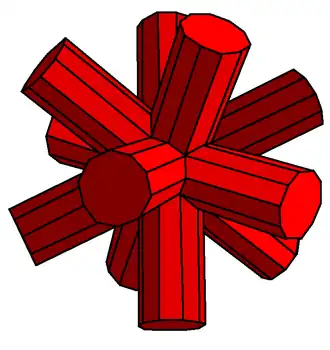
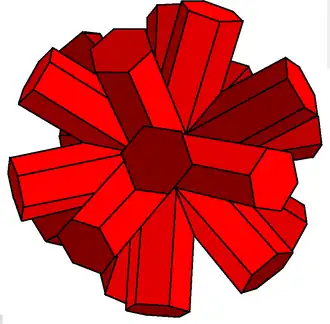
In Wenninger (1983), a unique family of stellations with unbounded vertices are identified.[33] These originate from orthogonal edges of faces that pass through centers of their corresponding dual hemipolyhedra. The following is a list of these stellations; specifically, of non-convex, uniform hemipolyhedra (with coincidental figures in parentheses).
| Image | Name | Stellation core |
|---|---|---|
 |
Tetrahemihexacron | Tetrahemihexahedron |
 |
Hexahemioctacron (octahemioctacron) |
Octahemioctahedron |
 |
Small dodecahemidodecacron (small icosihemidodecacron) |
Small icosihemidodecahedron |
 |
Great icosihemidodecacron (great dodecahemidodecacron) |
Great dodecahemidodecahedron |
 |
Small dodecahemicosacron (great dodecahemicosacron) |
Great dodecahemicosahedron |
This family of stellations does not strictly fulfill the definition of a polyhedron that is bound by vertices, and Wenninger notes that at the limit their facets can be interpreted as forming unbounded elongated pyramids, or equivalently, prisms (indistinguishably).[51] Of these, only the tetrahemihexahedron would produce a stellation without another coincidental figure, the tetrahemihexacron.
Notes
- ^ More specifically, Pacioli's "elevation" of polyhedra involved truncating (or rectifying) the Platonic solids, afterwhich pyramids of different bases are systematically attached to faces of the polyhedra in order to augment them into a "star-like" polyhedron.[5] In this same work, da Vinci illustrates a concaved triakis icosahedron, which shares its outer shell with the great stellated dodecahedron.[6]
- ^ Kepler (1997, Book I: II. Definitions; p. 17) defines a star polygon via stellation of a convex polygon:
"Some of these [figures] are primary and basic, not extending beyond their boundaries, and it is to these that the previous definition properly applies: others are augmented, as if it were extending beyond their sides, and if two non-neighboring sides of one of the basic figures are produced they meet [to form a vertex of the augmented figure]: these are called Stars." - ^ McKeown & Badler (1980) presented an early computer algorithm to generate and visualize stellations of convex polyhedra,[26] as for the 227 stellations of the rhombic triacontahedron that Pawley (1975) formally described.[27]
- ^ The core of a star polyhedron or compound is the largest convex solid that can be drawn inside them, while their case is the smallest convex solid that contains them.[32]
- ^ Using index notation from Coxeter et al. (1999) (C), the Crennells' third edition of The Fifty-Nine Icosahedra, and Magnus Wenninger's notation as found in Wenninger (1989) (W), where applicable.
- ^ A "chiral" stellation is enantiomorphous, while a "reflexible" stellation maintains the same group symmetry as its stellation core, yet is achiral. For a count of these separately, visit the parent source.
- ^ 358833072 from earlier sources,[22] and extending to 358833106 per a deeper analysis by Webb of Miller's fifth rule.[45]
- ^ Regular compound polyhedra larger than the stellated octahedron are made of larger sets of regular polyhedra with chiral symmetry.
References
Works cited
- ^ Brückner (1900), p. 260.
- ^ Coxeter (1969), p. 37.
- ^ Chasles (1875), pp. 480, 481.
- ^ Pacioli (1509), pls. XIX, XX.
- ^ Innocenzi (2018), p. 248.
- ^ Pacioli (1509), pls. XXV, XXVI.
- ^ Jamnitzer (1568), eng. F.IIII.
- ^ a b Innocenzi (2018), pp. 256, 257.
- ^ Jamnitzer (1568), eng. C.V.
- ^ Hart (1996). "Wentzel Jamnitzer's Polyhedra".
- ^ Kepler (1619), Liber I: II. Definitio (pp. 6, 7).
- ^ Kepler (1997), Book I: II. Definitions (p. 17).
- ^ Wenninger (1965), pp. 244.
- ^ Kepler (1619), Liber II: XXVI Propositio (p. 60).
- ^ Kepler (1997), Book II: XXVI Proposition (pp. 116, 117).
- ^ Wenninger (1965), pp. 244, 245.
- ^ Poinsot (1810), pp. 39–42.
- ^ Wenninger (1965), p. 245.
- ^ Cauchy (1813), pp. 68–75.
- ^ Coxeter et al. (1938), pp. 7, 8.
- ^ a b Webb (2000).
- ^ a b c d Messer (1995), p. 26.
- ^ Wenninger (1983), pp. 36, 153.
- ^ Messer (1995), p. 27.
- ^ Webb (2001). "Stella Polyhedral Glossary".
- ^ McKeown & Badler (1980), pp. 19–24.
- ^ Lansdown (1982), p. 55.
- ^ Coxeter (1948), pp. 95.
- ^ Cundy (1949), p. 48.
- ^ Coxeter (1948), pp. 96.
- ^ Coxeter (1948), p. 99.
- ^ Coxeter (1948), p. 98.
- ^ a b Wenninger (1983), pp. 101–119.
- ^ Pawley (1975), p. 225.
- ^ Weisstein (1999). "Great Dodecahedron-Small Stellated Dodecahedron Compound".
- ^ Holden (1971), p. 134.
- ^ a b Webb (2001). "Enumeration of Stellations (Research)".
- ^ a b c d e Coxeter (1973), p. 96.
- ^ a b c d e f g h i Messer (1995), p. 32.
- ^ Wenninger (1989), pp. 35, 38–40.
- ^ Coxeter et al. (1938).
- ^ Hart (1996). "Stellations of the Triakis Tetrahedron".
- ^ a b Cundy & Rollett (1961), pp. 149–151.
- ^ Pawley (1975).
- ^ Webb (2001). "Miller's Fifth Rule".
- ^ Coxeter (1973), pp. 48, 49.
- ^ Wenninger (1989), pp. 34–36, 41–65.
- ^ a b Holden (1971), p. 165.
- ^ Hart (1996). "Stellations".
- ^ Weisstein (1999). "Rhombic Dodecahedron Stellations".
- ^ Wenninger (1983), pp. 101, 103, 104.
Secondary sources
- Chasles, Michel (1875). Aperçu historique sur l'origine et le développement des méthodes en géométrie particulièrement de celles qui se rapportent à la géométrie moderne, suivi d'un mémoire de géométrie sur deux principes généraux de la science, la dualité et l'homographie [Historical overview of the origin and development of methods in geometry, particularly those relating to modern geometry, followed by a geometry dissertation on two general principles of science, duality and homography.] (in French) (2nd ed.). Paris (École polytechnique): Gauthiers-Villars. pp. 1–851. JFM 07.0021.01. MR 1355544 – via Gallica (BnF).
- Coxeter, H. S. M. (1969). Introduction to Geometry (2nd ed.). New York: Wiley. pp. 1–486. ISBN 0471182834. MR 0346644 – via Scribd.
- Coxeter, H. S. M. (1973). Regular Polytopes (3rd ed.). New York: Dover. ISBN 0-486-61480-8.
- Hart, George W. (1996). "Virtual Polyhedra (The Encyclopedia of Polyhedra)". www.georgehart.com.
- Hart, George W. (1996). "Stellations". www.georgehart.com.
- Cundy, H. Martyn (February 1949). "Regular Polytopes. By H.S.M. Coxeter. Pp. xx, 324. 50s. 1948". The Mathematical Gazette. 33 (303). Cambridge University Press: 47–49. doi:10.2307/3608432. JSTOR 3608432.
- Cundy, H. Martyn; Rollett, A. P. (1961). "The Stellations of the Rhombic Dodecahedron". Mathematical Models (PDF) (2nd ed.). New York: Oxford University Press. pp. 1–280. ISBN 9780199140183. MR 0124167 – via Prometeo (UNAM).
{{cite book}}: ISBN / Date incompatibility (help) - Holden, Alan (1971). Shapes, space, and symmetry. New York: Columbia University Press. pp. 1–200. ISBN 9780231035491 – via Internet Archive.
- Innocenzi, Plinio (2018). "The Divine Proportion". The Innovators Behind Leonardo. Cham: Springer Nature. pp. 231–260. doi:10.1007/978-3-319-90449-8. ISBN 978-3-319-90448-1.
- Lansdown, John (September 1982). "Hypergraphics: Visualizing Complex Relationships in Art, Science and Technology". Computers and the Humanities. 16 (1). Review of original work by David W. Brisson (1978). Springer Nature: 55–57. ISSN 0010-4817. JSTOR 30204734.
- Webb, Robert (2000). "Stella: Polyhedron Navigator". Symmetry: Culture and Science. 11 (1–4): 231–268. Zbl 1026.52010 – via Stella.
- Webb, Robert (2001). "Stella Polyhedral Glossary". Stella. Retrieved 23 July 2025.
- Weisstein, Eric W. (1999). "Rhombic Dodecahedron Stellations". MathWorld. Wolfram Research.
- Weisstein, Eric W. (1999). "Great Dodecahedron-Small Stellated Dodecahedron Compound". MathWorld. Wolfram Research.
- Wenninger, Magnus (1965). "Historically Speaking: The world of polyhedra*" (PDF). Mathematics Teacher. 58 (3). National Council of Teachers of Mathematics: 244–248. doi:10.5951/MT.58.3.0244. – via Maurice Starck
Primary sources
- Brückner, Max (1900). Vielecke und Vielflache: Theorie und Geschichte [Polygons and Polyhedra: Theory and History] (in German). Leipzig: B.G. Treubner. pp. 1–268. JFM 31.0479.04. OL 13159002W – via Internet Archive.
- Cauchy, Augustin-Louis (1813). "1er Mémoire: Recherches sur les polyèdres" [1st Memoir: Research on polyhedra]. Journal de l'École polytechnique (in French). 9 (16). Read in undergraduate courses at l'École polytechnique, on February 1811. Paris: Gauthiers-Villars: 68–86 – via Munich Digitization Center (BSB).
- Coxeter, H. S. M. (1948). Regular Polytopes (1st ed.). London: Methuen & Co. pp. 1–321. MR 0027148. Zbl 0031.06502 – via Internet Archive.
- Coxeter, H. S. M.; du Val, P.; Flather, P.; Petrie, J. F. (1938). "The Fifty-Nine Icosahedra". University of Toronto Studies (Mathematical Series) (6). Plates (I–XX) by Flather & Petrie. University of Toronto Press: 1–26. JFM 64.0643.02 – via Scribd.
- Third edition: Coxeter, H. S. M.; et al. (1999). The Fifty-Nine Icosahedra. Illustrations by Kate and David Crennell. Tarquin. pp. 1–72. ISBN 978-1899618323.
- Jamnitzer, Wenzel (1568). Perspectiva Corporum Regularium [Perspective of the Regular Solids] (in German). Engravings by Jost Amman (A.I–I.III) from drawings by Jamnitzer. Nuremberg: Christoph Heussler. pp. 1–4. MR 0673767 – via Getty Research Portal & Internet Archive.
- Kepler, Johannes (1619). Harmonices Mundi [The Harmonies of the World] (in Latin). Five plate engravings (Book II, pp. 58:59) and numerous woodcut illustrations prepared by Wilhelm Schickard. Linz: Gottfried Tambach & John Plancus (printer). pp. i–v, 1–66, 1–255. doi:10.5479/sil.135810.39088002800316 – via Smithsonian Libraries & Internet Archive.
- English translation: Kepler, Johannes (1997). Harmony of the World. Memoirs. Vol. 209. Translated by Duncan, A. M.; Aiton, E. J. Philadelphia: American Philosophical Society Press. pp. i–xlii, 1–549. doi:10.70249/9798893982398. ISBN 9798893982398. Zbl 0883.01051 – via De Gruyter Brill.
- Luke, Dorman (October 1957). "Stellations of the Rhombic Dodecahedron". The Mathematical Gazette. 41 (337). Cambridge University Press: 189–194. doi:10.2307/3609190. JSTOR 3609190.
- Messer, Peter W. (1995). "Stellations of the rhombic triacontahedron and beyond" (PDF). Structural Topology (21). Structural Topology Research Group (University of Montreal): 25–46. ISSN 0226-9171. MR 1351717 – via IRI (CSIC-UPC).
- McKeown, Kathleen R.; Badler, Norman I. (1980). Creating polyhedral stellations. SIGGRAPH '80: Proceedings of the 7th annual conference on Computer graphics and interactive techniques (Seattle). New York: Association for Computing Machinery. pp. 19–24. doi:10.1145/965105.807463. ISBN 978-0-89791-021-7.
- Pacioli, Luca (1509). Divina proportione (in Italian). Woodcut illustrations by Leonardo da Vinci (I–LXI). Venice: Paganino Paganini.
- Manuscript: Pacioli, Luca (December 14, 1498). Divina proportione (in Italian). Colored woodcut illustrations by Leonardo da Vinci (I–LXI). Milan: Biblioteca Ambrosiana.
- Original manuscript reprint: Pacioli, Luca (1956). De Divina Proportione. Fontes Ambrosiani (in Italian). Vol. 31. Milan: Mediobanca. pp. i–xxix, 1–247.
- Pawley, G. S. (1975). "The 227 triacontahedra". Geometriae Dedicata. 4 (2–4): 221–232. doi:10.1007/BF00148756. MR 0400015.
- Pawley, G. S. (1973). "Stellated triacontahedra" (Document). Unpublished manuscript.
- Poinsot, Louis (1810). "Mémoire: Sur les Polygones et les Polyèdres" [Memoir: On Polygons and Polyhedra]. Journal de l'École polytechnique (in French). 4 (10). Paris: Imprimerie de la République: 16–48 – via Gallica (BnF).
- Webb, Robert (2001). "Enumeration of Stellations (Research)". Stella. Retrieved 21 August 2025.
- Webb, Robert (2001). "Miller's Fifth Rule". Stella. Retrieved 23 August 2025.
- Wenninger, Magnus (1983). Dual Models. Cambridge University Press. pp. 1–156. ISBN 0521098599. MR 0730208.
- Wenninger, Magnus (1989). Polyhedron Models. Cambridge University Press. pp. 1–208. ISBN 0521069173. MR 0467493 – via Scribd.
External links
- Stellation and Facetting - a Brief History from Guy's Polyhedral Pages (Guy Inchbald) for a brief chronological listing regarding stellation
- Stellations of the Rhombic Triacontahedron from Virtual Polyhedra (The Encyclopedia of Polyhedra) (George W. Hart)
- Icosahedron Stellations from Mathworld (Eric W. Weisstein) - contains an image of all stellations based on the icosahedron (per Coxeter)