2-Methyl-2-pentanol
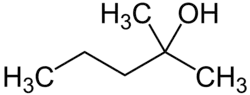 | |
 | |
| Names | |
|---|---|
| Preferred IUPAC name
2-Methylpentan-2-ol | |
| Other names
2-Methyl-2-pentanol
Dimethyl propyl carbinol Dimethylbutanol | |
| Identifiers | |
CAS Number
|
|
3D model (JSmol)
|
|
| ChEMBL | |
| ChemSpider | |
| ECHA InfoCard | 100.008.802 |
| EC Number |
|
PubChem CID
|
|
| UNII | |
| UN number | 2560 |
CompTox Dashboard (EPA)
|
|
InChI
| |
SMILES
| |
| Properties | |
Chemical formula
|
C6H14O |
| Molar mass | 102.177 g·mol−1 |
| Appearance | Colorless liquid |
| Density | 0.8350 g/cm3 at 20 °C |
| Melting point | −103 °C (−153 °F; 170 K) |
| Boiling point | 121.1 °C (250.0 °F; 394.2 K) |
| 33 g/L | |
| Solubility | soluble in ethanol, diethyl ether |
| Hazards | |
| GHS labelling: | |
Pictograms
|
 
|
Signal word
|
Warning |
Hazard statements
|
H226, H315, H319, H335 |
Precautionary statements
|
P210, P233, P240, P241, P242, P243, P261, P264, P271, P280, P302+P352, P303+P361+P353, P304+P340, P305+P351+P338, P312, P321, P332+P313, P337+P313, P362, P370+P378, P403+P233, P403+P235, P405, P501 |
| Related compounds | |
Related compounds
|
Hexanol |
Except where otherwise noted, data are given for materials in their standard state (at 25 °C [77 °F], 100 kPa).
Infobox references
| |


2-Methyl-2-pentanol (IUPAC name: 2-methylpentan-2-ol) is an organic chemical compound. It can be added to a gas chromatograph to help distinguish between branched compounds, especially alcohols.[2] Its presence in urine can be used to test for exposure to 2-methylpentane.[3] As with many other short-chain alcohols, 2-methyl-2-pentanol can produce intoxication and sedative effects similar to those of ethanol, though it is more irritating to mucous membranes and generally more toxic to the body.[4]
See also
References
- ^ Lide DR (1998). Handbook of Chemistry and Physics (87 ed.). Boca Raton, Florida: CRC Press. pp. 3–398, 8–106. ISBN 0-8493-0594-2.
- ^ Guiochon G, Guillemin CL (1988). Quantitative gas chromatography: for laboratory analyses and on-line process control. Elsevier. p. 518. ISBN 978-0-444-42857-8. Retrieved 2010-01-22.
- ^ Lauwerys RR, Hoet P (2001). Industrial chemical exposure: guidelines for biological monitoring. CRC Press. p. 190. ISBN 978-1-56670-545-5. Retrieved 2010-01-22.
- ^ Morrow AL, Montpied P, Paul SM (1991). "Ethanol and the GABA A receptor-gated chloride ion channel.". Neuropharmacology of Ethanol. Boston, MA.: Birkhäuser. pp. 49–76. doi:10.1007/978-1-4757-1305-3_3. ISBN 978-1-4757-1307-7.
Alcohols | |||||||||||||||||
|---|---|---|---|---|---|---|---|---|---|---|---|---|---|---|---|---|---|
| By consumption |
| ||||||||||||||||
| Primary alcohols (1°) |
| ||||||||||||||||
| Secondary alcohols (2°) | |||||||||||||||||
| Tertiary alcohols (3°) |
| ||||||||||||||||
| Hydric alcohols |
| ||||||||||||||||
| Amyl alcohols |
| ||||||||||||||||
| Aromatic alcohols |
| ||||||||||||||||
| Saturated fatty alcohols |
| ||||||||||||||||
| Branched and unsaturated fatty alcohols |
| ||||||||||||||||
| Sugar alcohols |
| ||||||||||||||||
| Terpene alcohols |
| ||||||||||||||||
| Dialcohols |
| ||||||||||||||||
| Trialcohols | |||||||||||||||||
| Sterols |
| ||||||||||||||||
| Fluoroalcohols |
| ||||||||||||||||
| Preparations |
| ||||||||||||||||
| Reactions |
| ||||||||||||||||
| |||||||||||||||||
