Sulforaphane
 | |
 | |
 | |
| Names | |
|---|---|
| Preferred IUPAC name
1-Isothiocyanato-4-(methanesulfinyl)butane | |
| Identifiers | |
CAS Number
|
|
3D model (JSmol)
|
|
| ChEBI | |
| ChEMBL | |
| ChemSpider | |
PubChem CID
|
|
| UNII | |
CompTox Dashboard (EPA)
|
|
InChI
| |
SMILES
| |
| Properties | |
Chemical formula
|
C6H11NOS2 |
| Molar mass | 177.29 g/mol |
Except where otherwise noted, data are given for materials in their standard state (at 25 °C [77 °F], 100 kPa).
Infobox references
| |


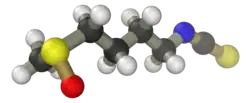
Sulforaphane (sometimes sulphoraphane in British English) is a phytochemical[1] within the isothiocyanate group of organosulfur compounds.[2] It is produced when the enzyme myrosinase transforms glucoraphanin, a glucosinolate, into sulforaphane upon damage to the plant (such as from chewing or chopping during food preparation), which allows the two compounds to mix and react.
Sulforaphane is present in cruciferous vegetables, such as broccoli, Brussels sprouts, and cabbage.[2]
Sulforaphane has two possible stereoisomers due to the presence of a stereogenic sulfur atom.[3]
The R-sulforaphane enantiomer occurs naturally, while the S-sulforaphane can be synthesized.[4]
 Glucoraphanin, the glucosinolate precursor to sulforaphane |
Occurrence and isolation
Sulforaphane occurs in broccoli sprouts, which, among cruciferous vegetables, have the highest concentration of glucoraphanin, the precursor to sulforaphane.[2][5] It is also found in cabbage, cauliflower, Brussels sprouts, bok choy, kale, collards, mustard greens, and watercress.[2]
Research
As of 2025, randomized controlled trials of sulforaphane-rich preparations in humans have demonstrated changes in surrogate biomarkers, such as reduced bronchial epithelial Ki-67 in former smokers,[6] altered prostate-specific antigen kinetics in men with biochemical recurrence of prostate cancer,[7] and increased urinary excretion of airborne pollutants such as benzene and acrolein.[8] Small clinical studies have also reported possible improvements in some symptoms of autism spectrum disorder,[9] although later reviews found the results inconsistent and not conclusive.[10] Despite these findings, no clinical trial has shown that sulforaphane reduces the actual incidence, progression, or mortality of cancer or other diseases, and overall clinical evidence remains limited and inconclusive.[11]
See also
- Raphanin
References
- ^ The Impact of Sulforaphane on Sex-Specific Conditions and Hormone Balance: A Comprehensive Review. By: Fahey, Jed W., Raphaely, Mirran, Applied Sciences (2076-3417), 20763417, Jan2025, Vol. 15, Issue 2
- ^ a b c d "Isothiocyanates". Micronutrient Information Center, Linus Pauling Institute, Oregon State University. 2025. Retrieved 21 January 2025.
- ^ Janczewski Ł (March 2022). "Sulforaphane and Its Bifunctional Analogs: Synthesis and Biological Activity". Molecules. 27 (5): 1750. doi:10.3390/molecules27051750. PMC 8911885. PMID 35268851.
- ^ Zhang Y, Lu Q, Li N, Xu M, Miyamoto T, Liu J (March 2022). "Sulforaphane suppresses metastasis of triple-negative breast cancer cells by targeting the RAF/MEK/ERK pathway". npj Breast Cancer. 8 (1) 40. doi:10.1038/s41523-022-00402-4. PMC 8948359. PMID 35332167.
- ^ Houghton CA, Fassett RG, Coombes JS (November 2013). "Sulforaphane: translational research from laboratory bench to clinic". Nutrition Reviews. 71 (11): 709–726. doi:10.1111/nure.12060. PMID 24147970.
- ^ Singh K, Lin J, Hsu F (2016). "Broccoli sprout extract reduces bronchial epithelial cell proliferation in former smokers". Cancer Prevention Research. 9 (8): 696–703. doi:10.1158/1940-6207.CAPR-16-0126. PMID 27402788.
- ^ Alumkal J, Slottke R, Tangen C (2015). "Randomized clinical trial of sulforaphane in men with biochemical recurrence of prostate cancer". Investigational New Drugs. 33 (2): 480–489. doi:10.1016/S0065-230X(15)00010-X. PMID 25640273.
- ^ Egner P, Chen J, Wang J, Wu Y, Sun Y, Zhang Q, Zhou J, Chen T, Zhu J, Zhang B (2014). "Phase 2 trial of broccoli sprout beverage on detoxication of airborne pollutants in China". Cancer Prevention Research. 7 (8): 813–823. doi:10.1158/1940-6207.CAPR-14-0103. PMC 4125483. PMID 24913818.
- ^ Zimmerman A, Singh K, Connors S, Liu H, Panjwani A (2014). "Randomized controlled trial of sulforaphane in autism spectrum disorder". Proceedings of the National Academy of Sciences. 111 (43): 15550–15555. doi:10.1073/pnas.1416940111. PMC 4210299. PMID 25288738.
- ^ Jahan Y, Moradi K (2023). "Efficacy of sulforaphane supplementation in autism spectrum disorder: A systematic review and meta-analysis". Frontiers in Psychiatry. 14 (1): 1098803. doi:10.1038/s41467-023-39599-8. PMC 10318044. PMID 37400452.
- ^ Yanaka A (2023). "Sulforaphane and its effects on cancer chemoprevention: current status and future prospects". Frontiers in Oncology. 13 (15): 1251895. doi:10.3389/fonc.2023.1251895. PMC 10710291. PMID 37653291.
{{cite journal}}: CS1 maint: article number as page number (link)