6 Metre
 Class symbol | |
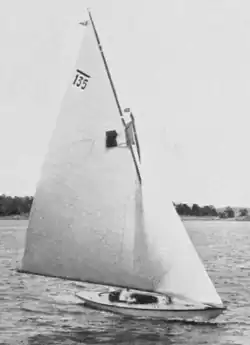 French Mac Miche – gold medalist at the 1912 Summer Olympics in Stockholm | |
| Development | |
|---|---|
| Year | 1907 (rule design) |
| Design | Development class |
The International Six Metre class is a class of classic racing yachts. Sixes are a construction class, meaning that the boats are not identical but are all designed to meet specific measurement formula, in this case International rule. At their heyday, Sixes were the most important international yacht racing class, and they are still raced around the world. "Six metre" in class name does not, somewhat confusingly, refer to length of the boat, but product of the formula; 6mR boats are, on average, 10–11 metres long.
History

The International rule was set up in 1907 to replace numerous handicap systems which were often local, or at best national, and often also fairly simple, producing extreme boats which were fast but lightly constructed and impractical. The Six Metre class was not the smallest rating established under the rule, but was nonetheless the most popular, and they were chosen as an Olympic class in 1908. However, it was not until revision of the Rule in 1920 when the Sixes really became a popular international racing class. The 1920s and '30s were 'golden age' of the International Rule boats and Sixes were still the most popular class, attracting top sailors and designers to compete for prestigious trophies such as Scandinavian Gold Cup and Olympic medals.
Alexander Robertson & Sons produced a total of five Six Metre yachts between 1921 and 1953. In 1937 their young naval architect David Boyd designed the sleek Six Metre racing yacht Circe, which was described by many as the most successful racing yacht produced at the yard. Mr J. Herbert Thom, one of the Clyde's best helmsmen sailed the yacht with tremendous success in America in 1938 and brought back the Seawanhaka Cup, which was successfully defended in home waters the following year. In later years Circe represented Russia in the 1952 Summer Olympics.
However, Six Metres were criticized as having become too expensive and towards the end of the 1930s they became more so, making the class too exclusive. Under what is known as the Second International rule (1920–33) the yachts had gone from being less than 9.1 metres (30 ft) in overall length to being almost 12 metres (40 ft). By 1929, the 5 Metre class was becoming more popular as a cheaper and smaller alternative for Sixes, but the final blow was creation of the International 5.5 Metre class in 1949. The 5.5 Metres soon replaced the Six Metres as the premier international racing class, and after the 1952 Helsinki Olympics Sixes were dropped from Olympic regattas. The Gold Cup was also transferred to the 5.5 m class from 1953 onwards.
Despite this, the class continued to exist, and new boats were made utilising the newest contemporary technologies, although sparingly. During the 1980s, many old sailboat classes experienced revival of interest and Sixes were at the forefront of this development. The Class has undergone a renaissance which has continued to this day, with many old yachts restored or rebuilt to racing condition. Six Metre competition is thriving once again with active fleets in Europe, North America and Scandinavia. Performance differences between classic and modern era Sixes are usually small and they can be raced together.
In 2019 the International Six Metre Association launched an online archive website, allowing researchers around the world to access historical information about the class.
Events
Olympics
| Games | Gold | Silver | Bronze |
|---|---|---|---|
| 1908 London |
.svg.png) Great Britain Great BritainGilbert Laws Thomas McMeekin Charles Crichton |
.svg.png) Belgium BelgiumLéon Huybrechts Louis Huybrechts Henri Weewauters |
 France FranceHenri Arthus Louis Potheau Pierre Rabot |
| 1912 Stockholm |
France Gaston Thubé Amédée Thubé Jacques Thubé |
 Denmark DenmarkHans Meulengracht-Madsen Steen Herschend Sven Thomsen |
 Sweden SwedenEric Sandberg Otto Aust Harald Sandberg |
| 1920 Antwerp 1907 rule |
Belgium Émile Cornellie Frédéric Bruynseels Florimond Cornellie |
 Norway NorwayEinar Torgersen Leif Erichsen Andreas Knudsen |
Norway Henrik Agersborg Einar Berntsen Trygve Pedersen |
| 1920 Antwerp 1919 rule |
Norway Andreas Brecke Paal Kaasen Ingolf Rød |
Belgium Léon Huybrechts Charles Van Den Bussche John Klotz |
no further competitors |
| 1924 Paris |
Norway Anders Lundgren Christopher Dahl Eugen Lunde |
Denmark Vilhelm Vett Knud Degn Christian Nielsen |
 Netherlands NetherlandsJohan Carp Anthonij Guépin Jan Vreede |
| 1928 Amsterdam |
Norway Johan Anker Erik Anker Håkon Bryhn Crown Prince Olav |
Denmark Vilhelm Vett Aage Høy-Petersen Niels Otto Møller Peter Schlütter |
 Estonia EstoniaNikolai Vekšin Andreas Faehlmann Georg Faehlmann Eberhard Vogdt William von Wirén |
| 1932 Los Angeles |
Sweden Tore Holm Olle Åkerlund Åke Bergqvist Martin Hindorff |
.svg.png) United States United StatesRobert Carlson Temple Ashbrook Frederic Conant Emmett Davis Donald Douglas Charles Smith |
.svg.png) Canada CanadaPhilip Rogers Gardner Boultbee Ken Glass Jerry Wilson |
| 1936 Berlin |
Great Britain Christopher Boardman Miles Bellville Russell Harmer Charles Leaf Leonard Martin |
Norway Magnus Konow Karsten Konow Fredrik Meyer Vaadjuv Nyqvist Alf Tveten |
Sweden Sven Salén Lennart Ekdahl Martin Hindorff Torsten Lord Dagmar Salén |
| 1948 London |
United States Herman Whiton Alfred Loomis Michael Mooney James Smith James Weekes |
.svg.png) Argentina ArgentinaEnrique Sieburger, Sr. Emilio Homps Rodolfo Rivademar Rufino Rodríguez de la Torre Enrique Sieburger, Jr. Julio Sieburger |
Sweden Tore Holm Carl Robert Ameln Martin Hindorff Torsten Lord Gösta Salén |
| 1952 Helsinki |
United States Herman Whiton Everard Endt John Morgan Eric Ridder Julian Roosevelt Emelyn Whiton |
Norway Finn Ferner Tor Arneberg Johan Ferner Erik Heiberg Carl Mortensen |
 Finland FinlandErnst Westerlund Ragnar Jansson Jonas Konto Rolf Turkka Paul Sjöberg |
World Championship
Scandinavian Gold Cup
References
External links
- ISMA International Six Metre Association new website of the ISMA International Six Metre Association
- International Six Metre Archive
- International Six Metre Association
- Metre Boat Index
- Book: The Six Metre - 100 Years of Racing, published on the centenary of the International Rule
- Sailing Anarchy: Sailboat tour of a 6 meter "Sprig" (video)