Cruiseferry

A cruiseferry or cruise ferry is a ship that combines the features of a cruise ship and a Ro-Pax ferry. Many passengers travel with the ships for the cruise experience, staying only a few hours at the destination port or not leaving the ship at all, while others use the ships as means of transportation. Some operators prefer to refer to them as "cruise ships with car decks."[1]
Cruiseferry traffic is mainly concentrated in the seas of Northern Europe, especially the Baltic Sea and the North Sea. However, similar ships traffic across the English Channel as well as the Irish Sea, Mediterranean and even on the North Atlantic. Cruiseferries also operate from India, China and Australia.
Baltic Sea cruiseferries
In the northern Baltic Sea, two major rival companies, Viking Line and Silja Line, have for decades competed on the routes between Turku and Helsinki in Finland and Sweden's capital Stockholm. Since the 1990s Tallink has also risen as a major company in the area, culminating with acquisition of Silja Line in 2006.
While superficially resembling cruise ships that operate primarily in tropical climates, Baltic cruiseferries will have windows rather than balconies for cabins/suites, plus a higher hull and promenade deck with higher positioning of lifeboats (the height above water called the freeboard), a longer bow, and for additional strength they are often designed with thicker hull plating than is found on cruise ships, as well as a deeper draft for greater stability. Cruise ferries share these above attributes with ocean liners in order to protect against the large waves and cold stormy weather, since cruise ferries are expected to ply the Baltic Sea year-round while cruise ships can only do so in the summer.[2]
The largest Baltic cruiseferries offer many of the amenities found on contemporary cruise ships, including a wide range of restaurants, entertainment options, and health and fitness facilities. However on cruiseferries, many of these facilities such as the pool deck and shopping arcade are fully enclosed due to the cool Baltic climate. Cruiseferry cabins are typically smaller as voyages are only one or two nights, plus food is generally not included in cruise ferry fares, whereas cruise ships usually have itineraries lasting three nights or more and fares are all inclusive.[3]
List of largest cruiseferries of their time
The term "cruiseferry" did not come into use until the 1980s, although it has been retroactively applied to earlier ferries that have large cabin capabilities and public spaces in addition to their car- and passenger-carrying capacity.
| Year | Name | Tonnage1 | Company | Traffic area | Flag | Notes |
|---|---|---|---|---|---|---|
| 1956 | MV Akdeniz | 8,809 GRT | Turkish Maritime Lines | Mediterranean Sea |  Turkey Turkey |
Built 1955 |
| 1975 | MS Belorussiya | 16,331 GRT | Black Sea Shipping Company | Black Sea |  Soviet Union Soviet Union |
Alongside five identical sisters built 1975–76 |
| 1976 | MS Napoléon | 20,079 GRT | SNCM | Mediterranean |  France France |
Sent to Comarit in 2002. |
| 1977 | GTS Finnjet | 24,605 GRT | Enso-Gutzeit (Finnlines traffic) | Baltic Sea |  Finland Finland |
Gas turbine-powered. Also fastest and longest |
| 1981 | MS Finlandia | 25,905 GRT | Effoa (Silja Line traffic) | Baltic Sea | Finland |
Alongside identical sister MS Silvia Regina |
| 1982 | MS Scandinavia | 26,747 GT | Scandinavian World Cruises, later DFDS Seaways |
New York—Bahamas Copenhagen—Oslo |
 Denmark Denmark |
|
| 1985 | MS Svea | 33,829 GT | Johnson Line (Silja Line traffic) | Baltic Sea |  Sweden Sweden |
|
| 1985 | MS Mariella | 37,799 GT | SF Line (Viking Line traffic) | Baltic Sea | Finland |
|
| 1989 | MS Athena | 40,012 GT | Rederi AB Slite (Viking Line traffic) | Baltic Sea | Sweden |
|
| 1989 | MS Cinderella | 46,398 GT | SF Line (Viking Line traffic) | Baltic Sea | Finland |
|
| 1990 | MS Silja Serenade | 58,376 GT | Silja Line | Baltic Sea | Finland |
|
| 1991 | MS Silja Symphony | 58,377 GT | Silja Line | Baltic Sea | Sweden |
|
| 1993 | MS Silja Europa | 59,914 GT | Tallink | Baltic Sea |  Estonia Estonia |
Ordered by Rederi AB Slite for Viking Line traffic |
| 2001 | MS Pride of Rotterdam | 59,925 GT | P&O Ferries | North Sea |  Netherlands Netherlands |
|
| 2001 | MS Pride of Hull | 59,925 GT | P&O Ferries | North Sea | Netherlands |
|
| 2004 | MS Color Fantasy | 75,027 GT | Color Line | Kattegat, Skagerrak |  Norway Norway |
|
| 2007 | MS Color Magic | 75,100 GT | Color Line | Kattegat, Skagerrak | Norway |
|
| 1May be specified in gross tonnage (GT) or gross register tons (GRT). | ||||||
List of cruiseferry operators
Åland
 Eckerö Linjen
- () Viking Line
Australia
.svg.png)
Canada
.svg.png)
Croatia

Denmark
Estonia
Faroe Islands

Finland
- Eckerö Line
- Silja Line (operated by Tallink)
- () Viking Line
- Finnlines
- Wasa Line
France
- Brittany Ferries
- Corsica Ferries - Sardinia Ferries
- Corsica Linea
Greece
 ANEK Lines
- Blue Star Ferries
- Hellenic Seaways
- LANE Lines
- Levante Ferries
- Minoan Lines
- NEL Lines
- Superfast Ferries
- Ventouris Ferries
Hong Kong
 Genting Hong Kong (defunct)[4]
Ireland

Italy
 Grandi Navi Veloci
- Grimaldi Lines
- Corsica Ferries
- Moby Lines
- Tirrenia di Navigazione
Mexico
 Baja Ferries
Norway
- Color Line
- Fjord Line
Poland
 Polferries
Spain
 Trasmediterranea
- Baleària
Sweden
Tunisia
• Tunisia ferries (COTUNAV)
United Kingdom
 P&O Ferries
- NorthLink Ferries
- Brittany Ferries
- Irish Ferries
- Stena Line
Japan

Gallery
-
 Pont-Aven, Brittany Ferries' flagship.
 -
 M/S Silja Europa, the largest cruiseferry in the world 1993–2001.
 -
 M/S Cinderella departing Helsinki.
 -
_-_2021-09-05_-_6_(cropped).jpg)
-
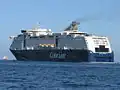 M/S Color Fantasy, the largest cruiseferry in the world 2004–2007.
 -
 MS Cruise Roma in Civitavecchia, Italy.
 -

-

-
 MS Galaxy in Helsinki West Harbour.
 -

-

-
 MV Cap Finistère of Brittany Ferries sailing from Portsmouth International Port, UK for Bilbao, Spain.
See also

References
- ^ "Top 6 European Cruise Ferries". Cruise Critic. Retrieved 27 July 2025.
- ^ "Top 6 European Cruise Ferries". Cruise Critic. Retrieved 27 July 2025.
- ^ "Top 6 European Cruise Ferries". Cruise Critic. Retrieved 27 July 2025.
- ^ Ngui, Yantoultra (2022). "How a Billionaire's Cruise Empire Imploded in Hong Kong". Bloomberg.com. Retrieved 2 November 2024 – via EBSCOhost.
- ^ "Travelscene boosts options in Cruiseferry programme". Travel Trade Gazette UK & Ireland. No. 2534. 2002. p. 63. Retrieved 2 November 2024 – via EBSCOhost.
Modern merchant ships | ||
|---|---|---|
| Overviews |  | |
| Dry cargo | ||
| Tankers |
| |
| Passenger | ||
| Support |
| |
| Other types |
| |
| Related |
| |