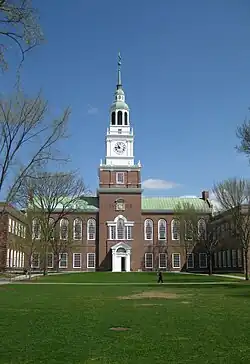
Trustees of Dartmouth College v. Woodward, 17 U.S. (4 Wheat.) 518 (1819), was a landmark decision in United States corporate law from the United States Supreme Court dealing with the application of the Contracts Clause of the United States Constitution to private corporations. The case arose when the president of Dartmouth College was deposed by its trustees, leading to the New Hampshire legislature attempting to force the college to become a public institution and thereby place the ability to appoint trustees in the hands of the governor of New Hampshire. The Supreme Court upheld the sanctity of the original charter of the college, which predated the creation of the State.[1]
The decision settled the nature of public versus private charters and resulted in the rise of the American business corporation and the American free enterprise system.[2]
Background
In 1769, King George III of Great Britain granted a charter to Dartmouth College that spelled out the purpose of the school, set up the structure to govern it, and gave it land. In 1816, over 30 years after the conclusion of the American Revolution, the New Hampshire legislature altered Dartmouth's charter in order to reinstate the College's deposed president, place the ability to appoint positions in the hands of the governor, add new members to the board of trustees, and create a state-controlled board of visitors with veto power over trustee decisions. This effectively converted the school from a private to a public institution. The College's book of records, corporate seal, and other corporate property were removed. The trustees of the College objected and sought to have the actions of the legislature declared unconstitutional.
The trustees retained Dartmouth alumnus Daniel Webster, a New Hampshire lawyer who later became a U.S. Senator for Massachusetts and Secretary of State under President Millard Fillmore. Webster argued the college's case against William H. Woodward, the state-approved secretary of the new board of trustees. Webster's speech in support of Dartmouth (which he called "a small college," adding, "and yet there are those who love it") was reportedly so moving that it helped convince Chief Justice John Marshall and almost brought Marshall to tears, according to the later recollection of attendant Chauncey A. Goodrich.[3]
Judgment
The decision, handed down on February 2, 1819, ruled in favor of the college and invalidated the act of the New Hampshire Legislature, which in turn allowed Dartmouth to continue as a private institution and take back its buildings, seal, and charter. The majority opinion of the court was written by Marshall. The opinion reaffirmed Marshall's belief in the sanctity of a contract (also seen in Fletcher v. Peck[4]) as necessary to the functioning of a republic (in the absence of royal rule, contracts rule).
The Court ruled that the college's corporate charter qualified as a contract between private parties, the King and the trustees, with which the legislature could not interfere. Even though the United States were no longer royal colonies, the contract was still valid because the Constitution said that a state could not pass laws to impair a contract. The fact that the government had commissioned the charter did not transform the school into a civil institution. Marshall's opinion emphasized that the term "contract" referred to transactions involving individual property rights, not to "the political relations between the government and its citizens."[5]
Significance
The decision was not without precedent; the Court had invalidated a state act in Fletcher v. Peck (1810),[4] concluding that contracts, no matter how they were procured (in that case, a land contract had been illegally obtained), cannot be invalidated by state legislation. Fletcher was not a popular decision at the time, and a public outcry ensued. Thomas Jefferson's earlier commiseration with New Hampshire Governor William Plumer stated essentially that the earth belongs to the living. Popular opinion influenced some state courts and legislatures to declare that state governments had an absolute right to amend or repeal a corporate charter. The courts, however, have imposed limitations on this.
After the Dartmouth decision, many states wanted more control, so they passed laws or constitutional amendments giving themselves the general right to alter or revoke at will, which the courts found to be a valid reservation.[6][7] But the courts had established that the alteration or revocation of private charters or laws authorizing private charters must be reasonable and cannot cause harm to the members (founders, stockholders, and the like).[8][9][10]
The traditional view is that this case is one of the most important Supreme Court rulings, strengthening the Contracts Clause and limiting the power of the States to interfere with private charters, including those of commercial enterprises.[11]
See also
Notes
- ^ Dartmouth College v. Woodward, 17 U.S. (4 Wheat.) 518 (1819).
- ^ Newmyer, R. K. (2001). John Marshall and the heroic age of the Supreme Court. Baton Rouge: Louisiana State University Press. ISBN 0-8071-2701-9.
- ^ WILSON, CARROLL A. "Daniel Webster and Dartmouth | Dartmouth Alumni Magazine | April 1943". Dartmouth Alumni Magazine | The Complete Archive. Retrieved January 14, 2025.
- ^ a b Fletcher v. Peck, 10 U.S. (6 Cranch) 87 (1810).
- ^ The Oyez Project, "Dartmouth College v. Woodward", 17 U.S. 518 (1819)]
- ^ Miller v. State, 82 U.S. (15 Wall.) 478 (1872).
- ^ Pennsylvania College Cases, 80 U.S. (13 Wall.) 190 (1871).
- ^ Terrett v. Taylor, 13 U.S. (9 Cranch) 43 (1815).
- ^ Shields v. Ohio, 95 U.S. 319 (1877).
- ^ Greenwood v. Freight Company, 105 U.S. 13 (1881).
- ^ "Chapter 14. Private Contracts, the Contract Clause and the Police Power", Charles Evans Hughes and the Supreme Court, Columbia University Press, pp. 168–184, December 31, 1951, doi:10.7312/hend90602-015, ISBN 978-0-231-87956-9, retrieved July 6, 2023
External links
|
|---|
|
|
|
|
|
|
|
|
|---|
| Dormant Commerce Clause |
- Brown v. Maryland (1827)
- Willson v. Black-Bird Creek Marsh Co. (1829)
- Cooley v. Board of Wardens (1852)
- Wabash, St. Louis & Pacific Railway Co. v. Illinois (1886)
- Swift & Co. v. United States (1905)
- George W. Bush & Sons Co. v. Malloy (1925)
- Baldwin v. G.A.F. Seelig, Inc. (1935)
- Edwards v. California (1941)
- Southern Pacific Co. v. Arizona (1945)
- Dean Milk Co. v. City of Madison (1951)
- Miller Bros. Co. v. Maryland (1954)
- Bibb v. Navajo Freight Lines, Inc. (1959)
- National Bellas Hess v. Illinois (1967)
- Pike v. Bruce Church, Inc. (1970)
- Hughes v. Alexandria Scrap Corp. (1976)
- Complete Auto Transit, Inc. v. Brady (1977)
- Hunt v. Washington State Apple Advertising Commission (1977)
- City of Philadelphia v. New Jersey (1978)
- Exxon Corp. v. Governor of Maryland (1978)
- Reeves, Inc. v. Stake (1980)
- Kassel v. Consolidated Freightways Corp. (1981)
- Sporhase v. Nebraska ex rel. Douglas (1982)
- White v. Mass. Council of Construction Employers (1983)
- South-Central Timber Development, Inc. v. Wunnicke (1984)
- Maine v. Taylor (1986)
- Healy v. Beer Institute, Inc. (1989)
- Quill Corp. v. North Dakota (1992)
- Chemical Waste Management, Inc. v. Hunt (1992)
- Oregon Waste Systems, Inc. v. Department of Environmental Quality of Oregon (1994)
- C&A Carbone, Inc. v. Town of Clarkstown (1994)
- West Lynn Creamery, Inc. v. Healy (1994)
- Granholm v. Heald (2005)
- United Haulers Ass'n v. Oneida-Herkimer Solid Waste Management Authority (2007)
- Department of Revenue of Kentucky v. Davis (2008)
- Comptroller of the Treasury of Maryland v. Wynne (2015)
- South Dakota v. Wayfair, Inc. (2018)
- Tennessee Wine and Spirits Retailers Assn. v. Thomas (2019)
- National Pork Producers Council v. Ross (2023)
|
|---|
| Others | |
|---|
|
|
|
|
|---|
| Copyright Act of 1790 | |
|---|
| Patent Act of 1793 | |
|---|
| Patent infringement case law |
- Evans v. Jordan (1815)
- Hollister v. Benedict & Burnham Manufacturing Co. (1885)
- Rowell v. Lindsay (1885)
- Schillinger v. United States (1894)
- Bauer & Cie. v. O'Donnell (1913)
- General Talking Pictures Corp. v. Western Electric Co. (1938)
|
|---|
| Patentability case law |
- Pennock v. Dialogue (1829)
- Hotchkiss v. Greenwood (1851)
- O'Reilly v. Morse (1853)
- Cochrane v. Deener (1876)
- City of Elizabeth v. American Nicholson Pavement Co. (1878)
- Egbert v. Lippmann (1881)
- Consolidated Safety-Valve Co. v. Crosby Steam Gauge & Valve Co. (1885)
- Voss v. Fisher (1885)
|
|---|
| Copyright Act of 1831 |
- Wheaton v. Peters (1834)
- Backus v. Gould (1849)
- Stephens v. Cady (1853)
- Stevens v. Gladding (1854)
- Little v. Hall (1856)
- Paige v. Banks (1872)
- Baker v. Selden (1879)
- Callaghan v. Myers (1888)
- Higgins v. Keuffel (1891)
- Holmes v. Hurst (1899)
- Brady v. Daly (1899)
- Bolles v. Outing Co. (1899)
- Mifflin v. R. H. White Company (1903)
- Mifflin v. Dutton (1903)
|
|---|
| Copyright Act of 1870 |
- Perris v. Hexamer (1879)
- Trade-Mark Cases (1879)
- Merrell v. Tice (1881)
- Schreiber v. Sharpless (1884)
- Burrow-Giles Lithographic Co. v. Sarony (1884)
- Thornton v. Schreiber (1888)
- Banks v. Manchester (1888)
- Callaghan v. Myers (1888)
- Thompson v. Hubbard (1889)
- Higgins v. Keuffel (1891)
- Belford v. Scribner (1892)
- Brady v. Daly (1899)
- Bolles v. Outing Co. (1899)
- Bleistein v. Donaldson Lithographing Co. (1903)
- McLoughlin v. Raphael Tuck & Sons Co. (1903)
- American Tobacco Co. v. Werckmeister (1907)
- Werckmeister v. American Tobacco Co. (1907)
- United Dictionary Co. v. G. & C. Merriam Co. (1907)
- White-Smith Music Publishing Co. v. Apollo Co. (1908)
- Dun v. Lumbermen's Credit Ass'n (1908)
- Bobbs-Merrill Co. v. Straus (1908)
- Scribner v. Straus (1908)
- Bong v. Campbell Art Co. (1909)
- Henry v. A.B. Dick Co. (1912)
|
|---|
| Sherman Antitrust Act of 1890 | |
|---|
| International Copyright Act of 1891 |
- Press Pub. Co. v. Monroe (1896)
- McLoughlin v. Raphael Tuck & Sons Co. (1903)
- American Tobacco Co. v. Werckmeister (1907)
- White-Smith Music Publishing Co. v. Apollo Co. (1908)
- Globe Newspaper Co. v. Walker (1908)
- Bong v. Campbell Art Co. (1909)
- Caliga v. Inter Ocean Newspaper Co. (1909)
- Hills and Co. v. Hoover (1911)
- Kalem Co. v. Harper Bros. (1911)
|
|---|
| Copyright Act of 1909 | |
|---|
| Patent misuse case law | |
|---|
| Clayton Antitrust Act of 1914 |
- Fashion Originators' Guild of America v. FTC (1941)
- Dowling v. United States (1985)
|
|---|
| Lanham Act |
- Inwood Laboratories, Inc. v. Ives Laboratories, Inc. (1982)
- San Francisco Arts & Athletics, Inc. v. United States Olympic Committee (1987)
- Two Pesos, Inc. v. Taco Cabana, Inc. (1992)
- Qualitex Co. v. Jacobson Products Co. (1995)
- College Savings Bank v. Florida Prepaid Postsecondary Education Expense Board (1999)
- Cooper Industries, Inc. v. Leatherman Tool Group, Inc. (2001)
- TrafFix Devices, Inc. v. Marketing Displays, Inc. (2001)
- Dastar Corp. v. Twentieth Century Fox Film Corp. (2003)
- Moseley v. V Secret Catalogue, Inc. (2003)
- Lexmark International, Inc. v. Static Control Components, Inc. (2014)
- POM Wonderful LLC v. Coca-Cola Co. (2014)
- Matal v. Tam (2017)
- Iancu v. Brunetti (2019)
- Romag Fasteners, Inc. v. Fossil, Inc. (2020)
|
|---|
| Copyright Act of 1976 |
- Zacchini v. Scripps-Howard Broadcasting Co. (1977)
- Sony Corp. of America v. Universal City Studios, Inc. (1984)
- Mills Music, Inc. v. Snyder (1985)
- Harper & Row v. Nation Enterprises (1985)
- Community for Creative Non-Violence v. Reid (1989)
- Stewart v. Abend (1990)
- Feist Publications, Inc., v. Rural Telephone Service Co. (1991)
- Fogerty v. Fantasy, Inc. (1994)
- Campbell v. Acuff-Rose Music, Inc. (1994)
- Lotus Dev. Corp. v. Borland Int'l, Inc. (1996)
- Quality King Distributors Inc., v. L'anza Research International Inc. (1998)
- Feltner v. Columbia Pictures Television, Inc. (1998)
- New York Times Co. v. Tasini (2001)
- Eldred v. Ashcroft (2003)
- MGM Studios, Inc. v. Grokster, Ltd. (2005)
- Reed Elsevier, Inc. v. Muchnick (2010)
- Golan v. Holder (2012)
- Kirtsaeng v. John Wiley & Sons, Inc. (2013)
- Petrella v. Metro-Goldwyn-Mayer, Inc. (2014)
- American Broadcasting Cos., Inc. v. Aereo, Inc. (2014)
- Star Athletica, LLC v. Varsity Brands, Inc. (2017)
- Fourth Estate Public Benefit Corp. v. Wall-Street.com (2019)
- Rimini Street Inc. v. Oracle USA Inc. (2019)
- Allen v. Cooper (2020)
- Georgia v. Public.Resource.Org, Inc. (2020)
|
|---|
| Other copyright cases |
- American Lithographic Co. v. Werkmeister (1911)
- Ferris v. Frohman (1912)
- Order of St. Benedict of New Jersey v. Steinhauser (1914)
- International News Service v. Associated Press (1918)
- L. A. Westermann Co. v. Dispatch Printing Co. (1919)
- Lumiere v. Mae Edna Wilder, Inc. (1923)
- Educational Films Corp. v. Ward (1931)
- Fox Film Corp. v. Doyal (1932)
- George v. Victor Talking Machine Co. (1934)
- KVOS v. Associated Press (1936)
- Gibbs v. Buck (1939)
- Buck v. Gallagher (1939)
- Commissioner v. Wodehouse (1949)
- Miller Music Corp. v. Charles N. Daniels, Inc. (1960)
- Pub. Affairs Associates, Inc. v. Rickover (1962)
- Fortnightly Corp. v. United Artists Television, Inc. (1968)
- Goldstein v. California (1973)
- Teleprompter Corp. v. Columbia Broadcasting (1974)
- Twentieth Century Music Corp. v. Aiken (1975)
|
|---|
| Other patent cases |
- Continental Paper Bag Co. v. Eastern Paper Bag Co. (1908)
- Minerals Separation, Ltd. v. Hyde (1916)
- United States v. General Electric Co. (1926)
- United States v. Univis Lens Co. (1942)
- Altvater v. Freeman (1943)
- Sinclair & Carroll Co. v. Interchemical Corp. (1945)
- Funk Bros. Seed Co. v. Kalo Inoculant Co. (1948)
- Great Atlantic & Pacific Tea Co. v. Supermarket Equipment Corp. (1950)
- Graver Tank & Manufacturing Co. v. Linde Air Products Co. (1950)
- Aro Manufacturing Co. v. Convertible Top Replacement Co. (1961)
- Compco Corp. v. Day-Brite Lighting, Inc. (1964)
- Wilbur-Ellis Co. v. Kuther (1964)
- Brulotte v. Thys Co. (1964)
- Walker Process Equipment, Inc. v. Food Machinery & Chemical Corp. (1965)
- Graham v. John Deere Co. (1966)
- United States v. Adams (1966)
- Brenner v. Manson (1966)
- Lear, Inc. v. Adkins (1969)
- Anderson's-Black Rock, Inc. v. Pavement Salvage Co. (1969)
- Zenith Radio Corp. v. Hazeltine Research, Inc. (1971)
- Gottschalk v. Benson (1972)
- United States v. Glaxo Group Ltd. (1973)
- Dann v. Johnston (1976)
- Sakraida v. Ag Pro Inc. (1976)
- Parker v. Flook (1978)
- Diamond v. Chakrabarty (1980)
- Diamond v. Diehr (1981)
- Bonito Boats, Inc. v. Thunder Craft Boats, Inc. (1989)
- Eli Lilly & Co. v. Medtronic, Inc. (1990)
- Markman v. Westview Instruments, Inc. (1996)
- Warner-Jenkinson Co. v. Hilton Davis Chemical Co. (1997)
- Pfaff v. Wells Electronics, Inc. (1998)
- Dickinson v. Zurko (1999)
- Florida Prepaid Postsecondary Education Expense Board v. College Savings Bank (1999)
- J. E. M. Ag Supply, Inc. v. Pioneer Hi-Bred International, Inc. (2001)
- Festo Corp. v. Shoketsu Kinzoku Kogyo Kabushiki Co. (2002)
- Merck KGaA v. Integra Lifesciences I, Ltd. (2005)
- eBay Inc. v. MercExchange, L.L.C. (2006)
- Illinois Tool Works Inc. v. Independent Ink, Inc. (2006)
- LabCorp v. Metabolite, Inc. (2006)
- MedImmune, Inc. v. Genentech, Inc. (2007)
- KSR International Co. v. Teleflex Inc. (2007)
- Microsoft Corp. v. AT&T Corp. (2007)
- Quanta Computer, Inc. v. LG Electronics, Inc. (2008)
- Bilski v. Kappos (2010)
- Global-Tech Appliances, Inc. v. SEB S.A. (2011)
- Stanford University v. Roche Molecular Systems, Inc. (2011)
- Microsoft Corp. v. i4i Ltd. Partnership (2011)
- Mayo Collaborative Services v. Prometheus Laboratories, Inc. (2012)
- Kappos v. Hyatt (2012)
- Bowman v. Monsanto Co. (2013)
- Gunn v. Minton (2013)
- Association for Molecular Pathology v. Myriad Genetics, Inc. (2013)
- FTC v. Actavis, Inc. (2013)
- Alice Corp. v. CLS Bank International (2014)
- Akamai Techs., Inc. v. Limelight Networks, Inc. (2014)
- Teva Pharmaceuticals USA, Inc. v. Sandoz, Inc. (2015)
- Kimble v. Marvel Entertainment, LLC (2015)
- Apple Inc. v. Samsung Electronics Co. (2016)
- TC Heartland LLC v. Kraft Foods Group Brands LLC (2017)
- Peter v. NantKwest, Inc. (2019)
|
|---|
| Other trademark cases | |
|---|
|
|
|
|
|
|
|
|

 Works related to Trustees of Dartmouth College v. Woodward at Wikisource