This article is about calculating decompression using nitrox. For calculating narcotic effects using trimix, see
Equivalent narcotic depth.
The equivalent air depth (EAD) is a way of approximating the decompression requirements of breathing gas mixtures that contain nitrogen and oxygen in different proportions to those in air, known as nitrox.[1][2][3]
The equivalent air depth, for a given nitrox mix and depth, is the depth of a dive when breathing air that would have the same partial pressure of nitrogen. So, for example, a gas mix containing 36% oxygen (EAN36) being used at 27 metres (89 ft) has an EAD of 20 metres (66 ft).
Calculations in metres
The equivalent air depth can be calculated for depths in metres as follows:
- EAD = (Depth + 10) × (Fraction of N2 / 0.79) − 10
Working the earlier example, for a nitrox mix containing 64% nitrogen (EAN36) being used at 27 metres, the EAD is:
- EAD = (27 + 10) × (0.64 / 0.79) − 10
- EAD = 37 × 0.81 − 10
- EAD = 30 − 10
- EAD = 20 metres
So at 27 metres on this mix, the diver would calculate their decompression requirements as if on air at 20 metres.
Calculations in feet
The equivalent air depth can be calculated for depths in feet as follows:
- EAD = (Depth + 33) × (Fraction of N2 / 0.79) − 33
Working the earlier example, for a nitrox mix containing 64% nitrogen (EAN36) being used at 90 feet, the EAD is:
- EAD = (90 + 33) × (0.64 / 0.79) − 33
- EAD = 123 × 0.81 − 33
- EAD = 100 − 33
- EAD = 67 feet
So at 90 feet on this mix, the diver would calculate their decompression requirements as if on air at 67 feet.
For a given nitrox mixture and a given depth, the equivalent air depth expresses the theoretical depth that would produce the same partial pressure of nitrogen if regular air (79% nitrogen) was used instead:

Hence, following the definition of partial pressure:

with  expressing the fraction of nitrogen and
  expressing the pressure at the given depth. Solving for
  then yields a general formula:
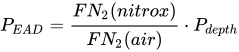
In this formula,  and
and  are absolute pressures. In practice, it is much more convenient to work with the equivalent columns of seawater depth, because the depth can be read off directly from the depth gauge or dive computer. The relationship between pressure and depth is governed by Pascal's law:

Using the SI system with pressures expressed in pascal, we have:

Expressing the pressures in atmospheres yields a convenient formula (1 atm ≡ 101325 Pa):

To simplify the algebra we will define  . Combining the general formula and Pascal's law, we have:

so that

Since  , the equivalent formula for the imperial system becomes

Substituting R again, and noting that  , we have the concrete formulas:


Dive tables
Although not all dive tables are recommended for use in this way, the Bühlmann tables are suitable for use with these kind of calculations. At 27 metres depth the Bühlmann 1986 table (for altitudes of 0–700 m) allows 20 minutes bottom time without requiring a decompression stop, while at 20 metres the no-stop time is 35 minutes. This shows that using EAN36 for a 27-metre dive can give a 75% increase in no-stop bottom time over using air at the same theoretical level of risk of developing symptoms of decompression sickness.
US Navy tables have also been used with equivalent air depth, with similar effect. The calculations are theoretically valid for all Haldanean decompression models.
References
|
|---|
|
|
|---|
- Cleaning and disinfection of personal diving equipment
- Human factors in diving equipment design
- List of diving equipment manufacturers
|
|
|
|
|---|
| Activities | |
|---|
| Competitions |
- Nordic Deep
- Vertical Blue
- Disciplines
|
|---|
| Equipment | |
|---|
| Freedivers | |
|---|
| Hazards | |
|---|
| Historical | |
|---|
| Organisations | |
|---|
|
|
|
|
|---|
| Specialties | |
|---|
Diver
organisations | |
|---|
Diving tourism
industry | |
|---|
Diving events
and festivals |
- Diversnight
- Underwater Bike Race
|
|---|
|
|
|
|
|---|
Diving
disorders | Pressure
related | | Oxygen | |
|---|
| Inert gases | |
|---|
| Carbon dioxide | |
|---|
Breathing gas
contaminants | |
|---|
|
|---|
Immersion
related | |
|---|
|
|---|
| Treatment | |
|---|
| Personnel | |
|---|
| Screening | |
|---|
| Research | Researchers in
diving physiology
and medicine | |
|---|
Diving medical
research
organisations | |
|---|
|
|---|
|
|
|
|
|---|
Archeological
sites | |
|---|
Underwater art
and artists | |
|---|
Engineers
and inventors | |
|---|
Historical
equipment |
|
|---|
Military and
covert operations | |
|---|
| Scientific projects | |
|---|
| Awards and events | |
|---|
| Incidents | |
|---|
|
|
Publications |
|---|
| Manuals |
- NOAA Diving Manual
- U.S. Navy Diving Manual
- Basic Cave Diving: A Blueprint for Survival
- Underwater Handbook
- Bennett and Elliott's physiology and medicine of diving
- Encyclopedia of Recreational Diving
- The new science of skin and scuba diving
- Professional Diver's Handbook
- Basic Scuba
|
|---|
Standards and
Codes of Practice | |
|---|
| General non-fiction | |
|---|
| Research |
- List of Divers Alert Network publications
|
|---|
| Dive guides | |
|---|
|
|
Training and registration |
|---|
Diver
training |
|
|---|
Recreational
scuba
certification
levels | | Core diving skills | |
|---|
| Leadership skills | |
|---|
| Specialist skills | |
|---|
|
|---|
Diver training
certification
and registration
organisations | Commercial diver
certification
authorities |
- Australian Diver Accreditation Scheme (ADAS)
- Commercial diver registration in South Africa
- Divers Institute of Technology
- Health and Safety Executive (HSE)
- Department of Employment and Labour
|
|---|
Commercial diving
schools |
- Divers Academy International
- Norwegian diver school
|
|---|
Free-diving
certification
agencies | |
|---|
Recreational
scuba
certification
agencies | |
|---|
Scientific diver
certification
authorities | |
|---|
Technical diver
certification
agencies |
|
|---|
|
|---|
Military diver
training centres | |
|---|
Military diver
training courses | |
|---|
|
|
|
|---|
| Surface snorkeling | |
|---|
| Snorkeling/breath-hold | |
|---|
| Breath-hold | |
|---|
| Open Circuit Scuba | |
|---|
| Rebreather | |
|---|
Sports governing
organisations
and federations | |
|---|
| Competitions | |
|---|
|
|
|
|---|
Pioneers
of diving | |
|---|
Underwater
scientists
archaeologists and
environmentalists | |
|---|
Scuba record
holders |
- Pascal Bernabé
- Jim Bowden
- Mark Ellyatt
- Sheck Exley
- Nuno Gomes
- Claudia Serpieri
- Krzysztof Starnawski
|
|---|
Underwater
filmmakers
and presenters | |
|---|
Underwater
photographers | |
|---|
Underwater
explorers | |
|---|
| Aquanauts | |
|---|
| Writers and journalists | |
|---|
| Rescuers | |
|---|
| Frogmen | |
|---|
| Commercial salvors | |
|---|
|
|
Science of underwater diving |
|---|
- List of researchers in underwater diving
|
|
Other |
|---|
Deep-submergence
vehicle | |
|---|
| Submarine rescue |
|
|---|
| Submarine escape |
|
|---|
Special
interest
groups | |
|---|
Neutral buoyancy
facilities for
Astronaut training | |
|---|
| Other |
- Nautilus Productions
- Helicopter Aircrew Breathing Device
- Scuba diving therapy
- Seabed mining
|
|---|
|
|
|


