First Kurz government
First Kurz government | |
|---|---|
 30th Cabinet of Austria | |
_(cropped).jpg) | |
| Date formed | 18 December 2017 |
| Date dissolved | 3 June 2019 |
| People and organisations | |
| Appointed by | Alexander Van der Bellen |
| Chancellor | Sebastian Kurz (2017–2019) Hartwig Löger (Acting; 2019) |
| Vice-Chancellor | Heinz-Christian Strache (2017–2019) Hartwig Löger (2019) |
| No. of ministers | 13 |
| Member parties | Austrian People's Party (ÖVP) Freedom Party of Austria (FPÖ) (2017–2019) |
| Status in legislature | Majority coalition (2017–2019) 113 / 183 (62%)
Semi-technocratic minority cabinet (2019) 62 / 183 (34%)
|
| Opposition parties | Social Democratic Party of Austria (SPÖ) Freedom Party of Austria (FPÖ) (2019) NEOS JETZT |
| Opposition leader | Christian Kern (2017–2018) Pamela Rendi-Wagner (2018–2019) |
| History | |
| Election | 2017 legislative election |
| Predecessor | Kern government |
| Successor | Bierlein government |
The First Kurz government (German: Erste Bundesregierung Kurz or Kurz I for short) was the 30th Government of Austria in office from 18 December 2017 until 3 June 2019. It succeeded the Kern government formed after the 2017 legislative election. Sebastian Kurz, chairman of the centre-right Austrian People's Party, known by its initials in German as ÖVP, reached an agreement on a coalition with the far-right Freedom Party of Austria (FPÖ), setting the stage for Kurz to become chancellor of Austria—the youngest head of government in Europe—for the first time.[1]
In the wake of the May 2019 Ibiza affair, Kurz terminated the coalition agreement and called for a snap election, which was ultimately held on 29 September 2019, after some disagreements over the timing. Kurz announced that his government would run as a minority technocratic caretaker government in the interim.[2] However, on 27 May 2019, his government was dismissed by the National Council through a motion of no confidence, the first successful parliamentary vote of no confidence in the Second Republic.[3] On 3 June 2019, President Alexander Van der Bellen swore in a technocratic caretaker government led by Brigitte Bierlein, which held office until the new coalition government between the ÖVP and The Greens was sworn in.
Composition
| Portrait | Name | Office | Took office | Left office | Party | Federal Home State | ||
|---|---|---|---|---|---|---|---|---|
Leadership | ||||||||
|
|
Sebastian Kurz | Chancellor of Austria (2017-2019) |
18 December 2017 | 28 May 2019 | ÖVP | .svg.png) Vienna Vienna
| ||
_(cropped).jpg)
|
Hartwig Löger | Acting Chancellor of Austria (2019) Vice Chancellor of Austria (2019) Minister of Finance (2017-2019) |
18 December 2017 | 3 June 2019 | ÖVP | .svg.png) Styria Styria
| ||
.JPG)
|
Heinz-Christian Strache | Vice Chancellor of Austria Minister of Civil Service and Sports |
18 December 2017 | 22 May 2019 | FPÖ | Vienna
| ||
Ministers | ||||||||

|
Eckart Ratz | Minister of the Interior | 22 May 2019 | 3 June 2019 | Independent | .svg.png) Vorarlberg Vorarlberg
| ||

|
Herbert Kickl | 18 December 2017 | 22 May 2019 | FPÖ | .svg.png) Carinthia Carinthia
| |||
_(24876263787)_(cropped).jpg)
|
Karin Kneissl | Minister for Europe, Integration and Foreign Affairs | 18 December 2017 | 3 June 2019 | Independent (FPÖ nominated) |
Vienna
| ||
.jpg)
|
Josef Moser | Minister of Constitutional Affairs, Reforms, Deregulation and Justice | 18 December 2017 | 3 June 2019 | Independent (ÖVP nominated) |
.svg.png) Tyrol Tyrol
| ||
|
|
Johann Luif | Minister of Defence | 22 May 2019 | 3 June 2019 | Independent | .svg.png) Burgenland Burgenland
| ||

|
Mario Kunasek | 18 December 2017 | 22 May 2019 | FPÖ | Styria
| |||
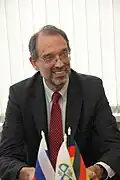
|
Heinz Faßmann | Minister of Education, Science and Research | 18 December 2017 | 3 June 2019 | Independent (ÖVP nominated) |
(Born abroad) | ||
|
|
Walter Pöltner | Minister of Labor, Social Affairs, Health and Consumer Protection | 22 May 2019 | 3 June 2019 | Independent | Vienna
| ||
_(cropped).jpg)
|
Beate Hartinger-Klein | 18 December 2017 | 22 May 2019 | FPÖ | Styria
| |||
|
|
Valerie Hackl | Minister of Transport, Innovation and Technology | 22 May 2019 | 3 June 2019 | Independent | Vienna
| ||

|
Norbert Hofer | 18 December 2017 | 22 May 2019 | FPÖ | Styria
| |||
.jpg)
|
Elisabeth Köstinger | Minister of Sustainability and Tourism | 18 December 2017 | 3 June 2019 | ÖVP | Carinthia
| ||
.jpg)
|
Margarete Schramböck | Minister of Digital and Economic Affairs | 8 January 2018 | 3 June 2019 | ÖVP | Tyrol
| ||
_(cropped).jpg)
|
Juliane Bogner-Strauß | acting Minister of Civil Service and Sports | 22 May 2019 | 3 June 2019 | ÖVP | Styria
| ||
Chancellery ministers | ||||||||
_(cropped).jpg)
|
Gernot Blümel | Chancellery minister for the EU, Arts, Culture and Media | 18 December 2017 | 3 June 2019 | ÖVP | Vienna
| ||
|
|
Juliane Bogner-Strauß | Chancellery minister for Women, Families and Youth | 18 December 2017 | 3 June 2019 | ÖVP | Styria
| ||
State secretaries | ||||||||
_(cropped).jpg)
|
Hubert Fuchs | State secretary in the Ministry of Finance | 18 December 2017 | 22 May 2019 | FPÖ | .svg.png) Salzburg Salzburg
| ||
.jpg)
|
Karoline Edtstadler | State secretary in the Ministry of the Interior | 18 December 2017 | 3 June 2019 | ÖVP | Salzburg
| ||
Actions
See also
References
- ^ "Kurz Set to Become Austrian Chancellor, Backed by Nationalists". Bloomberg. 18 December 2017. Retrieved 18 December 2017.
- ^ "Austria's Kurz Turns to Technocrat Cabinet as Populists Ousted". Bloomberg. 20 May 2019. Retrieved 21 May 2019.
- ^ "Kabinett Kurz verliert Misstrauensabstimmung". orf.at (in German). 27 May 2019. Retrieved 27 May 2019.
External links
- Government members Archived 23 March 2019 at the Wayback Machine
- Neue ÖVP-FPÖ Regierung steht
| First Republic |
| |
|---|---|---|
| Second Republic |
| |