Look up vieux riche in Wiktionary, the free dictionary.
Old money is a social class of the rich who have been able to maintain their wealth over multiple generations, in contrast with new money whose wealth has been acquired within its own generation. The term often refers to perceived members of the de factoaristocracy in societies that historically lack an officially established aristocratic class (such as the United States).
Wealth and class
Wealth—assets held by an individual or by a household—provides an important dimension of social stratification because it can pass from generation to generation, ensuring that a family's offspring will remain financially stable. Families with "old money" use accumulated assets or savings to bridge interruptions in income, thus guarding against downward social mobility.[1]
United States
According to anthropologist W. Lloyd Warner, the upper class in the United States during the 1930s was divided into the upper-upper and the lower-upper classes.[2] The lower-upper were those who did not come from traditionally wealthy families. They earned their money from investments and business, rather than inheritance. Examples include John D. Rockefeller, whose father was a traveling peddler; Cornelius Vanderbilt, whose father operated a ferry in New York Harbor; Henry Flagler, who was the son of a Presbyterian minister; and Andrew Carnegie, who was the son of a Scottish weaver. In contrast to the nouveau riche, whose riches were acquired in their own generation, the upper-upper class were families viewed as "quasi-aristocratic" and "high society".[2] These families had been rich and prominent in the politics of the United States for generations. In many cases, their prominence predated the American Revolution (1765–1783), when their ancestors had accumulated fortunes as members of the elite planter class, or as merchants, slave traders, ship-owners, or fur traders. In many cases, especially in Virginia, Maryland, and the Carolinas, the source of these families' wealth were vast tracts of land granted to their ancestors by the Crown or acquired by headright during the colonial period. These planter class families were often related to each other through intermarriage for more than 300 years, and are sometimes known as American gentry. They produced several Founding Fathers of the United States and a number of early presidents of the United States.
After the American Civil War (1861–1865), many in the upper-upper class saw their wealth greatly reduced. Their slaves became freedmen. Union forces under Generals William Tecumseh Sherman and Philip Sheridan had also cut wide swaths of destruction through portions of Virginia, the Carolinas and Georgia. They destroyed crops, killed or confiscated livestock, burned barns and gristmills, and in some cases torched plantation houses and even entire cities such as Atlanta. They were using scorched earth tactics, designed to starve the Confederate States of America into submission. After the Thirteenth Amendment to the United States Constitution (1865) and the emancipation of the slaves, many plantations were converted to sharecropping. African American freedmen were working as sharecroppers on the same land which they had worked as slaves before the war. Despite the fact that their circumstances were greatly reduced, the enactment of Jim Crow laws and the disenfranchisement of freed black people allowed many planter class families in the Southern United States to regain their political prominence, if not their great wealth, following Reconstruction (1863–1877).
In the early 20th century, the upper-upper class were seen as more prestigious than the nouveau riche even if the nouveau riche had more wealth.[2] During the late 19th century and early 20th century, the nouveau rich flaunted their wealth by building Gilded Age mansions that emulated the palaces of European royalty, while old money was more conservative. American "Old money" families tend to adhere to various Mainline Protestant denominations; Episcopalians[3][4] and Presbyterians are the most prevalent among them.[5]
Early Colonial
The Byrd Family of Virginia, FFV, is descended from William Byrd I who received a 1,200-acre (4.9 km2) grant on 27 October 1673 at the fall line of the James River that would later become the site of Richmond, Virginia.[6] Byrd's son William Byrd II of Westover Plantation who inherited the land was an American planter and author from Charles City County in colonial Virginia. He expanded his holdings to approximately 179,000-acre (720 km2) and founded the City of Richmond.[7] Although much of the family's wealth was squandered during the 18th century by William Byrd III through gambling and bad investments, descendant Richard Evelyn Byrd Sr. became wealthy as an apple grower in the Shenandoah Valley and publisher of the Winchester Star newspaper. He was elected to the Virginia House of Delegates in 1906 and served as Speaker from 1908 to 1914. His son Harry Flood Byrd was elected the 50th Governor of Virginia in 1925, and later served in the US Senate until his retirement in 1965. Byrd controlled a Democraticpolitical machine known as the Byrd Organization that dominated Virginia politics for most of the 20th century.[8] Byrd was succeeded in the US Senate by his son Harry F. Byrd Jr. who served until 1981. The family also produced early Ohio political leader and jurist, Charles Willing Byrd,[9] and polar explorer, Rear AdmiralRichard E. Byrd.
The Cabot family arrived in Salem from the Isle of Jersey in 1700 and made fortunes in shipping. George Cabot was an American merchant, seaman, and politician from Massachusetts. He represented Massachusetts in the U.S. Senate and was the presiding officer of the infamous Hartford Convention. Samuel Cabot Jr. was an American businessman in the early-nineteenth-century China Trade. James Elliot Cabot was an American philosopher and author, born in Boston to Samuel Cabot Jr., and Eliza Cabot. Edward Clarke Cabot was an American architect and artist. Henry Cabot Lodge was a member of the Porcellian Club, an American Republican politician, historian, and statesman from Massachusetts. He served in the United States Senate from 1893 to 1924 and is best known for his positions on foreign policy.At the age of 21, Godfrey Lowell Cabot (see Lowells below) founded the Cabot Corporation, the largest producer of carbon black in the country.
The Corbin Family, FFV, of Middlesex County, Virginia, beginning with Henry Corbin was an emigrant from England who became a tobacco planter in the Virginia colony and served in both houses of the Virginia General Assembly, in the House of Burgesses representing Lancaster County before the creation of Middlesex County on Virginia's Middle Neck, then on the Governor's Council.[13] The governor and council made Corbin a justice of the Lancaster County court in 1657.[14] Lancaster County voters in both 1659 and 1660 elected Corbin as one of their representatives in the House of Burgesses, alongside the county's largest plantation owner, John Carter, Sr. His son Gawin Corbin (burgess) was prominent in political affairs. His daughter Laetitia Corbin Lee married Richard Lee II of Machodoc Plantation, while another daughter Ann married William Tayloe (the nephew). Gawin Corbin Sr., son of the Burgess was a Virginia planter and politician who served in the House of Burgesses representing Middlesex County, Virginia. Richard Corbin was a Virginia planter and politician who represented Middlesex County in the House of Burgesses and the Virginia Governor's Council.[15][16] Although a noted Loyalist during the American Revolutionary War (during which two brothers served in British forces), he considered himself a Virginian and two of his descendants of the same name also served in the Virginia General Assembly following the conflict. Hannah Lee Corbin was an American women's rights advocate and member of the Lee family in Virginia. A controversial widow in her own time in part for her refusal to marry her paramour (with whom she had children) or conversion from the Church of England to the Baptists, she may today be best known for asking that women be given the right to vote. John Tayloe Corbin was a Virginia planter and politician who represented King and Queen County in the House of Burgesses.[17] The son of the powerful planter Richard Corbin, a member of the Governor's Council, he was likewise a Loyalist during the American Revolutionary War (during which two brothers served in British forces), but remained in Virginia.
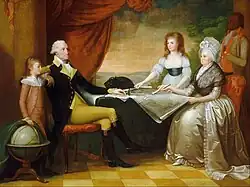
George and Martha Washington with their Grandchildren. George Washington Parke Custis, and Eleanor Parke Custis
The Custis Family FFV dates back to the mid-seventeenth century, four members of the Custis family immigrated to the colony of Virginia: Anne, John Custis II, William II, and their uncle John I. John II was the most successful at establishing the family name into prominent society, advancing into the Virginia ruling class by serving as a sheriff, justice of the peace, surveyor, coroner, militia officer, member of the House of Burgess, and Councillor. John II also built a large mansion that he called Arlington. His descendants included his son John Custis III and grandson John IV, who was born in August 1678. John Custis IV was the father of Daniel Parke Custis, Martha Dandridge Custis's first husband, Martha's Second husband was George Washington. Making his step grandchildren and wife USA First Inaugural Family
The Delano family of Massachusetts and New York is descended from Philippe de Lannoy, who was born in 1602 to parents of French and Dutch descent. In the United States, members of the Delano family include U.S. presidents Franklin Delano Roosevelt, Ulysses S. Grant and Calvin Coolidge, astronaut Alan B. Shepard, and writer Laura Ingalls Wilder. Delano family forebears include the Pilgrims who chartered the Mayflower, seven of its passengers, and three signers of the Mayflower Compact.
The Griswold Family of Connecticut made their fortune in shipping, banking, railroads, and industry. They have been prominent in American politics, producing five governors and numerous senators and congressmen.
The Harrisons of Berkley, FFV, of Virginia is an American political family, of the Commonwealth of Virginia, whose direct descendants include a Founding Father of the United States, Benjamin Harrison V, and three U. S. presidents: William Henry Harrison, Benjamin Harrison, and Abraham Lincoln. The Virginia Harrison family consists primarily of two branches with origins in northern England. One branch, led by Benjamin Harrison I, journeyed by way of Bermuda to Virginia before 1633 and settled along the James River where they became wealthy planters; they are often referred to as the James River Harrisons. Successive generations of this branch served in the legislature of the Colony of Virginia, including Benjamin V, who was a signatory of the Declaration of Independence and later governor of Virginia. This branch of the Harrison family produced President William Henry Harrison, Benjamin V's son, and President Benjamin Harrison, William Henry's grandson, as well as another Virginia governor, Albertis Harrison. The family also includes two Chicago mayors and members of the U.S. House of Representatives and the U.S. Senate. The other branch of the Virginia Harrisons emigrated from Britain to New England in 1687 and moved south to the Shenandoah Valley of Virginia 50 years later; they were led by Isaiah Harrison. This branch most likely descended from an interim chaplain of the Jamestown Colony, Rev. Thomas Harrison, who was kindred to the James River Harrisons, but by 1650 had returned to England. President Abraham Lincoln descended from the Shenandoah Valley Harrisons, as did entertainer Elvis Presley. This branch of the family also included the founders of Harrisonburg and Dayton and physician J. Hartwell Harrison, who was part of the medical team that accomplished the world's first successful kidney transplant surgery.
Arms of the Van Watervliet family. The Van Everinghe van Watervliet family (eventually simplified and Anglicized to Van Every and Van Avery) were Dutch barons who first amassed a fortune as brewers, land owners, and high governmental officials in the old country in the mid-16th Century. Migrating to North America in the mid-17th Century they continued to become prominent smiths, fur traders, and land owners from the founding of Beverwijck, present day Albany, New York, through the American Revolution. The city of Watervliet, New York, is likely named after the family's original ridderhofstede (knightly estate) in the County of Zeeland. The first members were granted a warrant as sole suppliers of arms and armor to Fort Orange, were active in the Albany Convention during Leisler's Rebellion, and were close associates of the Van Rensselaers. Later, one member took the Oath of Secrecy as a Son of Liberty, served as Chairman of the SchenectadyCommittee of Correspondence and as a Senator in the newly-formed New York Assembly. Several served as officers in the militia during the Revolution, including in Van Rensselaer's Regiment, and one served alongside George Washington from 1775-1780, including the bitter winter at Valley Forge and the Crossing of the Delaware. Later generations include industrialists, hoteliers, inventors, professional athletes, and writers, and share bloodlines with George Washington, John Adams, Benjamin Franklin, and Philip Schuyler.
Late Colonial
The Astor family made their fortune in the 18th century, through fur trading, real estate, the hotel industry, and other investments.
The Forbes family of Boston made their fortune in the shipping and later railroad industries as well as other investments. They have been a prominent wealthy family in the United States for 200 years.
The Hartwick family is of mainly English and German descent, and their ancestry and fortune predates the American Revolution. The Hartwicks have produced several politicians and military generals, such as Edward Hartwick. By World War I, the family-controlled most of the lumber in the United States. The Hartwick's philanthropic works include the founding of Hartwick College, and Hartwick Pines State Park.
Early National Era
The Du Pont family fortune began in 1803, but they became an extraordinarily wealthy family by selling gunpowder during the American Civil War. By World War I, the DuPont family produced virtually all American gunpowder. In 1968, Ferdinand Lundberg declared the Du Pont fortune to be America's largest family fortune.[22] As of 2008 E. I. du Pont de Nemours and Company ranked 81st on the Fortune 500 list of the largest U.S. corporations.[23]
The Van Leer family of Pennsylvania made their fortune in the iron business. They have been prominent in academia, business, and American politics. Descendants include successful entrepreneurs, governors, congressmen, university presidents, and university founders.
The Whitney family is an American family notable for their business enterprises, social prominence, wealth and philanthropy, founded by John Whitney, who came from London, England to Watertown, Massachusetts in 1635. The Whitney family are members of the Episcopal Church.[4]
Although many "old money" individuals do not rank as high on the list of Forbes 400 richest Americans as their ancestors did, their wealth continues to grow. Many families increased their holdings by investment strategies such as the pooling of resources.[26]: 115 For example, the Rockefeller family's estimated net worth of $1 billion in the 1930s grew to $8.5 billion by 2000—that is, not adjusted for inflation. In 60 years, four of the richest families in the United States increased their combined $2–4 billion in 1937 to $38 billion without holding large shares in emerging industries. When adjusted for inflation, the actual dollar wealth of many of these families has shrunk since the '30s.[26]: 115 [27]: 2
From a private wealth manager's perspective, "old money" can be classified into two: active "old money" and passive "old money". The former includes inheritors who, despite the inherited wealth at their disposal or that which they can access in the future, choose to pursue their own career or set up their own businesses.[28]Paris Hilton and Sir Stelios Haji-Ioannou did this. On the other hand, passive "old money" are the idle rich or those who are not wealth producers.[28]
"Old money" contrasts with the nouveau riche and parvenus. These fall under the category "new money" (those not from traditionally wealthy families).
Europe
The Rothschild family, as an example, established finance houses across Europe from the 18th century and was ennobled by the Habsburg emperor and Queen Victoria. Throughout the 19th century, they controlled the largest fortune in the world, in today's terms many hundreds of billions. The family has, at least to some extent, maintained its wealth for over two centuries.
On the other hand, in Britain, the term generally exclusively refers to the nobility – that is, the peerage and landed gentry – who traditionally live off the land inherited paternally.[29] The British concept is analogous to good lineage and it is not uncommon to find someone with "old money" who is actually poor or insolvent.[30] By 2001, however, those belonging to this category—the aristocratic landowners—are still part of the wealthiest list in the United Kingdom.[31] For instance, the Duke of Westminster, by way of his Grosvenor estate, owns large swaths of properties in London that include 200 acres of Belgravia and 100 acres of Mayfair.[32] There is also the case of Viscount Portman, who is the owner of 100 acres of land north of Oxford Street.
Many countries had wealth-based restrictions on voting. In France, out of a nation of 27 million people, only 80,000 to 90,000 were allowed to vote in the 1820 French legislative election and the richest one-quarter of them had two votes.[33]
^Scholz, Claudia W.; Juanita M. Firestone (2007). "Wealth". In George Ritzer (ed.). Blackwell Encyclopedia of Sociology. Blackwell Reference Online. Malden, MA: Wiley-Blackwell. ISBN 978-1405124331.
^ abW. Williams, Peter (2016). Religion, Art, and Money: Episcopalians and American Culture from the Civil War to the Great Depression. University of North Carolina Press. p. 176. ISBN 9781469626987. The names of fashionable families who were already Episcopalian, like the Morgans, or those, like the Fricks, who now became so, goes on interminably: Aldrich, Astor, Biddle, Booth, Brown, Du Pont, Firestone, Ford, Gardner, Mellon, Morgan, Procter, the Vanderbilt, Whitney. Episcopalian branches of the Baptist Rockefellers and Jewish Guggenheims even appeared on these family trees.
^Davidson, James D.; Pyle, Ralph E.; Reyes, David V. (1995). "Persistence and Change in the Protestant Establishment, 1930–1992". Social Forces. 74 (1): 157–175 [p. 164]. doi:10.1093/sf/74.1.157. JSTOR2580627.
^Emory G. Evans, " Corbin, Richard (1713 or 1714-20 May 1790)" in Dictionary of Virginia Biography, Vol. 3, pp. 466-468 also available at https://ehttps://www.lva.virginia.gov/public/dvb/bio.asp?b=Corbin_Richard/
^ abEssvale Corporation Limited (2008). Business Knowledge for IT in Private Wealth Management: A Complete Handbook for IT Professionals. London: Essvale Corporation Limited. p. 45. ISBN 9780955412493.
^Ferguson, Niall (1 November 1999). The House of Rothschild: Money's Prophets: 1798-1848. Vol. 1 (First ed.). New York: Penguin Books. p. 481‒85. ISBN 0140240845.
Baltzell, E. Digby. Philadelphia Gentlemen: The Making of a New Upper Class (1958).
Beckert, Sven. The monied metropolis: New York City and the consolidation of the American bourgeoisie, 1850–1896 (2003).
Brooks, David. Bobos in paradise: The new upper class and how they got there (2010)
Davis, Donald F. "The Price of Conspicious [sic] Production: The Detroit Elite and the Automobile Industry, 1900–1933." Journal of Social History 16.1 (1982): 21–46. online
Farnum, Richard. "Prestige in the Ivy League: Democratization and discrimination at Penn and Columbia, 1890–1970." in Paul W. Kingston and Lionel S. Lewis, eds. The high-status track: Studies of elite schools and stratification (1990).
Foulkes, Nick. High Society – The History of America's Upper Class, (Assouline, 2008) ISBN 2759402886.
Fraser, Steve and Gary Gerstle, eds. Ruling America: A History of Wealth and Power in a Democracy, Harvard University Press, 2005, ISBN 0-674-01747-1.
Ghent, Jocelyn Maynard, and Frederic Cople Jaher. "The Chicago Business Elite: 1830–1930. A Collective Biography." Business History Review 50.3 (1976): 288–328. online
Hood, Clifton. In Pursuit of Privilege: A History of New York City's Upper Class and the Making of a Metropolis (2016). Covers 1760–1970.
Ingham, John N. The Iron Barons: A Social Analysis of an American Urban Elite, 1874–1965 (1978)
Jaher, Frederic Cople, ed. The Rich, the Well Born, and the Powerful: Elites and Upper Classes in History (1973), essays by scholars
Jaher, Frederick Cople. The Urban Establishment: Upper Strata in Boston, New York, Chicago, Charleston, and Los Angeles (1982).
Phillips, Kevin P. Wealth and Democracy: A Political History of the American Rich, Broadway Books 2003, ISBN 0-7679-0534-2.
Story, Ronald. (1980) The forging of an aristocracy: Harvard & the Boston upper class, 1800-1870
Williams, Peter W. Religion, Art, and Money: Episcopalians and American Culture from the Civil War to the Great Depression (2016), especially in New York City