Georgia (country)
Georgia | |
|---|---|
| Motto: ძალა ერთობაშია Dzala ertobashia "Strength is in Unity" | |
| Anthem: თავისუფლება Tavisupleba "Freedom" | |
.svg.png) 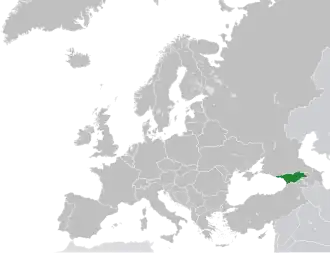 Location of Georgia
| |
| Capital and largest city | Tbilisi 41°43′N 44°47′E / 41.717°N 44.783°E |
| Official languages | Georgian |
| Recognised regional languages | Abkhaz[a] |
| Ethnic groups (2014[a]) |
|
| Religion (2014) |
|
| Demonym(s) | Georgian |
| Government | Unitary parliamentary republic |
| Mikheil Kavelashvili[b] | |
| Irakli Kobakhidze[b] | |
• Chairperson of the Parliament | Shalva Papuashvili[b] |
| Legislature | Parliament |
| Establishment history | |
| 13th c. BC – AD 580 | |
| 786–1008 | |
• Unification of Georgia | 1008 |
• The Tripartite division | 1463–1810 |
| 12 September 1801 | |
| 26 May 1918 | |
| 12 February 1921 | |
| 25 February 1921 | |
• Independence from the Soviet Union • Declared • Finalized | 9 April 1991 26 December 1991 |
| 24 August 1995 | |
| Area | |
• Total | 69,700 km2 (26,900 sq mi) (119th) |
| Population | |
• 2024[9] census |  3,914,000 3,914,000 |
• Density | 56.3/km2 (145.8/sq mi) (137th) |
| GDP (PPP) | 2025 estimate |
• Total | $113.583 billion[a][10] (99th) |
• Per capita | $30,749 [10] (70th) |
| GDP (nominal) | 2025 estimate |
• Total | $35.353 billion[a][10] (106th) |
• Per capita | $9,571[10] (83rd) |
| Gini (2021) |  34.2[a][11] 34.2[a][11]medium inequality |
| HDI (2023) | 0.844[a][12] very high (57th) |
| Currency | Georgian lari (₾) (GEL) |
| Time zone | UTC+4 (GET) |
| Date format | dd.mm.yyyy |
| Calling code | +995 |
| ISO 3166 code | GE |
| Internet TLD | .ge, .გე |
| |


Georgia[c] is a country in the Caucasus region on the coast of the Black Sea. It is located at the intersection of Eastern Europe and West Asia,[13][14][15] and is today generally regarded as part of Europe. It is bordered to the north and northeast by Russia, to the south by Turkey and Armenia, and to the southeast by Azerbaijan. Georgia covers an area of 69,700 square kilometres (26,900 sq mi).[16] It has a population of 3.9 million,[d][9] of which over a third live in the capital and largest city, Tbilisi. Ethnic Georgians, who are native to the region, constitute a majority of the country's population and are its titular nation.
Georgia has been inhabited since prehistory, hosting the world's earliest known sites of winemaking, gold mining, and textiles.[17][18] The classical era saw the emergence of several kingdoms, such as Colchis and Iberia, that formed the nucleus of the modern Georgian state. In the early fourth century, Georgians officially adopted Christianity, which contributed to their unification under the Kingdom of Georgia. Georgia reached its Golden Age during the High Middle Ages under the reigns of King David IV and Queen Tamar. Beginning in the 15th century, the kingdom declined and disintegrated due to internal discord and pressure from various regional powers, including the Mongols, the Ottoman Empire, and Persia, before being gradually annexed into the Russian Empire starting in 1801.
After the Russian Revolution in 1917, Georgia briefly emerged as an independent republic under German protection.[19] However, the country was invaded and annexed by the Red Army in 1921; it then became one of the republics of the Soviet Union. In the 1980s, an independence movement grew quickly, leading to Georgia's secession from the Soviet Union in April 1991. For much of the subsequent decade, the country endured economic crises, political instability, and secessionist wars in Abkhazia and South Ossetia. Following the peaceful Rose Revolution in 2003, Georgia strongly pursued a pro-Western foreign policy, introducing a series of reforms aimed at integration into the European Union and NATO. This Western orientation led to worsening relations with Russia, culminating in the Russo-Georgian War of 2008 and continued Russian occupation of parts of Georgia.
Georgia is a representative democracy governed as a unitary parliamentary republic.[20][21] It is a developing country with an emerging market economy. Sweeping economic reforms since 2003 have resulted in the country having one of the fastest rates of GDP growth. Georgia is a member of numerous international organizations, including the Council of Europe, Eurocontrol, BSEC, GUAM, and Energy Community. As part of the Association Trio, Georgia is an official candidate for membership in the European Union.[22] Since October 2024, Georgia has been immersed in a deep political crisis.
Etymology
Names of Georgia

Ancient Greeks (Strabo, Herodotus, Plutarch, Homer, etc.) and Romans (Titus Livius, Tacitus, etc.) referred to early western Georgians as Colchians and eastern Georgians as Iberians (Iberoi, Ἰβηροι in some Greek sources).[23]
The first mention of the name Georgia is in Italian on the mappa mundi of Pietro Vesconte dated 1320.[24] At the early stage of its appearance in the Latin world, the name was often spelled Jorgia.[25] Lore-based theories were given by 13th-century traveller Jacques de Vitry, who explained the name's origin by the popularity of Saint George among Georgians.[26] Jean Chardin thought that Georgia came from the Greek γεωργός ('tiller of the land').
Modern scholarship generally derives the name Georgia from the Persian term Gurj (گرج), a historical ethnonym for Georgians. The ultimate origin of this term is debated, though it may be connected to gurğān, a region name meaning “land of wolves.”[27] From Persian, the term was borrowed into Byzantine Greek, Slavic, and later Western European languages.[28][29] The adoption of the term Georgia in Western Europe coincided with increased contact during the Crusades and trade through Black Sea ports controlled by Genoese merchants. The association with St. George, a popular figure in medieval Christendom, may have reinforced the exonym’s appeal in Latin Europe.
The native name is Sakartvelo (საქართველო; 'land of Kartvelians'), derived from the core central Georgian region of Kartli, recorded from the 9th century, and in extended usage referring to the entire medieval Kingdom of Georgia prior to the 13th century. The Georgian circumfix sa-X-o is a standard geographic construction designating 'the area where X dwell', where X is an ethnonym.[30] The self-designation used by ethnic Georgians is Kartvelebi (ქართველები, i.e. 'Kartvelians'), first attested in the Umm Leisun inscription found in the Old City of Jerusalem, dated to the 5th or 6th century.
The medieval Georgian Chronicles present an eponymous ancestor of the Kartvelians, Kartlos, a great-grandson of Japheth who medieval chroniclers believed to have been the root of the local name of their kingdom. However, scholars agree that the word Kartli is derived from the Karts, a proto-Kartvelian tribe that emerged as a dominant regional group in ancient times.[28] The name Sakartvelo (საქართველო) consists of two parts. Its root, kartvel-i (ქართველ-ი), specifies an inhabitant of the core central-eastern Georgian region of Kartli, or Iberia as it is known in sources of the Eastern Roman Empire.[31]
State name
The official English-language name of the country is "Georgia" per Article 2 of the English-language version of the Georgian Constitution,[32] adopted in 1995 (although, at that time, the name was specified in Article 1 instead[33]). In Georgia's two official languages (Georgian and Abkhaz), the country is named საქართველო[34] (Sakartvelo) and Қырҭтәыла (Kərttʷʼəla) respectively. Prior to the adoption of the Constitution in 1995 and following the dissolution of the USSR, the country was officially called the "Republic of Georgia".[35][36]
Several languages continue to use the Russian variant of the country's name, Gruzia, which the Georgian authorities have sought to replace through diplomatic campaigns. Since 2006, Israel,[37] Japan,[38] South Korea[39] and Hungary[40][41] officially changed their appellation of the country to variants of the English Georgia.[42] In 2020, Lithuania became the first country in the world to adopt Sakartvelas in all official communications.[43]
History
Prehistory
The oldest traces of archaic humans in what is now Georgia date from approximately 1.8 million years ago in the form of the Dmanisi hominins, a subspecies of Homo erectus representing the oldest-known fossils of hominins in Eurasia.[44] Buffered by the Caucasus and benefiting from the Black Sea ecosystem, the region seems to have served as a refugium throughout the Pleistocene,[45] while the first continuous primitive settlements date back to the Middle Paleolithic, close to 200,000 years ago.[46] During the Upper Paleolithic, settlements developed mostly in Western Georgia, in the valleys of the Rioni and Qvirila rivers.[47]
Signs of agriculture date back to at least the 6th millennium BC, especially in Western Georgia, while the Mtkvari basin became stably populated in the 5th millennium BC, as evidenced with the rise of various cultures closely associated with the Fertile Crescent, including the Trialetian Mesolithic, the Shulaveri–Shomu culture, and the Leyla-Tepe culture.[48] Archaeological findings show that settlements in modern-day Georgia were responsible for the first use of fibers, possibly for clothing, more than 34,000 years ago,[49] the first cases of viticulture (7th millennium BC),[50] and the first signs of gold mining (3rd millennium BC).[51]
The Kura-Araxes, Trialeti, and Colchian cultures coincided with the development of proto-Kartvelian tribes that may have come from Anatolia during the expansion of the Hittite Empire, including the Mushki, Laz, and Byzeres. Some historians have suggested that the collapse of the Hittite world in the Late Bronze Age led to an expansion of the influence of these tribes to the Mediterranean Sea, notably with the Kingdom of Tabal.[52]
Antiquity

The classical period saw the rise of a number of Georgian states, including Colchis in western Georgia, where Greek mythology located the Golden Fleece sought after by the Argonauts. Archaeological evidence points to a wealthy kingdom in Colchis as early as the 14th century BC[53] and an extensive trade network with Greek colonies on the eastern Black Sea shore (such as Dioscurias and Phasis),[54] though, the entire region would be annexed first by Pontus and then by the Roman Republic in the first century BC.
Eastern Georgia remained a decentralized mosaic of various clans (ruled by individual mamasakhlisi) until the 4th century BC when it was conquered by Alexander the Great, eventually leading to the creation of the Kingdom of Iberia under the protectorate of the Seleucid Empire, an early example of advanced state organization under one king and an aristocratic hierarchy.[55] Various wars with the Roman Empire, Parthia, and Armenia made Iberia regularly change its allegiance, though it remained a Roman client state for most of its history.
In 337, King Mirian III adopted Christianity as the state religion of Iberia, beginning the Christianization of the Western Caucasus region and solidly anchoring it in Rome's sphere of influence by abandoning the ancient Georgian polytheistic religion heavily influenced by Zoroastrianism.[56] However, the Peace of Acilisene in 384 formalized the Sasanian control over the entire Caucasus, though Christian rulers of Iberia sought to rebel at times, leading to devastating wars in the 5–6th centuries, most famously under the rule of King Vakhtang Gorgasali who expanded Iberia to its largest historical extent by capturing all of western Georgia and building a new capital in Tbilisi.
Medieval unification of Georgia
.jpg)
In 580, the Sasanian Empire abolished the Kingdom of Iberia, leading to the disintegration of its constituent territories into various feudal regions by the early Middle Ages. The Roman–Persian Wars plunged the region into chaos, with both Persia and Constantinople supporting various warring factions in the Caucasus, however, the Byzantine Empire was able to establish control over Georgian territories by the end of the 6th century, ruling Iberia indirectly through a local Kouropalates.[57]
In 645, the Arabs invaded southeastern Georgia, starting an extended period of Muslim domination in the region; this also led to the establishment of several feudal states seeking independence from each other, such as the Emirate of Tbilisi and the Principality of Kakheti.[58] Western Georgia remained mostly a Byzantine protectorate, especially following the Lazic War.[59]
.jpg)
The lack of a central government in Georgia allowed the rise of the Bagrationi dynasty in the early 9th century. Consolidating lands in the southwestern region of Tao-Klarjeti, Prince Ashot I (813–830) used infighting between Arab governors to expand his influence to Iberia and was recognized as Presiding Prince of Iberia by both the Abbasid Caliphate and the Byzantine Empire. Though Ashot's descendants formed competing princely lines, Adarnase IV managed to unify most Georgian lands (except for Kakheti and Abkhazia) and was crowned King of the Iberians in 888, restoring the monarchy abolished three centuries prior.[60]
In Western Georgia, the Kingdom of Abkhazia benefited from the weakening of Byzantium in the region to unify various tribes and become one of the most powerful states of the Caucasus in the 8th century.[61] In the 9th-10th centuries, Abkhazia grew its influence through several military campaigns and came to control much of Iberia and competing with the Bagrationi. Dynastic conflicts eventually weakened Abkhazia in the second half of the 10th century while in Tao-Klarjeti, Prince David III used his influence within Byzantine Anatolia to empower the Bagrationi. Bagrat III, heir of the Bagrationi dynasty, successively became King of Abkhazia (978), Prince of Tao-Klarjeti (1000), and King of the Iberians (1008), allowing him to unify most Georgian feudal states and be crowned in 1010 as King of Georgia.
Golden Age and Division

For much of the 11th century, the nascent Georgian kingdom experienced geopolitical and internal difficulties, with various noble factions opposed to the centralization of the Georgian state. They were often backed by the Byzantine Empire, which feared a dominion of the Caucasus region by the Bagrationi dynasty, and in some instances fueled internal conflict through aristocratic families seeking more power. However, ties between Byzantium and Georgia were normalized when the two countries faced a new common enemy, the rising Seljuk Empire in the 1060s. Following the decisive Byzantine defeat at the Battle of Manzikert in 1071, Constantinople started to retreat from eastern Anatolia and entrusted Georgia with its administration, placing Georgia at the forefront of war with the Turks in the 1080s.
The Kingdom of Georgia reached its zenith in the 12th to early 13th centuries. This period during the reigns of David IV (r. 1089–1125) and his great-granddaughter Tamar (r. 1184–1213) has been widely termed as the Georgian Golden Age.[62] This early Georgian renaissance, which preceded its Western European analog, was characterized by impressive military victories, territorial expansion, and a cultural renaissance in architecture, literature, philosophy and the sciences.[63] The Golden Age of Georgia left a legacy of great cathedrals, romantic poetry and literature, and the epic poem The Knight in the Panther's Skin, considered a national epic.[64][65]
David IV suppressed dissent of feudal lords and centralized power in his hands to effectively deal with foreign threats. In 1121, he decisively defeated much larger Turkish armies during the Battle of Didgori and abolished the Emirate of Tbilisi.[66]
.jpg)
The 29-year reign of Tamar, the first female ruler of Georgia, is considered the most successful in Georgian history.[68] Tamar was given the title "king of kings"[67] and succeeded in neutralizing her opposition, while embarking on an energetic foreign policy aided by the downfall of the rival powers of the Seljuks and Byzantium. Supported by a powerful military élite, Tamar was able to build on the successes of her predecessors to consolidate an empire that dominated the Caucasus, and extended over large parts of present-day Azerbaijan, Armenia, eastern Turkey, and northern Iran, and used the vacuum of power left by the Fourth Crusade to create the Empire of Trebizond as a Georgian vassal state.[69]
The revival of the Kingdom of Georgia was set back after Tbilisi was captured and destroyed by the Khwarezmian leader Jalal ad-Din in 1226,[70] followed by devastating invasions by Mongol ruler Genghis Khan. The Mongols were expelled by George V the Brilliant (r. 1299–1302), known for reuniting eastern and western Georgia and restoring the country's previous strength and Christian culture. After his death, local rulers fought for their independence from central Georgian rule, until the total disintegration of the kingdom in the 15th century. Georgia was further weakened by several disastrous invasions by Timur. Invasions continued, giving the kingdom no time for restoration, with both Qara Qoyunlu and Aq Qoyunlu Turkomans constantly raiding its southern provinces.
Tripartite division

The Kingdom of Georgia collapsed into anarchy by 1466 and fragmented into three independent kingdoms and five semi-independent principalities. Neighboring large empires subsequently exploited the internal division of the weakened country, and beginning in the 16th century, various Ottoman and Iranian forces subjugated western and eastern regions of Georgia, respectively.[71] This pushed local Georgian rulers to seek closer ties with Russia. In 1649, the Kingdom of Imereti sent ambassadors to the Russian royal court, with Russia returning the favor in 1651. In the presence of these ambassadors, Alexander III of Imereti swore an oath of allegiance to Tsar Alexis of Russia on behalf of Imereti.[72] Subsequent rulers also sought assistance from Pope Innocent XII but without success.[73]
The rulers of regions that remained partly autonomous organized rebellions on various occasions. As a result of incessant Ottoman–Persian Wars and deportations, the population of Georgia dwindled to 784,700 inhabitants at the end of the 18th century.[74] Eastern Georgia, composed of the regions of Kartli and Kakheti, had been under Iranian suzerainty since the Peace of Amasya signed with neighboring rivalling Ottoman Turkey (Safavid Georgia). With the death of Nader Shah in 1747, both kingdoms broke free and were reunified through a personal union under the energetic king Heraclius II, who succeeded in stabilizing Eastern Georgia to a degree.[75]

In 1783, Russia and the eastern Georgian Kingdom of Kartli-Kakheti signed the Treaty of Georgievsk, which made eastern Georgia a protectorate of Russia, guaranteed its territorial integrity and the continuation of its reigning Bagrationi dynasty in return for prerogatives in the conduct of Georgian foreign affairs.[76]
Despite its commitment to defend Georgia, Russia rendered no assistance when the Iranians invaded in 1795, capturing and sacking Tbilisi and massacring its inhabitants.[77] Although Russia initiated a punitive campaign against Persia in 1796, the Russian Imperial authorities subsequently violated key promises of the Georgievsk Treaty and in 1801 proceeded to annex eastern Georgia, while abolishing the Georgian royal Bagrationi dynasty, as well as the autocephaly of the Georgian Orthodox Church. Pyotr Bagration, one of the descendants of the abolished house of Bagrationi, later joined the Russian army and became a prominent general in the Napoleonic wars.[78]
Within the Russian Empire
The incorporation of Georgian territories into the Russian Empire was a gradual process that began with the annexation of the eastern kingdom of Kartli-Kakheti in 1801.[79] Following the death of King George XII, Tsar Paul I signed a decree declaring Georgia’s integration, which was confirmed by Tsar Alexander I later that year.[79] Russian forces assumed control in 1802, compelling the local nobility to swear allegiance to the empire.[79] The western Georgian kingdom of Imereti was annexed in 1810 after resisting Russian domination; its last king, Solomon II, was exiled and died in Turkey in 1815. Over the next several decades, the remaining western polities - Guria (1829), Svaneti (1858), and Mingrelia (1867)—were gradually absorbed.[80] Adjara, long contested between Russia and the Ottoman Empire, was incorporated in 1878 after the Russo-Turkish War.[81]
Georgian lands were administered through the Caucasus Viceroyalty, governed from Tiflis (modern-day Tbilisi). Russian became the official language of administration, and the Georgian Orthodox Church lost its autocephaly in 1811, becoming a subordinate part of the Russian Holy Synod.[79] Georgian clerics were replaced by Russian bishops, fueling resentment among the population and contributing to the early formation of national consciousness.[79]
..jpg)
While Russian rule curtailed political autonomy and cultural expression, it also brought relative stability and facilitated modernization of the economy. The construction of the Transcaucasian Railway, completed between the 1860s and 1880s, connected Tiflis to Poti, Batumi, and Baku, integrating Georgia into the imperial transportation network and accelerating the movement of goods, people, and ideas.[82] This infrastructural development enabled industrial growth, particularly in mining (manganese in Chiatura, coal in Tkibuli), oil transport (Batumi), and winemaking.[82] Urban centers such as Tiflis, Kutaisi, Batumi, and Poti grew rapidly and became hubs of commerce, finance, and political activity.
The Georgian nobility was increasingly integrated into the Russian aristocracy, with many serving in the imperial army or civil service.[83] However, the abolition of serfdom in the 1860s, while a formal milestone, failed to provide meaningful land redistribution, leaving most peasants impoverished and dependent.[82] Meanwhile, industrialization gave rise to a new urban working class concentrated in rail yards, factories, and mines. Poor labor conditions and lack of political rights fostered discontent.[82]
Popular resistance to Russian rule emerged early, with rebellions in Imereti (1819–1820) and Guria (1841), as well as smaller uprisings elsewhere.[79] While these were suppressed, opposition eventually coalesced into a broader national revival movement, spearheaded in the late 19th century by intellectuals such as Ilia Chavchavadze. His efforts to revive the Georgian language, restore national history, and demand civil rights laid the ideological foundation for Georgian nationalism.[84]
By the turn of the 20th century, Georgia had become one of the most politically dynamic regions in the empire. The 1905 Russian Revolution sparked mass protests, strikes, and peasant revolts across Georgia, particularly in the countryside and in industrial towns.[79] Though eventually suppressed, the revolution emboldened leftist movements, especially the Mensheviks, who would dominate Georgian politics in the years preceding the Russian Revolution.[85] Georgia emerged from the imperial period with a strong tradition of labor activism, nationalist thought, and a highly mobilized urban population.
Declaration of independence

Following the collapse of the Russian Empire in the wake of the 1917 Russian Revolution, Georgia joined Armenia and Azerbaijan in forming the Transcaucasian Democratic Federative Republic (TDFR) in April 1918.[86] The federation was short-lived, dissolving in May amid disagreements between the three republics and the advancing Ottoman forces. On 26 May 1918, Georgia declared independence and established the Democratic Republic of Georgia, with Nikolay Chkheidze as head of the Constituent Assembly and Noe Zhordania, leader of the Menshevik Social Democratic Party, as prime minister.
The new republic adopted a multi-party democratic system and introduced progressive reforms, including land redistribution, the separation of church and state, labor protections, and universal suffrage. The 1921 constitution, adopted shortly before the Soviet invasion, was one of the most liberal of its time, emphasizing civil liberties and minority rights. Georgia also pursued a policy of ethnic and religious inclusivity, granting cultural autonomy to national minorities and promoting minority-language schools.[87]
Georgia’s independence was challenged on multiple fronts. The republic fought the Georgian–Armenian War in December 1918 over disputed border regions in Lori and Javakheti, which ended with British-mediated negotiations.[88] In 1919, Georgian forces led by General Giorgi Mazniashvili launched operations against the White Army in the Black Sea coastal areas near Sochi and Adler, though these territorial gains were later relinquished under Allied pressure.[89]

Despite military pressures and internal tensions, Georgia sought international recognition and established diplomatic relations with several European powers. The Treaty of Moscow, signed in May 1920, saw Soviet Russia formally recognize Georgia’s independence.[90] This recognition, however, did not prevent the Red Army invasion in February 1921. After several weeks of fighting, including the Battle of Tbilisi, the Georgian government was forced into exile. Soviet authorities established the Georgian Soviet Socialist Republic, formally incorporated into the USSR in 1922.
Soviet Georgia
After the Red Army invaded Georgia in February 1921, the Georgian Social Democratic government fled into exile. On 25 February 1921, Soviet forces entered Tbilisi, and a Bolshevik-led government was installed under Filipp Makharadze. Georgia was formally incorporated into the Transcaucasian Socialist Federative Soviet Republic (TSFSR) in 1922, along with Armenia and Azerbaijan, and became a founding republic of the USSR.[82] Full Soviet control was only established after the suppression of the August 1924 anti-Bolshevik uprising, which involved widespread repression and mass executions.[91]
In the 1920s and early 1930s, Georgia underwent sweeping socioeconomic transformation as part of Soviet policies of collectivization, nationalization, and industrialization.[82] Traditional elites and clergy were targeted in purges, and the Georgian Orthodox Church was severely repressed, with most churches closed or repurposed.[92] The republic saw the creation of new industries, particularly during the First Five-Year Plan (1928–1932), with rapid growth in textiles, metallurgy, and food processing. The construction of the railway network and hydroelectric plants further integrated Georgia into the all-Union economy.[93]

Several prominent Soviet leaders were Georgian, most notably Joseph Stalin, who led the USSR from the mid-1920s until his death in 1953. Georgians such as Lavrentiy Beria and Sergo Ordzhonikidze also held key positions. Under Stalin, Georgia experienced intense political repression. The Great Purge (1936–1938) devastated Georgia’s intellectual, political, and cultural elite, with thousands executed or sent to Gulag labor camps.[94]
During World War II, more than 700,000 Georgians (or approximately 20% of the republic's total population) fought in the Red Army; approximately 350,000 were killed.[95] Although German forces never reached Georgia, the strategic importance of the Caucasus oil fields made the region a key Soviet stronghold.[96] In the postwar years, Georgia became one of the more economically developed republics of the USSR, with expanding urban centers, higher education institutions, and a growing scientific and artistic intelligentsia.[97]
Following Stalin’s death, the 1956 protests in Tbilisi erupted in response to Khrushchev’s de-Stalinization, resulting in the deaths of dozens of demonstrators. The event fueled nationalist sentiment and alienation from the Soviet regime. Though political dissent was suppressed, Georgia remained one of the more restive republics. The 1978 demonstrations in defense of the constitutional status of the Georgian language succeeded in reversing a Kremlin-backed proposal to downgrade it, marking a rare concession to public protest.
By the 1980s, Georgia faced mounting challenges: economic stagnation, widespread corruption, environmental degradation, and political disillusionment. The advent of perestroika and glasnost unleashed suppressed grievances, strengthened by the activities of prominent dissidents like Merab Kostava and Zviad Gamsakhurdia. On 9 April 1989, a peaceful demonstration in Tbilisi demanding independence was violently dispersed by Soviet troops, killing at least 21 civilians, mostly women. The Tbilisi Massacre became a turning point, galvanizing public support for independence and discrediting the Communist Party's authority in Georgia.
As the Soviet Union weakened, Georgia moved rapidly toward independence. By 1990, pro-independence parties had won local elections, and in April 1991, Georgia declared the restoration of its independence.
Independence, civil wars

On 9 April 1991, the Supreme Council of Georgia declared the country’s independence, following a referendum in which over 98% of participating voters endorsed secession from the Soviet Union.[98] Georgia became the first non-Baltic Soviet republic to formally declare independence.[99] In May, Zviad Gamsakhurdia, a prominent dissident and leader of the Round Table–Free Georgia coalition, was elected president with 86.5% of the vote.[100]
Soon after taking office, Gamsakhurdia’s presidency was marked by increasing political polarization and accusations of autocratic behavior. In December 1991, a violent coup d’état was launched by opposition militias, including the Mkhedrioni paramilitary group and rogue elements of the National Guard.[101] After weeks of street fighting in Tbilisi, Gamsakhurdia was ousted in early January 1992 and later fled the country. The conflict soon escalated into a broader civil war, with pro- and anti-Gamsakhurdia forces clashing particularly in western Georgia until 1993.[102]
Meanwhile, ethnic tensions in South Ossetia and Abkhazia erupted into full-scale wars. Between 1991 and 1992, Georgian forces clashed with South Ossetian separatists, resulting in hundreds of deaths and the flight of tens of thousands. In Abkhazia, war broke out in August 1992, when Georgian forces entered the region to reassert central authority. Supported by North Caucasian militants, Russian forces, and elements of the Soviet military infrastructure, Abkhaz separatists routed Georgian forces in September 1993. The war resulted in the mass expulsion of between 230,000 and 250,000 ethnic Georgians, the destruction of dozens of communities, and thousands of civilian deaths. Georgia lost de facto control over both territories, which have since remained outside central government authority.[103]
In the midst of the military collapse, Eduard Shevardnadze, the former Soviet foreign minister, returned to Georgia in March 1992 and was appointed chair of the newly formed State Council. With Russian backing and internal consolidation, Shevardnadze gained the presidency in 1995 through new elections held under a presidential constitution.[104] The 1995 Constitution formally established Georgia as a unitary presidential republic with a centralized political system.[105]
While Shevardnadze was credited with restoring a degree of internal stability, his tenure was characterized by widespread corruption, state fragility, and chronic economic hardship. Georgia suffered from persistent power outages, inflation, and infrastructure collapse during the 1990s. In many regions, governance was dominated by local warlords or criminal networks, and state control over law enforcement and customs remained weak.[104]
Despite internal challenges, Shevardnadze pursued a pro-Western foreign policy, seeking closer ties with the United States, NATO, and the European Union. Georgia joined the Partnership for Peace program in 1994 and became a key partner in the Caspian energy corridor, notably through its support for the Baku–Tbilisi–Ceyhan pipeline project.[106] These developments brought increased Western attention but did little to improve domestic governance or living standards.
Rose revolution and UNM government
In November 2003, widespread protests erupted over disputed parliamentary elections, leading to the peaceful overthrow of President Eduard Shevardnadze in what became known as the Rose Revolution. The movement was led by former allies of Shevardnadze, including Mikheil Saakashvili, Zurab Zhvania, and Nino Burjanadze, who accused the government of electoral fraud and entrenched corruption. Following Shevardnadze’s resignation, Saakashvili won a landslide victory in the 2004 presidential election and became Georgia’s third president.[107]
The new government launched an ambitious reform agenda aimed at combating corruption, liberalizing the economy, modernizing the state bureaucracy, and reorienting Georgia’s foreign policy toward Euro-Atlantic integration. The Ministry of Internal Affairs and other institutions underwent dramatic restructuring, and petty corruption was largely eliminated. In 2004, the central government reasserted control over the Autonomous Republic of Adjara, previously under the semi-independent rule of Aslan Abashidze, without resorting to violence.[104]
Relations with Russia deteriorated sharply during this period, due in part to Georgia’s support for the United States in the global war on terror, its NATO aspirations, and Russia’s backing of the separatist regions of Abkhazia and South Ossetia. Despite growing tensions, Georgia and Russia reached a 2005 agreement for the withdrawal of Russian military bases in Batumi and Akhalkalaki, completed by 2007. However, Russia retained control over the Gudauta base in Abkhazia.[108]

In August 2008, escalating provocations and skirmishes in South Ossetia led to a brief but intense military conflict known as the Russo-Georgian War. After shelling of Georgian villages by separatist forces, Georgia launched a military operation to reclaim control over South Ossetia. Russia responded with a large-scale invasion by land, air, and sea, citing the protection of civilians and peacekeepers. Russian forces pushed into Georgia proper, occupying several cities. A European Union–mediated ceasefire was brokered by French President Nicolas Sarkozy on 12 August. Russia subsequently recognized Abkhazia and South Ossetia as independent states, a move condemned by Georgia and most of the international community. The war displaced nearly 200,000 people, many of whom later returned, though tens of thousands of ethnic Georgians remained permanently displaced. Georgia formally severed diplomatic relations with Russia and declared the two regions to be occupied territories.
In the years following the war, the Saakashvili government continued its program of modernization, focusing on infrastructure, education, and technological development. However, it faced growing criticism both domestically and internationally for authoritarian tendencies, the concentration of power in the executive, and the use of state institutions against political opponents. Accusations of abuse in the prison system, restrictions on media, and flawed elections undermined Saakashvili’s popularity.[109]
Georgian Dream government (2012–present)
.jpg)
In preparation for the 2012 parliamentary elections, Georgia implemented constitutional reforms to switch to a parliamentary democracy, moving executive powers from the President to the Prime Minister. The transition was set to start with the 2012 parliamentary elections and to be completed with the 2013 presidential elections.[110]
The 2012 Georgian parliamentary election marked the defeat of the United National Movement and the victory of the Georgian Dream party — the first peaceful electoral transfer of power in Georgia.[111] The first year marked the contentious "cohabitation" period between the new Georgian Dream government and President Saakashvili, who retained his post until the presidential election in October 2013.[112][113][114] Giorgi Margvelashvili, nominated by Georgian Dream, won the election and succeeded Saakashvili, furthering solidifying the power of Georgian Dream.[115] Bidzina Ivanishvili, a businessman who founded the Georgian Dream, served as its first Prime Minister before resigning in 2013. However, he continued to be the most influential person within the party, despite not holding any position until 2018.[116][117] As for Saakashvili, he left Georgia shortly after the 2013 election and was convicted in 2018 in absentia on corruption charges and abuse of power, which he denied. Saakashvili continued to be the chairman of the United National Movement party from abroad, which now became the main opposition party[118]
Georgian Dream won the 2016 parliamentary elections, achieving a constitutional supermajority of 115 out of 150 seats.[119][120][121] In the 2018 presidential election, the Georgian Dream party backed independent Salome Zurabishvili, who won in the second round, becoming the first woman in Georgia to hold the office in full capacity.[122] This was the last direct election of a Georgian president, as additional constitutional reforms removed the popular vote.[123]
In 2019, the protests erupted over the visit of Russian MP Sergei Gavrilov and his participation in the Interparliamentary Assembly on Orthodoxy. The protesters demanded the electoral reform to change the mixed proportional-majoritarian voting system which they alleged greatly benefited the ruling party in the 2016 election. The ruling party conceded on some demands and condemned Gavrilov's visit. After international mediation to overcome the deep political crisis in the run-up to the 2020 parliamentary elections, an amended electoral system was adopted, specifically for those elections.[124] As result of the lowered threshold, nine parties were elected to parliament. Georgian Dream secured 48 percent of the votes, nearly the same as four years earlier, which translated into 90 out of 150 seats due to the more proportional electoral system with a highly reduced number of majoritarian districts. However, the opposition made accusations of fraud, triggering another round of political crisis, lasting months. The opposition and protesting citizens demanded a new vote.[125] The political crisis was temporarily resolved by an EU brokered agreement in April 2021,[126] from which both the ruling Georgian Dream and the opposition United National Movement withdrew a few months later.[127]
During the Russian invasion of Ukraine in 2022, Georgia provided diplomatic and humanitarian support for Ukraine but did not join other countries in imposing sanctions on Russia. Since the beginning of the war Georgia has topped the list of countries to which Russian exiles moved. Russians, just like many foreigners, were allowed to stay in Georgia for one year without a visa, though many Georgians began to view the presence of more Russian citizens in Georgia as a security risk.[128][129] Shortly after the outbreak of the war, Georgia applied for membership of the EU at the same time as Ukraine and Moldova. While the latter two received the candidate status a few months later, Georgia was given preconditions to receive the candidate status, which predominantly focused on judicial reforms, rule of law, de-oligarchization and addressing the highly polarized political and media climate.[130]

In the following months, the relations with the European Union worsened and the Georgian Dream party turned from the pro-European social democratic one into the Eurosceptic and socially conservative party. In March 2023 Georgian Dream attempted to adopt the Law on Transparency of Foreign Influence, which requires Non-Governmental Organizations (NGOs) to register as "agents of foreign influence" if they receive more than 20 percent of their funding from abroad.[131] However, the discussions of the bill were termined amidst the protests and the pressure from the US State Department, United Nations and European Union.[132] Nevertheless, the similar bill was reintroduced in April 2024 and adopted in the next month.[133]
In December 2023, despite not having fulfilled most preconditions, Georgia was granted the EU-candidate status. Instead, these criteria and additional ones, such as free and fair 2024 parliamentary elections, were made conditional for Georgia to move ahead to the actual accession talks.[134]
The alleged irregularities and fraud in the 26 October 2024 Georgian parliamentary elections led to a protracted political crisis and the protests. The crisis was furthered exacerbated after Prime Minister Irakli Kobakhidze announced the temporary suspension of the accession process of Georgia's EU membership until 2028, citing blackmail.[135] Another round of political crisis developed amidst the inauguration of the ruling party candidate Mikheil Kavelashvili as the new president by the parliamentary electoral college, which the previous president Salome Zourabichvili, who went into opposition to the ruling party during the 2020–2021 Georgian political crisis, described as illegitimate and refused to recognize the transfer of power.[136][137]
Geography

Georgia is a mountainous country situated almost entirely in the South Caucasus, while some slivers of the country are situated north of the Caucasus Watershed in the North Caucasus.[138][139] The country lies between latitudes 41° and 44° N, and longitudes 40° and 47° E, with an area of 67,900 km2 (26,216 sq mi). The Likhi Range divides the country into eastern and western halves.[140] Historically, the western portion of Georgia was known as Colchis while the eastern plateau was called Iberia.[141]
The Greater Caucasus Mountain Range forms the northern border of Georgia.[140] The main roads through the mountain range into Russian territory lead through the Roki Tunnel between Shida Kartli and North Ossetia and the Darial Gorge (in the Georgian region of Khevi). The southern portion of the country is bounded by the Lesser Caucasus Mountains.[140] The Greater Caucasus Mountain Range is much higher in elevation than the Lesser Caucasus Mountains, with the highest peaks rising more than 5,000 metres (16,404 ft) above sea level.
.jpg)
The highest mountain in Georgia is Mount Shkhara at 5,203 metres (17,070 ft), and the second highest is Mount Janga at 5,059 m (16,598 ft) above sea level. Other prominent peaks include Mount Kazbek at 5,047 m (16,558 ft), Shota Rustaveli Peak 4,960 m (16,273 ft), Tetnuldi 4,858 m (15,938 ft), Ushba 4,700 m (15,420 ft), and Ailama 4,547 m (14,918 ft).[140] Out of the abovementioned peaks, only Kazbek is of volcanic origin. The region between Kazbek and Shkhara (a distance of about 200 km (124 mi) along the Main Caucasus Range) is dominated by numerous glaciers.[141]
The term Lesser Caucasus Mountains is often used to describe the mountainous (highland) areas of southern Georgia that are connected to the Greater Caucasus Mountain Range by the Likhi Range.[140] The overall region can be characterized as being made up of various, interconnected mountain ranges (largely of volcanic origin) and plateaus that do not exceed 3,400 metres (11,155 ft) in elevation. Prominent features of the area include the Javakheti Volcanic Plateau, lakes, including Tabatskuri and Paravani, as well as mineral water and hot springs. Two major rivers in Georgia are the Rioni and the Mtkvari.[141]
Topography


The landscape within the nation's boundaries is quite varied. Western Georgia's landscape ranges from low-land marsh-forests, swamps, and temperate rainforests to eternal snows and glaciers, while the eastern part of the country even contains a small segment of semi-arid plains.[141]
Much of the natural habitat in the low-lying areas of western Georgia has disappeared during the past 100 years because of agricultural development and urbanization. A large majority of the forests that covered the Colchis plain are now virtually non-existent with the exception of the regions that are included in the national parks and reserves (e.g. Lake Paliastomi area). At present, the forest cover generally remains outside of the low-lying areas and is mainly located along the foothills and the mountains. Western Georgia's forests consist mainly of deciduous trees below 600 metres (1,969 ft) above sea level and contain species such as oak, hornbeam, beech, elm, ash, and chestnut. Evergreen species such as box may also be found in many areas. About 1,000 of the 4,000 higher plants of Georgia are endemic.[142]

The west-central slopes of the Meskheti Range in Ajaria as well as several locations in Samegrelo and Abkhazia are covered by temperate rain forests. Between 600–1,000 metres (1,969–3,281 ft) above sea level, the deciduous forest becomes mixed with both broad-leaf and coniferous species making up the plant life. The zone is made up mainly of beech, spruce, and fir forests. From 1,500–1,800 metres (4,921–5,906 ft), the forest becomes largely coniferous. The tree line generally ends at around 1,800 metres (5,906 ft) and the alpine zone takes over, which in most areas, extends up to an elevation of 3,000 metres (9,843 ft) above sea level.[141] Eastern Georgia's landscape (referring to the territory east of the Likhi Range) is considerably different from that of the west, although, much like the Colchis plain in the west, nearly all of the low-lying areas of eastern Georgia including the Mtkvari and Alazani River plains have been deforested for agricultural purposes. The general landscape of eastern Georgia comprises numerous valleys and gorges that are separated by mountains. In contrast with western Georgia, nearly 85 per cent of the forests of the region are deciduous. Coniferous forests only dominate in the Borjomi Gorge and in the extreme western areas. Out of the deciduous species of trees, beech, oak, and hornbeam dominate. Other deciduous species include several varieties of maple, aspen, ash, and hazelnut.[141]
At higher elevations above 1,000 metres (3,281 ft) above sea level (particularly in the Tusheti, Khevsureti, and Khevi regions), pine and birch forests dominate. In general, the forests in eastern Georgia occur between 500–2,000 metres (1,640–6,562 ft) above sea level, with the alpine zone extending from 2,000–2,300 to 3,000–3,500 meters (6,562–7,546 to 9,843–11,483 ft). The only remaining large, low-land forests remain in the Alazani Valley of Kakheti.[141]
Climate


The climate of Georgia is extremely diverse, considering the nation's small size. There are two main climatic zones, roughly corresponding to the eastern and western parts of the country. The Greater Caucasus Mountain Range plays an important role in moderating Georgia's climate and protects the nation from the penetration of colder air masses from the north. The Lesser Caucasus Mountains partially protect the region from the influence of dry and hot air masses from the south.[143]
Much of western Georgia lies within the northern periphery of the humid subtropical zone with annual precipitation ranging from 1,000–2,500 mm (39–98 in), reaching a maximum during the Autumn months. The climate of the region varies significantly with elevation and while much of the lowland areas of western Georgia are relatively warm throughout the year, the foothills and mountainous areas (including both the Greater and Lesser Caucasus Mountains) experience cool, wet summers and snowy winters (snow cover often exceeds 2 metres or 6 feet 7 inches in many regions).[143]
Eastern Georgia has a transitional climate from humid subtropical to continental. The region's weather patterns are influenced both by dry Caspian air masses from the east and humid Black Sea air masses from the west. The penetration of humid air masses from the Black Sea is often blocked by mountain ranges (Likhi and Meskheti) that separate the eastern and western parts of the nation.[141] The wettest periods generally occur during spring and autumn, while winter and summer months tend to be the driest. Much of eastern Georgia experiences hot summers (especially in the low-lying areas) and relatively cold winters. As in the western parts of the nation, elevation plays an important role in eastern Georgia where climatic conditions above 1,500 metres (4,921 ft) are considerably colder than in the low-lying areas.[141]
Biodiversity
.jpg)

Because of its high landscape diversity and low latitude, Georgia is home to about 5,601 species of animals, including 648 species of vertebrates (more than 1% of the species found worldwide) and many of these species are endemics.[144] A number of large carnivores live in the forests, namely brown bears, wolves, lynxes and Caucasian leopards. The common pheasant (also known as the Colchian pheasant) is an endemic bird of Georgia which has been widely introduced throughout the rest of the world as a game bird. The number of invertebrate species is considered to be very high but data is distributed across a high number of publications. The spider checklist of Georgia, for example, includes 501 species.[145] The Rioni River may contain a breeding population of the critically endangered bastard sturgeon.[146]
Slightly more than 6,500 species of fungi, including lichen-forming species, have been recorded from Georgia,[147][148] but this number is far from complete. The true total number of fungal species occurring in Georgia, including species not yet recorded, is likely to be far higher, given the generally accepted estimate that only about seven per cent of all fungi worldwide have so far been discovered.[149] Although the amount of available information is still very small, a first effort has been made to estimate the number of fungal species endemic to Georgia, and 2,595 species have been tentatively identified as possible endemics of the country.[150] 1,729 species of plants have been recorded from Georgia in association with fungi.[148] According to the International Union for Conservation of Nature, there are 4,300 species of vascular plants in Georgia.[151]
Georgia is home to four ecoregions: Caucasus mixed forests, Euxine-Colchic deciduous forests, Eastern Anatolian montane steppe, and Azerbaijan shrub desert and steppe.[152] It had a 2018 Forest Landscape Integrity Index mean score of 7.79/10, ranking it 31st globally out of 172 countries.[153]
Government and politics
Georgia is a representative democratic parliamentary republic; the President serves as the largely ceremonial head of state,[154] whereas the Prime Minister is head of government. Executive power is vested in the Cabinet of Georgia, composed of ministers headed by the Prime Minister and appointed by the Parliament. As of 2025, the Presidency is disputed between Salome Zourabichvili, who claims to be the de jure head of state, and Mikheil Kavelashvili, who was inaugurated by the ruling party following the widely disputed 2024 Georgian presidential election. Since February 2024, the post of the Prime Minister has been occupied by Irakli Kobakhidze, whose legitimacy is also disputed.
Legislative authority is vested in the Parliament of Georgia. It is unicameral and has 150 members, known as deputies, of whom 30 are elected by plurality to represent single-member districts, and 120 are chosen to represent parties by proportional representation. Members of parliament are elected for four-year terms.
Different opinions exist regarding the degree of political freedom in Georgia. Saakashvili believed in 2008 that the country is "on the road to becoming a European democracy."[155] In their 2022 report Freedom House lists Georgia as "partly free", recognizing a trajectory of democratic improvement surrounding the 2012–13 transfer of power but observed a process of democratic backslide in later years of the Georgian Dream rule.[156] In the 2023 Democracy Index, the Economist Intelligence Unit classifies Georgia as a "hybrid regime", which denotes an incomplete democratic transition from authoritarianism to democracy characterized by elements of both systems.[157]
In 2025, the annual Democracy Index of the V-Dem Institute classified Georgia for the first time as an electoral autocracy, noting the country showed one of the biggest drops on the list and its largest one-year decline. V-Dem notes Georgia is considered to be in a so-called "bell-turn" episode or "failed democratization", meaning its autocratization took place less than five years after a period of democratization. The report describes that post-Saakashvili Georgia went through a period of democratization with improvements in judicial independence, freedom of speech, and civil liberties. The reversal of this trend started in 2018, with gradual deteriorations till 2023 when rapid democratic erosion set in, resulting in a plummeting of the score in 2024.[158]
Foreign relations
The explicit western orientation of Georgia, deepening political ties with the US and European Union, notably through its EU and NATO membership aspirations, the US Train and Equip military assistance programme, and the construction of the Baku–Tbilisi–Ceyhan pipeline, increasingly strained Tbilisi's relations with Moscow in the early 2000s. Georgia's decision to boost its presence in the coalition forces in Iraq was an important initiative.[159] The European Union has identified Georgia as a prospective member,[160] and Georgia has sought membership.[161]
Georgia is currently working to become a full member of NATO. In August 2004, the Individual Partnership Action Plan of Georgia was submitted officially to NATO. On 29 October 2004, the North Atlantic Council of NATO approved the Individual Partnership Action Plan (IPAP) of Georgia, and Georgia moved on to the second stage of Euro-Atlantic Integration. In 2005, the agreement on the appointment of Partnership for Peace (PfP) liaison officer between Georgia and NATO came into force, whereby a liaison officer for the South Caucasus was assigned to Georgia. On 2 March 2005, the agreement was signed on the provision of the host nation support to and transit of NATO forces and NATO personnel. On 6–9 March 2006, the IPAP implementation interim assessment team arrived in Tbilisi. On 13 April 2006, the discussion of the assessment report on implementation of the Individual Partnership Action Plan was held at NATO Headquarters, within 26+1 format.[162] In 2009 the Georgia-NATO Interparliamentary Council was created within the NATO Parliamentary Assembly to hold twice yearly meetings to discuss all aspects of Georgia-NATO cooperation. In 2017, a poll by the National Democratic Institute, an American NGO, revealed that the majority of Georgians and politicians in Georgia support the push for NATO membership.[163]
.jpg)
In 2011, the North Atlantic Council designated Georgia as an "aspirant country".[164] Since 2014, Georgia–NATO relations are guided by the Substantial NATO–Georgia Package (SNGP), which includes the NATO–Georgia Joint Training and Evaluation Centre and facilitation of multi-national and regional military drills.[165]
In September 2019, Russian Foreign Minister Sergey Lavrov said that "NATO approaching our borders is a threat to Russia."[166] He was quoted as saying that if NATO accepts Georgian membership with the article on collective defence covering only Tbilisi-administered territory—i.e., excluding the Georgian territories Abkhazia and South Ossetia, both of which are currently Russian-supported unrecognized breakaway republics—"we will not start a war, but such conduct will undermine our relations with NATO and with countries who are eager to enter the alliance."[167]
George W. Bush became the first sitting U.S. president to visit the country.[168] The street leading to Tbilisi International Airport has since been dubbed George W. Bush Avenue.[169] On 2 October 2006, Georgia and the European Union signed a joint statement on the agreed text of the Georgia–European Union Action Plan within the European Neighbourhood Policy (ENP). The Action Plan was formally approved at the EU–Georgia Cooperation Council session on 14 November 2006, in Brussels.[170] In June 2014, the EU and Georgia signed an Association Agreement, which entered into force on 1 July 2016.[171] On 13 December 2016, EU and Georgia reached the agreement on visa liberalization for Georgian citizens.[172] On 27 February 2017, the Council adopted a regulation on visa liberalization for Georgians travelling to the EU for a period of stay of 90 days in any 180-day period.[173]
Georgia applied for EU membership on 3 March 2022, soon after the beginning of the Russian invasion of Ukraine.[174] In December 2023, Georgia was granted EU Candidate status by the European Council.[175][176][177][178] In November 2024, Prime Minister Irakli Kobakhidze declared the country's EU accession process would be paused until 2028, leading to protests.[179]
Military

Georgia's military is organized into land and air forces collectively known as the Georgian Defense Forces (GDF); naval forces were merged into the Coast Guard in 2009, which falls under the Internal Affairs Minister. More than 20% of the GDF consists of conscripts.[180] The mission and functions of the GDF are based on the Constitution of Georgia, Georgia's Law on Defense and National Military Strategy, and international agreements to which Georgia is signatory. As of 2021, Georgia's military budget was 900₾ ($280) million, of which newly two-thirds is allocated for maintaining defence forces readiness and potency development.[181] After its independence from the Soviet Union, Georgia began to develop its own military industry, namely through the state owned STC Delta.[182] The country produces a range of indigenous military equipment, including armored vehicles, artillery systems, aviation systems, personal protection equipment, and small arms.[183]
Georgian military personnel have served in several international operations. During later periods of the Iraq War, Georgia had up to 2,000 soldiers serving in the American-led Multi-National Force.[184] Georgia also participated in the NATO-led International Security Assistance Force in Afghanistan; with 1,560 troops in 2013, it was at that time the largest contributor among non-NATO countries[185] and in per capita terms.[186][187] Over 11,000 Georgian soldiers rotated through Afghanistan during the course of the war;[188] 32 were killed,[189] mostly during the Helmand campaign, and 435 were wounded, including 35 amputees.[190][191]
Corruption
Prior to the Rose Revolution, Georgia was among the most corrupt countries in the world.[192] However, following the reforms brought by the peaceful revolution, corruption in the country abated dramatically. In 2010, Transparency International (TI) named Georgia "the best corruption-buster in the world."[193] In 2012, the World Bank called Georgia a "unique success" of the world in fighting corruption, noting "Georgia's experience shows that the vicious cycle of endemic corruption can be broken and, with appropriate and decisive reforms, can be turned into a virtuous cycle."[194]
Although Georgia has been very successful in reducing blatant forms of corruption, other more subtle corrupt practices have been noted. For example, in its 2017 report, Council of Europe observed that while most day-to-day corruption has been eliminated, there are some indications of a "clientelistic system" whereby the country's leadership may allocate resources in ways that generate the loyalty and support it needs to stay in power.[195] Since 2012 stagnation in corruption fighting efforts can be observed, according to Transparency International.[196] Since 2016 the Transparency International Corruption Perception Index hovers around 56 out of 100 points. In comparison, that places Georgia in the top 50 out of 180 countries, among Central European and Mediterranean EU member states.[197]
Human rights and freedom
Human rights in Georgia are guaranteed by the country's constitution. There is an independent human rights public defender elected by the Parliament of Georgia to ensure such rights are enforced.[198] Georgia has ratified the Framework Convention for the Protection of National Minorities in 2005. NGO "Tolerance", in its alternative report about its implementation, speaks of a rapid decrease in the number of Azerbaijani schools and cases of appointing headmasters to Azerbaijani schools who do not speak the Azerbaijani language.[199]
The government came under criticism for its alleged use of excessive force on 26 May 2011 when it dispersed protesters led by Nino Burjanadze, among others, with tear gas and rubber bullets after they refused to clear Rustaveli Avenue for an independence day parade despite the expiration of their demonstration permit and despite being offered to choose an alternative venue.[200][201][202][203] While human rights activists maintained that the protests were peaceful, the government pointed out that many protesters were masked and armed with heavy sticks and Molotov cocktails.[204] Georgian opposition leader Nino Burjanadze said the accusations of planning a coup were baseless, and that the protesters' actions were legitimate.[203][205]

Since independence, Georgia maintained harsh policies against drugs, handing out lengthy sentences even for marijuana use. This came under criticism from human rights activists[206] and led to protests.[207] In response to lawsuits from civil society organizations, in 2018 the Constitutional Court of Georgia ruled that "consumption of marijuana is an action protected by the right to free personality"[208] and that "[Marijuana] can only harm the user's health, making that user him/herself responsible for the outcome. The responsibility for such actions does not cause dangerous consequences for the public."[209] With this ruling, Georgia became one of the first countries in the world to legalize cannabis, although using the drug in the presence of children is still illegal and punishable by fines or imprisonment.[210] Georgian prisons tend to be overcrowded with poor living conditions.[211][212]
LGBT individuals in Georgia frequently face harassment and violence.[213] Minor protections exist against discrimination on the basis of sexual orientation or gender identity. Since 2008 transgender people had been allowed to change their gender marker following sex reassignment surgery. However, a bill passed in 2024 seeks to remove many protections from LGBT people.[214][215][216] The European Union, and various human rights organizations have condemned the legislation.[214][217][218] In 2024, Georgian President Salome Zourabichvili condemned the high-profile murder of Kesaria Abramidze, a transgender woman, and subsequently attended her funeral to pay respects.[219][220] The law prohibits both surgeries (or other manipulations) for changing a gender and indication of another gender in state-issued ID documents, among other things.[221]
Administrative divisions

Georgia is administratively divided into 9 regions, 1 capital region, and 2 autonomous republics. These in turn are subdivided into 67 districts and 5 self-governing cities.[222]
Georgia contains two official autonomous regions, of which one has declared independence. Officially autonomous within Georgia,[223] the de facto independent region of Abkhazia declared independence in 1999.[224] In addition, another territory not officially autonomous has also declared independence. South Ossetia is officially known by Georgia as the Tskhinvali region, as it views "South Ossetia" as implying political bonds with Russian North Ossetia.[225] It was called South Ossetian Autonomous Oblast when Georgia was part of Soviet Union. Its autonomous status was revoked in 1990. De facto separate since Georgian independence, offers were made to give South Ossetia autonomy again, but in 2006 an unrecognized referendum in the area resulted in a vote for independence.[225]
In both Abkhazia and South Ossetia large numbers of people had been given Russian passports, some through a process of forced passportization by Russian authorities.[226] This was used as a justification for Russian invasion of Georgia during the 2008 South Ossetia war after which Russia recognized the region's independence.[227] Georgia considers the regions as occupied by Russia.[228][229] The two self-declared republics gained limited international recognition after the 2008 Russo-Georgian War. Most countries consider the regions to be Georgian territory under Russian occupation.[230]

and Kvemo Svaneti
| Region | Centre | Area (km2) | Population[231] | Density |
|---|---|---|---|---|
| Abkhazia | Sukhumi | 8,660 | 242,862est | 28.04 |
| Adjara | Batumi | 2,880 | 333,953 | 115.95 |
| Guria | Ozurgeti | 2,033 | 113,350 | 55.75 |
| Imereti | Kutaisi | 6,475 | 533,906 | 82.45 |
| Kakheti | Telavi | 11,311 | 318,583 | 28.16 |
| Kvemo Kartli | Rustavi | 6,072 | 423,986 | 69.82 |
| Mtskheta-Mtianeti | Mtskheta | 6,786 | 94,573 | 13.93 |
| Racha-Lechkhumi and Kvemo Svaneti | Ambrolauri | 4,990 | 32,089 | 6.43 |
| Samegrelo-Zemo Svaneti | Zugdidi | 7,440 | 330,761 | 44.45 |
| Samtskhe-Javakheti | Akhaltsikhe | 6,413 | 160,504 | 25.02 |
| Shida Kartli | Gori | 5,729 | 300,382est | 52.43 |
| Tbilisi | Tbilisi | 720 | 1,108,717 | 1,539.88 |
Economy

Archaeological research demonstrates that Georgia has been involved in commerce with many lands and empires since ancient times, largely due its location on the Black Sea and later on the historical Silk Road. Gold, silver, copper and iron have been mined in the Caucasus Mountains. Georgian wine making is a very old tradition and a key branch of the country's economy. The country has sizeable hydropower resources.[232] Throughout Georgia's modern history agriculture and tourism have been principal economic sectors, because of the country's climate and topography.
For much of the 20th century, Georgia's economy was within the Soviet model of command economy. Since the fall of the USSR in 1991, Georgia embarked on a major structural reform designed to transition to a free market economy. As with all other post-Soviet states, Georgia faced a severe economic collapse. The civil war and military conflicts in South Ossetia and Abkhazia aggravated the crisis. The agriculture and industry output diminished. By 1994 the gross domestic product had shrunk to a quarter of that of 1989.[233]
Since the early 21st century visible positive developments have been observed in the economy of Georgia. In 2007, Georgia's real GDP growth rate reached 12 per cent, making Georgia one of the fastest-growing economies in Eastern Europe. Georgia has become more integrated into the global trading network: its 2015 imports and exports account for 50% and 21% of GDP respectively.[234] Georgia's main imports are vehicles, ores, fossil fuels and pharmaceuticals. Main exports are ores, ferro-alloys, vehicles, wines, mineral waters and fertilizers.[235][236] The World Bank dubbed Georgia "the number one economic reformer in the world" because it has in one year improved from rank 112th to 18th in terms of ease of doing business,[237] and by 2020 further improved its position to 6th in the world.[238] As of 2021, it ranked 12th in the world for economic freedom. In 2019, Georgia ranked 61st on the Human Development Index (HDI). Between 2000 and 2019, Georgia's HDI score improved by 17.7%.[239] Of factors contributing to HDI, education had the most positive influence[240] as Georgia ranks in the top quintile in terms of education.
Georgia is developing into an international transport corridor through Batumi and Poti ports, Baku–Tbilisi–Kars Railway line, an oil pipeline from Baku through Tbilisi to Ceyhan, the Baku–Tbilisi–Ceyhan pipeline (BTC) and a parallel gas pipeline, the South Caucasus Pipeline.[241]
Since coming to power the Saakashvili administration accomplished a series of reforms aimed at improving tax collection. Among other things a flat income tax was introduced in 2004.[242] As a result, budget revenues have increased fourfold and a once large budget deficit has turned into a surplus.[243][244]
As of 2001, 54 per cent of the population lived below the national poverty line but by 2006 poverty decreased to 34 per cent and by 2015 to 10.1 per cent.[245] In 2015, the average monthly income of a household was 1,022.3₾ (about $426).[246] 2015 calculations place Georgia's nominal GDP at US$13.98 billion.[247] Georgia's economy is becoming more devoted to services (as of 2016, representing 59.4 per cent of GDP), moving away from the agricultural sector (6.1 per cent).[248] Since 2014, unemployment has been gradually decreasing each year but remained in double digits and worsened during the COVID-19 pandemic.[249] A perception of economic stagnation led to a 2019 survey of 1,500 residents finding unemployment was considered a significant problem by 73% of respondents, with 49% reporting their income had decreased over the prior year.[250]
Georgia's telecommunications infrastructure is ranked the last among its bordering neighbors in the World Economic Forum's Network Readiness Index (NRI) – an indicator for determining the development level of a country's information and communication technologies. Georgia ranked number 58 overall in the 2016 NRI ranking,[251] up from 60 in 2015.[252] Georgia was ranked 57th in the Global Innovation Index in 2024.[253]
Tourism
.jpg)
Tourism is an increasingly significant part of the Georgian economy. In 2016, over 2.7 million tourists brought approximately US$2.16 billion to the country.[254] In 2019, the number of international arrivals reached a record high of 9.3 million people.[255] with foreign exchange income in the year's first three-quarters amounting to over US$3 billion. The country plans to host 11 million visitors by 2025 with annual revenues reaching US$6.6 billion.[256] According to the government, there are 103 resorts in different climatic zones in Georgia. Tourist attractions include more than 2,000 mineral springs, over 12,000 historical and cultural monuments, four of which are recognized as UNESCO World Heritage Sites (Bagrati Cathedral in Kutaisi and Gelati Monastery, historical monuments of Mtskheta, and Upper Svaneti).[257] Other tourist attractions are Cave City, Ananuri Castle/Church, Sighnaghi and Mount Kazbek. In 2018, more than 1.4 million tourists from Russia visited Georgia.[258]
Transport
.jpg)
Transport in Georgia is provided by rail, road, ferry, and air. The total length of roads in Georgia, excluding the occupied territories, is 21,110 kilometres (13,120 mi) and railways – 1,576 km (979 mi).[259] Positioned in the Caucasus and on the coast of the Black Sea, Georgia is a key country through which energy imports to the European Union from neighboring Azerbaijan pass.
The Georgian railways represent an important transport artery for the Caucasus, as they make up the largest proportion of a route linking the Black and Caspian Seas. In turn, this has allowed them to benefit in recent years from increased energy exports from neighbouring Azerbaijan to the European Union, Ukraine, and Turkey.[260] Passenger services are operated by the state-owned Georgian Railway while freight operations are carried out by a number of licensed operators. Since 2004, the Georgian Railways have been undergoing a rolling programme of fleet-renewal and managerial restructuring which is aimed at making the service provided more efficient and comfortable for passengers.[261] Infrastructural development has also been high on the agenda for the railways, with the key Tbilisi railway junction expected to undergo major reorganization in the near future.[262] Additional projects also include the construction of the economically important Kars–Tbilisi–Baku railway, which was opened on 30 October 2017 and connects much of the Caucasus with Turkey by standard gauge railway.[263][264]
_in_Batumi%252C_Georgia_on_June_23%252C_2020.jpg)
Air and maritime transport is developing in Georgia, with the former mainly used by passengers and the latter for transport of freight. Georgia currently has four international airports, the largest of which is by far Tbilisi International Airport, hub for Georgian Airways, which offers connections to many large European cities. Other airports in the country are largely underdeveloped or lack scheduled traffic, although, as of late, efforts have been made to solve both these problems.[265] There are a number of seaports along Georgia's Black Sea coast, the largest and most busy of which is the Port of Batumi; while the town is itself a seaside resort, the port is a major cargo terminal in the Caucasus and is often used by neighbouring Azerbaijan as a transit point for making energy deliveries to Europe. Scheduled and chartered passenger ferry services link Georgia with Bulgaria,[266] Romania, Turkey and Ukraine.[267]
Demographics

Like most native Caucasian peoples, the Georgians do not fit into any of the main ethnic categories of Europe or Asia. The Georgian language, the most pervasive of the Kartvelian languages, is not Indo-European, Turkic, or Semitic. The present-day Georgian or Kartvelian nation is thought to have resulted from the fusion of indigenous inhabitants with various immigrants who moved into South Caucasus from Anatolia in remote antiquity.[269]
Preliminary results of 2024 census indicates that the population is approximately 3,914,000 as of November 2024,[9][e] an increse from 3,713,804 in the previous census in October 2014.[270][e] The population declined by 40,000 in 2021, a reversal of the trend towards stabilization of the last decade and, for the first time since independence, the population was recorded to be below 3.7 million. According to the 2014 census, Ethnic Georgians form about 86.8 percent of the population, while the remainder includes ethnic groups such as Abkhazians, Armenians, Assyrians, Azerbaijanis, Greeks, Jews, Kists, Ossetians, Russians, Ukrainians, Yezidis and others.[270][e] The Georgian Jews are one of the oldest Jewish communities in the world. According to the 1926 census there were 27,728 Jews in Georgia.[271][f] Georgia was also once home to significant ethnic German communities, numbering 11,394 according to the 1926 census.[271][g] Most of them were deported during World War II.[274]
The 2014 census, carried out in collaboration with the United Nations Population Fund (UNFPA), found a population gap of approximately 700,000 compared to the 2014 data from the National Statistical Office of Georgia, Geostat, which was cumulatively built on the 2002 census. Consecutive research estimated the 2002 census to be inflated by 8 to 9 percent,[275] which affected the annually updated population estimates in subsequent years. One explanation put forward by UNFPA is that families of emigrants continued to list them in 2002 as residents for fear of losing certain rights or benefits. Also, the population registration system from birth to death was non-functional. It was not until around 2010 that parts of the system became reliable again. With the support of the UNFPA, the demographic data for the period 1994–2014 has been retro-projected.[276] On the basis of that back-projection, Geostat has corrected its data for these years.
The 1989 census recorded 341,000 ethnic Russians, or 6.3 percent of the population,[277] 52,000 Ukrainians and 100,000 Greeks in Georgia.[278] The population of Georgia, including the breakaway regions, has declined by more than 1 million due to net emigration in the period 1990–2010.[279][278] Other factors in the population decline include birth-death deficits for the period 1995–2010 and the exclusion of Abkhazia and South Ossetia from the statistics. Russia received by far the most migrants from Georgia. According to United Nations data, this totaled 625,000 by 2000, declining to 450,000 by 2019.[280] Initially, the out-migration was driven by non-Georgian ethnicities, but increasing numbers of Georgians emigrated as well,[281] due to the war, the crisis-ridden 1990s, and the subsequent bad economic outlook. The 2010 Russian census recorded about 158,000 ethnic Georgians living in Russia,[282] with approximately 40,000 living in Moscow by 2014.[283] There were 184 thousand immigrants in Georgia in 2014 with most of them hailing from Russia (51.6%), Greece (8.3%), Ukraine (8.11%), Germany (4.3%), and Armenia (3.8%).[284][e]
In the early 1990s, following the dissolution of the Soviet Union, violent separatist conflicts broke out in the autonomous region of Abkhazia and Tskhinvali Region. Many Ossetians living in Georgia left the country, mainly to Russia's North Ossetia.[285] On the other hand, at least 160,000 Georgians left Abkhazia after the breakout of hostilities in 1993.[286] Of the Meskhetian Turks who were forcibly relocated in 1944, only a tiny fraction returned to Georgia as of 2008.[287]
In the 2024 Global Hunger Index, Georgia is one of 22 countries with a GHI score of less than 5. Differences between their scores are minimal. With a score under 5, Georgia has a level of hunger that is low.[288]
The most widespread language group is the Kartvelian family, which includes Georgian, Svan, Mingrelian and Laz.[289][290][291][292][293][294] The official language of Georgia is Georgian, with Abkhaz having official status within the autonomous region of Abkhazia. Georgian is the primary language of 87.7 per cent of the population, followed by 6.2 per cent speaking Azerbaijani, 3.9 per cent Armenian, 1.2 per cent Russian, and 1 per cent other languages.[295][e]
| Rank | Name | Administrative divisions of Georgia | Pop. | ||||||
|---|---|---|---|---|---|---|---|---|---|
| 1 | Tbilisi | Tbilisi | 1 108 717 | ||||||
| 2 | Batumi | Adjara | 152 839 | ||||||
| 3 | Kutaisi | Imereti | 147 635 | ||||||
| 4 | Rustavi | Kvemo Kartli | 125 103 | ||||||
| 5 | Gori | Shida Kartli | 48 143 | ||||||
| 6 | Zugdidi | Samegrelo-Zemo Svaneti | 42 998 | ||||||
| 7 | Poti | Samegrelo-Zemo Svaneti | 41,465 | ||||||
| 8 | Sokhumi | Abkhazia | 39,100[h] | ||||||
| 9 | Khashuri | Shida Kartli | 33 627 | ||||||
| 10 | Tskhinvali | Shida Kartli | 30,000[h] | ||||||
Religion
- Orthodox Christian (83.4%)
- Muslim (10.7%)
- Armenian Apostolic (2.9%)
- Roman Catholic (0.5%)
- Others (2.5%)
Today, 83.4 percent of the population practices Eastern Orthodox Christianity, with the majority of these adhering to the national Georgian Orthodox Church.[296][e] The Georgian Orthodox Church is one of the world's oldest Christian churches, and claims apostolic foundation by Saint Andrew.[297] In the first half of the 4th century, Christianity was adopted as the state religion of Iberia (present-day eastern Georgia), following the missionary work of Saint Nino of Cappadocia.[298][299] The Church gained autocephaly during the early Middle Ages; it was abolished during the Russian domination of the country, restored in 1917 and fully recognized by the Ecumenical Patriarchate of Constantinople in 1989.[300]
The special status of the Georgian Orthodox Church is officially recognized in the Constitution of Georgia and the Concordat of 2002, although religious institutions are separate from the state.
Religious minorities of Georgia include Muslims (10.7 percent), Armenian Christians (2.9 percent) and Roman Catholics (0.5 percent).[296][e] 0.7 percent of those recorded in the 2014 census declared themselves to be adherents of other religions, 1.2 percent refused or did not state their religion and 0.5 percent declared no religion at all.[296]
Islam is represented by both Azerbaijani Shia Muslims (in the south-east), ethnic Georgian Sunni Muslims in Adjara, Chechen sub-ethnic group of Sunni Kists in the Pankisi Gorge, and Laz-speaking Sunni Muslims as well as Sunni Meskhetian Turks along the border with Turkey. In Abkhazia, a minority of the Abkhaz population is also Sunni Muslim. There are also smaller communities of Greek Muslims (of Pontic Greek origin) and Armenian Muslims, both of whom are descended from Ottoman-era converts to Turkish Islam from Eastern Anatolia who settled in Georgia following the Lala Mustafa Pasha's Caucasian campaign that led to the Ottoman conquest of the country in 1578. Georgian Jews trace the history of their community to the 6th century BC[301] but due to immigration to Israel, by the early 2000s their numbers had dwindled to several thousand.[302][303]
Despite the long history of religious harmony in Georgia,[304] there have been instances of religious discrimination and violence against "nontraditional faiths", such as Jehovah's Witnesses, by followers of the defrocked Orthodox priest Basil Mkalavishvili.[305]
In addition to traditional religious organizations, Georgia retains secular and irreligious segments of society (0.5 percent),[306] as well as a significant portion of religiously affiliated individuals who do not actively practice their faith.[307]
Education

The education system of Georgia has undergone sweeping, though controversial, modernization since 2004.[308][309] Education in Georgia is mandatory for all children aged 6–14.[310] The school system is divided into elementary (six years; ages 6–12), basic (three years; ages 12–15), and secondary (three years; ages 15–18), or alternatively vocational studies (two years). Access to higher education is given to students who have gained a secondary school certificate. Only those students who have passed the Unified National Examinations may enroll in a state-accredited higher education institution, based on ranking of the scores received at the exams.[311]
Most of these institutions offer three levels of study: a bachelor's programme (three to four years); a master's programme (two years), and a doctoral programme (three years). There is also a certified specialist's programme that represents a single-level higher education programme lasting from three to six years.[310][312] As of 2016, 75 higher education institutions are accredited by the Ministry of Education and Science of Georgia.[313] Gross primary enrolment ratio was 117 percent for the period of 2012–2014, the 2nd highest in Europe after Sweden.[314]
Tbilisi has become the main artery of the Georgian educational system, particularly since the creation of the First Georgian Republic in 1918 permitted the establishment of modern, Georgian-language educational institutions. Tbilisi is home to several major institutions of higher education in Georgia, notably the Tbilisi State Medical University, which was founded as Tbilisi Medical Institute in 1918, and the Tbilisi State University (TSU), which was established in 1918 and remains the oldest university in the entire Caucasus region.[315] The number of faculty and staff (collaborators) at TSU is approximately 5,000, with over 35,000 students enrolled. The following four universities are also located in Tbilisi: Georgian Technical University,[316] which is Georgia's main and largest technical university, The University of Georgia (Tbilisi),[317] as well as Caucasus University[318] and Free University of Tbilisi.[319]
Culture
%252C_1300.jpg)
Georgian culture evolved over thousands of years from its foundations in the Iberian and Colchian civilizations.[320] Georgian culture enjoyed a renaissance and golden age of classical literature, arts, philosophy, architecture and science in the 11th century.[321] Georgian culture was influenced by Classical Greece, the Roman Empire, the Byzantine Empire, the various Iranian empires (notably the Achaemenid, Parthian, Sassanian, Safavid, and Qajar empires),[322][323][324][325] and later, since the 19th century, by the Russian Empire and the Soviet Union.[326]
This long history has provided a national narrative which encompasses the successful preservation of unique culture and identity in a consistent territory, despite external pressures. Christianity and the Georgian language are particularly important national identifiers.[327] These cultural, religious, and later political attributes are associated with a European and Western identity, based on a national perception of these attributes that contrasts with surrounding powers.[326][327][328][329] This self-identity is stronger among the dominant ethnic Georgian population than in the country's minority groups.[329]
Georgia is known for its folklore, traditional music, dances, theatre, cinema, and art. Notable painters from the 20th century include Niko Pirosmani, Lado Gudiashvili, Elene Akhvlediani; notable ballet choreographers include George Balanchine, Vakhtang Chabukiani, and Nino Ananiashvili; notable poets include Galaktion Tabidze, Lado Asatiani, and Mukhran Machavariani; and notable theatre and film directors include Robert Sturua, Tengiz Abuladze, Giorgi Danelia, and Otar Ioseliani.[330]
Architecture and arts
.jpg)
Georgian architecture has been influenced by many civilizations. There are several architectural styles for castles, towers, fortifications and churches. The Upper Svaneti fortifications, and the castle town of Shatili in Khevsureti, are some of the finest examples of medieval Georgian castle architecture. Other architectural features of Georgia include Rustaveli Avenue in Tbilisi and the Old Town District.
Georgian ecclesiastic art is one of the most notable aspects of Georgian Christian architecture, which combines the classical dome style with the original basilica style, forming what is known as the Georgian cross-dome style. Cross-dome architecture developed in Georgia during the 9th century; before that, most Georgian churches were basilicas. Other examples of Georgian ecclesiastic architecture can be found outside Georgia: Bachkovo Monastery in Bulgaria (built in 1083 by the Georgian military commander Grigorii Bakuriani), Iviron monastery in Greece (built by Georgians in the 10th century), and the Monastery of the Cross in Jerusalem (built by Georgians in the 9th century). One of the most famous late 19th/early 20th century Georgian artists was primitivist painter Niko Pirosmani.[331]
Literature
The Georgian language, and the Classical Georgian literature of the poet Shota Rustaveli, were revived in the 19th century after a long period of turmoil, laying the foundations of the romantics and novelists of the modern era such as Grigol Orbeliani, Nikoloz Baratashvili, Ilia Chavchavadze, Akaki Tsereteli, and Vazha-Pshavela.[330] The Georgian language is written in three unique scripts which, according to traditional accounts, were invented by King Pharnavaz I of Iberia in the 3rd century BC.[332][333]
Media
Television, magazines, and newspapers in Georgia are all operated by both state-owned and for-profit corporations which depend on advertising, subscription, and other sales-related revenues. The Constitution of Georgia guarantees freedom of speech. The media environment of Georgia remains the freest and most diverse in the South Caucasus,[334] despite the long-term politicization and polarization affecting the sector. The political struggle for control over the public broadcaster has left it without a direction in 2014 too.[335]
Music
Georgia has an ancient musical tradition, which is primarily known for its early development of polyphony. Georgian polyphony is based on three vocal parts, a unique tuning system based on perfect fifths, and a harmonic structure rich in parallel fifths and dissonances. Three types of polyphony have developed in Georgia: a complex version in Svaneti, a dialogue over a bass background in the Kakheti region, and a three-part partially improvised version in western Georgia.[336] The Georgian folk song "Chakrulo" was one of 27 musical compositions included on the Voyager Golden Records that were sent into space on Voyager 2 on 20 August 1977.[337]
Cuisine

Georgian cuisine and wine have evolved through the centuries, adapting traditions in each era. One of the most unusual traditions of dining is supra, or Georgian table, which is also a way of socializing with friends and family. The head of supra is known as tamada. He also conducts the highly philosophical toasts, and makes sure that everyone is enjoying themselves. Various historical regions of Georgia are known for their particular dishes: for example, khinkali (meat dumplings), from eastern mountainous Georgia, and khachapuri, mainly from Imereti, Samegrelo and Adjara.[338]
Wine

Georgia is one of the oldest wine-producing countries in the world. Archaeology indicates that fertile valleys and slopes in and around Georgia have been home to grapevine cultivation and neolithic wine production (Georgian: ღვინო, ɣvino) for millennia.[339][340][341][342] Local traditions associated with wine are entwined with its national identity.[339] In 2013, UNESCO added the ancient traditional Georgian winemaking method using the Kvevri clay jars to the UNESCO Intangible Cultural Heritage Lists.[339][343]
Georgia's moderate climate and moist air, influenced by the Black Sea, provide the best conditions for vine cultivation. The soil in vineyards is so intensively cultivated that the grapevines grow up the trunks of fruit trees, eventually hanging down along the fruit when they ripen. This method of cultivation is called maglari.[344] Among the best-known Georgian wine regions are Kakheti (further divided into the micro-regions of Telavi and Kvareli), Kartli, Imereti, Racha-Lechkhumi and Kvemo Svaneti, Adjara and Abkhazia.
Georgian wine has been a contentious issue in recent relationships with Russia. Political tensions with Russia have contributed to the 2006 Russian embargo of Georgian wine, Russia claimed Georgia produced counterfeit wine. It was an "official" reason, but the instability of economic relations with Russia is well known, as they use the economic ties for political purposes.[345] Counterfeiting problems stem from mislabelling by foreign producers and falsified "Georgian Wine" labels on wines produced outside of Georgia and imported into Russia under the auspices of being Georgian produced.[345] The shipment of counterfeit wine has been primarily channelled through Russian managed customs checkpoints in Russian-occupied Georgian territories Abkhazia and South Ossetia, where no inspection and regulation occurs.[345]
Sports

The most popular sports in Georgia are football, basketball, rugby union, wrestling, judo, and weightlifting. Rugby is considered Georgia's national sport.[346] Historically, Georgia has been famous for its physical education; the Romans were fascinated with Georgians' physical qualities after seeing the training techniques of ancient Iberia.[347] Wrestling remains a historically important sport of Georgia, and some historians think that the Greco-Roman style of wrestling incorporates many Georgian elements.[348]
Within Georgia, one of the most popularized styles of wrestling is the Kakhetian style. There were a number of other styles in the past that are not as widely used today. For example, the Khevsureti region of Georgia has three styles of wrestling. Other popular sports in 19th century Georgia were polo, and Lelo, a traditional Georgian game very similar to rugby.[349]
The first and only race circuit in the Caucasian region is located in Georgia. Rustavi International Motorpark originally built in 1978, was re-opened in 2012 after total reconstruction[350] costing $20 million. The track satisfies the FIA Grade 2 requirements and currently hosts the Legends car racing series and Formula Alfa competitions.[351]
Basketball was always one of the notable sports in Georgia, and Georgia had a few very famous Soviet Union national team members, such as Otar Korkia, Mikheil Korkia, Zurab Sakandelidze and Levan Moseshvili. Dinamo Tbilisi won the prestigious EuroLeague competition in 1962. Georgia has had five players in the NBA: Vladimir Stepania, Jake Tsakalidis, Nikoloz Tskitishvili, Tornike Shengelia and former Golden State Warriors centre Zaza Pachulia. Other notable basketball players include the two time EuroLeague champion Giorgi Shermadini and EuroLeague players Manuchar Markoishvili and Viktor Sanikidze. The sport is regaining its popularity in the country recently, and the Georgia national basketball team has qualified for the EuroBasket tournament five consecutive times since its first appearance in 2011.
There are a number of world-class Georgian MMA fighters. Ilia Topuria, Merab Dvalishvili, Giga Chikadze and Roman Dolidze are highly ranked fighters currently signed with the UFC.
Georgian athletes have won a total of 40 Olympic medals, mostly in wrestling, judo and weightlifting.[352] Competitive bodybuilding sanctioned by the European IFBB is also popular in the country.[353]
See also
- Index of Georgia (country)-related articles
- Outline of Georgia (country)
Notes
- ^ In the Autonomous Republic of Abkhazia.[1][2]
- ^ a b c As result of the 2024 Georgian parliamentary election and the subsequent constitutional crisis, key political positions and the legitimacy of Georgia's parliament have been disputed. Opposition forces have contested the legitimacy of Kavelashvili, and the outgoing president Salome Zourabichvili has claimed to continue to be legitimate president.[5][6][7] Also, international platforms have disputed the legitimacy of the de facto Georgian authorities after the 2024 elections, including the European Parliament.[8]
- ^ Georgian: საქართველო, romanized: sakartvelo, IPA: [sakʰartʰʷelo] ⓘ
- ^ Excluding Abkhazia and South Ossetia, the two partially recognized states under Russian occupation. The government of Georgia considers the two republics as integral parts of the country, with international support.
- ^ a b c d e f g h Data not including Abkhazia and South Ossetia
- ^ Combined population of urban (23,433 in 1922) and rural (2,326 in 1917) communities.[272]
- ^ Estimated 14,000 in 1922.[273]
- ^ a b Occupied city, estimated data
References
- ^ "Article 8", Constitution of Georgia. In Abkhazian AR, also Abkhazian.
- ^ "Constitution of Georgia" (PDF). Parliament of Georgia. Archived from the original (PDF) on 10 December 2017.
- ^ a b "2014 General Population Census – Main Results" (PDF). National Statistics Office of Georgia (Geostat). 28 April 2016. Archived from the original (PDF) on 5 February 2017. Retrieved 7 June 2017.
- ^ "საქართველოს მოსახლეობის საყოველთაო აღწერის საბოლოო შედეგები" (PDF). National Statistics Office of Georgia. 28 April 2016. Archived from the original (PDF) on 10 October 2017. Retrieved 29 April 2016.
- ^ "Georgia's outgoing president Salome Zourabichvili refuses to quit as successor Mikheil Kavelashvili sworn in". BBC News. 29 December 2024. Retrieved 29 December 2024.
- ^ "Showdown in Georgia as pro-EU president refuses to step down". POLITICO. 28 December 2024. Retrieved 29 December 2024.
- ^ Chrisafis, Angelique (29 December 2024). "Georgia's pro-west president says she remains 'only legitimate president' as new leader sworn in". The Guardian. ISSN 0261-3077. Retrieved 29 December 2024.
- ^ "MEPs: Georgia's self-proclaimed authorities have no legitimacy". European Parliament. 13 February 2025. Retrieved 18 February 2025.
- ^ a b c "2024 Population and Agricultural Census of Georgia Preliminary Results" (PDF). National Statistics Office of Georgia. 25 June 2025.
- ^ a b c d "World Economic Outlook Database, October 2023 Edition. (Georgia)". IMF.org. International Monetary Fund. 10 October 2023. Retrieved 13 October 2023.
- ^ "GINI index (World Bank estimate) – Georgia". data.worldbank.org. World Bank. Archived from the original on 20 July 2018. Retrieved 6 June 2023.
- ^ "Human Development Report 2025" (PDF). United Nations Development Programme. 6 May 2025. Archived (PDF) from the original on 6 May 2025. Retrieved 6 May 2025.
- ^ Encyclopedic World Atlas, George Philip & Son, Oxford University Press: 2002, p.104
- ^ Histories 4.38. Cf. James Rennell, The geographical system of Herodotus examined and explained, Volume 1, Rivington 1830, p. 244
- ^ Encyclopedia Britannica", Caucasus, June 2021: "One widely accepted scheme draws the dividing line along the crest of the Greater Caucasus range, putting the portion of the region north of the line in Europe and the portion south of it in Asia. Another puts the western portion of the Caucasus region in Europe and the eastern part (the bulk of Azerbaijan and small portions of Armenia, Georgia, and Russia's Caspian Sea coast) in Asia..."
- ^ Nana Bolashvili, Andreas Dittmann, Lorenz King, Vazha Neidze (eds.): ``National Atlas of Georgia``, 138 pages, Steiner Verlag, 2018, ISBN 978-3-515-12057-9
- ^ 'World's oldest wine' found in 8,000-year-old jars in Georgia. BBC News: 13 November 2017
- ^ Doce, Elisa Guerra (2004). "The Origins of Inebriation: Archaeological Evidence of the Consumption of Fermented Beverages and Drugs in Prehistoric Eurasia". Journal of Archaeological Method and Theory. 22 (3): 751–782. doi:10.1007/s10816-014-9205-z. ISSN 1072-5369. S2CID 143750976.
- ^ Jones, Stephen (27 October 2020). "The establishment of Soviet power in Transcaucasia: The case of Georgia 1921–1928". Soviet Studies. 40 (4): 627. doi:10.1080/09668138808411783.
- ^ "Constitution of Georgia". The Legislative Herald of Georgia. 29 June 2020. Article 1.1, 7.2, 45, 52 and 54. Archived from the original on 27 October 2023. Retrieved 25 March 2022.
- ^ "Consolidating Parliamentary Democracy in Georgia". UNDP Georgia. Archived from the original on 19 June 2021. Retrieved 25 March 2022.
- ^ "European Council". Consilium. 26 October 2023.
- ^ David Braund (1994). A History of Colchis and Transcaucasian Iberia, 550 BC-AD 562. Oxford University Press. pp. 17–18. ISBN 978-0-19-814473-1.
- ^ Rouben Galichian (2007) Countries South of the Caucasus in Medieval Maps: Armenia, Georgia and Azerbaijan. pp. 188–189
- ^ Boeder; et al. (2002). Philology, typology and language structure. Peter Lang. p. 65. ISBN 978-0820459912
- ^ Peradze, Gregory. "The Pilgrims' derivation of the name Georgia". Georgica, Autumn, 1937, nos. 4 & 5, 208–209
- ^ Hock, Hans Henrich; Zgusta, Ladislav (1997). Historical, Indo-European, and Lexicographical Studies. Walter de Gruyter. p. 211. ISBN 978-3-11-012884-0.
- ^ a b Mikaberidze (2015), p. 3.
- ^ Rapp (2014), p. 21.
- ^ Rapp, Stephen H. (2003), Studies in Medieval Georgian Historiography: Early Texts And Eurasian Contexts, pp. 419–423. Peeters Publishers, ISBN 90-429-1318-5
- ^ Constantine Porphyrogenitus (1967). Gyula Moravcsik (ed.). De Administrando Imperio. translated by R.J.H Jenkins. Dumbarton Oaks Center for Byzantine Studies.
- ^ "Article 2.1", Constitution of Georgia, Legislative Herald of Georgia, archived from the original on 27 October 2023, retrieved 25 March 2022,
'Georgia' is the name of the state of Georgia.
- ^ "Article 1.3", საქართველოს კონსტიტუცია (transl. Constitution of Georgia), Legislative Herald of Georgia, 1995, retrieved 29 May 2025,
საქართველოს სახელმწიფოს სახელწოდებაა „საქართველო".
- ^ "Article 2.1", საქართველოს კონსტიტუცია (transl. Constitution of Georgia), Legislative Herald of Georgia, retrieved 29 May 2025,
საქართველოს სახელმწიფოს სახელწოდებაა „საქართველო".
- ^ "Tbilisi". Encyclopædia Britannica. 11 July 2023.
Tbilisi, formerly Tiflis, capital of the republic of Georgia
- ^ "Georgia country profile". BBC News. 14 March 2012. Retrieved 13 March 2025.
- ^ Horovitz, David (17 May 2006). "'By Georgia! Don't call us Gruzia'". The Jerusalem Post. Retrieved 19 November 2023.
- ^ "Japan intends to officially use 'Georgia' instead of 'Gruzia'". Trend News Agency. 21 October 2014. Retrieved 19 November 2023.
- ^ Lomsadze, Giorgi (28 June 2011). "Georgia: Stop Calling Me "Gruzia"". Eurasianet. Retrieved 19 November 2023.
- ^ "Orbán Viktor Georgiában tárgyal". miniszterelnok.hu (in Hungarian). 27 October 2024. Retrieved 26 March 2025.
- ^ "Orbán Viktor sajtónyilatkozata Magyarország és Georgia kormányának közös munkaülését követően". miniszterelnok.hu (in Hungarian). 12 October 2023. Retrieved 26 March 2025.
- ^ Rekhviashvili, Jimsher (13 July 2011). "Georgia Asks Friends To Stop Calling It 'Gruzia'". Radio Free Europe/Radio Liberty. Retrieved 19 November 2023.
- ^ "Lithuania approves Sakartvelo as official name for Georgia". LRT. 11 January 2021. Retrieved 19 November 2023.
- ^ "Georgian archaeologists find 1.8-million-year-old human tooth". Reuters. 9 September 2022. Retrieved 26 November 2023.
- ^ Roebroeks, Wil (1993). The Earliest Occupation of Europe. Leiden: Modderman Stichting / Faculty of Archaeology – Leiden University. pp. 207–209. ISBN 9789073368071.
- ^ Tsotskolauri, Avtandil (2017). საქართველოს ისტორია. Tbilisi: Saunje. pp. 12–17. ISBN 978-9941-451-79-9.
- ^ Kot, Małgorzata (20 June 2021). "Filling the gaps: Late Upper Palaeolithic settlement in Gvardjilas Klde, Georgia". Quaternary International. 587–588: 384–399. Bibcode:2021QuInt.587..384K. doi:10.1016/j.quaint.2020.07.034. Retrieved 27 November 2023.
- ^ Baudouin, Emmanuel (2019). "Rethinking architectural techniques of the Southern Caucasus in the 6th millennium BC: A re-examination of former data and new insights". Paléorient (45–1): 115–150. doi:10.4000/paleorient.602. Retrieved 27 November 2023.
- ^ Lavole, Amy (10 September 2009). "Oldest-known fibers to be used by humans discovered". The Harvard Gazette. Retrieved 27 November 2023.
- ^ "Discover the Secret Birthplace of Wine". National Geographic. 21 May 2018. Archived from the original on 2 December 2023. Retrieved 27 November 2023.
- ^ Hauotmann, Andreas (2009). "Bronze Age gold in Southern Georgia". ArcheoSciences. 33 (33): 75–82. doi:10.4000/archeosciences.2037. Retrieved 27 November 2023.
- ^ Javakhishvili, Ivane (1950). Historical-Ethnological problems of Georgia, the Caucasus and the Near East. Tbilisi: Tbilisi State University. pp. 130–135.
- ^ "Archaeologists discover 14th–12th centuries BCE Colchis artefacts in western Georgia". Agenda.ge. 13 May 2022. Retrieved 2 December 2023.
- ^ Lichell, Vakhtang (2016). "Geoarchaeology of Phasis (Georgia)". Méditerranée. 126 (126): 119–128. doi:10.4000/mediterranee.8317. Retrieved 2 December 2023.
- ^ David Marshall Lang (1997). Lives and Legends of the Georgian Saints (2nd ed.). St. Vladimir's Seminary Press. ISBN 978-0-913836-29-3.
- ^ Cyril Toumanoff (1967). Studies in Christian Caucasian History. Georgetown University Press. pp. 83–84, 377.
- ^ Asatiani 2009, pp. 48–50
- ^ Asatiani 2009, pp. 54–61
- ^ Asatiani 2009, pp. 47–48
- ^ Asatiani 2009, pp. 67–70
- ^ Smith, Graham; Vivien Law (1998). Nation-building in the post-Soviet borderlands. Cambridge University Press. p. 56. ISBN 978-0-521-59968-9.
- ^ David Marshall Lang (1976). Modern History of Soviet Georgia. London: Greenwood Press. p. 29. ISBN 978-0-8371-8183-7.
- ^ Ivana Marková; Alex Gillespie, eds. (2011). Trust and Conflict: Representation, Culture and Dialogue. Cultural Dynamics of Social Representation. p. 43. ISBN 978-0-415-59346-5.
- ^ Howard Aronson; Dodona Kiziria (1999). Georgian Literature and Culture. Slavica. p. 119. ISBN 978-0-89357-278-5.
- ^ Suny, Ronald Grigor (1996). Armenia, Azerbaijan, and Georgia. DIANE Publishing. p. 184. ISBN 978-0-7881-2813-4. Archived from the original on 21 December 2016. Retrieved 1 December 2017.
The Knight in the Panther Skin occupies a unique position as the Georgian national epic.
- ^ Javakhishvili, Ivane (1982). k'art'veli eris istoria [The History of the Georgian Nation] (in Georgian). Vol. 2. Tbilisi State University Press. pp. 184–187.
- ^ a b Eastmond (2010), p. 109.
- ^ Eastmond (2010), p. 93.
- ^ Imagining history at the crossroads: Persia, Byzantium, and the architects of the written Georgian past, Volume 2 p 652. University of Michigan 1997. 1997. ISBN 978-0-591-30828-0. Retrieved 25 September 2016.
- ^ René Grousset, Rene (1991). 'The Empire of the Steppes. Rutgers University Press. p. 260.
- ^ Mikaberidze (2015), p. xxxi.
- ^ " ნ. ტოლჩანოვის იმერეთში ელჩობის მუხლობრივი აღწერილობა, 1650–1652", გამოსცა ი. ცინცაძემ, თბ., 1970, გვ. 37–38
- ^ გურამ შარაძე, ბედნიერებისა და სათნოების საუნჯე, თბილისი, გამომცემლობა საბჭოთა საქართველო, 1984: pp. 436–437.
- ^ ჯაოშვილი, ვახტანგ (1984). საქართველოს მოსახლეობა XVIII-XX საუკუნეებში: დემოგრაფიულ-გეოგრაფიული გამოკვლევა (1st ed.). მეცნიერება. p. 72.
- ^ Fisher et al. (1991), p. 328.
- ^ Георгиевский трактат [Treaty of Georgievsk] (in Russian). Moscow State University. 24 July 1783. Archived from the original on 1 May 2015. Retrieved 1 February 2015.
- ^ Relations between Tehran and Moscow, 1797–2014. Retrieved 17 May 2015.
- ^ Mikaberidze, Alexander (2009), Burnham, Robert (ed.), Peter Bagration: The Best Georgian General of the Napoleonic Wars, The Napoleon Series, archived from the original on 16 August 2018, retrieved 19 February 2019
- ^ a b c d e f g Gelava, Sopo (26 February 2017). "Key stages of the Russian expansion". Myth Detector. Retrieved 21 July 2025.
- ^ "History to Remember: Annexation of Georgia in Russian Empire (1801-1878)". The Financial. 9 December 2022. Retrieved 21 July 2025.
- ^ "Ajaria". Encyclopedia Britannica. 19 July 1998. Retrieved 21 July 2025.
- ^ a b c d e f Laxer, Michael (25 February 2023). "Soviet power established in Georgia: February 25, 1921". The Left Chapter. Retrieved 21 July 2025.
- ^ Volkhonsky, Mikhail (8 August 2022). "The Governmental Policy of Supporting the Georgian Nobility under Alexander III: Debts and Estates". Quaestico Rossica. 10 (3).
- ^ Barbakadze, Tamar (28 April 2024). "Journey outward: Ilia Chavchavadze walking within the Russian empire". Nineteenth-Century Contexts. 46 (3): 345–354.
- ^ Lee, Eric (28 December 2017). "The Legacy of the Georgian Revolution". Europe Now. Retrieved 21 July 2025.
- ^ Bakradze, Lasha (2020), "The German Perspective on the Transcaucasian Federation and the influence of the Committee for Georgia's Independence", Caucasus Survey, 8 (1): 59–68, doi:10.1080/23761199.2020.1714877, S2CID 213498833
- ^ Lee, Eric (20 November 2018). "100 Years On, What's Left Of Georgian Social Democracy?". The Foreign Policy Centre. Retrieved 21 July 2025.
- ^ Andersen, Andrew (2024). "The Armeno-Georgian War of 1918" (PDF). Russia's Expansion in the Caucasus and Georgia. Rondeli Foundation.
- ^ Iagorashvili, Irakli (2 November 2020). "3 pieces of disinformation about Sochi, Stalin's repressions and demography". Myth Detector. Retrieved 21 July 2025.
- ^ Groeneveld, Jelger (7 May 2020). "Georgia's Phantom Treaty". Civil Georgia. Retrieved 21 July 2025.
- ^ Chkadua, Giorgi. "The August 1924 Uprising: Plan, Outcome, Interpretation" (PDF). Russia's Expansion in the Caucasus and Georgia. Rondeli Foundation.
- ^ Sosiashvili, Giorgi. "Persecution of Clerics in Shida Kartli During the First Years of Soviet Occupation". Occasional Papers on Religion in Eastern Europe.
- ^ Gvelesiani, G. (1 August 1968). Characteristic features of development and territorial distribution of industry in the Georgian SSR (PDF) (Report). United Nations Industrial Development Organization. Retrieved 21 July 2025.
- ^ "Communist Dictatorship in Georgia. The Soviet Occupation (1921-1991)". CommunistCrimes.org. Retrieved 21 July 2025.
- ^ Chen, C. Peter. "Georgia". World War II Database. Retrieved 21 July 2025.
- ^ "Georgia's North Caucasian Territories, 1944-1957". GeorgiaSomethingYouKnowWhatever. 17 March 2014. Retrieved 21 July 2025.
- ^ Suny, Ronald Grigor (15 May 1979). Soviet Georgia in the Seventies (PDF) (Report). The Wilson Center. Retrieved 21 July 2025.
- ^ Group 5. "Georgian Independence". Russia in Global Perspective. Retrieved 21 July 2025.
{{cite web}}: CS1 maint: numeric names: authors list (link) - ^ Dobbs, Michael (9 April 1991). "Soviet Georgian Republic Proclaims Independence". The Washington Post. Retrieved 21 July 2025.
- ^ Randolph, Eleanor (26 May 1991). "NATIONALIST LEADER WINNING HANDILY IN SOVIET GEORGIAN PRESIDENTIAL VOTE". The Washington Post. Retrieved 21 July 2025.
- ^ Freedom House (18 December 2001). "Freedom in the World 2002 - Georgia". UNHCR. Retrieved 21 July 2025.
- ^ Human Rights Watch (1 March 1995). "Georgia/Abkhazia: Violations of the Laws of War and Russia's Role in the Conflict". UNHCR. Retrieved 21 July 2025.
- ^ "Georgia: Abkhazia and South Ossetia". Princeton University. Retrieved 21 July 2025.
- ^ a b c "Georgia (1991-present)". University of Central Arkansas. Retrieved 21 July 2025.
- ^ Erkvania, Tinatin (20 July 2022). "The Government versus the President". Verfassungsblog. Retrieved 21 July 2025.
- ^ Yancey Bassett, Ann (30 April 2025). "The U.S.-Georgia Relationship Following Trump and Georgian Dream Victories". The Fletcher Forum. Retrieved 21 July 2025.
- ^ Commission on Security and Cooperation in Europe (8 August 2004). Georgia's "Rose Revolution" (PDF) (Report).
- ^ Sokov, Nikolai (1 June 2005). "The Withdrawal of Russian Military Bases from Georgia: Not Solving Anything" (PDF). PONARS Policy Memo. 363.
- ^ Gvadzabia, Mikheil (14 March 2025). "The five cases against former President Mikheil Saakashvili". OC Media. Retrieved 21 July 2025.
- ^ "Georgia's Constitutional Changes". International Crisis Group. 1 March 2012. Retrieved 29 December 2021.
- ^ "Saakashvili Concedes Defeat in Parliamentary Election", Civil.ge, 2 October 2012, retrieved 29 December 2021
- ^ "Georgian tycoon Ivanishvili confirmed as prime minister". Reuters. 25 October 2012. Retrieved 29 December 2021.
- ^ "Georgia: Conflict Rather than Cohabitation". Eurasianet. 8 February 2013. Retrieved 29 December 2021.
- ^ "Georgia's Historic Transition Faces Crucial Tests In 2013". RFE/RL. 16 December 2012. Retrieved 29 December 2021.
- ^ "Georgia PM ally Giorgi Margvelashvili 'wins presidency'". BBC News. 27 October 2013.
- ^ "Irakli Garibashvili Named as Georgia's Next Prime Minister". Jamestown Foundation. 4 November 2013. Retrieved 29 December 2021.
- ^ "Did Georgia's 'Informal Leader' Pressure Prime Minister To Resign?". RFE/RL. 24 December 2015. Retrieved 29 December 2021.
- ^ "Mikheil Saakashvili: Georgian ex-president arrested returning from exile". BBC News. 1 October 2021.
- ^ "Constitutional Amendments Initiated". Civil.ge. 3 May 2017. Retrieved 29 December 2021.
- ^ "Georgian government offers concessions to end crisis". Eurasianet. 24 June 2019. Retrieved 29 December 2021.
- ^ "Transparency International urges dialogue with civil society during political crisis in Georgia". Transparency International. 30 November 2019. Retrieved 29 December 2021.
- ^ Speaker Nino Burjanadze held the office as female interim President twice, in 2003 and 2007.
- ^ "Georgia elects Salome Zurabishvili as first woman president". BBC News. 29 November 2018.
- ^ "Georgian Dream, Opposition Reach Consensus over Electoral Reform". Civil.ge. 8 March 2020. Retrieved 29 December 2021.
- ^ "Georgia protests: Tbilisi police fire water cannon at demonstrators". BBC News. 8 November 2020.
- ^ "New EU Proposal: Amnesty for Rurua, Melia, 2022 Snap Polls if GD Gets Less than 43% in Locals". Civil.ge. 18 April 2021. Retrieved 29 December 2021.
- ^ "President Michel to Start Consultations after GD's EU-Brokered Deal Withdrawal". Civil.ge. 29 July 2021. Retrieved 29 December 2021.
- ^ Shota Kincha (22 May 2022). "Russian exiles get a chilly reception in Georgia – VoxEurop". Voxeurope. Retrieved 26 June 2022.
- ^ "90 დღე 366-ის წინააღმდეგ - საქართველო-რუსეთის უვიზო მიმოსვლის მოკლე ისტორია". Radio Freedom. 20 May 2023.
- ^ "European Commission's Memo Detailing Recommendations for Georgia". Civil Georgia. 17 June 2022. Retrieved 8 April 2025.
- ^ "Law on "Transparency of Foreign Funding" Passes 76-13 in the First Reading". Civil Georgia. 7 March 2023. Retrieved 12 May 2024.
- ^ Ritchie, Rhea Mogul,Sophie Tanno,Niamh Kennedy,Hannah (9 March 2023). "Georgia withdraws 'foreign influence' bill but opposition vows more protests". CNN. Retrieved 12 May 2024.
{{cite web}}: CS1 maint: multiple names: authors list (link) - ^ "Ruling party to resubmit bill on transparency of foreign influence to Parliament | AGENDA.GE". agenda.ge. Retrieved 12 May 2024.
- ^ "EC Spells Out Nine Steps for Georgia to Start Accession Negotiations". Civil Georgia. 8 November 2023. Retrieved 8 April 2025.
- ^ "PM Kobakhidze: No EU accession negotiations until 2028, rejecting grants to avoid blackmail". 1TV. Retrieved 13 December 2024.
- ^ "Joint Statement by High Representative Josep Borrell and European Commission on Parliamentary elections". 1TV. Retrieved 13 December 2024.
- ^ "Two Georgia opposition leaders arrested at anti-government protest". The Guardian. 2 February 2025. Retrieved 8 April 2025.
- ^ 'Caucasus (region and mountains, Eurasia)' Archived 27 April 2010 at the Wayback Machine. Encyclopædia Britannica, 2010: "Occupying roughly 170,000 sq mi (440,000 km2), it is divided among Russia, Georgia, Azerbaijan, and Armenia and forms part of the traditional dividing line between Europe and Asia. It is bisected by the Caucasus Mountains; the area north of the Greater Caucasus range is called Ciscaucasia and the region to the south Transcaucasia. Inhabited from ancient times, it was under nominal Persian and Turkish suzerainty until conquered by Russia in the 18th–19th centuries."
- ^ "CESWW – Definition of Central Eurasia". Cesww.fas.harvard.edu. Archived from the original on 5 August 2010. Retrieved 6 August 2010.
- ^ a b c d e "Georgia:Geography". Cac-biodiversity.org. Archived from the original on 11 May 2011. Retrieved 3 July 2011.
- ^ a b c d e f g h i Nana Bolashvili, Andreas Dittmann, Lorenz King, Vazha Neidze (eds.): National Atlas of Georgia – Nationalatlas von Georgien, 138 pages, Steiner Verlag, 2018ISBN 978-3-515-12057-9
- ^ "Endemic Species of the Caucasus". Endemic-species-caucasus.info. 7 January 2009. Archived from the original on 12 April 2009. Retrieved 5 May 2009.
- ^ a b Howe, G. Melvyn; Lang, David Marshall. "Georgia". Encyclopedia Britannica. Encyclopædia Britannica. Retrieved 17 December 2020.
- ^ "Eucariota, Animalia, Chordata". Georgian Biodiversity Database. Institute of Ecology. 2015. Archived from the original on 25 June 2016. Retrieved 7 June 2016.
- ^ "Caucasian Spiders " Checklists & Maps". Caucasus-spiders.info. Archived from the original on 28 March 2009. Retrieved 5 May 2009.
- ^ "Dramatic Double Sturgeon Discovery in Georgia". WWF. 15 June 2020. Retrieved 26 June 2020.
- ^ Nakhutsrishvili, I.G. ["Flora of Spore Producing Plants of Georgia (Summary)"]. 888 pp., Tbilisi, Academy of Science of the Georgian SSR, 1986
- ^ a b "Cybertruffle's Robigalia – Observations of fungi and their associated organisms". cybertruffle.org.uk. Archived from the original on 20 September 2011. Retrieved 27 July 2011.
- ^ Kirk, P.M., Cannon, P.F., Minter, D.W. and Stalpers, J. "Dictionary of the Fungi". Edn 10. CABI, 2008
- ^ "Fungi of Georgia – potential endemics". cybertruffle.org.uk. Archived from the original on 27 September 2011. Retrieved 27 July 2011.
- ^ "Georgia – a haven for biodiversity". IUCN, International Union for Conservation of Nature. 7 December 2012. Retrieved 29 June 2019.
- ^ Dinerstein, Eric; Olson, David; Joshi, Anup; Vynne, Carly; Burgess, Neil D.; Wikramanayake, Eric; Hahn, Nathan; Palminteri, Suzanne; Hedao, Prashant; Noss, Reed; Hansen, Matt; Locke, Harvey; Ellis, Erle C; Jones, Benjamin; Barber, Charles Victor; Hayes, Randy; Kormos, Cyril; Martin, Vance; Crist, Eileen; Sechrest, Wes; Price, Lori; Baillie, Jonathan E. M.; Weeden, Don; Suckling, Kierán; Davis, Crystal; Sizer, Nigel; Moore, Rebecca; Thau, David; Birch, Tanya; Potapov, Peter; Turubanova, Svetlana; Tyukavina, Alexandra; de Souza, Nadia; Pintea, Lilian; Brito, José C.; Llewellyn, Othman A.; Miller, Anthony G.; Patzelt, Annette; Ghazanfar, Shahina A.; Timberlake, Jonathan; Klöser, Heinz; Shennan-Farpón, Yara; Kindt, Roeland; Lillesø, Jens-Peter Barnekow; van Breugel, Paulo; Graudal, Lars; Voge, Maianna; Al-Shammari, Khalaf F.; Saleem, Muhammad (2017). "An Ecoregion-Based Approach to Protecting Half the Terrestrial Realm". BioScience. 67 (6): 534–545. doi:10.1093/biosci/bix014. ISSN 0006-3568. PMC 5451287. PMID 28608869.
- ^ Grantham, H. S.; Duncan, A.; Evans, T. D.; Jones, K. R.; Beyer, H. L.; Schuster, R.; Walston, J.; Ray, J. C.; Robinson, J. G.; Callow, M.; Clements, T.; Costa, H. M.; DeGemmis, A.; Elsen, P. R.; Ervin, J.; Franco, P.; Goldman, E.; Goetz, S.; Hansen, A.; Hofsvang, E.; Jantz, P.; Jupiter, S.; Kang, A.; Langhammer, P.; Laurance, W. F.; Lieberman, S.; Linkie, M.; Malhi, Y.; Maxwell, S.; Mendez, M.; Mittermeier, R.; Murray, N. J.; Possingham, H.; Radachowsky, J.; Saatchi, S.; Samper, C.; Silverman, J.; Shapiro, A.; Strassburg, B.; Stevens, T.; Stokes, E.; Taylor, R.; Tear, T.; Tizard, R.; Venter, O.; Visconti, P.; Wang, S.; Watson, J. E. M. (2020). "Anthropogenic modification of forests means only 40% of remaining forests have high ecosystem integrity – Supplementary Material". Nature Communications. 11 (1): 5978. Bibcode:2020NatCo..11.5978G. doi:10.1038/s41467-020-19493-3. ISSN 2041-1723. PMC 7723057. PMID 33293507.
- ^ BBC Georgia elects Salome Zurabishvili as first woman president, 29 November 2018
- ^ Berry, Lynn (7 January 2008). "Georgia Leader: Country on Right Track". Fox News. Archived from the original on 8 January 2008. Retrieved 17 October 2008.
In an interview with The Associated Press, Saakashvili acknowledged Georgia's path had not been smooth but said the election demonstrated that the former Soviet republic was on the road to becoming a European democracy.
- ^ "Georgia: Freedom in the World 2022 Country Report". Freedom House. Retrieved 5 February 2023.
Georgia holds regular and competitive elections. Its democratic trajectory showed signs of improvement during the period surrounding a change in government in 2012–13, but recent years have featured backsliding. Oligarchic influence affects the country's political affairs, policy decisions, and media environment, and the rule of law is undermined by politicization. Civil liberties are inconsistently protected.
- ^ "Democracy Index 2021: the China challenge" (PDF). Economist Intelligence Unit. pp. 44–47. Archived from the original (PDF) on 26 March 2022. Retrieved 6 February 2023.
- ^ "Democracy Report 2025 - 25 Years of Autocratization – Democracy Trumped?" (PDF). V-Dem Institute. 2025. pp. 14, 16, 24, 26, 27. Retrieved 5 July 2025.
- ^ "U.S. Announces New Military Assistance Program for Georgia". Civil.Ge. 5 November 2004. Retrieved 29 December 2021.
- ^ European Parliament, Resolution 2014/2717(RSP), 17 July 2014: "...pursuant to Article 49 of the Treaty on European Union, Georgia, Moldova and Ukraine – like any other European state – have a European perspective and may apply to become members of the Union…"
- ^ Jorge Liboreiro (24 June 2022). "Why was Georgia not granted EU candidate status?". Euronews. Retrieved 24 November 2022.
- ^ "Georgia's way to NATO". Mfa.gov.ge. 27 May 2010. Archived from the original on 27 August 2008. Retrieved 2 November 2010.
- ^ "NDI Poll: Economy Still Top Concern for Georgians; Support for NATO and EU Stable" (PDF). National Democratic Institute. 16 January 2017. Archived from the original (PDF) on 27 February 2017. Retrieved 27 February 2017.
- ^ Press Release (2011) 145. NATO. 7 December 2011. Accessed 3 January 2011.
- ^ "Substantial NATO-Georgia Package (SNGP)" (PDF). NATO. Archived (PDF) from the original on 10 September 2016. Retrieved 10 February 2019.
- ^ "Lavrov: If Georgia Joins NATO, Relations Will Be Spoiled". Georgia Today. 26 September 2019. Archived from the original on 27 September 2020. Retrieved 2 October 2019.
- ^ "Russian FM Lavrov supports resumption of flights to Georgia as Georgians 'realised consequences' of June 20". Agenda.ge. 26 September 2019. Retrieved 29 September 2019.
- ^ "Europe | Bush praises Georgian democracy". BBC News. 10 May 2005. Archived from the original on 19 December 2008. Retrieved 5 May 2009.
- ^ Bush Heads to Europe for G – 8 Summit, The New York Times
- ^ "EU, Georgia Sign ENP Action Plan". Civil.Ge. 3 October 2006. Retrieved 29 December 2021.
- ^ "EU/Georgia Association Agreement". EEAS. 13 September 2016. Archived from the original on 28 February 2017. Retrieved 27 February 2017.
- ^ "Visas: Council confirms agreement on visa liberalisation for Georgia". European Council – Council of the European Union. 20 December 2016. Archived from the original on 28 February 2017. Retrieved 27 February 2017.
- ^ "Visas: Council adopts regulation on visa liberalisation for Georgians". European Council – Council of the European Union. 27 February 2017. Archived from the original on 27 February 2017. Retrieved 27 February 2017.
- ^ Civil.ge (3 March 2022). "Georgia's PM Signs Application to Join the EU". Civil.ge. Retrieved 3 March 2022.
- ^ "Civil Georgia | BREAKING: Georgia Granted EU Candidate Status". civil.ge. 14 December 2023. Retrieved 14 December 2023.
- ^ "European Council grants EU candidate status to Georgia – Council President". Agenda.ge. Retrieved 14 December 2023.
- ^ Bayer, Lili (14 December 2023). "Deal reached to open EU accession talks with Ukraine and Moldova – Europe live". the Guardian. ISSN 0261-3077. Retrieved 14 December 2023.
- ^ "EU to open membership talks with Ukraine and Moldova". 14 December 2023. Retrieved 14 December 2023.
- ^ Coote, Darryl (29 November 2024). "Police and protesters clash in Tbilisi after PM suspends Georgia's EU bid". United Press International. Retrieved 29 November 2024.
- ^ "Conscientious Objection to Military Service in Europe" (PDF). European Bureau for Conscientious Objection. Belgium. 15 May 2024. pp. 79–81.
- ^ "Budget" (PDF). Ministry of Defence of Georgia. Archived (PDF) from the original on 6 August 2021. Retrieved 6 August 2021.
- ^ "Delta History". STC Delta. Archived from the original on 5 July 2016. Retrieved 21 July 2016.
- ^ "Delta Products". STC Delta. Archived from the original on 15 July 2016. Retrieved 21 July 2016.
- ^ Collin, Matthew (9 March 2007). "Georgia to double troops in Iraq". BBC News. Archived from the original on 22 December 2016. Retrieved 21 July 2016.
- ^ "MoD Releases Details on Georgian Troops Wounded in May 13 Helmand Attack". Civil Georgia. 14 May 2013. Archived from the original on 19 June 2013. Retrieved 29 December 2021.
- ^ "Georgia deploying 750 soldiers to Afghanistan". Hurriyet Daily News. Agence France-Presse. 4 August 2010. Archived from the original on 6 May 2016. Retrieved 21 July 2016.
- ^ Mikheil Saakashvili (14 December 2009). "Why Georgia sends troops to Afghanistan". The Daily Telegraph. Archived from the original on 29 April 2016. Retrieved 21 July 2016.
- ^ Ostroska, Jessica (16 July 2014). "Georgian Army ends mission in Helmand". Afghanistan International Security Assistance Force. Archived from the original on 8 August 2014. Retrieved 21 July 2016.
- ^ Georgian Soldier Killed in Afghanistan : "bringing the total number of Georgia's Afghanistan death toll to 32", 4 August 2017
- ^ "Georgian Troops End Mission in Helmand". Civil Georgia. 17 July 2014. Archived from the original on 5 August 2014. Retrieved 29 December 2021.
- ^ "Georgian Soldier Succumbs to Injuries Suffered in Afghanistan". Civil Georgia. 8 June 2015. Archived from the original on 11 October 2017. Retrieved 29 December 2021.
- ^ Berglund, Christopher; Engvall, Johan (3 September 2015). "How Georgia Stamped Out Corruption on Campus". Foreign Policy.
- ^ "Lessons from Georgia's fight against graft". The Economist. 7 February 2012.
- ^ "Georgia's Fight Against Corruption in Public Services Wins Praise". The World Bank. 31 January 2012.
- ^ "Fourth Evaluation Round on Georgia". Council of Europe, 17 January 2017
- ^ "Georgia's anti-corruption reforms stall amid political crisis and allegations of state capture". Transparency International. 28 January 2021. Retrieved 29 December 2021.
- ^ "Corruption Perception Index 2020". Transparency International. 28 January 2021. Retrieved 29 December 2021.
- ^ "Georgia's public defender". Ombudsman.ge. Archived from the original on 21 July 2011. Retrieved 3 July 2011.
- ^ "Alternative report on the implementation by Georgia of the Framework Convention for the Protection of National Minorities in the region of Kvemo Kartli – Tbilisi, 2008 – p. 58–59" (PDF). Archived from the original (PDF) on 18 July 2011. Retrieved 3 July 2011.
- ^ "US, Britain, call for probe into May 26 events in Georgia". News.Az. 28 May 2011. Archived from the original on 1 June 2011. Retrieved 3 July 2011.
- ^ Rachel Denber (26 May 2011). "Georgia: Police Used Excessive Force on Peaceful Protests". Human Rights Watch. Archived from the original on 2 July 2011. Retrieved 3 July 2011.
- ^ "Tbilisi Mayor's Offers Protesters Alternative Venues for Rally". Civil.ge. Archived from the original on 22 July 2011. Retrieved 29 December 2021.
- ^ a b Misha, Dzhindzhikhashvili (26 May 2011). "Georgian Police Say 2 Killed in Protest Dispersal". ABC News. Associated Press. Archived from the original on 22 January 2012. Retrieved 24 December 2011.
- ^ "Audio, Video Recordings Implicate Protest Leaders to 'Plotting Violence'". Civil.ge. Archived from the original on 25 October 2012. Retrieved 29 December 2021.
- ^ Luke Harding in Moscow and agencies (9 April 2009). "Thousands gather for street protests against Georgian president Mikheil Saakashvili". The Guardian. UK. Archived from the original on 6 September 2013. Retrieved 3 July 2011.
- ^ "PM Strongly Against of Marijuana Decriminalization". Civil Georgia. 4 June 2015. Retrieved 29 December 2021.
- ^ "Fighting back against Georgia's war on drugs". openDemocracy. 15 December 2016. Archived from the original on 13 January 2017. Retrieved 14 January 2017.
- ^ Berlin is Out, Tbilisi is In, Forbes, September 2018
- ^ "Georgian Court Abolishes Fines For Marijuana Consumption". Radio Free Europe/Radio Liberty. 30 July 2018. Retrieved 9 August 2018.
- ^ Wayne, Shawn (30 July 2018). "Smoking Marijuana Legalized in Georgia". Georgia Today. Archived from the original on 8 August 2018. Retrieved 9 August 2018.
- ^ Davitaia, Prof. Dr. Avtandil. "ISHR Georgia Report 2010: Prison Conditions in the Republic of Georgia". International Society for Human Rights (ISHR). Archived from the original on 1 January 2015.
- ^ "2008 Human Rights Report: Georgia". 2008 Country Reports on Human Rights Practices. US Department of State. Retrieved 25 February 2009.
- ^ "LGBT Rights in Georgia". Equaldex.
- ^ a b "Press Review - Georgia transgender model murdered as lawmakers pass anti LGBTQ bill". France 24. 20 September 2024.
- ^ Hansford, Amelia (19 September 2024). "Trans model found dead in Georgia's capital Tbilisi". PinkNews.
- ^ Service, RFE/RL's Georgian. "Well-Known Georgian Transgender Model Stabbed To Death". Radio Free Europe/Radio Liberty.
- ^ "EU foreign policy chief urges Georgia to retract bill restricting LGBTQ+ rights". 18 September 2024 – via Le Monde.
- ^ "Georgia: Halt legislative assault on LGBTI rights". Amnesty International. 26 March 2024.
- ^ ‘A sobering call’: Transgender woman killed in Georgia day after anti-LGBTQ+ law passed, Politico Europe: September 19, 2024
- ^ კესარია აბრამიძე დაკრძალეს, Mtavari Arkhi: 22 September 2024
- ^ "GD initiates draft legislative package on Protection of Family Values and Minors". 1tv.ge. 4 September 2024.
- ^ "Registry of Municipalities". National Agency of Public Registry. Archived from the original on 2 February 2017. Retrieved 7 October 2022.
- ^ "Government of Georgia – Abkhazia". Government.gov.ge. Archived from the original on 17 July 2011. Retrieved 3 July 2011.
- ^ "Regions and territories: Abkhazia". BBC News. 8 February 2011. Archived from the original on 20 April 2010. Retrieved 30 January 2011.
- ^ a b "Regions and territories: South Ossetia". BBC News. 8 February 2011. Archived from the original on 17 February 2011. Retrieved 30 January 2011.
- ^ "Human Rights in the Occupied Territories of Georgia". Osce.org. Archived from the original on 16 June 2012. Retrieved 30 October 2012.
- ^ "Russian Passportization". The New York Times. 10 September 2008. Archived from the original on 15 November 2012. Retrieved 30 October 2012.
- ^ "Resolution of the Parliament of Georgia on the Occupation of the Georgian Territories by the Russian Federation". 29 August 2008. Archived from the original on 3 September 2008.
- ^ "Abkhazia, S. Ossetia Formally Declared Occupied Territory". Civil Georgia. 28 August 2008. Archived from the original on 3 September 2008. Retrieved 29 December 2021.
- ^ "The Law of Georgia on Occupied Territories (431-IIs)" (PDF). State Ministry for Reintegration. 23 October 2008. Archived from the original (PDF) on 24 June 2014. Retrieved 1 February 2015.
- ^ "2014 General Population Census Main Results General Information — National Statistics Office of Georgia" (PDF). Archived (PDF) from the original on 8 August 2016. Retrieved 7 October 2022.
- ^ "U.S. Energy Information Administration "World Hydroelectricity Installed Capacity"". Eia.doe.gov. Archived from the original on 23 November 2010. Retrieved 30 October 2012.
- ^ "The World Bank in Georgia 1993–2007" (PDF). World Bank. 2009. Archived (PDF) from the original on 23 July 2013. Retrieved 14 August 2013.
- ^ "World Integrates Trade Solution – Country Snapshot Georgia". World Bank. 2015. Retrieved 7 October 2022.
- ^ "Georgia Imports". World Bank. Retrieved 7 October 2022.
- ^ "External Merchandise Trade". National Statistics Office of Georgia Geostat. Retrieved 7 October 2022.
- ^ World Bank Economy Rankings Archived 15 September 2008 at the Wayback Machine.
- ^ World Bank (2018). Doing Business 2019 (PDF). World Bank Publications. pp. 5, 11, 13. ISBN 978-1-4648-1326-9. Archived (PDF) from the original on 6 November 2018. Retrieved 2 November 2018.
- ^ "Briefing note for countries on the 2020 Human Development Report" Archived 22 May 2022 at the Wayback Machine, United Nations Development Program, 2020
- ^ "Briefing note for countries on the 2020 Human Development Report": Figure 1: Trends in Georgia's HDI component indices 2000–2019 Archived 22 May 2022 at the Wayback Machine, United Nations Development Program, 2020
- ^ "South Caucasus Pipeline". Archived from the original on 28 September 2017. Retrieved 21 September 2017.
- ^ The Financial Times – Flat taxes could be a flash in the pan, IMF research says
- ^ World Bank, World Development Indicators 2008 Archived 18 April 2010 at the Wayback Machine
- ^ "Frequently Asked Questions: I. Macroeconomic Environment". investingeorgia.org. Archived from the original on 28 June 2010.
- ^ "Living conditions". GeoStat. Archived from the original on 3 February 2017. Retrieved 26 January 2017.
- ^ "Households Income". GeoStat. Archived from the original on 25 December 2016. Retrieved 26 January 2017.
- ^ "Gross Domestic Product (GDP)". GeoStat. Archived from the original on 3 February 2017. Retrieved 26 January 2017.
- ^ "Services, value added (% of GDP) – Georgia". World Bank. 2015. Retrieved 7 October 2022.
- ^ "Employment and Unemployment". Retrieved 8 August 2021., National Statistics Office of Georgia.
- ^ "Georgia Poll Reflects Widespread Concern over Economic Issues". International Republican Institute. 18 July 2019. Retrieved 9 September 2021.
- ^ "Networked Readiness Index 2016". Global Information Technology Report 2016. World Economic Forum. Archived from the original on 21 December 2016. Retrieved 21 December 2016.
- ^ "Networked Readiness Index 2015". Global Information Technology Report 2015. World Economic Forum. Archived from the original on 25 January 2017. Retrieved 26 January 2017.
- ^ World Intellectual Property Organization (2024). Global Innovation Index 2024: Unlocking the Promise of Social Entrepreneurship. World Intellectual Property Organization. p. 18. doi:10.34667/tind.50062. ISBN 978-92-805-3681-2. Retrieved 6 October 2024.
- ^ "Georgian National Tourism Administration – Researches". Georgian National Tourism Administration. Archived from the original on 28 February 2017. Retrieved 26 January 2017.
- ^ "Statistics". MIA. February 2018. Archived from the original on 29 October 2019. Retrieved 3 May 2018.
- ^ "Georgia Tourism Strategy" (PDF). Archived (PDF) from the original on 18 July 2017.
- ^ "Invest in Georgia: Tourism". Archived from the original on 26 June 2010.
- ^ "Russian Flight Ban Could Cost Georgia $300M, Experts Say". The Moscow Times. 24 June 2019.
- ^ "Statistical Yearbook of Georgia 2021" (PDF). National Statistics Office of Georgia. 28 December 2021. p. 200. Retrieved 31 December 2021.
- ^ "Georgian Railway". Railway.ge. Archived from the original on 6 May 2012. Retrieved 10 June 2012.
- ^ "Georgian Railway". Railway.ge. Archived from the original on 7 October 2012. Retrieved 10 June 2012.
- ^ "Georgian Railway". Railway.ge. Archived from the original on 6 May 2012. Retrieved 10 June 2012.
- ^ "Georgian Railway". Railway.ge. Archived from the original on 6 May 2012. Retrieved 10 June 2012.
- ^ "Baku-Tbilisi-Kars Railway Line Officially Launched". Radio Free Europe/Radio Liberty. 30 October 2017. Archived from the original on 1 November 2017. Retrieved 3 November 2017.
- ^ "Kutaisi's airport: Georgia's opportunity". Evolutsia.Net. 18 January 2012. Archived from the original on 29 February 2012. Retrieved 10 June 2012.
- ^ "Varna – Batumi". Ukrferry. Archived from the original on 2 February 2017. Retrieved 31 January 2017.
- ^ "Schedules". Ukrferry. Archived from the original on 2 February 2017. Retrieved 31 January 2017.
- ^ "ECMI – European Centre For Minority Issues Georgia". www.ecmicaucasus.org. Archived from the original on 4 September 2014. Retrieved 2 October 2014.
- ^ History of Modern Georgia, David Marshal Lang, p 18.
- ^ a b "Main Results of the 2014 Census (Publication)" (PDF). Census.ge, National Statistics Office of Georgia (Geostat). 28 April 2016. pp. 2–8. Archived from the original (PDF) on 8 August 2016. Retrieved 2 February 2022.
- ^ a b "1926 ethnic composition". Ethno Kavkaz (in Russian). Retrieved 18 May 2022.
- ^ Russian Review (1925), p. 499.
- ^ Russian Review (1925), p. 498.
- ^ "Deutsche Kolonisten in Georgien". Einung. Archived from the original on 1 March 2017. Retrieved 31 January 2017.
- ^ Hakkert (2017), pp. 1–4.
- ^ "Retro-projection of main demographic indicators for the period 1994–2014". National Statistics Office of Georgia (Geostat). 18 May 2018. Retrieved 2 February 2022.
- ^ Georgia: Ethnic Russians Say, "There's No Place Like Home" Archived 16 February 2018 at the Wayback Machine. EurasiaNet.org. 30 April 2009.
- ^ a b Ethnic minorities in Georgia Archived 1 May 2009 at the Wayback Machine. Federation Internationale des Ligues des Droits de l'Homme.
- ^ Hakkert (2017), p. 14.
- ^ "International migrant stock 2019, 'by destination and origin'". United Nations. 2019. Retrieved 2 February 2022.
- ^ Jones (2013), p. 204.
- ^ "Results of the 2010 All-Russian Population Census". Russian Census (in Russian). 18 June 2014. Archived from the original on 9 December 2021. Retrieved 2 February 2022.
- ^ "Georgians in Russia". Russia Beyond the Headlines. 18 June 2014. Retrieved 2 February 2022.
- ^ "Immigrants by previous country of residence and usual place of residence". Archived from the original on 9 August 2016. Retrieved 2 May 2016.
- ^ Human Rights Watch/Helsinki, Russia: The Ingush–Ossetian Conflict in the Prigorodnyi Region Archived 13 May 2007 at the Wayback Machine, May 1996.
- ^ Hakkert (2017), p. 43.
- ^ World Directory of Minorities and Indigenous Peoples – Uzbekistan: Meskhetian Turks Archived 16 October 2012 at the Wayback Machine. Minority Rights Group International.
- ^ "Global Hunger Index Scores by 2024 GHI Rank". Global Hunger Index (GHI) - peer-reviewed annual publication designed to comprehensively measure and track hunger at the global, regional, and country levels. Retrieved 18 December 2024.
- ^ Boeder (2002), p. 3.
- ^ Boeder (2005), p. 6.
- ^ Gamkrelidze (1966), p. 69.
- ^ Fähnrich & Sardzhveladze (2000), p. .
- ^ Kajaia (2001), p. .
- ^ Klimov (1998), p. 14.
- ^ "Population by region, by native languages and fluently speak Georgian language". Archived from the original on 8 August 2016. Retrieved 2 May 2016.
- ^ a b c "Immigrants by previous country of residence and usual place of residence". Archived from the original on 9 August 2016. Retrieved 2 May 2016.
- ^ "The History of Georgian Orthodox Church". Patriarchate of Georgia. Archived from the original on 11 January 2015. Retrieved 10 June 2012.
- ^ Toumanoff, Cyril (1963). "Iberia between Chosroid and Bagratid Rule". Studies in Christian Caucasian History. Georgetown. pp. 374–377. Archived from the original on 8 February 2012. Retrieved 4 June 2012.
- ^ Rapp, Stephen H. Jr (2007). "7 – Georgian Christianity". The Blackwell Companion to Eastern Christianity. John Wiley & Sons. p. 138. ISBN 978-1-4443-3361-9. Retrieved 11 May 2012.
- ^ "მართლმადიდებელი ავტოკეფალური ეკლესიები". საქართველოს საპატრიარქო. Archived from the original on 28 February 2017. Retrieved 27 February 2017.
- ^ Constantine B. Lerner. "The Wellspring of Georgian Historiography: The Early Medieval Historical Chronicle The Conversion of Katli and The Life of St. Nino", England: Bennett and Bloom, London, 2004, p. 60
- ^ Jacobs, Dan Norman. Paul, Ellen Frankel. Studies of the Third Wave: Recent Migration of Soviet Jews to the United States VNR AG, 1 January 1981 ISBN 978-0-86531-143-5 pp. 13–14
- ^ "statistics.ge". www.statistics.ge. Archived from the original on 31 August 2006.
- ^ Spilling & Wong (2008), p. .
- ^ "Memorandum to the U.S. Government on Religious Violence in the Republic of Georgia". Human Rights Watch. 29 August 2001. Archived from the original on 2 November 2008. Retrieved 5 May 2009.
- ^ "საქართველოს მოსახლეობის საყოველთაო აღწერის საბოლოო შედეგები". netgazeti.ge. Netgazeti. 28 April 2016. Archived from the original on 13 May 2016. Retrieved 28 April 2016.
- ^ Caucasus Analytical Digest No.20 Archived 25 March 2015 at the Wayback Machine, Heinrich Böll Stiftung, 11 October 2010
- ^ "Georgia purges education system". 29 July 2005. Archived from the original on 19 December 2008. Retrieved 10 September 2008 – via news.bbc.co.uk.
- ^ Molly Corso (13 May 2005) Education reform rocks Georgia Archived 31 July 2016 at the Wayback Machine. Eurasianet. United Nations Development Programme. Retrieved on 2 September 2008.
- ^ a b Education system in Georgia. National Tempus Office Georgia. Retrieved on 2 September 2008.
- ^ "Centralized university entrance examinations". National assessment and examinations center. Archived from the original on 26 February 2017. Retrieved 31 January 2017.
- ^ Education institutions Archived 11 May 2011 at the Wayback Machine. Ministry of Education and Science of Georgia. Retrieved on 2 September 2008.
- ^ "Authorized institutions". Ministry of Education and Science of Georgia. Archived from the original on 22 October 2016. Retrieved 23 October 2016.
- ^ "Gross enrollment ratio, primary, both sexes". The World Bank. Archived from the original on 23 October 2016. Retrieved 23 October 2016.
- ^ "New Tbilisi.Gov.Ge – თბილისის მერიის ოფიციალური ვებ გვერდი". Tbilisi.gov.ge. Archived from the original on 20 February 2012. Retrieved 5 January 2014.
- ^ "Contact". gtu.ge. Archived from the original on 27 February 2017. Retrieved 16 February 2017.
- ^ "Contact". ug.edu.ge. Archived from the original on 1 March 2017. Retrieved 16 February 2017.
- ^ "Contact". cu.edu.ge. Archived from the original on 16 February 2017. Retrieved 16 February 2017.
- ^ "Contact". freeuni.edu.ge. Archived from the original on 17 February 2017. Retrieved 16 February 2017.
- ^ Georgia : in the mountains of poetry 3rd rev. ed., Nasmyth, Peter
- ^ Rapp, Stephen H. (2003), Studies in Medieval Georgian Historiography: Early Texts And Eurasian Contexts. Peeters Publishers, ISBN 90-429-1318-5
- ^ I. Gagoshidze "The Achaemenid influence in Iberia" Boreas 19. (1996)
- ^ Yarshater, Ehsan. "Encyclopædia Iranica" Archived 7 May 2016 at the Wayback Machine Routledge & Keagan Paul, 2001. ISBN 978-0-933273-56-6 pp 464–479
- ^ Kennan, Hans Dieter; et al. (2013). Vagabond Life: The Caucasus Journals of George Kennan. University of Washington Press. p. 32.
(...) Iranian power and cultural influence dominated eastern Georgia until the coming of the Russians
- ^ Willem Floor, Edmund Herzig. Iran and the World in the Safavid Age I.B.Tauris, 15 September 2012 ISBN 1850439303 p 494
- ^ a b Jones, Stephen (1 September 2003). "The role of cultural paradigms in Georgian foreign policy". Journal of Communist Studies and Transition Politics. 19 (3): 83–110. doi:10.1080/13523270300660019. ISSN 1352-3279. S2CID 154183255.
- ^ a b Batiashvili, Nutsa (2012). "The 'Myth' of the Self: The Georgian National Narrative and Quest for 'Georgianness'". In Assmann, Aleida; Shortt, Linda (eds.). Memory and Political Change. Palgrave Macmillan UK. pp. 186–200. doi:10.1057/9780230354241_11. ISBN 978-0-230-35424-1.
- ^ Beacháin, Donnacha Ó; Coene, Frederik (November 2014). "Go West: Georgia's European identity and its role in domestic politics and foreign policy objectives". Nationalities Papers. 42 (6): 923–941. doi:10.1080/00905992.2014.953466. ISSN 0090-5992. S2CID 153586649.
- ^ a b "Georgia's Unfinished Search for Its Place in Europe". Carnegie Europe. 6 April 2021. Retrieved 6 August 2022.
- ^ a b Lang David, Georgians.
- ^ "Niko Pirosmani – Short Biographical Information". Niko Pirosmani. Steele Communications. Archived from the original on 28 December 2016. Retrieved 21 December 2016.
- ^ Lang, David Marshall. Georgia. p. 515.
- ^ "Georgian Alphabet". 101languages.net. Archived from the original on 28 October 2012. Retrieved 30 October 2012.
- ^ "Media freedom in Eastern Partnership countries: Georgia tops list, Ukraine improves position". enpi-info.eu. 29 September 2014. Archived from the original on 3 March 2016.
- ^ Freedom House, Georgia 2015 Press Freedom report Archived 4 March 2016 at the Wayback Machine
- ^ "Georgian Polyphonic Singing, "Chakrulo"". UNESCO. 2008. Archived from the original on 5 February 2017. Retrieved 17 December 2016.
- ^ "The Untold Story of How "Chakrulo" Ended Up in Space". Georgian Journal. 25 September 2014. Archived from the original on 16 August 2016. Retrieved 21 July 2016.
- ^ Tiko Tuskadze (13 July 2017). Supra: A feast of Georgian cooking. Pavilion. ISBN 978-1-911595-45-8. OCLC 992463647.
- ^ a b c Miquel Hudin; Daria Kholodolina (2017), Georgia: A guide to the cradle of wine, Vinologue, p. 300, ISBN 978-1-941598-05-4
- ^ "Traditional winemaking in Georgia – the oldest wine in the world". cycloscope. 3 February 2014. Archived from the original on 15 April 2015. Retrieved 15 April 2015.
- ^ Watson, Ivan. "Unearthing Georgia's wine heritage". CNN. Archived from the original on 29 April 2010. Retrieved 21 February 2018.
- ^ Spilling & Wong (2008), p. 128.
- ^ "UNESCO – Ancient Georgian traditional Qvevri wine-making method". ich.unesco.org. Retrieved 9 September 2019.
- ^ Goldstein, Darra (1958). The Georgian feast: the vibrant culture and savory food of the Republic of Georgia. US: University of California Press. p. 4. ISBN 0-520-21929-5.
{{cite book}}: ISBN / Date incompatibility (help) - ^ a b c "Position Unchanged On Russian WTO Negotiations". Radio Free Europe/Radio Liberty. 2 February 2012. Retrieved 21 February 2018.
- ^ Claude Saurel: "Georgia's rugby revolution is only just starting" Archived 6 October 2021 at the Wayback Machine, Rugby World Cup, 30 August 2019
- ^ Romans erected the statue of the Iberian King Pharsman after he demonstrated Georgian training methods during his visit to Rome; Cassius Dio, Roman History, LXIX, 15.3
- ^ Williams, Douglas. Georgia in my Heart, 1999.
- ^ Bath, Richard (ed.) The Complete Book of Rugby (Seven Oaks Ltd, 1997 ISBN 1-86200-013-1) p67
- ^ "Rustavi 2 Broadcasting Company". Rustavi2.com. 29 April 2012. Archived from the original on 1 May 2013.
- ^ "Georgian National Broadcaster". 1tv.ge. 30 April 2012.
- ^ "Olympedia – Georgia (GEO)". olympedia.org.
- ^ Grech, Kevin (18 June 2022). "Photos & Results: 2022 IFBB Georgia Grand Prix". Evolution of Bodybuilding. Retrieved 28 August 2023.
Sources
- Asatiani, Nodar (2009). History of Georgia. Tbilisi: Publishing House Petite. ISBN 978-9941-9063-6-7.
- Asmus, Ronald (2010). A Little War that Shook the World: Georgia, Russia, and the Future of the West. NYU. ISBN 978-0-230-61773-5.
- Avalov, Zurab (1906). Prisoedinenie Gruzii k Rossii. S.-Peterburg: Montvid.
- Boeder, W. (2002). "Speech and thought representation in the Kartvelian (South Caucasian) languages". In Güldemann, T.; von Roncador, M. (eds.). Reported Discourse. A Meeting-Ground of Different Linguistic Domains. Typological Studies in Language. Vol. 52. Amsterdam/Philadelphia: Benjamins. pp. 3–48.
- Boeder, W. (January–February 2005). "The South Caucasian languages". Lingua. 115 (1–2): 5–89. doi:10.1016/j.lingua.2003.06.002.
- Eastmond, Antony (2010). Royal Imagery in Medieval Georgia. Penn State Press. ISBN 978-0-271-01628-3.
- Fähnrich, H.; Sardzhveladze, Z. (2000). Etymological Dictionary of the Kartvelian Languages (in Georgian). Tbilisi.
{{cite book}}: CS1 maint: location missing publisher (link) - Fisher, William Bayne; Avery, P.; Hambly, G. R. G.; Melville, C. (1991). The Cambridge History of Iran. Vol. 7. Cambridge: Cambridge University Press. ISBN 978-0-521-20095-0.
- Gamkrelidze, Th. (January–March 1966). "A Typology of Common Kartvelian". Language. 42 (1): 69–83. doi:10.2307/411601. JSTOR 411601.
- Goltz, Thomas (2003). Georgia Diary: A Chronicle of War and Political Chaos in the Post-Soviet Caucasus. Thomas Dunne Books. ISBN 0-7656-1710-2.
- Gvosdev, Nikolas K. (2000). Imperial policies and perspectives towards Georgia: 1760–1819. Basingstoke: Macmillan. ISBN 0-312-22990-9.
- Hakkert, Ralph (29 November 2017). Population Dynamics in Georgia – An Overview Based on the 2014 General Population Census Data (PDF) (Report). United Nations Population Fund (UNFPA) Office in Georgia, National Statistics Office of Georgia (Geostat). ISBN 978-9941-27-278-3. Archived (PDF) from the original on 5 November 2021. Retrieved 2 February 2022.
- Jones, Stephen (2013). Georgia: A Political History Since Independence. I.B. Tauris, distributed by Palgrave Macmillan. ISBN 978-1-84511-338-4.
- Kajaia, O. (2001). Megrelian-Georgian dictionary (in Georgian). Vol. 1. Tbilisi.
{{cite book}}: CS1 maint: location missing publisher (link) - Klimov, G. (1998). Languages of the World: Caucasian languages (in Russian). Moscow: Academia.
- Lang, David M. (1957). The last years of the Georgian Monarchy: 1658–1832. New York: Columbia University Press.
- Mikaberidze, Alexander (2015). Historical Dictionary of Georgia (2nd ed.). Rowman & Littlefield. ISBN 978-1-4422-4146-6. Retrieved 1 December 2017.
- Rapp, Stephen H. Jr. (2014). The Sasanian World through Georgian Eyes: Caucasia and the Iranian Commonwealth in Late Antique Georgian Literature. Ashgate Publishing. ISBN 978-1-4724-2552-2.
- Rayfield, Donald (2012). Edge of Empires: A History of Georgia. Reaktion Books. ISBN 978-1-78023-030-6.
- Spilling, Michael; Wong, Winnie (2008). Georgia. Cultures of The World (2nd ed.). ISBN 978-0-7614-3033-9.
- Suny, Ronald Grigor (1994). The Making of the Georgian Nation (2nd ed.). Indiana University Press. ISBN 0-253-20915-3.
- "The Transcaucasian Soviet Federation". Russian Review. 3 (24). Washington, D.C.: The Russian Information Bureau: 496–499. 15 December 1925. Retrieved 20 April 2022.
External links
Government
- Government of Georgia official website Archived 18 June 2024 at the Wayback Machine (in Georgian)
- Government of Georgia official website Archived 26 December 2023 at the Wayback Machine (in English)
- Official website of the Ministry of Foreign Affairs of Georgia
- Official website of the Georgian National Tourism Administration
- Official website of the American Chamber of Commerce in Georgia
General information
- Bealby, John Thomas (1911). . Encyclopædia Britannica. Vol. 11 (11th ed.). pp. 758–761.
- Georgia at UCB Libraries GovPubs
- Georgia profile from the BBC News
 Wikimedia Atlas of Georgia
 Geographic data related to Georgia (country) at OpenStreetMap
- Association of Modern Scientific Investigation – (AMSI)

