This article is about the John Coltrane album. For the composition on the first track of this album, see
Giant Steps (composition). For other uses, see Giant Steps (disambiguation).
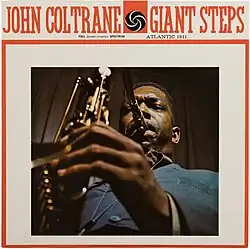
Giant Steps is a studio album by the jazz musician John Coltrane. It was released in January or February 1960 through Atlantic Records.[1] This was Coltrane's first album as leader for the label, with which he had signed a new contract the previous year. The record is regarded as one of the most influential jazz albums of all time. Many of its tracks have become practice templates for jazz saxophonists.[7][8] In 2004, it was one of fifty recordings chosen that year by the Library of Congress to be added to the National Recording Registry. It attained gold record status in 2018, having sold 500,000 copies.[9]
Two tracks, "Naima" and "Syeeda's Song Flute", are respectively named after Coltrane's wife at the time and her daughter, whom he adopted. A third, "Mr. P.C.", takes its name from the initials of bassist Paul Chambers, who played on the album. A fourth, "Cousin Mary", is named in honor of Mary Lyerly, Coltrane's younger cousin.
Background
In 1959, Miles Davis's business manager Harold Lovett negotiated a record contract for Coltrane with Atlantic, the terms of which included a $7,000 annual guarantee (equivalent to $75,506 in 2024).[10] Initial sessions for this album, the second recording date for Coltrane under his new contract after a January 15 date led by Milt Jackson, took place on March 26, 1959.[11] Coltrane was dissatisfied with the results of this session with Cedar Walton and Lex Humphries, and hence they were not used for the album,[12] but appeared on subsequent compilations and reissues. Principal recording for the album took place on May 4 and 5, two weeks after Coltrane had participated in the final session for Kind of Blue.[13] The track "Naima" was recorded on December 2 with Coltrane's bandmates, the rhythm section from the Miles Davis Quintet, who would provide the backing for most of his next album, Coltrane Jazz.[14]
Coltrane's improvisation exemplifies the melodic phrasing that came to be known as sheets of sound, and features his explorations into third-related chord movements that came to be known as Coltrane changes.[15] The Giant Steps chord progression consists of a distinctive set of chords that create key centers a major third apart. Jazz musicians ever since have used it as a practice piece, its difficult chord changes presenting a "kind of ultimate harmonic challenge", and serving as a gateway into modern jazz improvisation. Several pieces on this album went on to become jazz standards, most prominently "Naima" and "Giant Steps".[12][16]
Reception and legacy
The Penguin Guide to Jazz selected this album as part of its suggested "Core Collection" calling it "Trane's first genuinely iconic record."[24] In 2003, the album was ranked number 102 on Rolling Stone magazine's list of The 500 Greatest Albums of All Time,[25] 103 in a 2012 revised list,[26] and 232 in a 2020 revised list.[27]
In 2000 it was voted number 764 in Colin Larkin's All Time Top 1000 Albums.[28]
On March 3, 1998, Rhino Records reissued Giant Steps as part of its Atlantic 50th Anniversary Jazz Gallery series. Included were eight bonus tracks, five of which had appeared in 1975 on the Atlantic compilation Alternate Takes, the remaining three earlier issued on The Heavyweight Champion: The Complete Atlantic Recordings in 1995.
In 2021, Stuart Nicholson of Jazzwise wrote: "So much has been written about Coltrane that it might appear you need a doctorate of music to go anywhere near his recordings. Nothing could be further from the truth, as Giant Steps demonstrates so eloquently. His music contains universal values that still speak to us now – the essential humanity of his work, the sheer joy of music making and the power and energy of his playing that even today can be both moving and uplifting. These are values that can be enjoyed by anyone and everyone, just as Coltrane intended."[29]
Track listing
Side one| Title | Date recorded |
|---|
| 1. | "Giant Steps" | May 5, 1959 | 4:43 |
|---|
| 2. | "Cousin Mary" | May 5, 1959 | 5:45 |
|---|
| 3. | "Countdown" | May 4, 1959 | 2:21 |
|---|
| 4. | "Spiral" | May 4, 1959 | 5:56 |
|---|
Side two| Title | Date recorded |
|---|
| 5. | "Syeeda's Song Flute" | May 5, 1959 | 7:00 |
|---|
| 6. | "Naima" | December 2, 1959 | 4:21 |
|---|
| 7. | "Mr. P.C." | May 5, 1959 | 6:57 |
|---|
1987 CD reissue bonus tracks| Title | Date recorded |
|---|
| 8. | "Giant Steps" (alternate version 1) | March 26, 1959 | 3:41 |
|---|
| 9. | "Naima" (alternate version 1) | March 26, 1959 | 4:27 |
|---|
| 10. | "Cousin Mary" (alternate take) | May 5, 1959 | 5:54 |
|---|
| 11. | "Countdown" (alternate take) | May 4, 1959 | 4:33 |
|---|
| 12. | "Syeeda's Song Flute" (alternate take) | May 5, 1959 | 7:02 |
|---|
1998 CD reissue additional bonus tracks| Title | Date recorded |
|---|
| 13. | "Giant Steps" (alternate version 2) | March 26, 1959 | 3:32 |
|---|
| 14. | "Naima" (alternate version 2) | March 26, 1959 | 3:37 |
|---|
| 15. | "Giant Steps" (alternate take) | May 5, 1959 | 5:00 |
|---|
Personnel
Thursday, March 26, 1959 (Tracks 8, 9, 13, 14)[30]
Monday, May 4, 1959 (Tracks 3, 4, 11) & Tuesday, May 5, 1959 (Tracks 1, 2, 5, 7, 10, 12 and 15)
- John Coltrane – tenor saxophone
- Tommy Flanagan – piano
- Paul Chambers – bass
- Art Taylor – drums
Wednesday, December 2, 1959 (Track 6)
Production
Release history
- 1960 – Atlantic Records SD 1311, vinyl record
- 1987 – Atlantic Records, first generation compact disc
- 1994 – Mobile Fidelity Gold CD
- 1998 – Rhino Records R2 75203, Deluxe Edition compact disc and 180-gram vinyl record
- 2020 – Atlantic Records R2 625106/603497848393, 60 Years Deluxe Edition, 2 CDs (Remastered Album + Outtakes)
References
- ^ a b [3][4][5][6]
- ^ Atlantic Masters CD Edition Liner Notes, 1998
- ^ Ostrow, Marty; Howard, Ira, eds. (January 23, 1960). "New Darin Album" (PDF). The Cash Box. New York: The Cash Box Publishing Co. p. 51. Archived (PDF) from the original on October 13, 2023.
- ^ Ackerman, Paul, ed. (January 25, 1960). "New Atlantic Pkgs. out this Week" (PDF). Billboard. Cincinnati: The Billboard Publishing Co. p. 2.
- ^ Ostrow, Marty; Howard, Ira, eds. (February 13, 1960). "February Album Releases" (PDF). The Cash Box. New York: The Cash Box Publishing Co. p. 46. Archived (PDF) from the original on October 13, 2023.
- ^ DeVito, Chris; Fujioka, Yasuhiro; Schmaler, Wolf; Wild, David (2013). Porter, Lewis (ed.). The John Coltrane Reference. New York/Abingdon: Routledge. p. 564. ISBN 9780415634632. Retrieved January 2, 2020.
- ^ Ben Ratliff. Coltrane: The Story of A Sound. New York: Farrar, Straus, and Giroux; 2007. ISBN 978-0-374-12606-3. pp. 53-54.
- ^ Lewis Porter. John Coltrane: His Life and Music. Ann Arbor: The University of Michigan Press, 1999. ISBN 0-472-10161-7, p. 145.
- ^ "What's News". The New York City Jazz Record. No. 202. January 2019. p. 5.
- ^ Lewis Porter. John Coltrane: His Life and Music. Ann Arbor: The University of Michigan Press, 1999. ISBN 0-472-10161-7, pp. 117-8.
- ^ Porter, p. 145, pp. 359-60.
- ^ a b Nisenson, Eric (2009). Ascension: John Coltrane and his Quest. New York: Hachette Books. p. 171. ISBN 9780786750955.
- ^ Porter, p. 360.
- ^ Giant Steps. Atlantic R2 75203, liner notes, p. 18.
- ^ Porter, pp. 145-148
- ^ "Giant Steps (1959)". JazzStandards.com. Archived from the original on December 2, 2010. Retrieved June 18, 2019.
- ^ Allmusic review
- ^ Gleason, Ralph J. (March 31, 1960). "John Coltrane: Giant Steps". DownBeat. Vol. 27, no. 7. p. 26.
- ^ Larkin, Colin (2007). Encyclopedia of Popular Music (4th ed.). Oxford University Press. ISBN 978-0195313734.
- ^ "Penguin Guide to Jazz review". Archived from the original on September 14, 2017. Retrieved June 18, 2009.
- ^ Rolling Stone review
- ^ Swenson, J., ed. (1985). The Rolling Stone Jazz Record Guide. US: Random House/Rolling Stone. p. 46. ISBN 0-394-72643-X.
- ^ "Virgin Encyclopedia review". Archived from the original on September 14, 2017. Retrieved June 18, 2009.
- ^ Cook, Richard; Brian Morton (2006) [1992]. "John Coltrane". The Penguin Guide to Jazz Recordings. The Penguin Guide to Jazz (8th. ed.). New York: Penguin. p. 269. ISBN 0-14-102327-9.
- ^ "102) Giant Steps". Rolling Stone. New York. November 2003. Archived from the original on March 22, 2009. Retrieved April 26, 2013.
- ^ "500 Greatest Albums of All Time Rolling Stone's definitive list of the 500 greatest albums of all time". Rolling Stone. 2012. Retrieved September 19, 2019.
- ^ "The 500 Greatest Albums of All Time". Rolling Stone. September 22, 2020. Retrieved August 26, 2021.
- ^ Larkin, Colin (2000). All Time Top 1000 Albums (3rd ed.). Virgin Books. p. 241. ISBN 0-7535-0493-6.
- ^ "Jazz Albums That Shook The World: The 1950s". Jazzwise. Retrieved June 16, 2025.
- ^ Atlantic Masters Edition CD Liner Notes 1998
External links
|
|---|
Discography |
Prestige
albums |
- Mating Call (with Tadd Dameron)
- Tenor Conclave
- Coltrane
- Interplay
- Wheelin' & Dealin'
- John Coltrane with the Red Garland Trio
- Soultrane
- Cattin' with Coltrane and Quinichette
- The Cats (with Tommy Flanagan and Kenny Burrell)
- Lush Life
- Settin' the Pace
- Standard Coltrane
- Kenny Burrell & John Coltrane
- Stardust
- Dakar
- The Believer
- Black Pearls
- Bahia
- The Last Trane
- Two Tenors
|
|---|
Blue Note
albums | |
|---|
Atlantic
albums | |
|---|
Impulse!
albums | |
|---|
With
Miles Davis | |
|---|
With
Thelonious Monk | |
|---|
| Live albums | |
|---|
| Compilations |
- Alternate Takes
- The Best of John Coltrane
- The Classic Quartet – Complete Impulse! Studio Recordings
- Coltrane for Lovers
- The Coltrane Legacy
- The Complete Columbia Recordings of Miles Davis with John Coltrane
- The Prestige Recordings
- Countdown: The Savoy Sessions
- Dial Africa: The Savoy Sessions
- Feelin' Good
- Gold Coast
- The Heavyweight Champion: The Complete Atlantic Recordings
- High Step
- The Major Works of John Coltrane
- Jupiter Variation
- Ken Burns Jazz: John Coltrane
- The Last Giant: Anthology
- Living Space
- To the Beat of a Different Drum
- Trane's Blues
- Trane's Modes
|
|---|
| Compositions |
- "26-2"
- "Alabama"
- "Blue Train"
- "Central Park West"
- "Countdown"
- "Equinox"
- "Giant Steps"
- "Impressions"
- "Lazy Bird"
- "Moment's Notice"
- "Mr. P.C."
- "Naima"
- "Ogunde"
|
|---|
| Documentaries |
- The Church of Saint Coltrane
- The World According to John Coltrane
- Chasing Trane: The John Coltrane Documentary
|
|---|
| Related | |
|---|
Tommy Flanagan |
|---|
Years given are for the recording(s), not first release, except where noted. |
Albums
as leader
or co-leader |
- Overseas (1957)
- Lonely Town (1959)
- The Tommy Flanagan Trio (1960)
- Solo Piano (1974)
- The Tommy Flanagan Tokyo Recital (1975)
- Trinity (1976)
- Alone Too Long (1977)
- Confirmation (1977–78)
- Eclypso (1977)
- Montreux '77 (1977)
- Ballads & Blues (1978)
- More Delights (1978)
- Our Delights (1978)
- Something Borrowed, Something Blue (1978)
- The Super Jazz Trio (1978)
- Together (and Kenny Barron, 1978)
- Tommy Flanagan Plays the Music of Harold Arlen (1978)
- Something Tasty (1979)
- Super-Session (1980)
- The Standard (1980)
- You're Me (1980)
- ...And a Little Pleasure (1981)
- The Magnificent Tommy Flanagan (1981)
- Giant Steps (1982)
- Thelonica (1982)
- The Magic of 2 (and Jaki Byard, 1982)
- Blues in the Closet (1983)
- I'm All Smiles (and Hank Jones, 1983)
- The Master Trio (and Ron Carter, Tony Williams, 1983)
- Nights at the Vanguard (1986)
- Jazz Poet (1989)
- Beyond the Blue Bird (1990)
- Flanagan's Shenanigans (1993)
- Lady Be Good ... For Ella (1993)
- Let's Play the Music of Thad Jones (1993)
- Sea Changes (1996)
- Sunset and the Mockingbird (1997)
|
|---|
With
Pepper
Adams |
- Motor City Scene (1960)
- Encounter! (1968)
- The Master (1980)
- The Adams Effect (1985)
|
|---|
With
Kenny
Burrell |
- Introducing Kenny Burrell (1956)
- Swingin' (1956)
- Kenny Burrell (Blue Note, 1956)
- All Day Long (1957)
- Kenny Burrell (Prestige, 1957)
- Kenny Burrell & John Coltrane (1958)
- Weaver of Dreams (1960–61)
- Bluesy Burrell (and Coleman Hawkins, 1962)
|
|---|
With
John
Coltrane |
- The Cats (no leader, 1957)
- Jazz Way Out (Wilbur Harden, 1958)
- Mainstream 1958 (Wilbur Harden, 1958)
- Tanganyika Strut (Wilbur Harden, 1958)
- (Coltrane, 1959)
|
|---|
With
Art
Farmer |
- Art (1960)
- Listen to Art Farmer and the Orchestra (1962)
- The Many Faces of Art Farmer (1964)
- Group Therapy (New York Jazz Sextet, 1965–66)
|
|---|
With
Ella
Fitzgerald |
- Ella at Juan-Les-Pins (1964)
- Ella in Hamburg (1965)
- Sunshine of Your Love (1968)
- Things Ain't What They Used to Be (And You Better Believe It) (1969)
- Ella in Budapest (1970)
- Ella à Nice (1971)
- Ella Loves Cole (1972)
- Jazz at Santa Monica Civic '72 (1972)
- Newport Jazz Festival: Live at Carnegie Hall (1973)
- Ella in London (1974)
- Fine and Mellow (1974)
- Montreux '75 (1975)
- Montreux '77 (1977)
|
|---|
With
Curtis
Fuller |
- Jazz ...It's Magic! (1957)
- Blues-ette (1959)
- Sliding Easy (1959)
- South American Cookin' (1961)
|
|---|
With
Coleman
Hawkins |
- At Ease with Coleman Hawkins (1960)
- Coleman Hawkins All Stars (1960)
- Night Hawk (and Eddie "Lockjaw" Davis, 1960)
- Back in Bean's Bag (1962)
- Desafinado (1962)
- Good Old Broadway (1962)
- Hawkins! Alive! At the Village Gate (1962)
- Hawkins! Eldridge! Hodges! Alive! At the Village Gate! (1962)
- Plays Make Someone Happy from Do Re Mi (1962)
- The Jazz Version of No Strings (1962)
- Today and Now (1962)
|
|---|
With
Milt
Jackson |
- Bags & Flutes (1957)
- Bags' Opus (1958)
- Bean Bags (1958)
- Vibrations (1960–61)
- Invitation (1962)
- Statements (1961)
- Jazz 'n' Samba (1964)
|
|---|
With
J.J.
Johnson |
- J Is for Jazz (1956)
- Blue Trombone (1957)
- Dial J. J. 5 (1957)
- First Place (1957)
- J. J. in Person! (1958)
- Pinnacles (1979)
|
|---|
With
Sonny
Rollins |
- Saxophone Colossus (1956)
- There Will Never Be Another You (1965)
- Falling in Love with Jazz (1989)
- Old Flames (1993)
- Sonny Rollins + 3 (1995)
|
|---|
With
others |
- Tentets (Franco Ambrosetti, 1985)
- Boss Tenor (Gene Ammons, 1960)
- Big Brass (Benny Bailey, 1960)
- Bash! (Dave Bailey, 1961)
- Who Is Gary Burton? (Gary Burton, 1962)
- Jazz Lab (Donald Byrd, 1957)
- Carter, Gillespie Inc. (Benny Carter and Dizzy Gillespie, 1976)
- Paul Chambers Quintet (1957)
- More Party Time (Arnett Cobb, 1960)
- Movin' Right Along (Arnett Cobb, 1960)
- Rhythm in Mind (Steve Coleman, 1991)
- Sonny's Dream (Birth of the New Cool) (Sonny Criss, 1968)
- Straight Ahead (Eddie "Lockjaw" Davis, 1976)
- Collectors' Items (Miles Davis, 1956)
- Quiet Kenny (Kenny Dorham, 1959)
- The Kenny Dorham Memorial Album (1960 [1976])
- Opening Remarks (Ted Dunbar, 1978)
- Patented by Edison (Harry "Sweets" Edison, 1960)
- The Book Cooks (Booker Ervin, 1960)
- The Song Book (Booker Ervin, 1964)
- Chromatic Palette (Tal Farlow, 1981)
- The Dizzy Gillespie Big 7 (1975)
- Gettin' with It (Benny Golson, 1959)
- Free (Benny Golson, 1962)
- The Panther! (Dexter Gordon, 1970)
- The Swingin'est (Bennie Green and Gene Ammons, 1958)
- Grey's Mood (Al Grey, 1973–75)
- It's About Time (Jimmy Hamilton, 1961)
- Can't Help Swinging (Jimmy Hamilton, 1961)
- Drum Suite (Slide Hampton, 1962)
- Out of the Afternoon (Roy Haynes and Roland Kirk, 1962)
- Really Big! (Jimmy Heath, 1960)
- New Picture (Jimmy Heath, 1985)
- Porgy & Bess (Joe Henderson, released 1997)
- The Artistry of Freddie Hubbard (1962)
- Mirage (Bobby Hutcherson, 1991)
- Bossa Nova Plus (Willis Jackson, 1962)
- Desert Winds (Illinois Jacquet, 1962)
- Budd Johnson and the Four Brass Giants (1960)
- Let's Swing! (Budd Johnson, 1960)
- Heart to Heart (Elvin Jones, 1980)
- Blues for Dracula (Philly Joe Jones, 1958)
- Detroit – New York Junction (Thad Jones, 1956)
- Mad Thad (Thad Jones, 1956–57)
- A Story Tale (Clifford Jordan and Sonny Red, 1961)
- The Adventurer (Clifford Jordan, 1978)
- Booker Little 4 and Max Roach (1958)
- Booker Little (1960)
- Vocalese (The Manhattan Transfer, 1985)
- Flute Flight (Herbie Mann and Bobby Jaspar, 1957)
- Flute Soufflé (Herbie Mann and Bobby Jaspar, 1957)
- Dusty Blue (Howard McGhee, 1960)
- Reincarnation of a Lovebird (Charles Mingus, 1960)
- De Lawd's Blues (Billy Mitchell, 1980)
- Smooth as the Wind (Blue Mitchell, 1960–61)
- The Incredible Jazz Guitar of Wes Montgomery (1960)
- Jeru (Gerry Mulligan, 1962)
- Jive at Five (Joe Newman, 1960)
- Good 'n' Groovy (Joe Newman with Frank Foster, 1960)
- Joe's Hap'nin's (Joe Newman, 1961)
- Straight Life (Art Pepper, 1979)
- The Oscar Pettiford Orchestra in Hi-Fi (1956)
- Limbo Carnival (Dave Pike, 1962)
- Dave Pike Plays the Jazz Version of Oliver! (Dave Pike, 1962)
- Pony's Express (Pony Poindexter, 1962)
- Keep Swingin' (Julian Priester, 1960)
- Wisteria (Jimmy Raney, 1985)
- Swingin' with Pee Wee (Pee Wee Russell, 1960)
- Stable Mates (A. K. Salim, 1957)
- Here Comes Louis Smith (Louis Smith, 1958)
- Roots (Idrees Sulieman, 1957)
- Tate-a-Tate (Buddy Tate, 1960)
- Color Changes (Clark Terry, 1960)
- Lucky Thompson Plays Happy Days Are Here Again (1965)
- Stan "The Man" Turrentine (1960)
- ZT's Blues (Stanley Turrentine, 1961)
- The Frank Wess Quartet (1960)
- Southern Comfort (Frank Wess, 1962)
- California Soul (Gerald Wilson, 1968)
- Pairing Off (Phil Woods, 1956)
- Rights of Swing (Phil Woods, 1961)
|
|---|
Discography |
|
|---|
Year(s) indicated are for the recording(s), not first release. |
As
leader
or
co-leader |
- Cedar! (1967)
- Spectrum (1968)
- The Electric Boogaloo Song (1969)
- Soul Cycle (1969)
- Breakthrough! (1972)
- A Night at Boomers, Vol. 1 (1973)
- A Night at Boomers, Vol. 2 (1973)
- Firm Roots (1974)
- Pit Inn (1974)
- Mobius (1975)
- Eastern Rebellion (1976)
- The Pentagon (1975)
- Beyond Mobius (1976)
- Eastern Rebellion 2 (1977)
- First Set (1977)
- Second Set (1977)
- Third Set (1977)
- Animation (1978)
- Eastern Rebellion 3 (1979)
- Soundscapes (1980)
- The Maestro (1981)
- Piano Solos (1981)
- Heart & Soul (1982)
- Among Friends (1982)
- The All American Trio (1983)
- Eastern Rebellion 4 (1983)
- Cedar's Blues (1985)
- The Trio 1 (1985)
- The Trio 2 (1985)
- The Trio 3 (1985)
- Cedar Walton (1985)
- Bluesville Time (1985)
- Blues for Myself (1986)
- Cedar Walton Plays (1986)
- Duo (1990)
- Cedar Walton at Maybeck (1992)
- Manhattan Afternoon (1992)
- Composer (1996)
- Roots (1997)
- The Promise Land (2001)
- Latin Tinge (2002)
- Underground Memoirs (2005)
- Midnight Waltz (2005)
- One Flight Down (2006)
- Seasoned Wood (2008)
- Voices Deep Within (2009)
- The Bouncer (2011)
|
|---|
As
sideman
with
Art Blakey
& The Jazz
Messengers |
- Three Blind Mice (1961)
- Mosaic (1961)
- Buhaina's Delight (1961)
- Caravan (1962)
- Ugetsu (1963)
- Free for All (1964)
- Kyoto (1964)
- Indestructible (1964)
- Golden Boy (1964)
- Buhaina (1973)
- Anthenagin (1973)
|
|---|
With
Art Farmer
(or where
stated),
Benny
Golson
&
The Jazztet |
- Take a Number from 1 to 10 (Golson, 1960–61)
- The Jazztet and John Lewis (The Jazztet, 1960–61)
- Big City Sounds (The Jazztet, 1961)
- The Jazztet at Birdhouse (The Jazztet, 1961)
- The Time and the Place (1967)
- The Art Farmer Quintet Plays the Great Jazz Hits (1967)
- Homecoming (1971)
- Yesterday's Thoughts (1975)
- To Duke with Love (1975)
- The Summer Knows (1976)
- Art Farmer Quintet at Boomers (1976)
- Voices All (The Jazztet, 1982)
|
|---|
With
Eddie Harris |
- Cool Sax from Hollywood to Broadway (1964)
- The In Sound (1965)
- Mean Greens (1966)
- The Tender Storm (1966)
- Excursions (1966)
- How Can You Live Like That? (1976)
|
|---|
With
Billy Higgins |
- Soweto (1979)
- The Soldier (1979)
- Once More (1980)
- Bridgework (1980–86)
- Billy Higgins Quintet (1993)
|
|---|
With
Milt Jackson |
- Milt Jackson at the Museum of Modern Art (1965)
- Born Free (1966)
- Milt Jackson and the Hip String Quartet (1968)
- Goodbye (1972–73)
- Olinga (1974)
|
|---|
With
Etta James | |
|---|
With
Clifford
Jordan |
- Spellbound (1960)
- Starting Time (1961)
- Bearcat (1962)
- These are My Roots: Clifford Jordan Plays Leadbelly (1965)
- Glass Bead Games (1973)
- Half Note (1974)
- Night of the Mark VII (aka, The Highest Mountain, Muse, 1975)
- On Stage Vol. 1 (1975)
- On Stage Vol. 2 (1975)
- On Stage Vol. 3 (1975)
- Firm Roots (1975)
- The Highest Mountain (SteepleChase, 1975)
|
|---|
With
Blue
Mitchell |
- The Cup Bearers (1962)
- Boss Horn (1966)
- Stratosonic Nuances (1975)
- Summer Soft (1977)
|
|---|
With
Houston
Person |
- Chocomotive (1967)
- Trust in Me (1967)
- Blue Odyssey (1968)
- Broken Windows, Empty Hallways (1972)
- The Big Horn (1976)
- Very Personal (1980)
- Naturally (2012)
|
|---|
With
others |
- God Bless Jug and Sonny (Gene Ammons & Sonny Stitt, 1973)
- Left Bank Encores (Gene Ammons & Sonny Stitt, 1973)
- Something for Lester (Ray Brown, 1977)
- Slow Drag (Donald Byrd, 1967)
- The Almoravid (Joe Chambers, 1971–73)
- Somethin's Cookin' (Junior Cook, 1981)
- Broken Shadows (Ornette Coleman, 1971–72)
- Katumbo (Dance) (Johnny Coles, 1971)
- (John Coltrane, 1959)
- Up, Up and Away (Sonny Criss, 1967)
- The Beat Goes On! (Sonny Criss, 1968)
- This Is the Moment! (Kenny Dorham, 1958)
- Blue Spring (Kenny Dorham & Cannonball Adderley, 1959)
- It's All Right! (Teddy Edwards, 1967)
- Soul Trombone (Curtis Fuller, 1961)
- Smokin' (Curtis Fuller, 1972)
- Tangerine (Dexter Gordon, 1972)
- Generation (Dexter Gordon, 1972)
- Bush Dance (Johnny Griffin, 1978)
- Roots (Slide Hampton, 1985)
- The Quota (Jimmy Heath, 1961)
- Triple Threat (Jimmy Heath, 1962)
- Mode for Joe (Joe Henderson, 1966)
- Hub Cap (Freddie Hubbard, 1961)
- Here to Stay (Freddie Hubbard, 1962)
- The Body & the Soul (Freddie Hubbard,1963)
- Bolivia (Freddie Hubbard, 1991)
- Highway One (Bobby Hutcherson, 1978)
- Farewell Keystone (Bobby Hutcherson, 1982)
- Really Livin' (J.J. Johnson, 1959)
- J.J. Inc. (J.J. Johnson, 1960)
- Save Your Love for Me (Etta Jones, 1986)
- Advance! (Philly Joe Jones, 1978)
- Drum Song (Philly Joe Jones, 1978)
- Seven Minds (Sam Jones, 1974)
- Something in Common (Sam Jones, 1974–77)
- First Class Kloss! (Eric Kloss, 1967)
- Abbey Is Blue (Abbey Lincoln, 1959)
- Strings! (Pat Martino, 1967)
- From This Moment On! (Charles McPherson, 1968)
- Horizons (Charles McPherson, 1968)
- Caramba! (Lee Morgan, 1968)
- The Sixth Sense (Lee Morgan, 1968)
- The Mode (Sonny Red, 1961)
- Sonny Red (1971)
- Setting Standards (Woody Shaw, 1983)
- For Losers (Archie Shepp, 1968–69)
- Kwanza (Archie Shepp, 1968–69)
- Now Is the Time (Idrees Sulieman, 1976)
- Goodbye Yesterday (Lucky Thompson, 1972)
- Concert: Friday the 13th – Cook County Jail (Lucky Thompson, 1972)
- I Offer You (Lucky Thompson, 1973)
- Another Story (Stanley Turrentine, 1969)
- Up Front (David Williams, 1986)
|
|---|
| Authority control databases | |
|---|

 [21]
[21]