Karuppuswamy
| Karuppannaswamy | |
|---|---|
Patroller of Boundaries[1] | |
 Idol of Karuppannaswamy | |
| Other names |
|
| Tamil Malayalam | கருப்பசாமி കറുപ്പണ്ണസാമി |
| Affiliation | Dravidian folk religion |
| Abode | Not accurate |
| Weapon | Aruval, Spear, Gada, Sword, Silver stick |
| Day | Tuesday, Wednesday, Friday, Saturday |
| Mount | Horse, Elephant |

Karuppannaswamy, also known as Karuppusamy or Karupparayan (Tamil: கருப்பண்ணசுவாமி, Malayalam: കറുപ്പണ്ണസാമി; lit. 'Black God' or 'Black'), is a powerful and widely worshipped guardian deity kaval deivam in Tamil folk religion, especially among rural and agrarian communities in Tamil Nadu and parts of Sri Lanka. He is considered a fierce protector, upholder of justice, and divine enforcer of dharma (righteousness). [2]
About Karuppannaswamy
Among Dravidians Karuppannaswamy is one of the most famous and respected deity, His presence is strongly felt in village guardian worship (grama devata tradition) and kuladeivam (ancestral deity) practices. People who worship Karuppannaswamy feel a deep, emotional, and personal connection to him—not as a distant god, but as a living guardian who watches over them day and night. Their respect is not based on fear alone, but on loyalty, gratitude, and unshakable trust. Words People Use for Him, Aandavar, Aiyya, Swamy, Veeran" (brave one) Many villagers—especially in Tamil Nadu and the border regions of Kerala—believe that Karuppar was once a real ancestor or guardian who lived, fought, and died for the protection of his people, clan, or village.Over time, due to his valor, righteousness, and loyalty, he was not forgotten after death. Instead, he became deified—raised to the level of a kuladeivam (family deity) or grama devata (village protector). Therefore, devotees engage in a high level of discipline and mental purity, as he does not permit rituals to be performed without both mental and physical cleanliness.
- Karuppar is seen as a divine judge—he upholds truth, loyalty, and justice above all.
- He is compassionate, but not tolerant of repeated wrongdoing.
Many agricultural castes and warrior clans worship Karuppannaswamy as their kuladeivam (family deity), because he is believed to have taken up the sacred responsibility of protecting their paddy fields, harvest, and rural boundaries. For warrior communities, he is not only a protector but is also revered as a Maha Guru—a divine teacher who embodies valor, discipline, and unwavering justice. In fact, almost every village has a shrine dedicated to Karuppannaswamy, recognizing him as the village’s guardian deity who watches over the wellbeing, boundaries, and prosperity of the entire community.
Ceremonies and Rituals Associated with Karuppannaswamy
Karuppannaswamy, a revered guardian deity in Tamil Nadu and parts of Kerala, is worshipped through several unique and traditional ceremonies that emphasize his role as a protector and enforcer of justice. These rituals often blend folk customs with spiritual symbolism, reflecting the deep connection between the deity and local communities.
Kodeil Vila Kodeil Vila (Tamil: கோடெயில் விலை) is a prominent annual ritual conducted to honor Karuppannaswamy and express gratitude for his protection. The ceremony includes special pujas and offerings, which in some villages may involve animal sacrifices such as goats or roosters, reflecting the deity’s fierce nature.
Devotees also offer arrack (a traditional liquor) and cigars, customary offerings in Karuppannaswamy worship. The event is marked by communal gatherings featuring folk dances, drumming, and processions. Priests or oracles often enter trance states to deliver divine messages to the community. In some cases, physical trials like fire-walking (Theemithi) are performed as acts of devotion.
Mayana Vettei Mayana Vettei (Tamil: மயன வேட்டை), meaning "hunt in the cremation ground," is a highly esoteric ritual emphasizing Karuppannaswamy’s dominion over death, evil spirits, and liminal spaces. Conducted mostly at night in or near cremation grounds, the ritual symbolizes the deity’s fearless pursuit and destruction of negative forces.
The ceremony may include chanting of mantras, invocation of spirits, and symbolic hunts performed by devotees. Masked dancers often represent Karuppannaswamy and his attendants, reinforcing the ritual’s dramatic and protective aspects. This rite serves to purify the village of malevolent influences and safeguard the community from black magic and disease.
Other Ritual Practices Padayatra: Devotees undertake processions carrying the deity’s idol or symbolic weapons around the village boundaries, reinforcing Karuppannaswamy’s protective presence.
* Theemithi (Fire Walking): As an expression of faith and purification, devotees walk barefoot over burning embers during festivals dedicated to Karuppannaswamy.
* Trance and Oracular Sessions: Oracles, believed to be possessed by the deity, provide guidance, warnings, and judgments to devotees.
* Offerings: Traditional offerings include liquor (arrack), cigars, millet, salt, and cloth (often red or black). Animal sacrifices are also practiced in certain regions as a fulfillment of vows.
These ceremonies foster communal unity and reinforce Karuppannaswamy’s role as a guardian and moral enforcer. They provide a framework for confronting fears related to death and evil, while renewing devotion, discipline, and commitment to truth among devotees. [6]
Temples of Karuppuswamy
Karuppusamy temples are found in outside of villages. Whole villages contribute to maintenance of temples. These temples do not have gopurams and have large statues of deities with large eyes, holding weapons like bows and arrows, swords, sickles and other weapons. There are statues of eight Matrikas and a hound, a lion and a horse with a main statue of Karuppuswamy.
Nadu Kal Worship (Nadu Kal Vazhipadu)
Nadu Kal Vazhipadu is an ancient and powerful form of Tamil folk worship, centered around a standing stone (Nadu Kal) which represents divine justice, ancestral memory, and the fierce presence of guardian deities like Karuppannaswamy, Muneeswarar,Sudalei Madan,Madurei Veeran. This stone is usually placed at a significant spot in the village—often at a crossroads, the village center, or near the boundary—symbolizing the deity's constant watch over the land and its people. The worship does not always involve an idol; instead, the stone itself becomes the form (uruvam) of the deity. In some shrines, it may be accompanied by a sword (aruval), trident (soolam), which represent Karuppar’s authority, power, and justice.
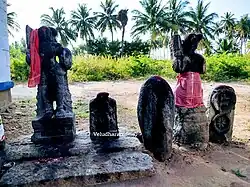

The rituals are generally simple but highly disciplined. Devotees clean the area, sprinkle turmeric water, and light oil lamps, incense, and camphor. Offerings include black cloth, coconut, betel leaves and nuts, lemon, puffed rice, black sesame seeds, and sometimes non-vegetarian food and country liquor—not for indulgence, but as symbols of truth and sacrifice. The Nadu Kal is also a place where people take sacred oaths (sathiyam) during family disputes or legal matters. It is believed that speaking a lie in front of the Nadu Kal and Karuppar would bring spiritual or physical punishment, as the deity does not tolerate falsehood, betrayal, or disrespect.
Worship often takes place at night, in silence or with the sound of parai (folk drum), and in a deeply reverent manner. Some devotees may go into trance (sami adudhal) and deliver messages from the deity. No one touches the sword or the stone casually. Devotees may also tie small bells or cloth pieces nearby, symbolizing prayers or vows. The worship is not focused on material desires, but rather on protection, truth, justice, and spiritual guidance. For those who accept Karuppannaswamy as their kuladeivam (ancestral deity), the Nadu Kal becomes not just a place of prayer, but a living spiritual courtroom—where dharma is upheld, and divine energy directly interacts with human lives. [7] [8] [9] [10] [11]
Worship of Karuppaswamy
Karuppuswamy worship is based on an ancient ancestral clan-based worship system in Hinduism. Here, most officiating priests are non-Brahmanas, and derive from local lineages that had initiated the religion generations ago. The worship pattern is non-Vedic or non-Agamic through folk tales, songs and arts of Villu Paattu, Karakattam, Koothu, etc. The local priests offer flowers and vibhuti (holy ash) to worshippers and plays a role of a oracle. Various people within the clan system are identified to play to the role of oracle on an annual turn basis. They undertake a vrata and maintain chastity and purity during the period. During the festivals, oracles get into Trance state of Swami Adudhal and deliver counselling messages to the group assembled there without bias. In some temples before the oracles deliver counselling messages, oracles stand on top of a aruval (Specifically forms of Karuppuswamy as Periyakaruppu, Muthukaruppu, Muppiliyaan). The normal problems addressed are family problems, financial troubles and local community and social issues for resolving within the community group with the agreement of local ancestral god through oracle. Whenever the wishes of the people are granted, they give their offerings to him based on what they vowed to offer.[12]

Karuppuswamy is worshipped in Trinidad and Tobago, Guyana, Fiji, Mauritius, Réunion, Seychelles, Guadeloupe, Singapore, Malaysia, Martinique as Sangili Karuppan, Sangani Baba.
Annual festivals of Karuppuswamy
The village committee would decide on when the annual festival be conducted. The time of the year when this would fall varies with villages and their local customs. Generally, the mass convention assembly of a large number of related family members is organized during spring for 2 days. The beginning of this festival will be with hoisting of a flag and tying a Kaappu. After this time, villagers cannot go out of the village but come in from a different village and after a festival ends, people can go out of the village and go to a different village.[13]
Trance
Trance is an important phenomenon that occurs in Karuppuswamy worship. This phenomenon essentially enables the god to possess the body of a human, who then goes on to display physical traits of the god. This is usually done at major festivals or prayers, and is considered to be a clear sign of the physical presence or blessing of the god. Some practitioners willingly invoke the god into their bodies, while for others it happens without their control. Trance is also used as a platform for devotees to communicate with the god and vice versa, to provide solutions and advises for a multitude of topics.
Forms Of Karuppannaswamy
The 21 forms of Karuppannaswamy represent different roles, energies, and duties carried out by the same divine guardian. "These forms are not "different gods," but rather different faces or modes of Karuppar, each one suited for specific purposes like protection, justice, healing, guarding, punishing, or guiding.
They come from oral tradition, village worship, trance rituals (sami adudhal), and kuladeivam customs — not from Vedic or temple-based Agamic texts. Therefore, these forms may differ slightly between regions.
|
Worship in Indo-Caribbean Dravidian folk religion
In Caribbean Shaktism in Guyana,[14] He is Sangani Baba. In the Indo-Caribbean community of Trinidad and Tobago, Guyana, Suriname, Guadeloupe, Martinique, Sangani Baba is worshipped as a powerful god.
Sangani Baba is often associated with the color black, which symbolizes his fierce and protective nature. He is considered a guardian god, offering his devotees protection, prosperity, and guidance. His worship in Indo-Caribbean Shaktism has elements of Hinduism that have been passed down through generations.[15]
Devotees offer various items to Sangani Baba as part of their worship. These offerings can include Vedic items such as camphor, butter, cloves, ghee. However, non-Vedic offerings such as cigarettes and alcohol are also made to him in these regions, reflecting the Tamil nature of the worship.[16]
Sacrifices of black chickens and black goats are made as part of rituals dedicated to Sangani Baba, showing the offering of life and the seeking of his blessings and favour. These practices reflect the deep connection and devotion of the Indo-Caribbean community Sangani Baba.[17]
In Indo-Caribbean Shaktism, Sangani Baba is revered as a god who can provide counsel and guidance. During festivals and special occasions, individuals chosen as oracles enter into a trance-like state, known as Swami Adudhal. In this state, they channel the messages and advice Sangani Baba to the assembled devotees, addressing their personal and community concerns and solving them.[18]
See also
- Aiyanar
- Ayyappan
- Isakki
- Kali
- Karumariamman
- Mariamman
- Madurai Veeran
- Muneeswarar
- Sudalai Madan
References
- ^ Possessed by the Virgin: Hinduism, Roman Catholicism, and Marian Possession in South India. Oxford University Press. 2018. ISBN 978-0-19-061509-3.
- ^ Bloomer, Kristin C. (2018). Possessed by the Virgin: Hinduism, Roman Catholicism, and Marian Possession in South India. Oxford University Press. p. 291. ISBN 978-0-19-061509-3.
- ^ https://www.hindutamil.in/news/supplements/anantha-jothi/1344476-about-god-karuppasamy-and-temple-history.html?
- ^ https://www.pillaicenter.com/karuppaswamy?
- ^ https://rudraindia.org/who-is-lord-karuppa-swamy?
- ^ https://www.karuppuswamykovil.in/temple-ok.php
- ^ https://tamilnadu-favtourism.blogspot.com/2016/04/hero-stones-nadukal-devikapuram.html?
- ^ https://expreppro.in/hero-stone-virakal-natukal-explained-upsc/?
- ^ https://irjt.iorpress.org/index.php/irjt/article/download/1825/1414/3697?
- ^ https://wanderingheritager.blogspot.com/2018/11/hero-sati-navakanda-stones-pulikuthi.html?
- ^ https://veludharan.blogspot.com/2018/05/hero-and-sati-stones-at-karuppana-samy.html
- ^ "Karuppuswamy-a village deity of Tamil Nadu". researchgate.net. Amirthalingam Murugesan.
- ^ "தேனி கருப்பசாமி கோவில் வருடாந்திர திருவிழா..! பால்குடம் எடுத்து ஊர்வலம்..!". tamil.news18.com (in Tamil). 29 October 2023. Retrieved 23 July 2025.
- ^ "Kali/Mariamma Worship in Guyana: A Brief Overview" (PDF). Dr. Marcelo Moura Mello.
- ^ "The Importance of Dee (Deeha) Baba Worship in Hinduism (Sanatan Dharma)" (PDF). Dipika. Narottam Das.
- ^ "The Importance of Dee (Deeha) Baba Worship in Hinduism (Sanatan Dharma)" (PDF). Dipika. Narottam Das.
- ^ "The Importance of Dee (Deeha) Baba Worship in Hinduism (Sanatan Dharma)" (PDF). Dipika. Narottam Das.
- ^ "The Importance of Dee (Deeha) Baba Worship in Hinduism (Sanatan Dharma)" (PDF). Dipika. Narottam Das.
Hindu deities and texts | ||
|---|---|---|
| Gods |  | |
| Goddesses | ||
| Deity groups | ||
| Texts (list) | ||