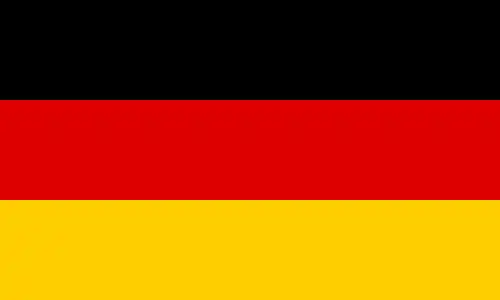
This list of German flags details flags and standards that have been or are currently used by Germany between 1848 and the present.
National flags
Flag
Date
Use
Description
1949–present
National and merchant flag (Bundes- und Handelsflagge A tricolour , made of three equal horizontal bands coloured black (top), red, and gold (bottom).
1950–present
State flag and ensign (Bundesdienstflagge military flag (Kriegsflagge variant of the coat of arms of Germany ) in the centre. The flag was originally used 1921–1933 in the Weimar Republic. While identical in heraldic terms to the original Weimar era flag, the modern exact design is slightly simplified.
National flag with coat of arms (Bundesflagge mit Bundeswappen
1997–present
Hanging national flag (Bannerflagge
1996–present
Hanging state flag
Standards
Presidential standard
Flag
Date
Use
Description
1921–1926;
Standard of the president of Germany
The standard depicts the elements of the coat of arms. A version of the standard that is identical in heraldic terms, but with a slightly different exact design, was used 1926–1933.
1933–1935 (de facto up to 1934)
Standard of the president
1926–1933
1919–1921
Flag of the president
1955–1960
Standard of the president of East Germany
1953–1955
1951–1953
1950–1951
1949–1950
1960–1990
Standard of the president of the State Council
1935–1945
Standard of the Führer
Imperial family standards
Flag
Date
Use
Description
1871–1888
German Emperor 's Standard
1888–1918
1871–1901
Empress Augusta and Empress Victoria 's Standard
1888–1918
Empress Augusta Viktoria 's Standard
1871–1888
Standard of the Crown Prince
1888–1918
1519–1556
Another imperial banner of Charles V
A black double-headed eagle with an escutcheon of the coat of arms of Charles V on a yellow field.
1493–1556
Banner of Maximilian I . Charles V continued using this banner.
A black double-headed eagle with the combined arms of Austria and Burgundy on a yellow field
1437–1493
Banner of Emperor Frederick III
A black double-headed eagle with the coat of arms of Austria on a yellow field
c. 1430-1806
Banner of the Holy Roman Emperor and state flag of the HRE
A black double-headed eagle with haloes on a yellow field
c. 1430–1806
Another banner of the Holy Roman Emperor and state flag of the HRE
A black double-headed eagle without haloes on a yellow field
800–1401
Banner of the Emperor of the Romans and of the King of Germany
An Imperial Eagle displayed with a halo sable armed and langued gules[ 1]
Other standards
Flag
Date
Use
Description
1871–1918
Royal Standard of the Emperor of Germany in Prussia (King of Prussia)
On a red field, an Iron Cross is shown. In the centre of the Iron Cross, the Imperial Eagle with a crown right on top of the eagle is shown. Around the eagle and crown, words spell the phrase: Gott mit uns
1844–1871
Old Royal Standard of the Emperor of Germany in Prussia (King of Prussia)
1871–1892
Royal Standard of the Crown Prince of Prussia
The same as the previous flag, but on a white field, instead of a red one.
1835–1918
Royal Standard of the King of Bavaria
1903–1918
Royal Standard of the Grand Duke of Hesse
1903–1918
Royal Standard of the Grand Duchess of Hesse
?–1918
Princely standard of Prince Reuss of Greiz
?–1918
Standard of the Duke of Saxe-Coburg-Gotha
Featured the flag of the British Royal Family until George V 's decision to change the house into Windsor .
1911-1918
Princely standard of Schaumburg-Lippe
1816-1837
Royal Standard of the Kingdom of Hanover
Flag of the King of Great Britain in Hannover until Queen Victoria .
Military
German Navy
Flag
Date
Use
Description
Ensigns
1956–
War ensign and jack (Seekriegsflagge und Gösch German Navy A swallowtail variant of the state flag
1960–1990
Naval ensign (Seekriegsflagge Volksmarine
1938–1945
Naval ensign of Kriegsmarine
1935–1938
1933–1935
Reich war flag (Reichskriegsflagge
1921–1933
Reich war flag (Reichskriegsflagge
1919–1921 (never used)
1903–1918 (1921)
Reich war flag
1892–1903
Reich war flag (Reichskriegsflagge
1867–1892
Imperial Navy war ensign (Kriegsflagge
1848–1852
War ensign of the Reichsflotte
1895–1918
Naval ensign of Prussian Navy
1819–1895
1816–1819
12th century
Naval ensign of the State of the Teutonic Order
1650–1694
Naval ensign of the Brandenburg Navy
15th century
War flag of the Holy Roman Empire
Red swords crossed on top of one another on a field. The top of the field is black and the bottom of the field is white.
15th century
A non-rectangular flag depicting a black eagle on a yellow field with a red bar on top
c. 12th –early 14th centuriesA non-rectangular flag depicting a white cross on a red field
Jacks
1956–
War ensign and jack (Seekriegsflagge und Gösch German Navy A swallowtail variant of the state flag
1935–1945
Jack of Kriegsmarine
1933–1935
1921–1933
Marine jack (Kriegsgösch
1903–1918 (1921)
1867–1903
Marine jack (Kriegsschiffgösch
1848–1852
Jack of the Reichsflotte
Other
1945–1947
Flag of the German Mine Sweeping Administration
The signal pennant "8"
Military and state flags
Flag
Date
Use
Description
Standard of the chancellor of Germany
A square variant of the Bundesdienstflagge with red border.
1957–
Standard of inspector general of the Bundeswehr
1964–
Troop colour (Truppenfahne Bundeswehr
A variant of the Kriegsflagge with aspect ratio of 1:1.
1950–1994
Flag of Deutsche Bundespost
Flag of the minister of Deutsche Bundespost
Flag of the president of Deutsche Bundespost
A swallowtail variant of the postal flag
Flag of the state secretary of Deutsche Bundespost
Non-Governmental flags
Civil ensign
Flag
Date
Use
Description
1949–present
Merchant flag A tricolour , made of three equal horizontal bands coloured black (top), red, and gold (bottom).
1973–1990
Merchant flag of German Democratic Republic (Handelsflagge
Tricolour of black, red, and yellow (same as West German colours), but bears the coat of arms of East Germany, consisting of a compass and a hammer encircled with rye
1959–1973
Merchant flag of German Democratic Republic (Handelsflagge
1946–1950
"C-Pennant" (C-Doppelstander civil ensign )
Used during the Occupation Period to identify German ships according to international law.
1935–1945
Merchant flag of German Reich variant with the Iron Cross
1933–1935
Merchant flag of German Reich (Handelsflagge
A red field, with a white disc with a black swastika at a 45-degree angle. Disc and swastika are exactly in the centre.
Merchant flag of German Reich variant with the Iron Cross (Eisernes Kreuz
Merchant flag of German Reich (Handelsflagge
Black, white, and red horizontal tricolour. Used in conjunction with the Parteiflagge
1921–1933
Merchant flag of Weimar Republic variant with the Iron Cross (Eisernes Kreuz
1919–1933
Merchant flag of Weimar Republic (Handelsflagge
1896–1918
Merchant flag variant with the Iron Cross (Eisernes Kreuz
1871–1918
Merchant flag of German Empire (National- und Handelsflagge
?–1918
Merchant flag of Mecklenburg-Schwerin
?–1864
Merchant flag of Duchy of Holstein
1816–1837
Merchant flag of Kingdom of Hanover
German Scouting flags
Other youth organisations
Sport flags
Pennant for the German Bicycle Union (1930s–1945)
Pennant for the German Car Club (?–1945)
Pennant for the German Aeronautic Union (1933–1937)
Pennant for the German Canoeing Association (2008–present)
Vexillology Associations flags
Flag
Date
Use
Description
1995–present
Flag of the German Vexillological Association
Flag of World Vexillological Research Institute
Flags of German states
Flags of German districts
Flags of German municipalities
Most municipalities have unique flags. Like state flags, most of them are with either a bicolour or tricolour stipes with or without the emblem ("wappen").
Unofficial regional flags
Flag
Date
Use
Description
1952–present
Flags of Baden
A horizontal tricolour of yellow and red.
A horizontal bicolour of red and yellow.
1990's–present
Flag of Franconia
1952–present
Flag of Mecklenburg
1816–present
Flag of Palatinate
1945–present
Flag of Pomerania
?–present
Flag of Westphalia
1945–present
Flag of Württemberg
Political flags
Religious flags
Ethnic groups flags
Historical flags
Francia, Kingdom of Germany, and the Holy Roman Empire (800–1806)
Flag
Date
Use
Description
c. 9th century
Imperial Oriflamme of Charlemagne .
A 3 pointed green banner with 8 golden crosses and 6 flowers.
c. 12th –early 14th centuries
War flag of the Holy Roman Empire
A non-rectangular flag depicting a white cross on a red field
1400–1523
Imperial Pavilion of Holy Roman Empire
A non-rectangular flag depicting a black eagle on a yellow field with a red bar on top
1400s
War flag of the Holy Roman Empire
Red swords crossed on top of one another on a field. The top of the field is black and the bottom of the field is white.
Teutonic Order State and Prussia (1226–1935)
Flag
Date
Use
Description
1226–1525
Flag of the Teutonic Order State
A black cross on a white field.
1466–1772
Flag of Royal Prussia
1525–1701
Flag of Ducal Prussia
1701–1750
First flag of the Kingdom in Prussia
A black eagle holding a rod and orb on a white field, a crown on top
1701–1935
Civil flag of Prussia
A bicolour design – white and black, split horizontally.
1750–1801
Second flag of the Kingdom in Prussia and first flag of the Kingdom of Prussia
A black eagle holding a sword and rod on a white field, a crown on top
1801–1803
Second flag of the Kingdom of Prussia
1803–1892
Third flag of the Kingdom of Prussia
The same as the previous flag, but the crown in the top of the flag is smaller.
1816
War flag of Prussia
A smaller black crowned eagle with yellow arm plates, a rod and orb, all on a white field with an Iron Cross in the upper-left corner
1892–1918
Fourth flag of the Kingdom of Prussia
1895–1918
War flag of Prussia
A non-rectangular flag depicting an Imperial Eagle in the centre of a white field, and in the upper-left corner, an Iron Cross is shown.
1918–1933
Flag of the Free State of Prussia
1933–1935
Service flag of the Free State of Prussia
The same as the previous flag, but the phrase Gott mit uns National Socialist swastika on the chest.
German Confederation (1815–1866)
North German Confederation (1866–1871)
Flag
Date
Use
Description
1867–1871
National and merchant flag (National- und Handelsflagge
A tricolour, made of three equal horizontal bands coloured black (top), white, and red (bottom)
German Empire (1871–1918)
Flag
Date
Use
Description
1871–1918
National and merchant flag (National- und Handelsflagge
1884–1918
Colonial flag
1903–1919
War Ensign (Reichskriegsflagge )
Weimar Republic (1919–1933)
Flag
Date
Use
Description
1919–1933
National flag (Nationalflagge
1921–1933
State flag (Dienstflagge zu Land
1921–1926
State ensign (Dienstflagge zur See
1926–1933
State ensign (Dienstflagge zur See
1919–1921
Flag of Defence Minister
1921–1933
Flag of Defence Minister
Nazi Germany (1933–1945)
The flag with the swastika and white disc centered was used throughout (1920–1945) as the NSDAP flag (Parteiflagge [ 2] German Empire . In 1935, the black-white-red horizontal tricolour was scrapped again, and the flag with the off-centre swastika and disc was instituted as the only national flag (and was to remain as such until 1945). The flag with the centered disc only continued to be used as the Parteiflagge
Flag
Date
Use
Description
Flags used 1933–1935
A red field, with a white disc with a black swastika at a 45-degree angle. Disc and swastika are exactly in the centre.
1933–1935
National flag (Nationalflagge
Merchant flag (Handelsflagge
Black, white, and red horizontal tricolour. Used in conjunction with the Parteiflagge
Merchant flag variant with the Iron Cross (Eisernes Kreuz
1933
Reich service flag (Reichsdienstflagge Wehrmacht
1933–1935
Reich service flag
Flag of the Minister of Defence
Flags used 1935–1945
A red field, with a white disc with a black swastika at a 45-degree angle. Disk and swastika are slightly off-centre.
Marine jack (Gösch
Merchant ensign (Reichshandelsflagge [ 3]
1933–1945
Banner (Bannerflagge
Banners were of various lengths, which were hung vertically on public buildings.
Banner (Bannerflagge
Banners that were also used by the national socialists (very rarely) along with the swastika.
1935–1945
Merchant flag variant with the Iron Cross
Reich service flag (Reichsdienstflagge
1935–1938
Flag of the Wehrmacht
Kriegsmarine Heer Luftwaffe
1938–1945
Kriegsmarine Heer Luftwaffe
1935–1945
Schutzstaffel
1921–1945
Sturmabteilung
1935–1945
National Socialist Motor Corps (NSKK)
1936–1945
Flag of the Ordnungspolizei (OrPo)
World War II aftermath in Germany
Allied Control Council (1945–1949) and Saar Protectorate
Flag
Date
Use
Description
1946–1950
"C-Pennant" (C-Doppelstander civil ensign )
Used during the Occupation Period to identify German ships according to international law.
1947–1957
Flag of Saar Protectorate
Flag of Saarland which was given by French Government. At this time period the Saar was a satellite state of France.
East Germany (1949–1990)
Flag
Date
Use
Description
1949–1959
State flag (Staatsflagge
1959–1990
State flag (Staatsflagge
Tricolour of black, red, and yellow (same as West German colours), but bears the coat of arms of East Germany, consisting of a compass and a hammer encircled with rye
Merchant flag (Handelsflagge
1963–1990
Hanging state flag (Bannerflagge
1955–1973
Flag of East German Post
1975–1990
Flag of East German Post
1960–1990
Flag of the National People's Army (Nationale Volksarmee
Regimental colours (Truppenfahne Nationale Volksarmee
1962–1990
Flag of boats of the Border Troops
Baden-Württemberg
Baden
Hohenzollern-Hechingen and Hohenzollern-Sigmaringen
Leyen
Flag
Date
Use
Description
1806–1814
Flag of the Principality of Leyen
until 1798
Flag of the County of Adendorf
Württemberg
Bavaria
Bavaria
Other countries in today's Bavarian lands
Brandenburg
East Frisia
Flag
Date
Use
Description
?–1835
Flag of Lordship of Kniphausende
1702–1751
Flag of Lordship of Kniphausen
1689–1702
Banner of Lordship of Kniphausen
Hesse
Lower Saxony
Brunswick
Hanover
Oldenburg
Schaumburg-Lippe
Mecklenburg-Vorpommern
North Rhine-Westphalia
Lippe
Other
Rhineland-Palatinate
Palatinate
Mainz
Trier
Saarland
Palatinate
Saxony
Saxony-Anhalt
Anhalt
Anhalt-Bernburg, Anhalt-Dessau and Anhalt-Köthen
Schleswig-Holstein
Heligoland
Holstein
Lübeck
Flag
Date
Use
Description
medieval–1918
Flag of Free City of Lübeck
Saxe-Lauenburg
Schleswig
Thuringia
Reuss
Saxe-Altenburg
Saxe-Coburg and Gotha
Saxe-Gotha-Altenburg
Saxe-Meiningen
Saxe-Weimar-Eisenach
Schwarzburg-Sondershausen
Other
Historic flag proposals
Note: Ottfried Neubecker's proposal of 1919 and those of Josef Wirmer in 1944 and of his brother Ernst in 1948 are clearly modeled on the Nordic Cross flags used in all Nordic countries – the flags of Denmark , Norway , Sweden , Finland and Iceland all having the same horizontal cross, though differing in colour.
Flag
Date
Use
Description
1817
German unification flag at Wartburg Festival
1832
German unification flag at Hambach Festival
1926
Ottfried Neubecker's Proposal
1944
Proposal for the flag of Germany after 1944 military coup d'état by Josef Wirmer ; later considered for adoption by the Constitutional Convention at Herrenchiemsee (Wirmer flag)
1948
Proposal for the flag for West Germany, based on Josef Wirmer 's 1944 design, created by his brother, Ernst
Proposal for the flag for West Germany by Paul Wentzcke, based on 1848 republican designs
A vertical black-red-yellow tricolour flag. (Not to be confused with Marawa Minangkabau, which is almost exactly similar.)
Proposal for the flag for West Germany by Edwin Redslob
Proposal for a national flag, by Robert Lehr
Nazi Germany occupations (1939–1945)
Flag
Date
Use
Description
1940
Proposal flag for General Government of occupied Poland
Flag proposal for the newly General Government, known only from the description.[ 4]
1939–1945
Unofficial flag of New Swabia
Flag of Reichskolonialbund and common flag for all German colonies during the Nazi period, in practice only for the New Swabia.
German colonial empire (1884–1918)
House Flags
German shipping company
Flag
Date
Use
Description
Aug. Bolten Wm. Miller’s Nachfolger
?–present
Bossler shipping companies
1819–present
F. A. Vinnen & Co.de
1871–present
Hamburg Süd
1920–present
Hugo Stinnes Schiffahrt
1901–present
Johann M. K. Blumenthalde
1903–present
Leonhardt & Blumbergde
1920–present
Ludwig & Jakob Götzde
1928–present
Reederei Baltrum-Liniede
1900–present
Reederei Warringsde
1982–present
Rickmers Group
?–present
Schiffswerft Philipp Ebert und Söhnede
1890–present
Unterweser Reedereide
1946–present
Waibel KGde
1885–present
Wyker Steamship Shipping Company Föhr-Amrumde
1896–1922
Argo Reedereide
1899–1969
A. Kirstende
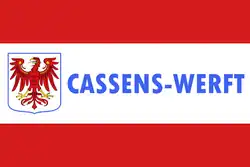
1875–2018
Cassens-Werftde
1872–1926
Deutsche Dampfschiffahrtsgesellschaft Kosmosde
1890–1942
Deutsche Ost-Afrika Linie
1881–1980
DDG Hansa
1873–1974
D. G. Neptunde
1821–1918
D. H. Wätjen & Co.de
1889–1970
Deutsche Levante-Liniede
1898–1931
Emil R. Retzlaff
1970s
Fendel-Stinnes
1958–1973
Hamburg Atlantic Line
1991–1997
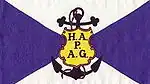
1847–1970
Hamburg America Line
1887–1939
Hamburg-Bremen-Africa-linede
1907–1920s
Hugo Stinnes Linien GmbH
1884–1914
Jantzen & Thormählen
1850–1879
Liniendienst von Joh. Ces. Godeffroy & Sohn
1924–1990
Lübeck Liniede
1808–?
Mathias Stinnesde
1857–1970
Norddeutscher Lloyd
1882–2018
Oldenburg-Portugiesische Dampfschiffs-Rhedereide
1869–1967
Reederei Robert Meyhoeferde
1905–1959
Roland-Liniede
1885–1942
Woermann-Linie
German Chartered company
Flag
Date
Use
Description
1882–1898
German New Guinea Company
1884–1920
German East Africa Company
1884–1885
1885–1903
German West African Company
1875–1939
Hernsheim & Co
1887
Jaluit Societyde
1888–?
1878–1887
German trading and plantation company from the South Sea Islands
Other companies
German yacht clubs
Flag
Club
Academic Sailing Club in Kielde
Blankeneser Segel-Clubde
Flensburger Segel-Clubde
Seebrucker Regatta-Verein
Segelclub Rhe
Segler Verein Wörthsee
Segler-Gemeinschaft Utting e.V.
Seglervereinigung 1903 Berlin
Spandauer Yacht-Clubde
Verein Seglerhaus am Wannsee
Württembergischer Yacht Club
Yacht-Club Bad Wiessee e.V.
The German Sea Sports Association HANSAde
AYC-StAGde
Hamburger Segel-Club
Kaiserlicher Yacht Club
Kieler Yacht-Club
Lübecker Yacht-Club
Marine-Regatta-Verein
Norddeutscher Regatta Verein
Yacht-Club Nürnbergde
Segel-Club Oberhavelde
Sailing Fellowship "The Coat of Arms of Bremen"de
Segel-Motorboot-Club Friedrichshafende
Stander ASV zu Halle
Segel-Club "Ahoi"de
Sailing club "Weser"de
Water Sports Club 1921de
Weser Yacht Club Bremerhavende
Yacht-Club von Deutschland (Burgee)
National Socialist Flyers Corps (NSFK)
Feldgendarmerie
Yacht-Club von Deutschland (Ensign)
References
External links
State-related Mobile military Mobile civil service Mobile civilian
Other entities By design
By nations
Names in
italics indicate
non-sovereign (dependent) territories, disputed states and/or former countries.
Authority control databases
National Other
.svg.png)
.svg.png)
.svg.png)
.svg.png)


.svg.png)
.svg.png)
.svg.png)
.svg.png)
.svg.png)
.svg.png)
.svg.png)


.svg.png)
.svg.png)
.svg.png)


.svg.png)
.svg.png)
.svg.png)
.svg.png)
.svg.png)
.svg.png)


.svg.png)
.svg.png)

.svg.png)
.svg.png)
.svg.png)
.svg.png)
.svg.png)
.svg.png)
.svg.png)
.svg.png)
.svg.png)
.svg.png)


.svg.png)


.svg.png)
.svg.png)
.svg.png)
.svg.png)
.svg.png)


.svg.png)


.svg.png)
.svg.png)

.svg.png)

.svg.png)
.svg.png)
.svg.png)
.svg.png)
.svg.png)

.svg.png)
.svg.png)
%252C_Bild_08.jpg)

_Logo_(Lilie).svg.png)


_-_Type_2.svg.png)


.svg.png)


 Pennant for the German Bicycle Union (1930s–1945)
 Pennant for the German Car Club (?–1945)
 Pennant for the German Aeronautic Union (1933–1937)
![Pennant for the German Canoeing Association [de] (2008–present)](./DKV_Pennant.svg.png) Pennant for the German Canoeing Association (2008–present)
Pennant for the German Canoeing Association (2008–present)

.svg.png)
.svg.png)


.svg.png)


.svg.png)


.svg.png)



.svg.png)
_Flagge.svg.png)


.svg.png)

.svg.png)

.svg.png)





_Lob.svg.png)

.svg.png)

.svg.png)
.svg.png)
.svg.png)
.svg.png)
.svg.png)

.svg.png)

.svg.png)
.svg.png)

.svg.png)
.svg.png)


.svg.png)


.svg.png)


.svg.png)
.svg.png)
.svg.png)
.svg.png)
.svg.png)
.svg.png)
.svg.png)


.svg.png)
.svg.png)
.svg.png)
.svg.png)
.svg.png)

.svg.png)

.svg.png)
.svg.png)
.svg.png)


.svg.png)


.svg.png)
.svg.png)
.svg.png)

.svg.png)
.svg.png)


.svg.png)


.svg.png)
.svg.png)

.svg.png)
.svg.png)


.svg.png)
.svg.png)

.svg.png)


.svg.png)


.svg.png)
.svg.png)


.svg.png)
.svg.png)
.svg.png)

.svg.png)

.svg.png)


.svg.png)

.svg.png)
.svg.png)


.svg.png)

.svg.png)


.svg.png)


.svg.png)










 Category