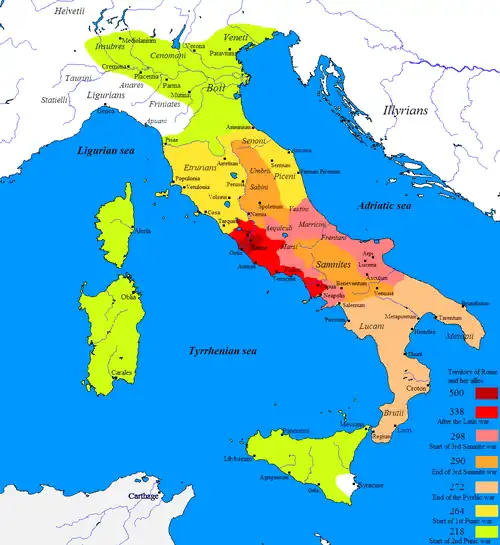
c. 509 BC – (legendary)Overthrow of the Roman monarchy[2] – According to the traditional account, Roman aristocrats expel Etruscan king Lucius Tarquinius Superbus, abolish the Roman Kingdom and establish the Roman Republic. Many details are generally accepted to be fictional, but scholars disagree about the degree to which the legendary narratives may or may not have a foundation in historical fact.
c. 508 BC – War between Clusium and Aricia – According to Livy, King Lars Porsena of the Etruscan city of Clusium besieged Rome on behalf of Tarquinius Superbus. The outcome is debated, but tradition states that it was a Roman victory. The Clusians then besieged the Latin town of Aricia, which received support from the Latin League as well as the Greek colony of Cumae and destroyed the Clusian army. Livy doesn't say whether the Romans participated as allies of Aricia, but defeated and surviving Etruscan soldiers were given refuge and medical treatment in Rome. He claimed some who stayed behind were given homes in a neighbourhood later known as the 'Tuscan quarter'.[3]
480 BC – Battle of Veii (480 BC) – Consuls Marcus Fabius Vibulanus and Gnaeus Manlius Cincinnatus win a heavy battle against Veians and their Etruscan allies. Gnaeus Manlius Cincinnatus and former consul Quintus Fabius are slain.
477 BC –
Battle of the Cremera – All the Fabii except Quintus Fabius Vibulanus are killed in battle with the Veientes.
Battle of the Temple of Hope – Consul Gaius Horatius Pulvillus fights indecisive battle with the Etruscans.
Battle of Colline Gate (477 BC) – Consul Gaius Horatius Pulvillus has indecisive victory over the Etruscan civilization soon after the Battle of the Temple of Hope.
321 BC – Battle of the Caudine Forks – Romans under Spurius Postumius Albinus and T. Verturius Calvinus are defeated by the Samnites under Gaius Pontius.
295 BC – Battle of Sentinum – Romans under Fabius Rullianus and Publius Decimus Mus defeat the Samnites and their Etruscan and Gallic allies, forcing the Etruscans, Gauls, and Umbrians to make peace.
293 BC – Battle of Aquilonia – Romans decisively defeat the Samnites.
War with Gauls and Etruscans (284–282 BC)
284 BC – Battle of Arretium – A Roman army under Lucius Caecilius Metellus Denter is defeated by the Gauls.
283 BC – Battle of Lake Vadimo – A Roman army under P. Cornelius Dolabella defeats the Etruscans and Gauls.
282 BC – Battle of Populonia – Etruscan resistance to Roman domination of Italy is finally crushed.
Battle of Cape Ecnomus – A Carthaginian fleet under Hamilcar and Hanno is defeated in an attempt to stop a Roman invasion of Africa by Marcus Atilius Regulus.
Battle of Adys – Romans under Regulus defeat the Carthaginians in North Africa.
255 BC – Battle of Tunis – Carthaginians under Xanthippus, a Greek mercenary, defeat the Romans under Regulus, who is captured.
251 BC – Battle of Panormus – Carthaginian forces under Hasdrubal are defeated by the Romans under L. Caecilius Metellus.
250 BC – Siege of Lilybaeum - Siege on the Carthaginian city of Lilybaeum by Roman army under Gaius Atilius Regulus Serranus and Lucius Manlius Vulso Longus. Carthaginian victory.
Battle of Ager Falernus – Avoiding destruction with deceit, Hannibal escapes Fabius' trap in this small skirmish.
216 BC –
Battle of Cannae – Hannibal destroys the main Roman army of Lucius Aemilius Paulus and Publius Terentius Varro in what is considered one of the great masterpieces of the tactical art.
146 BC – Battle of Corinth – Romans under Lucius Mummius defeat the Achaean League forces of Kritolaus, who is killed. Corinth is destroyed and Greece comes under direct Roman rule.
Siege of Uxellodunum – Caesar defeats a holdout city after the Battle of Alesia and cuts both the hands of all the men in the town
Roman–Parthian war of 54–53 BCE. This conflict resulted from the Parthian war of succession (57–54 BCE) between Mithridates IV and his brother Orodes II after killing their father, king Phraates III. The Roman invasion of Parthia, commencing in 54 BCE and ending catastrophically at the Battle of Carrhae in 53 BCE, was partially motivated by or justified as supporting Mithridates' claim to the Parthian throne.[6]
25–22 BC – Gaius Petronius' expeditions against Nubia - Roman forces managed to reach Qasr Ibrim and northern Nubia, capturing several cities, including Pselcis, Primis, Abuncis, Phthuris, Cambusis, Attenia, and Stadissias, then destroyed the city of Napata (kushite capital) and other cities in retaliation while taking captives. Kushites Kandake earns a favorable peace treaty and Romans established a new frontier at Hiere Sycaminos (Maharraqa), halting Rome's southward expansion in Africa.
25 BC Siege of Ma'rib - After Romans easily defeated the Arab army of 10,000 soldiers, conquered a few towns (including Mecca and Medina) and took on supplies from Nejran, Aelius Gallus besieged Ma'rib unsuccessfully for a week, before being forced to withdraw and unable to secure Incense trade route in land (the Nabateans, apparent allies, wanted the Romans to fail otherwise they would loose their monopoly over the spice trade). Rome is unable to conquest Sabaean kingdom of Ancient Yemen or coercing the incense states (Himyarite Arab kingdoms) of the Arabian Peninsula to become Roman client states.
25 BC Siege of Eudaemon - The supporting Roman fleet, after crossing the Gulf of Aqaba, occupied and sacked the port of Aden, securing the Roman merchant route to India in Red Sea. However, Roman interests wouldn't be served by a second expedition, becoming clear that certain fringes of the empire (like Nubia or Arabia) could not be won except at greater costs, being careful of further military adventures.
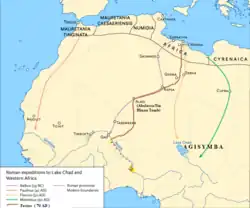
Sub-Saharan Roman expeditions-explorationsRoman expeditions to Lake Chad and the Niger River (19 BC–90 AD): Roman expeditions (two in the western Sahara, two in the central Sahara, and one in the area of Lake Chad) to subdue warring tribes in the area (like the warlike nomadic tribe of the Garamantes who lived in the current region of Fezzan) or to achieve the elimination of taxes on the nomads of the Sahara and plan possible routes of conquest to Sub-Saharan Africa, or at least control the Trans-Saharan caravan routes and penetrate into the kingdoms of the pygmies.
Battle of the Teutoburg Forest (9) – Cherusci-born Roman commander Arminius defects to a coalition Germanic rebel groups, who jointly ambush and annihilate three Roman legions under Publius Quinctilius Varus, prompting retaliation campaigns by the Romans. Germania Antiqua Roman province is abandoned with all their settlements such as the Waldgirmes Forum.
Battle at Pontes Longi (15) – Indecisive battle between a Roman army under Aulus Caecina Severus and Germanic troops led by Arminius.
83/84 – Battle of Mons Graupius. Romans under Gnaeus Julius Agricola defeat the Caledonians and temporally expanded Roman rule north into Caledonia (modern Scotland), establishing the northernmost Roman forts, like Cawdor, Tarradale and Portmahomack. Also, the fleet sailed north and made the first known circumnavigation of Britain, whereupon it was definitely discovered to be an island. It was proclaimed that Agricola had finally subdued all the tribes of Britain,[9] however, the costs of a drawn-out war outweighed any economic or political benefit and it was deemed more profitable to leave the Caledonians to themselves and dismantled Roman fortifications after Southern Uplands.[10]
62 – Battle of Rhandeia – Romans under Lucius Caesennius Paetus are defeated by a Parthian-Armenian army under King Tiridates of Parthia.
Nero's exploration of the Nile (62–67) – Roman expeditions to Equatorial Africa with the objective to reach the origin of Nile river and recopile information for a possible Roman planned conquest of Ethiopia.
363, 29 May – Battle of Ctesiphon – Emperor Julian defeats Shapur II of Persia outside the walls of the Persian capital, but is unable to take the city.
363, June – Battle of Samarra (363) – Julian fights the Sassanids and is subsequently killed in battle. Though indecisive, the battle leads to massive losses for the Roman Empire through a forced peace treaty.
380 – Battle of Thessalonica – The new Eastern Emperor, Theodosius I, is also defeated by the Thervings under Fritigern.
391 – Battle somewhere in Thrace: a band of Goths led Alaric I is defeated by Romans under Stilicho[15][16]
395-398 Revolt of Alaric I – Revolt of the Goths in the Eastern part of the Roman Empire
Stilicho's Pictish War – 398(?)
5th century
Map showing the paths of invasion by various groups into Eastern and Western Roman territoryReconstruction of the 407–409 sack of Gaul, based on Peter Heather (2005)
406, 31 December – traditional date of the Crossing of the Rhine: a mixed group of barbarians, which purportedly included Vandals, Alans and Suebi, crossed into northern Gaul.[13]
Another Visigothic invasion of Italy led by Alaric I (c. 408–410)[16][17]
409: Battle of Ostia – Visigoths under Alaric I defeated the Romans.
413 – Siege of Massilia – Visigoths under Ataulf were defeated by Romans under Bonifacius while trying to besiege the Roman city. They made peace with Rome soon after.
419 – Battle of the Nervasos Mountains – Western Romans and Suebi defeat Vandals and Alans.
Roman–Sasanian War of 421–422 - The Eastern Roman Emperor Theodosius II declared war against the Persians and obtained some victories, but in the end, the two powers agreed to sign a peace on the status quo ante.
Castinus' campaign against the Franks
422 – Battle of Tarraco – The Vandal king Gunderic defeat the Western Romans, making the Vandals the undisputed masters of Hispania.
425 – Siege of Arles -The Roman general Aëtius defeats the Visigoths under Theodoric I.
430-431 Aetius campaign in the Alps - Campaign against the Juthungi and Nori
Battle of Aylesford – Romano-Britons (under Vortimer) and Anglo-Saxons battle in Kent, victory is unclear.
457
Battle of Garigliano (457) – The Western Roman Emperor Majorian surprised a Vandal-Berber raiding party which was returning with loot from Campania.
Battle of Campi Cannini – Western Roman Emperor Majorian defeated an Alemanni invasion of Italy.
Gothic War (457-458)
458
Battle of Toulouse (458) – The Western Roman Emperor Majorian defeated the Visigoths.
Battle of Arelate – The Western Roman Emperor Majorian, with the support of Aegidius and Nepotianus, defeated the Visigoths at Arlate. With a treaty, the Visigothic returned all territory in Hispania to the Romans.
461 – Battle of Cartagena – A Vandal fleet surprised and destroyed the Roman fleet.
463 – Battle of Orleans – Gallo-Roman and Salian Frank forces under the command of Aegidius defeated a force of Visigoths at Orleans.
464 – Battle of Bergamo – Romans under General Ricimer defeated Alan invasion of Italy and killed their king.
468 – Battle of Cap Bon - Failure of the invasion of the kingdom of the Vandals by the Western and Eastern Roman Empires.
469 – Battle of Déols – Visigoths defeated Bretons and Gallo-Romans under Riothamus.
471 – Battle of Arles - Visigothic king Euric defeated the Roman general Anthemiolus, captured Arles and much of southern Gaul
472 – Siege of Rome - Ricimer, having fallen out with his choice for Roman Emperor, allied with the Burgundians and Germans under Odoacer, defeated and killed the Western Roman Emperor Anthemius.
^Webster, Jane (1996). "Ethnographic barbarity: colonial discourse and 'Celtic warrior societies'.". In Cooper, Nick (ed.). Roman Imperialism: Post-Colonial Perspectives(PDF). School of Archaeological Studies, University of Leicester. pp. 117–118. Retrieved 5 April 2023.
^Di Martino, Vittorio (2006). Roman Ireland. Cork: Collins. ISBN 978-1-905172-19-1
^Tacitus claims that Orkney was "discovered and subdued", but Thomson (2008) pp. 4–5 is as sceptical about Tacitus's claims on behalf of Agricola as he is about Claudius's earlier subjugation of Orkney (see above).

 Ancient Rome portal