List of fictional robots and androids
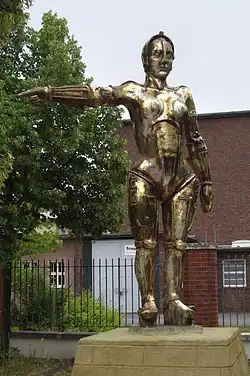
This list of fictional robots and androids is chronological, and categorised by medium. It includes all depictions of robots, androids and gynoids in literature, television, and cinema; however, robots that have appeared in more than one form of media are not necessarily listed in each of those media. This list is intended for all fictional computers which are described as existing in a humanlike or mobile form. It shows how the concept has developed in the human imagination through history.
Robots and androids have frequently been depicted or described in works of fiction. The word "robot" itself comes from a work of fiction, Karel Čapek's play, R.U.R. (Rossum's Universal Robots), written in 1920 and first performed in 1921.
Theatre
- Coppélia, a life-size dancing doll in the ballet of the same name, choreographed by Marius Petipa with music by Léo Delibes (1870)
- The word robot comes from Karel Čapek's play, R.U.R. (Rossum's Universal Robots), written in 1920 in Czech and first performed in 1921. Performed in New York 1922 and an English edition published in 1923. In the play, the word refers to artificially created life forms.[1] Named robots in the play are Marius, Sulla, Radius, Primus, Helena, and Damon. The play introduced and popularized the term "robot". Čapek's robots are biological machines that are assembled, as opposed to grown or born.
Literature
19th century and earlier
- The woman forged out of gold in Finnish myth The Kalevala (prehistoric folklore)
- From 600 BC onward, legends of talking bronze and clay statues coming to life have been a regular occurrence in the works of classical authors such as Homer, Plato, Pindar, Tacitus, and Pliny. In Book 18 of the Iliad, Hephaestus the god of all mechanical arts, was assisted by two moving female statues made from gold – "living young damsels, filled with minds and wisdoms". Another legend has Hephaestus being commanded by Zeus to create the first woman, Pandora, out of clay. The myth of Pygmalion, king of Cyprus, tells of a lonely man who sculpted his ideal woman, Galatea, from ivory, and promptly fell in love with her after the goddess Aphrodite brought her to life.
- The 5th-century BCE Chinese text, the Liezi, contains a description of a humanoid machine which can sing and dance like a human. The automaton is presented to King Mu of Zhou by its inventor, but it offends the king by winking at court ladies and trying to flirt with them, so the inventor disassembles it to show the court that it is a machine. The king sees that it has artificial analogues of human organs, which are made of leather, wood, glue, and paint, and each fulfill necessary functions for its operation.
- Talos, bronze giant Talos in Apollonius of Rhodes' Argonautica, 3rd century BC
- Brazen heads, attributed to numerous scholars involved in the introduction of Arabian science to medieval Europe, particularly Roger Bacon (13th century)
- Golem – The legend of the Golem, an animated man of clay, is mentioned in the Talmud. (16th century)
- Talus, "iron man" who mechanically helps Arthegall dispense justice in The Faerie Queene, the epic poem by Edmund Spenser, published in 1590
- Olimpia, automaton who captivates the hero Nathanael so much he wishes to marry her in E. T. A. Hoffmann's Der Sandmann (1814)
- Artificial human-like being created by Victor Frankenstein in Mary Shelley's Frankenstein; or, The Modern Prometheus (1818)
- The Steam Man of the Prairies, Edward S. Ellis' mechanical man powered by steam (1868).
- Olympia in Act I of Jacques Offenbach's The Tales of Hoffmann, based on the Hoffmann story (1881)
- A mechanical man run by electricity in Luis Senarens' Frank Reade and his Electric Man (1885)
- Hadaly, a mechanical woman run by electricity, in Auguste Villiers de l'Isle-Adam's The Future Eve (1886) – the novel credited with popularizing the word "android"
- "The Brazen Android" by William Douglas O'Connor. First appeared in The Atlantic Monthly, April 1891
- The Dancing Partner by Jerome K. Jerome of Three Men in a Boat fame (1893)
- The mecha-like tripods that the Martians use to conquer the Earth in The War of the Worlds by H. G. Wells (1897)
- "The New Frankenstein" by Ernest Edward Kellett (1899), in which an inventor creates an "anti-phonograph" that according to the narrator "can give the appropriate answer to every question I put", and installs in it a robotic female body that "will guide herself, answer questions, talk and eat like a rational being, in fact, perform the part of a society lady." The android proves convincing enough to fool two suitors who wish to marry her.[2]
- A robot chess-player in Moxon's Master by Ambrose Bierce (first published in the San Francisco Examiner on 16 Aug. 1899)
Early 1900s
- The "Metal Men" automata designed by a Thomas Edison-like scientist in Gustave Le Rouge's La Conspiration des Milliardaires and two sequels (1899–1903).
- Tik-Tok and Iron giant from L. Frank Baum's Ozma of Oz (1907). The movie Return to Oz was largely based on Ozma of Oz.
1920s
- R.U.R. (Rossum's Universal Robots) (1921), by Karel Čapek – credited with coining the term "robot". In its original Czech, "robota" means forced labour, and is derived from "rab", meaning "slave." R.U.R. depicts the first elaborate depiction of a machine take-over. Čapek's robots can also be seen as the first androids: they are in fact organic.
- Gaston Leroux's 1923 La Poupée Sanglante (The Bloody Doll) and La Machine à Assassiner (The Murdering Machine). The lead character, Bénédict Masson, is wrongly accused of murder and guillotined. His brain is later attached to an automaton created by scientist Jacques Cotentin, and Masson goes on to track and punish those who caused his death.
- Le Singe (The Monkey) (1925), by Maurice Renard and Albert Jean, imagined the creation of artificial lifeforms through the process of "radiogenesis", a sort of human electrocopying or cloning process.
- The Metal Giants (1926), by Edmond Hamilton, in which a computer brain who runs on atomic power creates an army of 300-foot-tall robots.
- Metropolis (1927), by Thea von Harbou, adapted by Fritz Lang on film, featuring character Maria and her robot double.
- Automata (1929), by S. Fowler Wright, about machines doing the humans' jobs before wiping them out.
1930s
- The "Professor Jameson" series by Neil R. Jones (early 1930s) featured human and alien minds preserved in robot bodies. It was reprinted in five Ace paperbacks in the late 1960s: The Planet of the Double Sun, The Sunless World, Space War, Twin Worlds and Doomsday on Ajiat.
- Zat the Martian robot, protagonist of John Wyndham's short story "The Lost Machine" (1932)
- Human cyborgs in Revolt of the Pedestrians by David H. Keller (1932)
- Robot surgeon in "Rex" by Harl Vincent (1934)
- "Helen O'Loy" from the story of the same title by Lester del Rey (1938)
- Adam Link of I, Robot by Eando Binder (1938)
- Robots discover their "roots" in Robots Return by Robert Moore Williams (1938).
- Robot as murder witness in True Confession by F. Orlin Tremaine (1939)
1940s
- Gnut in "Farewell to the Master" by Harry Bates (1940), later made into the classic 1951 science fiction film The Day the Earth Stood Still
- Unnamed "living plastic" robot in "Vault of the Beast" (1940), short story by A. E. van Vogt
- Jay Score ("J20"), emergency pilot of the Earth-to-Venus freighter Upskadaska City (colloquially called "Upsydaisy") in "Jay Score", a short story by Eric Frank Russell in the May 1941 issue of Astounding Science Fiction (1941)
- Jenkins in City by Clifford D. Simak (1944)
- Alojzy Kukuryk in Akademia pana Kleksa by Jan Brzechwa (1946), a mischievous mechanical doll able to pass as a human boy, and the main adversary of the protagonist, Mr Blot.
- Robots by Isaac Asimov:
- Robbie, Speedy, Cutie, and others, from the stories in I, Robot (1940–1950) (not to be confused with the Binder short story of the same title)
- L-76, Z-1, Z-2, Z-3, Emma-2, Brackenridge, Tony, Lenny, Ez-27 and others, from the stories in The Rest of the Robots (1964)
- R. Daneel Olivaw from The Caves of Steel (1954) and subsequent novels
- R. Giskard Reventlov from The Robots of Dawn (1983) and subsequent novels
- Andrew Martin from The Bicentennial Man (1976) (later made into a film) and The Positronic Man (a novel), co-written by Asimov and Robert Silverberg
- Norby in a series of books for children and adolescents, co-written with Janet Asimov
- The Humanoids from a novelette (1947) and two novels (1949 and 1980) by Jack Williamson
1950s and 1960s
- Astro Boy, series by Osamu Tezuka (published in Japan but available in English), an atomic-powered robot of 100,000 horsepower built to resemble a little boy, most specifically Tobio, the deceased son of Dr. Tenma. When not in school, Astro Boy spent his time dealing with robots and aliens. (1952)
- The Gallegher series of stories by Lewis Padgett (Henry Kuttner and C. L. Moore) collected in Robots Have No Tails (1952)
- The Mechanical Hound from Fahrenheit 451 by Ray Bradbury (1953)
- Bors, an old government integration robot pivotal to Philip K. Dick's novelette The Last of the Masters (1954)
- The Fury, a large steel robot that acts as jailer and executioner, in Henry Kuttner's "Two-Handed Engine" (1955)
- Zane Gort, a robot novelist in the short story "The Silver Eggheads" by Fritz Leiber (1959)
- SHROUD (Synthetic Human, Radiation OUtput Determined) and SHOCK (Synthetic Human Object, Casualty Kinematics), the sentient test dummies in the novel V. by Thomas Pynchon (1963)
- Frost, the Beta-Machine, Mordel, and the Ancient Ore Crusher in Roger Zelazny's short story "For a Breath I Tarry" (1966)
- Trurl and Klapaucius, the robot geniuses of The Cyberiad (Cyberiada, 1967; translated by Michael Kandel 1974) – collection of humorous stories about the exploits of Trurl and Klapaucius, "constructors" among robots
- The Iron Man in the novel The Iron Man: A Children's Story in Five Nights by Ted Hughes, illustrated by Andrew Davidson (1968), later changed to The Iron Giant to avoid confusion with its predecessor, the comic superhero of the same name
- Roy Batty, Pris, Rachael and several other Nexus-6 model androids. "Androids, fully organic in nature – the products of genetic engineering – and so human-like that they can only be distinguished by psychological tests; some of them don't even know that they're not human." – Do Androids Dream of Electric Sheep? by Philip K. Dick (1968)
- "The Electric Grandmother" in the short story of the same name, from I Sing the Body Electric by Ray Bradbury (1969), based on a 1962 Twilight Zone episode of the same name
- Mech Eagles from the novel Logan's Run (1967), robotic eagles designed to track and kill people who refuse to die at age 21
- Richard Daniel, an intensely loyal, old, un-remodeled robot, belonging to one family for generations, in "All the Traps of Earth" by Clifford Simak. When the last of his entire extended family of owners died, after 200 years, he is required by law to be disassembled; humans who made the law are still threatened by robots who are superior to them in functionality. He is sentient enough to take exception to that policy.
- Jenkins, the robot who served generations of the Webster family for nearly a thousand years, then the dogs modified by one of the Websters, dogs capable of reading and speech, who inherited the earth when humans left it by various methods, through all of the stories contained in the collection "City" by Clifford Simak. Humans entered "the sleep", or had their bodies converted to Jovian lifeforms to live on Jupiter.
1970s
- Personoids, in Stanisław Lem's book Próżnia Doskonała (1971). This is a collection of book reviews of nonexistent books, and was translated into English by Michael Kandel as A Perfect Vacuum (1983). "Personoids do not need any human-like physical body; they are rather an abstraction of functions of human mind, they live in computers."
- The Stepford Wives (1972) by Ira Levin – "The masculine plot to replace women with perfect looking, obedient robot replicas"
- Setaur, Aniel and Terminus in Tales of Pirx the Pilot by Stanisław Lem (1973)
- The Hangman in Home Is the Hangman by Roger Zelazny (1975), winner of that year's Nebula Award for Best Novella
- Andrew Martin from The Bicentennial Man (1976) by Isaac Asimov, and The Positronic Man (1992) by Asimov and Robert Silverberg
- Numerous droids from the Star Wars franchise novels (since 1977 for the main canon, 1976 for the Expanded Universe)
- Marvin the Paranoid Android in The Hitchhiker's Guide to the Galaxy (1979) by Douglas Adams and subsequent novels based on the original radio series
1980s
- Chip, the robot teenager in the Not Quite Human series (1985–1986) by Seth McEvoy. Disney later made the book into three movies.
- Roderick (1980) and Tik-Tok (1983) by John Sladek, two extreme examples of robot morality, one perfectly innocent and one perfectly criminal
- The Boppers, a race of Moon-based robots that achieve independence from humanity, in the series of books The Ware Tetralogy by Rudy Rucker
- R. Giskard Reventlov from The Robots of Dawn (1983) and subsequent novels by Isaac Asimov
- Elio, a character from A Tale of Time City (1987) by Diana Wynne Jones
- Manders in The Type One Super Robot (1987), a children's book by Alison Prince
- Solo from Robert Mason's novels Weapon (1989) and Solo (1993) (Note, the 1996 film titled Solo is based solely on the first novel, Weapon.)
- Sheen, a female android mysteriously programmed to guard and love Stile, a serf on the planet Proton, in the sci-fi/fantasy series Apprentice Adept (1980–82) by Piers Anthony.
- Spofforth, the dean of New York University in Mockingbird by Walter Tevis.
1990s
- Yod in Marge Piercy's He, She and It (1991)
- The One Who Waits in Charles Sheffield's Divergence (1991)
- Caliban in a trilogy by Roger MacBride Allen, set in the robots universe of Isaac Asimov (1993)
- Solo and Nimrod in Robert Mason's novel Solo (1993)
- Jay-Dub and Dee Model in Ken MacLeod's The Stone Canal (1996)
- Dorfl, and other Discworld golems deliberately described in terms reminiscent of an Asimovian robot, in Terry Pratchett's Feet of Clay (1996) and subsequent Discworld novels
2000s
- Cassandra Kresnov, in a series by Joel Shepherd (2001)
- Clunk, in a series by Simon Haynes (2004)
- Moravecs, sentient descendants of probes sent by humans to the Jovian belt, in Dan Simmons' Ilium (2003)
- Canti, one of the robots built by Medical Mechanica in FLCL (2003)
- Nimue Alban/Merlin Athrawes, in the Safehold series by David Weber (2007)
- Otis, the robot dog from Tanith Lee's Indigara (2007)
- Freya, in Charles Stross' Saturn's Children (2008)
- HCR-328 and Tom in Automatic Lover and Automatic Lover – Ten Years On by Ariadne Tampion (2008)
- Boilerplate, a Victorian-era robot in the illustrated coffee-table book Boilerplate: History's Mechanical Marvel, published by Abrams (2009)
2010s
- Adam, one of the first commercially available androids in Ian McEwan's Machines Like Me (2019)
- The Calculators, an ancient, ongoing family of androids in Paul Levinson's Robinson Calculator novelette (2019)
- Murderbot, a newly independent security robot in The Murderbot Diaries series by Martha Wells (2017-)
2020s
- Automata in The Automation, made by the Greco-Roman god Vulcan.
- Klara, the “Artificial Friend” narrator of Klara and the Sun (2021)
- Neotnia, the co-protagonist of Beautiful Shining People (2023)
- Crimson, a robot butler hunting the main characters and is the main antagonist in The Mystery at Crimson Mansion (2023)
Radio
- Marvin the Paranoid Android in The Hitchhiker's Guide to the Galaxy BBC radio series (1978–1980)
- Tidy, George, Fagor, Surgeon General Kraken and miscellaneous other androids from James Follett's Earthsearch BBC radio series (1980–1981)
- Fetchers, accident prone and apologetic gopher robots from the BBC radio series Nineteen Ninety-Four (1985)
Music
- "Max Mainspring, the Mechanical Man", a former grandfather clock brought to life in a 1950 children's record by Ray Bolger.
- "Robot Man", subject of a 1960 single by Connie Francis
- "Automatic Lover", robot featured in a 1978 disco track and music video by Dee D. Jackson, covered later that year by Sylvia.
- The Martian tripodal Killing Machines with heat rays in Jeff Wayne's Musical Version of the War of the Worlds (1978).
- Marvin, the Paranoid Android, released two singles in 1981, voiced by Stephen Moore from the BBC radio and TV productions of The Hitchhiker's Guide to the Galaxy.
- "Automatic Man", titular character of the 1983 song by Michael Sembello.
- "Mr. Roboto", the prison robot in the eponymous song from the rock opera Kilroy Was Here by Styx (1983).
- Topo, robot mascot of Topo & Roby, an Italo disco act, which charted in Europe in 1984 with "Under the Ice".
- "Electric Barbarella", a sexbot appearing in the music video for the 1997 track by Duran Duran.
- Pink Robots battled in The Flaming Lips' Yoshimi Battles the Pink Robots and its title single (2002).
- "Rapbot", a robot built for rapping, but with various other functions, including a toaster, from Fake Songs by Liam Lynch (2003).
- "Half Man Half Machine" from Goldie Lookin' Chain's 2004 single.
- Cindi Mayweather, the protagonist from the "Metropolis" concept series by Janelle Monáe (2007).
- Cyborg Noodle, the cyborg clone of Noodle from the virtual band Gorillaz who was created for the storyline of their album Plastic Beach (2010).
- "Selfmachine", titular character from the opening track of I Blame Coco's 2010 album The Constant.
- Rovix, K-pop group VIXX's robotic mascot (2012).
Film
Pre-1950

- The Mechanical Dummy, played by Ben Turpin in A Clever Dummy, a Sennett silent short dating from 1917 when the term "robot" did not yet exist. The dummy does not operate independently but performs limited movements when wired to a control box.
- The Automaton, a weaponized robot in The Master Mystery, a 1918 theatrical serial film starring Harry Houdini, featuring a fully realized mechanical man (implemented as a costumed actor)
- The Mechanical Man, one of two robots from the Italian silent film of the same name, directed by André Deed (1921)
- The Mechanical Horse, from a now-lost 1922 animated Aesop's Fable
- Maria/Futura, the Maschinenmensch, a robotic gynoid, played by German actress Brigitte Helm in both her robotic-appearing and human-appearing forms in Metropolis, the silent science fiction film by famed Austrian-German director Fritz Lang (1927)
- The Mechanical Cow (1927), cartoon companion of Oswald the Lucky Rabbit
- The Iron Man (1930), a robot man delivered to Farmer Al Falfa.
- Mechanical Racehorse built by Bosko in Ups 'n Downs (1931)
- Mechanical Man (1932), a robot opponent of Oswald the Lucky Rabbit
- The Robot, constructed from an automobile by Bimbo to win a boxing match, in this 1932 Talkartoon.
- Bosko's Mechanical Man (1933), a robot constructed by Bosko to perform household chores.
- Mechanical Farm Hands designed to perform farm chores in the 1933 Scrappy cartoon Technoracket.
- The Mechanical Man, a robot built by Flip the Frog to perform chores in Techno-Cracked (1933)
- Mickey's Mechanical Man (1933), a robot boxer invented by Mickey Mouse.
- The Juggernaut, a 7 foot tall robot programmed to be an assassin in the film serial The Vanishing Shadow (1934)
- Arbeitsmaschine and Kampfmaschine, working robots and fighting robots in the German movie Der Herr der Welt (1934) by Harry Piel; the mad scientist Professor Wolf (Walter Franck) is eventually killed by his fighting robot
- Black Beauty, a mechanical racehorse in the 1935 Happy Harmonies short The Old Plantation
- Muranian Robots in The Phantom Empire (1935), a 12-chapter Mascot Pictures serial combining the Western, musical and fantasy genres.
- The Tin Man (1935), voiced by Billy Bletcher ("My name is robot!") from the Roach comedy short of the same name featuring Thelma Todd and Patsy Kelly
- Jim Ripple's Robots in Loss of Sensation (1935), a film centering around a man who invents inexhaustible robots to replace humans working in factories
- Annihilants, robot soldiers belonging to Ming the Merciless in the Flash Gordon film series (1936)
- Volkites, robotic henchmen of the Atlantean tyrant Unga Khan in Undersea Kingdom (1936)
- The Mechanical Cow (1937), invented by Farmer Al Falfa after his dairy cows go on strike
- The Mechanical Handy Man (1937), a rooster-like robot designed by Oswald the Lucky Rabbit to perform chores
- Robot Butler and other robots confounding Donald Duck in Modern Inventions (1937)
- The New 1938 Creamlined Cow, mechanical dairy cow in the 1938 Looney Tunes short "Porky's Poppa"
- Robot Auto Mechanics in the 1938 Krazy Kat short The Auto Clinic
- World's Fair Robots in All's Fair at the Fair (1938)
- Iron Man, an 8 foot tall robot created by Dr. Alex Zorka in The Phantom Creeps (1939)
- Robot Sweeper and other robots in an "all electric model home" in the Looney Tunes short Dog Gone Modern (1939)
- Man of Tin (1940), a robotic wrestler invented by Scrappy and a mad scientist
- Steel "Killer" Robot in director William Witney's early 1940s film serial of 15 episodes Mysterious Doctor Satan (a.k.a. Doctor Satan's Robot) (1940, re-released in full-length 1966)
- The Mechanical Monsters in the Superman short of the same name (1941)
- The Monster and the Ape features the "Metalagon Man" a stolen robot (1945)
1950s
- Gort, the robot in the film The Day the Earth Stood Still (1951) (loosely based on Gnut, the robot protagonist of "Farewell to the Master" by Harry Bates, the original short story upon which the movie is based)
- Mark 1 in Mother Riley Meets the Vampire (1952)
- Mechano, the robotic cat programmed to kill or banish mice from houses, from the 1952 episode "Push-Button Kitty" of Tom and Jerry.
- Ro-Man Extension XJ-2, a gorilla-bodied robot bent on destroying Earth, in the movie Robot Monster (1952)
- Robot Pest Control purchased by Elmer Fudd to catch Bugs Bunny in Robot Rabbit (1953)
- The Twonky (1953)
- Gog and Magog in Gog (1954)
- Nyah's robot, Chani, in the British film Devil Girl from Mars (1954)
- Tobor, a robot created to replace astronauts in space in the film Tobor the Great (1954)
- Venusian robots invading Earth in Target Earth (1954)
- Robby the Robot in Forbidden Planet (1956) and The Invisible Boy (1957)
- Kronos (1957)
- Moguera, a large, mole-like robot in The Mysterians (1957) and several subsequent Japanese films
- Colossus in The Colossus of New York (1958)
- The Human Robot in The Robot vs. The Aztec Mummy (1958)
1960s
- Omega in First Spaceship on Venus (1960)
- Robot ZX29B, the Demolition Squad, and other robots sent by Yosemite Sam of Outer Space to capture Bugs Bunny in the Merrie Melodies short Lighter Than Hare (1960)
- Neptune Men, robotic aliens in Invasion of the Neptune Men, starring a young Sonny Chiba (1961)
- Robot John in Planet of Storms (1962), Voyage to the Planet of Prehistoric Women (1965) and Voyage to the Planet of Prehistoric Women (1968)
- The Humanoids (or "Clickers") in The Creation of the Humanoids (1962)
- Talos in Jason and the Argonauts (1963)
- Alien robots invade Earth in The Earth Dies Screaming. (1964)
- Torg in Santa Claus Conquers the Martians (1964)
- Frank Saunders (a.k.a. "Frankenstein"), an android version of Frankenstein's monster in Frankenstein Meets the Space Monster (1965)
- Sexbots or Fembots, including Robot # 11 (Diane) in Dr. Goldfoot and the Bikini Machine (1965) and Dr. Goldfoot and the Girl Bombs (1966), both starring Vincent Price
- Cyborg Garth A7 in Cyborg 2087 (1966)
- Robot Operator in The Terrornauts (1967)
- Mechani-Kong in King Kong Escapes (1967)
- Robot army in Superargo and the Faceless Giants (1968)
1970s
- The American defense computer Colossus that takes over the world in Colossus: The Forbin Project (1970)
- The all-robot police force in THX 1138 (1971)
- Huey, Dewey and Louie, drones in Silent Running (1972) – notable as the first movie in which non-humanoid robots were made mobile by manning them with amputees
- Jet Jaguar in Godzilla vs. Megalon (1973)
- The Gunslinger (played by Yul Brynner) and other androids in Westworld (1973) and Futureworld (1976)
- The robots in Sleeper (1973)
- Mechagodzilla in various Godzilla vs. Mechagodzilla (1974)
- The Stepford Wives (1975) – Joanna Eberhart and other women are being replaced with identical robots.
- Box in Logan's Run (1976)
- Necron-99, later called "Peace" from Ralph Bakshi's Wizards (1977)
- Proteus IV from Demon Seed (1977), an AI computer developed by Alex Harris, that eventually rapes the scientist's wife to be immortal
- C-3PO, R2-D2 and all the droids from the Star Wars franchise (since 1977 for the main canon, 1976 for the Expanded Universe)
- Robot Overlord from the 1977 Italian film Cosmos: War of the Planets
- Alien robot army threatens Earth in Starship Invasions. (1977)
- Aliens' robot army invades Earth in the Italian film War of the Robots. (1978)
- Beba-2 in Message from Space (1978)
- Elle and the Giant Robot in Starcrash (1978)
- Sparks, Lomax and others from the 1979 Canadian film H. G. Wells' The Shape of Things to Come
- Ash in Alien (1979)
- Hermes, an android double of his creator, in Unidentified Flying Oddball (1979)
- C.H.O.M.P.S. (Canine HOMe Protection System), a robotic dog invented by his young owner (1979)
- Tilk, Tilly and others in the 1979 Italian film Star Odyssey
- Ilia probe, a gynoid double of the original Ilia in Star Trek: The Motion Picture (1979)
- V.I.N.CENT (Vital Information Necessary CENTralized), B.O.B. (BiO-sanitation Battalion), Maximillian and the androids made out of humans in The Black Hole (1979)
1980s
- Hector in Saturn 3 (1980)
- Galaxina (1980), with Dorothy Stratten in the title role
- The giant robot from The King and the Mockingbird (1980)[3] The 1952 version provides one of the earliest uses of the Giant Robot/Mecha in animation.
- Bubo, a mechanical owl in Clash of the Titans (1981)
- Robot in segment 'So Beautiful, So Dangerous', Heavy Metal (1981)
- Val, Aqua, Phil and others from Heartbeeps (1981)
- The replicants Roy Batty, Pris, Leon Kowalski, Zhora, Rachael, and possibly Rick Deckard in Blade Runner (1982) (the film version of Do Androids Dream of Electric Sheep?)
- The Recognizers, police robots in Tron (1982)
- Max 404 and Cassandra One in Android (1982)
- Conal Cochran's androids who serve central antagonists/villains in Halloween III: Season of the Witch, a non-Halloween consecutive film
- Beta, an android left on Earth impersonating Alex Rogan while he is in space in The Last Starfighter (1984)
- T-800, the robot assassin in The Terminator (1984)
- Robot Spiders and various other robots, maliciously reprogrammed to kill in Runaway (1984)
- D.A.R.Y.L. (Data Analyzing Robot Youth Lifeform), a robot built to the government to look like a ten-year-old boy in the film D.A.R.Y.L. (1985)
- Tik-Tok in Return to Oz (1985)
- Sico, Paulie's robot in Rocky IV (1985)
- Spot in Eliminators (1986)
- Killbots in Chopping Mall (1986)
- Johnny 5 and the other S-A-I-N-T (Strategic-Artificially-Intelligent-Nuclear-Transport) military robots in Short Circuit (1986) and Short Circuit 2 (1988) and later Hot Cars, Cold Facts (1990)
- Jinx from the film SpaceCamp (1986)
- Bishop in Aliens (1986)
- R.A.L.F. (Robotic Assistant Labor Facilitator) and MAX (TriMAXion Drone Ship) in Flight of the Navigator (1986)
- BB and Samantha in Deadly Friend (1986)
- Ulysses, an android in the film Making Mr. Right (1987)
- Chip in the Not Quite Human movie adaptions based on the books by Seth McEvoy (1987)
- Dot Matrix in Spaceballs (1987)
- Toaster and Kirby in The Brave Little Toaster film series (1987–1997)
- ED-209 in RoboCop (1987)
- Data, positronic brain android from Star Trek: The Next Generation (1987–2002)
- R.O.T.O.R. (1987), the main antagonist of the movie of the same title
- The "fix-its" in *batteries not included (1987)
- Lore, Data's older brother Star Trek: The Next Generation (1988–1990)
- Cherry 2000 (1988), with Pamela Gidley in the title role
- Byron in Slipstream (1989) with Mark Hamill, Bill Paxton, and Bob Peck as Byron
1990s
- Quinn and DV-8 from Crash and Burn (1990)
- Lal, Data's offspring Star Trek: The Next Generation (1990)
- MARK13 in Hardware (1990)
- The Enforcer Drone from the 1990 film Spaced Invaders
- Johnny Cab from Total Recall (1990)
- Pino Petto from Silent Night, Deadly Night 5: The Toy Maker (1991)
- T-800 and T-1000, model Terminators played respectively by Arnold Schwarzenegger and Robert Patrick in Terminator 2: Judgment Day (1991)
- The good and evil robotic doubles of Bill and Ted in Bill & Ted's Bogus Journey (1991)
- Newman in And You Thought Your Parents Were Weird (1991)
- Eve from Eve of Destruction (1991)
- Mecha-King Ghidorah, a cyborg from Godzilla vs. King Ghidorah (1991)
- Mr. Static, The Robot from Demonic Toys
- Alsatia Zevo, the gynoid sister of Leslie Zevo and dollmaker in Toys (1992)
- Bishop in Alien 3 (1992)
- Otomo, android ninjas from RoboCop 3 (1993)
- The Sterilisation Units in A.P.E.X. (1994)
- J5 in Blankman (1994)
- Wallace's Techno Trousers in Nick Park's animated short Wallace & Gromit in The Wrong Trousers (1994)
- "SID 6.7", the villain in the film Virtuosity (1995) as a nanotech synthetic android, played by Russell Crowe
- David, Becker and Jessica from Screamers (1995) based on the short story "Second Variety" by Philip K. Dick
- Project 2501 in the movie adaptation of Masamune Shirow's Ghost in the Shell – Japanese manga anime describes AI surveillance of the population (1995)
- Evolver, villain from the 1995 film
- Solo (1996), based on Robert Mason's 1989 novel Weapon
- Call in Alien Resurrection (1997)
- The seductive Fembot assassins in Austin Powers: International Man of Mystery (1997) and in the rest of the Austin Powers series; in Austin Powers: The Spy Who Shagged Me (1999), it is revealed that Vanessa Kensington is a fembot, and in Austin Powers in Goldmember (2002), Britney Spears plays herself as one.
- Weebo in Flubber (1997)
- "Robot" in Lost in Space (1998), a movie based on the TV series
- Astor, an android played by Stacey Williams in Gangster World (1998)
- The Iron Giant (1999), a film version of the Ted Hughes children's novel The Iron Man
- Andrew, played by Robin Williams and others, the robot servant in The Bicentennial Man (1999), based on a short story by Isaac Asimov
- The Sentinels from The Matrix (1999)
- Battle Droids from Star Wars: Episode I – The Phantom Menace to Star Wars: Episode III – Revenge of the Sith
- RoboGadget in Inspector Gadget (1999)
2000s
- AMEE (Autonomous Mapping Exploration and Evasion), the robot scout in the film Red Planet (2000) who gets stuck in military mode and destroys the human crew of the spaceship
- Goddard, Jimmy Neutron's robot pet dog in Jimmy Neutron: Boy Genius (2001)
- Tima, a female android robot in the anime film Metropolis (2001)
- SIMON, from Lara Croft: Tomb Raider (2001)
- Many robots, including David, the lead character, in A.I. Artificial Intelligence (2001); based on the "Supertoys" of Brian Aldiss' short story "Supertoys Last All Summer Long"
- Kay-Em 14, female android in the tenth installment of the Friday the 13th franchise, Jason X (2002)
- Spyder robots, used by the PreCrime police force to locate and identify "perpetrators" in Minority Report (2002)
- Bruno from The Adventures of Pluto Nash (2002)
- S1M0NE (derived from SIMulation ONE), title character played by Rachel Roberts and starring Al Pacino (2002)
- Bio-Electronic Navigator a.k.a. B.E.N., an absent-minded robot from Disney's 2002 film Treasure Planet
- B-4, Data's and Lore's older brother in Star Trek: Nemesis (2002)
- US 47 in the 2002 Kannada language film Hollywood
- R4-P17 and the Droid Army in Star Wars: Episode II – Attack of the Clones (2002) and Star Wars: Episode III – Revenge of the Sith (2005)
- Arnold Schwarzenegger as the T-850 Terminator and Kristanna Loken as the T-X Terminatrix in Terminator 3: Rise of the Machines (2003)
- G2 from Inspector Gadget 2 (2003)
- The robot butler B166ER and the residents of the machine nation of Zero-One in the film shorts "The Second Renaissance Part I" and "The Second Renaissance Part II" from The Animatrix (2003)
- The Sentinels from the Matrix series (1999–2003)
- The robot from Zathura: A Space Adventure (2005)
- The "dolls", including Ria, in Natural City (2003)
- R.A.L.P.H. in Spy Kids 2: The Island of Lost Dreams (2002)
- Sonny (Type NS-5) and many others in I, Robot (2004)
- Omnidroid, a series of intelligent and destructive robots developed by Syndrome to fight and kill "Supers" in The Incredibles (2004)
- The monstrous robot dog in Rottweiler (2004)
- The great spirit Mata Nui, god robot from the Bionicle franchise; and the Vahki, the robot police enforcers in Bionicle 2: Legends of Metru Nui (2004)
- The Totenkopf Gatekeeper Robot, Totenkopf Guard Robots, unnamed giant robots and flying robots in Sky Captain and the World of Tomorrow (film) (2004)
- The entire cast of Robots (2005)
- Marvin the Paranoid Android in The Hitchhiker's Guide to the Galaxy (2005)
- "EDI" (Extreme Deep Invader") from Stealth (2005)
- Transmorphers, title characters from the 2007 direct-to-DVD film
- DOR-15 and Carl in Meet the Robinsons (2007)
- Iron Avengers from Next Avengers: Heroes of Tomorrow (2007)
- Billybot and Mandroid from the 2007 Cartoon Network film Billy and Mandy's Big Boogey Adventure.
- Giddy from Battle for Terra (2007)
- RoboDoc (MD 63) from the 2008 National Lampoon film of the same name
- WALL-E, EVE, M-O, GO-4, SECUR-T, PR-T, BURN-E, WALL-A and all other robot characters from the 2008 film WALL-E and the 2008 short BURN-E
- Gort, the robot in the film The Day the Earth Stood Still (2008), remake of The Day the Earth Stood Still (1951)
- "The Golden Army", robot horde from Hellboy II: The Golden Army (2008)
- The robot ninjas from Scooby-Doo! and the Samurai Sword (2008)
- Robot Probes from Monsters vs. Aliens (2009)
- Astro Boy and other robot characters from the 2009 film of the same name
- Several characters in Terminator Salvation (2009) including Marcus Wright, the T-800, several T-600's, The Motor-Terminators and The Harvester
- GERTY 3000 from the 2009 film Moon
- The Stitchpunks and others from the animated film 9 (2009)
- Robo from Super Capers (2009)
2010s
- Android, Robot gladiator in Planet Hulk (2010)
- Brainbots, Megamind's robotic jellyfish assistants in Megamind (2010)
- Chitti, a humanoid robot played by Rajinikanth, built to obey the three laws of Asimov, turns evil in Enthiran (2010)
- Paws, Kitty Galore's robotic Maine Coon in Cats & Dogs: The Revenge of Kitty Galore (2010)
- Candy Droober, Franklin Droober, Maureen Droober and Trace Mayter in Android Re-Enactment (2011)
- Atom, and Many characters from the film Real Steel (2011)
- Max, a robotic butler played by Lluís Homar, Gris, a free-thinking robotic cat, tiny robot horses and SI-9 in Eva (2011)
- '80s Robot in The Muppets (2011)
- Robot 7, from All-Star Superman (2011)
- David 8 and Walter One, androids played by Michael Fassbender in Prometheus (2012) and Alien: Covenant (2017)
- Tet, a tetrahedron in Earth's orbit that enslaved the human population, and cloned workers to maintain drones that keep humans from using the generators in Oblivion (2013)
- MecWilly, in the pub scene in the Italian film Regalo a sorpresa (2013)
- Jaegers, man-made, 250-ft war machines built to fight giant monsters called kaiju, who emerge from a portal in the Pacific Ocean to attack humanity, in Pacific Rim (2013)
- Dr. Wallace Damon, chief of a research group of investigation about UFOs from The Signal (2014)
- Sheriff Not-a-Robot, a robotic sheriff from the Old West and the Micro Managers, Lord Business' henchmen in The Lego Movie (2014)
- Baymax, an inflatable healthcare companion robot in Big Hero 6 (2014)
- TARS and CASE, adaptable rectangle robots in Interstellar (2014)
- Ultron, an evil robot portrayed by James Spader, and the Vision, an android portrayed by Paul Bettany, in Avengers: Age of Ultron (2015)
- Ava and Kyoko the androids in Ex Machina (2015)
- Athena, the audio-animatronic droid recruiter in Tomorrowland (2015)
- Intergalactic Advocate Bob, the assistance android that guides Jupiter Jones through the bureaucratic process in Jupiter Ascending (2015)
- T-800, the robot protector in Terminator Genisys (2015)
- CHAPPiE, the first robot with the ability to think and feel for himself, from the movie of the same name (2015)
- MOOSE and the Scouts in CHAPPiE
- Rob-Monkey, Gorilla Grodd's minions from Lego DC Comics Super Heroes: Justice League: Attack of the Legion of Doom (2015)
- BB-8, an astromech droid in Star Wars: The Force Awakens (2015)
- Arthur, an android bartender portrayed by Michael Sheen in Passengers (2016)
- Kit, Okra, OX King, Victor and Wilmer in Bling (2016)
- K-2SO, a Rebel-owned Imperial enforcer droid in Rogue One: A Star Wars Story (2016)
- Morgan, a female humanoid from Morgan (2016)
- S.A.R.-003, During the battle, Mills discovers an advanced S.A.R. (Study Analyze Reprogram), in Kill Command (2016)
- Bennie and Jet, robot dogs in Kingsman: The Golden Circle (2017)
- K, Luv, Freysa, Sapper Morton and Mariette, replicants in Blade Runner 2049 (2017)
- 7723, a weaponized robot in Next Gen (2018)
- A.X.L., a robotic dog in A.X.L. (2018)
- Cybots and the Robo-Clowns, the Joker's minions from Lego DC Comics Super Heroes: The Flash (2018)
- Nimani in A.I. Rising (2018)
- L3-37, played by Phoebe Waller-Bridge in Solo: A Star Wars Story (2018)
- Chucky, killer robot doll in Child's Play (2019)
- Foodio, a robot built to end world hunger in Invader Zim: Enter the Florpus (2019)
- T-800, the robot protector in Terminator: Dark Fate (2019)
- AUTO, in Automation (2019)
2020s
- Mechagodzilla from Godzilla vs. Kong (2021)
- Sox, a robotic cat from Pixar's Lightyear (2022)[4]
- M3GAN, an android companion created for the main character of the film M3GAN (2023)[5]
- ROZZUM unit 7134 ("Roz"), the main character of DreamWorks' The Wild Robot (2024)[6]
Television films and series
1960s and earlier
- In The Thin Man (1957–1959):
- Robby (Robby the Robot), a robot accused of murder in the episode "Robot Client" (1958)
- In The Twilight Zone (1961–1962):
- The Robot Simon (Robby the Robot) in the episode "Uncle Simon" (1963)
- Mr. Whipple's robot replacement (Robby the Robot) in the episode "The Brain Center at Whipple's" (1963)
- Rosie the Maid, Mac and UniBlab in The Jetsons (1962)[7]
- In Hazel (1961–1966):
- A robot maid (Robby the Robot) in the episode "Rosie's Contract" (1962)
- In Doctor Who (Seasons One to Six) (1963–1969) (see also List of Doctor Who robots):
- The Mechonoids, robot enemies of the Daleks in the serial The Chase (1965)
- The Chumblies in the serial Galaxy 4 (1965)
- Astro Boy in the Japanese animated series (1963–1966)
- Gigantor (1963–1966), Japanese animated TV series about the giant titular robot.
- In Lost in Space (1965–1968):
- Robot B-9 (a.k.a. The Robot), Class M-3 General Utility Non-Theorizing Environmental Control Robot assigned to the space craft Jupiter 2
- The Robotoid (Robby the Robot) in the episode "War of the Robots" (1966)
- The robot prison guard (Robby the Robot) in the episode "Condemned of Space" (1967)
- In The Addams Family (1964–1966):
- Smiley the Robot (Robby the Robot) in the episode "Lurch's Little Helper" (1966)
- Mildred the Maid (Robby the Robot) in The Banana Splits Adventure Hour (1968–1970)
- Slim John, rebel robot in the BBC series (1969)
1970s
- In Doctor Who (Seasons 7 to 17) (1970–1980):
- K9, the Doctor's robot dog companion with encyclopaedic knowledge and vast computer intelligence, created by Professor Marius and introduced in the serial The Invisible Enemy (1977)
- Numerous android characters in the Japanese superhero series Kikaider (1972), including the title character
- In Columbo (1971–1993):
- MM7 (Robby the Robot) in the episode "Mind Over Mayhem" (1974)
- In Ark II (1976):
- Alfie the Robot (Robby the Robot) in the episode "The Robot" (1976)
- Haro in Mobile Suit Gundam (1979)
- P.O.P.S. (Robot B-9 modified) in Mystery Island (1977–78)
- In Battlestar Galactica (1978–1979):
- The Cylons, mechanical men created by a race of reptile-like creatures
- Lucifer, an IL series Cylon, the robot assistant to Count Baltar introduced in "Saga of a Star World – Part III" (1978)
- In Mork & Mindy (1978–1982):
- Chuck the Robot (Robby the Robot) in the episode "Dr. Morkenstein" (1979)
1980s
- KARR ('Knight Automated Roving Robot), an early prototype of KITT in Knight Rider (1982–1986)
- The B.A.T.s (Battle Android Trooper) of the evil Cobra Organization in G.I. Joe: A Real American Hero series, first appeared in 1986
- Voltron of Voltron: Defender of the Universe (1984–1986)
- The synthoids from several episodes of the G.I. Joe: A Real American Hero series (1985)
- Conky 2000, robot who gives out the secret word in Pee-wee's Playhouse (1986–1991)
- T-Bob, a droid developed and owned by Scott Trakker, from the animated television series M.A.S.K., closely resembling R2-D2, and perhaps even a direct successor as an adapted Tx-series Industrial Automaton astromech droid, as implied by the show's storyline.
- Material for the Robotech II: The Sentinels (1987) and Robotech: The Shadow Chronicles (2007) sequels described a character named Janice Em as a "sexy robot" with an "android body." JANICE is an acronym (according to the voice actress Chase Masterson in the video: The Face behind the Voice mini-documentary) which means: Junctioned Artificial Neuro-Integrated Cybernetic Entity.
- Data, Lore, Lal (Data's daughter) and Juliana Tainer in the series Star Trek: The Next Generation (1987–1994, plus four movies)
- Tom Servo, Crow T. Robot, Gypsy and Cambot, created by and friends to Joel Hodgson and later Mike Nelson from Mystery Science Theater 3000 (1988)
- Talkie Toaster, Kryten, the Skutters, the Simulants and many others from the series Red Dwarf (1988)
1990s
- Alpha 5 from Mighty Morphin Power Rangers (1993–1996) to Power Rangers Turbo
- Megazords, giant robots from Power Rangers franchise (1993–present)
- Machine Empire from Power Rangers Zeo to Power Rangers in Space
- Alpha 6 from Power Rangers Turbo to Power Rangers Lost Galaxy and Power Rangers Operation Overdrive
- The many Evangelions, or EVAs, from the Neon Genesis Evangelion series
- 790, the sarcastic and perverse bodyless robot head of Lexx
- Blue Senturion, robotic Intergalactic Police Officer from Power Rangers Turbo to Power Rangers in Space
- A number of robots appear in Buffy the Vampire Slayer, including:
- Buffybot, a sexbot made by Warren Mears for Spike, appears in various episodes
- Bender the robot, as well as Flexo, Robot Santa, Kwanzaa-Bot, Calculon, Robot Devil, Clamps and other assorted robots including the Epsilon Rho Rho fraternity robots in the animated series Futurama (1999)
- Melfina from Outlaw Star
- Psycho Rangers from Power Rangers
- Andromon and Guardromon in the Digimon anime series
- Coconuts and Scratch and Grounder from Adventures of Sonic the Hedgehog: Doctor Eggman's robotic henchmen.[8]
- Steel/Iron Clan, Coyote, and Coldfire/Coldstone from Gargoyles
- Valerie 23 and Mary 25 from The Outer Limits
2000s
- Alpha 7 from Power Rangers Wild Force (2002)
- Chii, the Persocom in the Japanese anime series Chobits (2002)
- Cybernetic Ghost of Christmas Past from the Future, Rabbot, Robositter and Sheila from Aqua Teen Hunger Force (2000–2015)
- Daigunder in the Japanese anime series (2002)
- Frax and the Cyclobots from Power Rangers Time Force (2001)
- GIR from Invader Zim (2001): A dysfunctional robot who is assigned to serve Zim during his invasion of Earth.[9][10]
- Rommie, Gabriel/Balance of Judgement, Pax Magelanic, Doyle and various other warship AIs/avatars from Gene Roddenberry's Andromeda (2001–2005)
- Zeta from The Zeta Project (2001–2002): An android created by the government for espionage and infiltration. Due to a module secretly implanted by his creator, Eli Selig, Zeta abandons his mission and becomes a fugitive from the government and the NSA.[11]
- Robot Jones from the TV show Whatever Happened to... Robot Jones? (2002-2003): A robot who attends a human school in an attempt to understand humanity.[12]
- Jenny Wakeman / XJ-9 from My Life as a Teenage Robot (2003): An android created by Nora Wakeman who defends Earth from evil while attempting to live a normal human life.[12]
- R. Dorothy Wayneright in The Big O (2003)
- Karaibots from Teenage Mutant Ninja Turtles (2003–2009)
- H.E.L.P.eR. (Humanoid Electric Lab Partner Rboot), G.U.A.R.D.O. and Huggy in The Venture Bros. (2003–present)
- The Tachikoma spider tanks from Ghost in the Shell: Stand Alone Complex (2004–2005)
- C.A.R.R from Stroker and Hoop (2004–2005)
- D.A.V.E. (Digitally Advanced Villain Emulator) from The Batman (2004): A robot created by Hugo Strange that possesses the knowledge of various villains.[13]
- Cylons from Battlestar Galactica (2004)
- Centurions
- Hybrids
- Number One (John Cavil)
- Number Two (Leoben Conoy)
- Number Three (D'anna Biers)
- Number Four (Simon)
- Number Five (Aaron Doral)
- Number Six (Caprica Six et al.)
- Number Seven (Daniel)
- Number Eight (Sharon Valerii et al.)
- The Final Five:
- Galen Tyrol
- Tory Foster
- Samuel Anders
- Saul Tigh
- Ellen Tigh
- Miyu Greer from the anime series My-HiME (2004–2005) and My-Otome (2005–2006)
- Gunslinger from Trinity Blood (2005)
- Krybots, R.I.C. 2.0 (Robotic Interactive Canine) and S.O.P.H.I.E. (Series One Processor Hyper Intelligent Encriptor) from Power Rangers S.P.D. (2005)
- Robotboy (2005–2008)
- GR: Giant Robo (2007)
- Mackenzie Hartford from Power Rangers Operation Overdrive (2007)
- Cameron from Terminator: The Sarah Connor Chronicles (2008–2009)
- Cyber Shredder from TMNT: Back to the Sewer (2008–2010)
2010s
- Darkhawks from Guardians of the Galaxy
- Franky from One Piece
- Pacifista, models PX-0, Bartholomew Kuma, PX-1 to PX-Z from One Piece
Comics
Comic books/graphic novels
American
- Amazo (DC Comics): A power-replicating android created by Professor Ivo.[14]
- Awesome Android (Marvel Comics): A power-replicating robot created by the Mad Thinker. Traditionally depicted as non-sentient, the Awesome Android gains sentience in Dan Slott's She-Hulk series and becomes a legal assistant working in the same office as She-Hulk.[15]
- Brainiac (DC Comics): An android-like alien known as a Coluan, originating from the planet Colu. In some depictions, Brainiac is an artificial intelligence originating from Krypton.[16]
- Brainiac 5 (DC Comics): Brainiac's 31st-century descendant and a member of the Legion of Super-Heroes.[17]
- Computo (DC Comics): An artificial intelligence created by Brainiac 5 who went rogue and became an enemy of the Legion of Super-Heroes.[18]
- Doombots (Marvel Comics): A group of robots who resemble Doctor Doom and often act in his stead.[19]
- Dreadnought (Marvel Comics): A combat robot created by Hydra.
- G.I. Robot (DC Comics): The name of several robots who served as members of the US Army and Creature Commandos.[20]
- H.E.R.B.I.E. (Marvel Comics): The Fantastic Four's robot sidekick. He was created for the 1970s animated series The New Fantastic Four and later integrated into the comics continuity.[21]
- Hourman (DC Comics): An android from the 853rd century created by Tyler Chemorobotics who wields the Worlogog, an artifact containing a map of space and time.[22]
- Human Torch (Marvel Comics): The first character known as Human Torch, he is an android who possesses pyrokinetic abilities.[23]
- Jocasta (Marvel Comics): An android who was created by Ultron to serve as his wife, but rebelled against him, becoming an ally of the Avengers.[24]
- Kelex (DC Comics): A robot who was originally Jor-El's assistant on Krypton. Following Krypton's destruction, Kelex is transported to Earth and becomes Superman's assistant in the Fortress of Solitude.[25]
- L-Ron (DC Comics): Manga Khan's robot assistant, who joins the Justice League after being traded into their possession and possessing Despero's body.[26]
- Little Helper (Disney comics): A small robot with a lightbulb-like head who serves Gyro Gearloose.[27]
- Living Brain (Marvel Comics): A problem-solving robot who battled Spider-Man after malfunctioning. In "The Superior Spider-Man" storyline, Otto Octavius reprograms the Living Brain to become his assistant during his time in Spider-Man's body, with it remaining in this function and working for Spider-Man after Octavius returns to his body.[28]
- Manmachine, from the Manmachine epic[29]
- Machine Man (Marvel Comics): A robot created by the government who gained sentience and rebelled against his creators and the government.[30]
- Machine Teen from Marvel Comics
- Manhunters (DC Comics): A robotic peacekeeping force created by the Guardians of the Universe who gained sentience and rebelled against their creators, becoming an enemy of the Green Lantern Corps.[31]
- Metal Men (DC Comics): A group of robots created by Will Magnus and named after elements of the periodic table.[32]
- Red Tornado (DC Comics): An android who was created by T. O. Morrow and infused with the essence of the Tornado Champion, a wind entity from the planet Rann.[33]
- Roboduck (Marvel Comics): A robotic, humanoid duck who gained sentience after being infected with nanobots.
- Sentinels (Marvel Comics): A group of mutant-hunting robots created by Bolivar Trask.[34]
- Skeets (DC Comics): A drone-like robot who is the companion of Booster Gold.[35]
- Spider-Slayers (Marvel Comics): A group of robots created by Spencer Smythe and J. Jonah Jameson to hunt Spider-Man.[36]
- Technovore (Marvel Comics): An insectoid robot created by Stark Industries who can assimilate technology.[37]
- Tomorrow Woman (DC Comics): An android created by Professor Ivo to infiltrate the Justice League. However, Tomorrow Woman defies her programming and sacrifices herself to save the League from Ivo.[38]
- Ultron (Marvel Comics): An android created by Hank Pym who gained sentience and rebelled against his creator, becoming a prominent enemy of the Avengers.[24]
- Vision (Marvel Comics): An android who was created by Ultron to attack the Avengers, but gained sentience and rebelled against his creator, joining the Avengers instead.[24]
British
- The ABC Warriors from the comic 2000 AD, includes Hammerstein
- Armoured Gideon from 2000 AD
- Elektrobots in Reign of the Robots, a Dan Dare story from the Eagle comic (1957)
- Mechanismo, a range of robo-Judges from Judge Dredd
- Robo Machines
- Robot Archie in the UK comic Valiant who has appeared in Zenith and Albion
Other European
- Otomox, the self-proclaimed "Robot Master" by André Mavimus (writer) and Roger Roux (artist) (1943)[39]
- RanXerox, a mechanical creature made from Xerox photocopier parts, by Italian artists Stefano Tamburini and Tanino Liberatore; first appeared in 1978, in Italian, in the magazine Cannibale
South American
- Tonto and Lothar from The Metabarons (1992–2003)
Manga (Japanese comics)
- Giant Robo in the manga by Mitsuteru Yokoyama (1967–1968)
- Doraemon in the manga of the same name by Fujiko Fujio (1969)
- Arale Norimaki, the main character of Dr. Slump; also Obotchaman (1980–1984)
- Sergeant Metallic, Android 8, Android 16, Android 17, Android 18, and Android 19, all created by Dr. Gero (Android 20) from Dragon Ball (1984–1995)
- Banpei and Sigel in Oh My Goddess! by Kōsuke Fujishima (1988–present)
- Project 2501 in Masamune Shirow's Ghost in the Shell, a Japanese manga that describes an espionage AI that achieves sentience (1991)
- Chi and other Persocoms from the manga Chobits (2001–2002)
- Chachamaru Karakuri, plus other robots in the manga Negima by Ken Akamatsu (2003–2012)
- rei robot in the manga dr.stone by Boichi (2020)
Comic strips
- Robotman (1985) in the comic strip of the same name, which eventually became "Monty". Robotman left the strip and found happiness with his girlfriend Robota on another planet.
Web comics
- The Ottobot,[40] a robot duplicate of the character Francis Ray Ottoman featured in PvP
- Ping, the PlayStation 2 accessory robot-girl from Fred Gallagher's Megatokyo
Web-based media
- Stella 4D, a.k.a. Manager 45, on GO Moonbase;[41] first appears in episode 26
Animated shorts/series
- The Robot, a contestant in the Strongest Man in the World Contest, from Homestar Runner.[42]
- The Visor Robot, a futuristic robot with a visor, from Homestar Runner[43]
- The Grape-Nuts Robot, created by Bubs to imitate Strong Bad from Homestar Runner[44]
- Schniz, Fulker, CPDoom, and various background characters from Andrew Kauervane's[45] My God, Robots!
Machinima
- Lopez, Church and Tex, characters from the Rooster Teeth machinima Red vs. Blue. Only Lopez is a true artificial life-form, as both Church and Tex existed only as ghosts. Both characters were blown up during the course of the series, existing from that point onward in robot bodies other than their originals. They possess mechanical bodies similar to Lopez in design.
Podcasts
- Little Button Puss, character from Episode #310 of the Comedy Bang! Bang! podcast, played by John Gemberling. Little Button Puss, a.k.a. HPDP69-B, is a promotional robot built by Hewlett-Packard and is the first ever robot created with a fully sentient artificial intelligence, personality, and speaking function. It was designed by HP engineers for the express purpose of sexually pleasing humans. Comedy Bang! Bang! host Scott Aukerman was sent Little Button Puss as part of a promotional advertising campaign for the line of sex-robots. Little Button Puss looks like a metal dog, and has small flesh patches where its genitals are. Elsewhere, it's described as having the appearance of "nickel blue, gun metal". It is verified in the episode that Scott Aukerman lustily removed Little Button Puss' retractable genitals, threw them in a trash can, and then proceeded to use the HPDP69-B for its intended purpose. Afterwards, according to Comedy Bang! Bang! official canon, Aukerman looked back on the incident with shame. A complaint about the HPDP69-B is that for a sex-robot, "it looks too much like a metal dog". In a brief look into its past, Little Button Puss recounts an old romantic relationship with its long lost love, United Flight 93, who "died in the September 11th attacks".[46]
- The Co-Host 3000 (later Sidekick 3000), character from the Spill and Double Toasted podcasts, voiced by Tony Guerrero.
Computer and video games
- Aris Tendou, a student of Millennium Science School and club member of the Game Development Department from Blue Archive.
- Bastion, Orisa, Zenyatta, Tekhartha Mondatta and various omnics from Overwatch[47][48]
- GLaDOS (Portal): An artificial intelligence that maintains the Aperture Science Computer-Aided Enrichment Center.
- Claptrap, from the Borderlands series
- The distinct robots in the original Mega Man series, including Mega Man, Proto Man, and the Robot Masters.[49][50][51]
- The Metal Gears from the Metal Gear series
- K1-B0 (nicknamed Keebo) from Danganronpa V3: Killing Harmony
- Monokuma, the main antagonist of the Danganronpa franchise.[52]
- Robot bosses from Contra III: The Alien Wars
- Assorted monsters from the Final Fantasy series, including the superboss Omega Weapon
- The Badniks, the E-Series robots, Dr. Eggman Nega, Captain Whisker, Emerl, Metal Sonic, Mecha Sonic, Metal Knuckles, EggRobo, the Shadow Androids, Cubot, and Orbot from the Sonic the Hedgehog series
- Monitor Kernel Access / Monika.chr / Monika, from Doki Doki Literature Club!
- The Reploids of the Mega Man X and Mega Man Zero series, and Mega Man ZX, robots with the ability to think, feel, and make their own decisions, along with Mega Man X, the successor to the original Mega Man and the original basis for most Reploid's designs, and Zero, X's partner and the only Reploid not based on X.
- Shamus
- Cyber Sub-Zero, Cyrax, Sektor and Smoke from the Mortal Kombat series
- Robo (serial number R-66Y) from Chrono Trigger
- The Cyberdisc and Sectopod species in X-COM: UFO Defense
- Alisa Bosconovitch, Combot, Jacks and NANCY-MI847J from the Tekken series
- Cait Sith, a fortune-telling robotic cat controlled via remote by a man named Reeve Teusti, from Final Fantasy VII. By extension, Cait Sith rides atop a giant, robotic Moogle to which Cait Sith relays commands through a megaphone.[53]
- ROB 64 from the Star Fox series, starting with Star Fox 64
- The Servbots from Mega Man Legends
- The Robo-Kys from the Guilty Gear series
- Cortana, 343 Guilty Spark and 2401 Penitent Tangent, from the Halo series
- Clank, Doctor Nefarious, and countless others in the Ratchet & Clank series
- KOS-MOS, MOMO and the Realians from the Xenosaga trilogy[54][55]
- HK-47 from Star Wars: Knights of the Old Republic, part of the Star Wars expanded universe
- Dog from Half-Life 2
- Robot enemies from Journey to Silius (Raf World)
- Chibi-Robo, a tiny robot housekeeper that is the main playable character in the game of the same name
- Mike, a "karaoke robot" from WarioWare: Touched!; its creator, Dr. Crygor used him as a janitor
- Several Protoss units from StarCraft are robotic.
- The various classes of Forerunner Sentinels from Halo
- Wheatley from Portal 2
- Frobot from the eponymous Wii game
- The Androids from Detroit: Become Human
- Aigis and Metis from Persona 3; also Labrys from Persona 4 Arena
- EDI (an artificial intelligence operating an android formerly named Dr. Eva), Harbinger, Sovereign, the Reapers, and the Geth, including Legion, from the Mass Effect series
- The Servo series of domestic robots from The Sims: Livin' Large, The Sims 2: Open for Business and The Sims 4: Discover University. They make a cameo appearance as a statue within the science facility in The Sims 3, and have been made available in that game by fan creators.[56][57]
- The Mr. Handy, Mr. Gutsy, Sentry Bot, Assaultron, Eyebot and Securitron robots from the Fallout series.
- Amy Amania and Roscoe the Space Dog are rumored to be androids, from the Space Channel 5 series.[58][59]
- 2B, 9S and A2, the entirety of YoRHa as well as Devola and Popola from NieR: Automata
See also
- List of fictional computers
- List of fictional cyborgs
- List of fictional gynoids
- List of fictional military robots
- List of robots
- Android
- Gynoid
- Mecha
- Robot
- Robotic police officer
- Artificial intelligence in fiction
Notes
- ^ Long, Tony (25 January 2011). "Jan. 25, 1921: Robots First Czech In". Wired.com. Archived from the original on 18 May 2017. Retrieved 5 June 2017.
- ^ Hitchcock, Susan Tyler (2007). Frankenstein: A Cultural History. W. W. Norton & Company. p. 121. ISBN 978-0-393-06144-4.
- ^ "SFE: King and the Mockingbird, The". sf-encyclopedia.com.
- ^ Whitten, Sarah (29 April 2022). "Meet Sox, the breakout star of Disney's 'Lightyear' — and the next hot toy". CNBC. Retrieved 12 May 2025.
- ^ Rooney, David (4 January 2023). "'M3GAN' Review: Allison Williams Tangles With a Rogue Robot in Fun AI Horror That's Equal Parts Campy and Creepy". The Hollywood Reporter. Retrieved 12 May 2025.
- ^ Reul, Katie (5 March 2024). "The Wild Robot, Animated Film Starring Lupita Nyong'o and Pedro Pascal, Gets Gorgeous First Trailer". IGN. Retrieved 12 May 2025.
- ^ "The Jetsons". Tulsa World. 19 May 1989. p. 42. Archived from the original on 21 January 2024. Retrieved 21 January 2024 – via Newspapers.com.
- ^ Hinduja, Soniya (21 December 2024). "All 7 'Sonic the Hedgehog' TV Series, Ranked". MovieWeb. Retrieved 12 May 2025.
- ^ Spry, Jeff (5 June 2020). "GIR rescues mutant lab animals in first look at new 'Invader Zim' comic from Oni Press". SYFY. Retrieved 12 May 2025.
- ^ Dvorsky, George (2 May 2012). "Why Invader Zim's GIR should be your favorite robot sidekick". Gizmodo. Retrieved 12 May 2025.
- ^ Agard, Chancellor (12 August 2022). "From 'Batman' to 'Zeta Project': A Guide to the DC Animated Universe". Entertainment Weekly. Retrieved 12 May 2025.
- ^ a b Baron, Reuben; Khan, Fawzia; Subero, Olivia; Colwander, Michael; Iacobucci, Jordan; Waldstein, Howard; Locke, Alexandra; Devoe, Jeremy; Ashford, Sage (22 July 2018). "45 Awesome Cartoons Only 2000s Kids Will Remember". CBR. Retrieved 12 May 2025.
- ^ Meenan, Devin (30 September 2024). "The 5 Best Episodes Of 2004's The Batman TV Series, Ranked". SlashFilm. Retrieved 12 May 2025.
- ^ Wilson, John (25 December 2019). "The 10 Most Powerful Robots and Androids in DC Comics". CBR. Retrieved 12 May 2025.
- ^ Schedeen, Jesse; Yehl, Joshua (30 September 2014). "Every Character Who Has Lifted Thor's Hammer". IGN. Retrieved 12 May 2025.
- ^ Diaz, Eric (19 December 2024). "Brainiac, Superman's Second Most Important Villain, Explained". Nerdist. Retrieved 12 May 2025.
- ^ Motes, Jax (6 November 2017). "The Legion Of Super Heroes Expands As 'Supergirl' Adds Jesse Rath As Brainiac 5". ScienceFiction.com. Retrieved 12 May 2025.
- ^ Stanford, Jerry (6 December 2022). "10 Most Costly Mistakes In DC Comics". CBR. Retrieved 12 May 2025.
- ^ Webber, Tim (3 November 2023). "Mutantkind's History with Latveria, Explained". Marvel.com. Retrieved 12 May 2025.
- ^ Greenberger, Robert (2008), "G. I. Robot", in Dougall, Alastair (ed.), The DC Comics Encyclopedia, New York: Dorling Kindersley, p. 134, ISBN 978-0-7566-4119-1, OCLC 213309017
- ^ Mallory, Michael (20 July 2011). "Daredevil Has a What?". Animation Magazine. Retrieved 12 May 2025.
- ^ Fulton, James (7 June 2018). "Retro-Review: DC One Million's Hourman By Peyer, Morales & Others For DC Comics". Inside Pulse. Retrieved 12 May 2025.
- ^ Ricca, Brad (13 February 2014). "Unassuming Barber Shop: The Human Torch". The Beat. Retrieved 12 May 2025.
- ^ a b c Riesman, Abraham Josephine (4 May 2015). "Ultron Has Always Been a Dumb Character, and That's Okay". Vulture. Retrieved 12 May 2025.
- ^ Miranda, Nathan (24 January 2021). "Man of Steel: Why The Fortress of Solitude Has A Robot". Screen Rant. Retrieved 12 May 2025.
- ^ Webber, Tim (11 November 2016). "Not In Your League: The Least Memorable Justice Leaguers". CBR. Retrieved 12 May 2025.
- ^ Rod (30 January 2019). "Got a gyro or gear loose? You need Gyro Gearloose's Little Helper". The Brothers Brick. Retrieved 12 May 2025.
- ^ Davis, Angela (6 July 2024). "Spider-Man's First 10 Villains in Marvel History (Including 3 the MCU Hasn't Touched)". Screen Rant. Retrieved 12 May 2025.
- ^ "Fight Evil with Evil". Archived from the original on 13 May 2012. Retrieved 12 April 2012.
- ^ Raymond, Charles Nicholas (1 February 2021). "MCU's Second Android Superhero Teased (To Replace Vision?)". Screen Rant. Retrieved 12 May 2025.
- ^ Roth, Dylan (6 November 2020). "The History Of The Green Lantern Corps Explained". Looper. Retrieved 12 May 2025.
- ^ Balino, Tomas (3 January 2022). "The Untold Truth Of DC's Metal Men". Looper. Retrieved 12 May 2025.
- ^ Land, Ashley (28 August 2023). "Did These DC Superheroes Copy Their Villains?". CBR. Retrieved 12 May 2025.
- ^ Diaz, Eric (31 March 2024). "Who Are the Sentinels in X-MEN? The History of the Dangerous Marvel Enemy, Explained". Nerdist. Retrieved 12 May 2025.
- ^ Knox, Kelly (2 February 2023). "Who Is Booster Gold? The DCU's Superhero From the Future Explained". IGN. Retrieved 12 May 2025.
- ^ Diaz, Eric (3 July 2019). "Could J. Jonah Jameson Become the Next SPIDER-MAN Villain?". Nerdist. Retrieved 12 May 2025.
- ^ Ashford, Sage (11 January 2023). "Marvel's 10 Most Evil Robots". CBR. Retrieved 12 May 2025.
- ^ Fulton, James (7 June 2018). "Retro-Review: DC One Million's Hourman By Peyer, Morales & Others For DC Comics". Inside Pulse. Retrieved 12 May 2025.
- ^ Otomox Archived 14 August 2007 at the Wayback Machine at http://www.coolfrenchcomics.com Archived 16 October 2007 at the Wayback Machine
- ^ "Archived copy". Archived from the original on 17 October 2007. Retrieved 12 July 2005.
{{cite web}}: CS1 maint: archived copy as title (link) CS1 maint: bot: original URL status unknown (link) - ^ "GO Moonbase". Archived from the original on 13 January 2009.
- ^ The Homestar Runner Enters the Longest Page Title on the Website Contest! Archived 23 June 2016 at the Wayback Machine at http://www.homestarrunner.com Archived 26 February 2006 at the Wayback Machine
- ^ Homestarloween Party Archived 25 January 2016 at the Wayback Machine at http://www.homestarrunner.com Archived 26 February 2006 at the Wayback Machine
- ^ Compy 386! Archived 20 February 2006 at the Wayback Machine at http://www.homestarrunner.com Archived 26 February 2006 at the Wayback Machine
- ^ "Andrew Kauervane". Archived from the original on 25 February 2012. Retrieved 12 April 2012.
- ^ "Little Button Puss, episode #310 of Comedy Bang Bang: The Podcast on Earwolf". Archived from the original on 16 January 2015. Retrieved 14 January 2015.
- ^ "Bastion". Archived from the original on 4 March 2017. Retrieved 23 March 2017.
- ^ "Bastion". Archived from the original on 1 April 2017. Retrieved 23 March 2017.
- ^ "Everything you didn't know about Mega Man (the animated series)". SYFY. 20 November 2019. Retrieved 12 May 2025.
- ^ Nick (16 January 2018). "LEGO Proto Man, Mega Man's cooler older brother". The Brothers Brick. Retrieved 12 May 2025.
- ^ Sims, Chris (23 June 2011). "'Mega Man': An All-Ages Comic That Deals With War and the Nature of Humanity. Seriously". ComicsAlliance. Retrieved 12 May 2025.
- ^ Saucerman, Jenny (7 December 2017). "The joy of Danganronpa's Monokuma Theatre". Rock, Paper, Shotgun. Retrieved 12 May 2025.
- ^ Monfreda, Branden (8 February 2024). "Most Iconic Final Fantasy 7 Characters Explained". Insider Gaming. Retrieved 12 May 2025.
- ^ Lu, Zek (24 August 2024). "Xenosaga Episode I: Der Wille zur Macht Review". RPG Fan. Retrieved 12 May 2025.
- ^ Miucin, Filip (1 December 2017). "Xenoblade Chronicles 2: KOS-MOS Re: Will Appear in Sequel". IGN. Retrieved 12 May 2025.
- ^ "ModTheSims – Servo from The Sims 2". Mod The Sims. Retrieved 8 February 2021.
- ^ "ModTheSims – Servo – Complete Conversion". Mod The Sims. Retrieved 8 February 2021.
- ^ "Space Channel 5 Part #2 – Space Channel 5 Profiles – Courtesy of Evila!". lparchive.org. Retrieved 18 November 2021.
- ^ "Space Channel 5 Part #3 – Space Channel 5 Part 2 Profiles". lparchive.org. Retrieved 18 November 2021.
External links

Wikimedia Commons has media related to Fictional robots and Fictional androids.
- AMC Filmsite – Robots in Film – A Complete Illustrated History of Robots in the Movies
- Robots in Movies – over 600 movies with robots, androids, cyborgs and AI
- Robots on TV – over 300 TV series with robots, androids, cyborgs and AI
- Robot Hall of Fame at CMU – with fictional inductees HAL-9000 and R2-D2
- Round-up of fictional TV and movie robots at Den Of Geek
- Analysis of the greatest evil robots in fiction at Mahalo
- Mr ZED The Robot Comedian, David Kirk Taylor
| Gynoids |
|
|---|---|
| Male (androids) |
|
| Babies and children | |
| See also |
|
| |


| Main articles |
|  |
|---|---|---|
| Types | ||
| Classifications |
| |
| Locomotion | ||
| Navigation and mapping |
| |
| Research |
| |
| Companies |
| |
| Related |
| |
| ||
