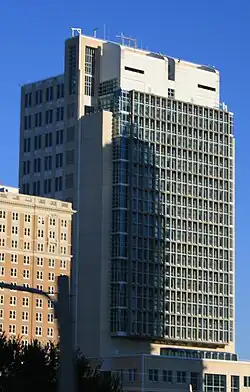
The United States District Court for the Middle District of Florida (in case citations, M.D. Fla.) is a federal court in the Eleventh Circuit (except for patent claims and claims against the U.S. government under the Tucker Act, which are appealed to the Federal Circuit).
The District was established on July 30, 1962, with parts of the Northern and Southern Districts transferring into the newly created Middle District.[1]
As of February 18, 2025, the acting United States attorney for the District is Sara C. Sweeney.[2]
Organization of the court
The United States District Court for the Middle District of Florida is one of three federal judicial districts in Florida.[3] Court for the District is held at Fort Myers, Jacksonville, Ocala, Orlando, and Tampa.
^From 1962-1966, Judge Young was jointly appointed to the Middle, Northern, and Southern Districts of Florida.
Chief judges
Chief judges have administrative responsibilities with respect to their district court. Unlike the Supreme Court, where one justice is specifically nominated to be chief, the office of chief judge rotates among the district court judges. To be chief, a judge must have been in active service on the court for at least one year, be under the age of 65, and have not previously served as chief judge.
A vacancy is filled by the judge highest in seniority among the group of qualified judges. The chief judge serves for a term of seven years, or until age 70, whichever occurs first. The age restrictions are waived if no members of the court would otherwise be qualified for the position.
When the office was created in 1948, the chief judge was the longest-serving judge who had not elected to retire, on what has since 1958 been known as senior status, or declined to serve as chief judge. After August 6, 1959, judges could not become or remain chief after turning 70 years old. The current rules have been in operation since October 1, 1982.
Succession of seats
Seat 1
Reassigned from Southern District on July 30, 1962 by 76 Stat. 247
Simpson
1962–1966
Krentzman, Jr.
1967–1982
Sharp
1983–2000
Antoon II
2000–2013
Mendoza
2014–present
Seat 2
Reassigned from Southern District on July 30, 1962 by 76 Stat. 247
Lieb
1962–1971
Hodges
1971–1999
Whittemore
2000–2017
Barber
2019–present
Seat 3
Reassigned from Southern District on July 30, 1962 by 76 Stat. 247
McRae, Jr.
1962–1973
Reed, Jr.
1973–1984
Fawsett
1986–2008
Scriven
2008–present
Seat 4
Seat assigned on July 30, 1962 by 76 Stat. 247 (concurrent with Northern and Southern Districts)
Seat reassigned solely to Middle District on September 17, 1966 by 80 Stat. 75
Seat established on October 20, 1978 by 92 Stat. 1629
Castagna
1979–1992
Bucklew
1993–2008
Honeywell
2009–2023
vacant
2023–present
Seat 9
Seat established on October 20, 1978 by 92 Stat. 1629
Moore II
1981–1995
Lazzara
1997–2011
Davis
2013–2023
vacant
2023–present
Seat 10
Seat established on December 1, 1990 by 104 Stat. 5089
Nimmons, Jr.
1991–2003
Covington
2004–2020
Mizelle
2020–present
Seat 11
Seat established on December 1, 1990 by 104 Stat. 5089
Merryday
1992–present
Seat 12
Seat established on November 29, 1999 by 113 Stat. 1501
Steele
2000–2015
Berger
2019–present
Seat 13
Seat established on November 29, 1999 by 113 Stat. 1501
Moody, Jr.
2000–2014
Byron
2014–present
Seat 14
Seat established on November 29, 1999 by 113 Stat. 1501
Presnell
2000–2012
Chappell
2013–present
Seat 15
Seat established on November 29, 1999 by 113 Stat. 1501
Corrigan
2002–2024
vacant
2024–present
Courthouse history
Historic Federal Courthouse in Tampa
Completed in 1908 by architect John Knox Taylor, the historic Federal courthouse in Tampa stands as the only civic building constructed in the eclectic renaissance style.[5] Initially serving as a U.S. Post Office, the courthouse moved two blocks down to its current location in 1998.[6] Congress named the court in honor of long-time Tampa representative and University of Florida Law alumnus Sam Gibbons; the congressman is largely recognized as the founder of the University of South Florida.[7]