Outline of chocolate
The following outline is provided as an overview of and topical guide to chocolate:
What is chocolate?
- Chocolate – raw or processed food produced from the seed of the tropical Theobroma cacao tree.[1] The seeds of the cacao tree have an intense bitter taste, and must be fermented to improve the flavour. Chocolate is a popular ingredient in confectionery items and candies.
What type of thing is chocolate?
Chocolate is a type of:
- Food – substance to provide nutritional support for the body, ingested by an organism and assimilated by the organism's cells in an effort to produce energy, maintain life, and/or stimulate growth.
- Confectionery – the set of food items that are rich in sugar, any one or type of which is called a confection. Modern usage may include substances rich in artificial sweeteners as well.
- Candy – confection made from a concentrated solution of sugar in water, to which flavourings and colourants are added. Candies come in numerous colours and varieties and have a long history in popular culture.
- Ingredient – substance that forms part of a mixture (in a general sense). For example, in cooking, recipes specify which ingredients are used to prepare a specific dish. Chocolate is often used as an ingredient in dessert items, such as cakes and cookies.
- Confectionery – the set of food items that are rich in sugar, any one or type of which is called a confection. Modern usage may include substances rich in artificial sweeteners as well.
What is chocolate made of?
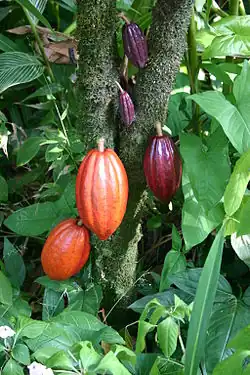
Necessary ingredients
- Cocoa (processed cacao)
- Cacao bean – Fatty seed of Theobroma cacao
- Chocolate liquor, also known as chocolate mass – Pure cocoa mass in solid or semi-solid form
- Cocoa butter – Pale-yellow, edible fat extracted from the cocoa bean
- Cocoa solids – Mixture remaining after cocoa butter is extracted from cocoa beans
- Chocolate liquor, also known as chocolate mass – Pure cocoa mass in solid or semi-solid form
- Cacao bean – Fatty seed of Theobroma cacao
Optional ingredients
- Milk – Nutrient-rich liquid produced by mammals
- Sugar – Sweet-tasting, water-soluble carbohydrates
- Vanilla – Spice extracted from orchids of the genus Vanilla
- Emulsifier – Mixture of two or more immiscible liquids
- Lecithin – Generic term for amphiphilic substances of plant and animal origin
- Polyglycerol polyricinoleate – Emulsion used in food production
Substances found in cacao
- Antioxidants – Compound that inhibits the oxidation of other molecules
- Caffeine – Central nervous system stimulant
- Phenethylamine – psychoactive drug that is usually inactive when orally ingested because most of it is metabolized into phenylacetic acid by monoamine oxidase (MAO), preventing significant concentrations from reaching the brain[2][3]
- Theobromine – also known as xantheose,[4] it contains no bromine[5] and has a similar, but lesser, effect to caffeine
- Theophylline – methylxanthine drug found in tea leaves
Source of cocoa
- Theobroma cacao, also known as Cacao tree – Species of tree grown for its seeds
- Types of cocoa beans
- Child labour in cocoa production – Controversial use of children in the production of cacao beans
- Environmental impact of cocoa production
- By country
- Cocoa production in Ivory Coast
- Cocoa production in Ghana
- Cocoa production in Nigeria
- Cocoa production in São Tomé and Príncipe
- Cocoa production in Sri Lanka
Types

Types of chocolate – Classification of different chocolate types
- Aerated chocolate – Chocolate containing tiny gas bubbles
- Baking chocolate – Chocolate intended for use in baking
- Bittersweet chocolate – Term for dark chocolate used in the United States to indicate the amount of added sugar
- Cioccolato di Modica – Italian specialty chocolate
- Compound chocolate – Combination of cocoa, vegetable fat and sweeteners
- Couverture – Chocolate with more cocoa butter
- Dark chocolate – Chocolate with high cocoa solid content
- Gianduja – Confection made of chocolate and hazelnut
- Milk chocolate – Solid chocolate containing added milk
- Modeling chocolate – Classification of different chocolate types
- Organic chocolate
- Raw chocolate – Chocolate made from unroasted cocoa beans
- Ruby chocolate – Variety of chocolate
- White chocolate – Chocolate made from only cocoa butter
- By country
- Belgian chocolate – Chocolate produced in Belgium
- French chocolate
- Swiss chocolate – Chocolate processed in Switzerland
Production methods
- Broma process – Method of extracting cocoa butter from cocoa beans
- Conching – Process for refining chocolate by stirring at high temperature
- Dutch process cocoa – Cocoa that has been treated with an alkalizing agent
- Enrober – Machine to coat a food item
- Federal Specification for Candy and Chocolate Confections – US standard for products made for use by the federal government
- Sugar crust – Method to prepare liquid filled chocolates
- Tempered chocolate – Technique in chocolate manufacture
Producers and trade organizations
Chocolate industry
- Chocolaterie – Company that manufactures chocolates and sells them directly
- Chocolatier – Someone who makes confectionery from chocolate
- List of chocolatiers
- Cocoa Processing Company Limited – Ghanaian cocoa processing company – a Ghanaian cocoa processing company
- International Cocoa Initiative – Nonprofit organization
- Kuapa Kokoo – Fairtrade-certified cocoa farmers organisation in Ghana – a Ghanaian farmers' cooperative organisation
- Bean-to-bar – Business model in chocolate production
- List of bean-to-bar chocolate manufacturers – Companies which produce chocolate from the beans
Brands
- List of chocolate bar brands – Alphabetical listing of brand names and marketing regions
- Scho-Ka-Kola – German chocolate brand containing coffee and kola nut – a chocolate brand containing coffee and cola nut
Edibles
- Brand names:
- Death by Chocolate – Various desserts that feature chocolate
- Candy – Sweet confection
- Chocolate bar – Confection
- Chocolate-coated marshmallow treats – Marshmallow, usually on a wafer base, coated in chocolate
- Chocolate-coated peanut – Peanuts coated in a shell of chocolate.
- Chocolate-coated raisin – Raisins coated in a shell of milk, dark or white chocolate.
- Cereals
- Cocoa Frosted Flakes – Sugar coated corn flakes with cocoa flavouring
- Cocoa Krispies – Cocoa flavored version of Rice Krispies
- Cocoa Puffs – Breakfast cereal made by General Mills
- Cookie Crisp – Breakfast cereal made by General Mills
- List of breakfast cereals
- Chocolate cake – Baked cake flavored with chocolate
- Chocolate layer cake – Cake made from stacked layers of cake held together by filling
- Black Forest gateau – Chocolate sponge cake with cherries
- Chocolate soufflé cake – Egg-based baked dish
- Devil's food cake – Moist, airy, rich chocolate layer cake
- Ding Dong – Small chocolate cake of hockey puck size
- Flourless chocolate cake – Chocolate custard cake
- Fudge cake – Baked cake flavored with chocolate
- Garash cake – Bulgarian chocolate and walnut cake
- German chocolate cake – Layered chocolate cake named after Samuel German
- Joffre cake – Chocolate buttermilk layer cake
- Molten chocolate cake – Dessert
- Red velvet cake – Red layer cake with icing
- Sachertorte – Chocolate cake
- Wacky cake – Cake made without eggs, butter or milk
- Chocolate layer cake – Cake made from stacked layers of cake held together by filling
- Chocolate pudding – Class of desserts with chocolate flavours
- Chocolate spread – Sweet chocolate-flavored paste
- Chocolate syrup – Chocolate-flavored condiment used as a topping or ingredient
- Chocolates –
- Chocolate money – Gold foil covered chocolates in the shape of coins
- Mint chocolate – Food produced from cacao seeds
- Confectionery – Art of making confections or sweet foods
- Choco pie – Snack cookie with chocolate coating
- Chocolate crackles – Confection in Australia and New Zealand made of puffed rice
- Chocolate truffle – Type of chocolate confectionery
- Rum ball – Truffle-like confection of cookie butter flavored with chocolate and rum
- Cookie – Small, flat and sweetened baked food
- Afghan biscuit – Traditional biscuit in New Zealand
- Black and white cookie – Round cookie with chocolate and vanilla frosting
- Chocolate biscuit – Biscuit flavoured with or covered in chocolate
- Chocolate brownie – Baked chocolate confection
- Chocolate chip – Small chunk of chocolate used as an ingredient
- Chocolate chip cookie – Drop cookie featuring chocolate chips
- List of cookies – List of notable cookie (biscuit) types
- Dessert – Sweet course that concludes a meal
- Chocolate salami – Italian, Portuguese and Romanian chocolate dessert
- Molten chocolate cake – Dessert
- Mousse – Soft creamy prepared food using air bubbles for texture
- Ice cream – Frozen dessert
- Chocolate chip – Small chunk of chocolate used as an ingredient
- Mint chocolate chip – Ice cream flavor
Drinks

- Cafe mocha – A chocolate-flavored variant of a caffè latte
- Chocolate milk – Sweetened chocolate-flavoured milk
- Crème de cacao – A sweet liqueur that tastes like chocolate.
- Hot chocolate – Heated beverage of chocolate in milk or water
- List of chocolate beverages – A list of notable beverages flavoured with chocolate
History
- History of chocolate
- Chocolataire – Social gathering featuring chocolate
Effects on health
- Theobromine poisoning – Overdose reaction to the xanthine alkaloid theobromine
Other articles
- Chocolate agar – Growth medium – named for its colour, does not contain cocoa
- Chocolate fountain – Device for serving chocolate fondue
- Chocolate spread – Sweet chocolate-flavored paste
- Cocoa-free chocolate alternative
- Military chocolate
- United States military chocolate – Standard U.S. military ration item
- Military chocolate (Switzerland) – Chocolate issued in the Swiss military
References
- ^ "Theobroma cacao". Hort.purdue.edu. 9 January 1998. Retrieved 17 April 2013.
- ^ Yang HY, Neff NH (November 1973). "Beta-phenylethylamine: a specific substrate for type B monoamine oxidase of brain". Journal of Pharmacology and Experimental Therapeutics. 187 (2): 365–71. doi:10.1016/S0022-3565(25)29682-3. ISSN 0022-3565. PMID 4748552.
- ^ Suzuki O, Katsumata Y, Oya M (March 1981). "Oxidation of beta-phenylethylamine by both types of monoamine oxidase: examination of enzymes in brain and liver mitochondria of eight species". Journal of Neurochemistry. 36 (3): 1298–301. doi:10.1111/j.1471-4159.1981.tb01734.x. ISSN 0022-3042. PMID 7205271. S2CID 36099388.
- ^ Malisoff, William Marias (1943). Dictionary of Bio-Chemistry and Related Subjects. Philosophical Library. pp. 311, 530, 573. ASIN B0006AQ0NU.
- ^ Bennett, Alan Weinberg; Bonnie K. Bealer (2002). The World of Caffeine: The Science and Culture of the World's Most Popular Drug. Routledge, New York. ISBN 0-415-92723-4.
- ^ "History". Archived from the original on 17 March 2009.
External links
- Chisholm, Hugh, ed. (1911). . Encyclopædia Britannica. Vol. 20 (11th ed.). Cambridge University Press. p. 259.
- The Food of the Gods A Popular Account of Cocoa – Freely downloadable book from Project Gutenberg
| Cocoa bean | |
|---|---|
| Components | |
| Types | |
| Products |
|
| Processes |
|
| Industry |
|
| By country |
|
| Other topics |
|
| |


