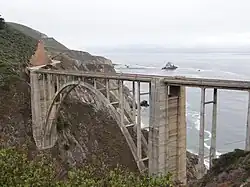
A parabolic arch is an arch in the shape of a parabola.[1] In structures, their curve represents an efficient method of load, and so can be found in bridges and in architecture in a variety of forms.
Unlike a catenary arch, the parabolic arch employs the principle that when weight is uniformly applied above, the internal compression (see line of thrust) resulting from that weight will follow a parabolic curve. Of all arch types, the parabolic arch produces the most thrust at the base. Also, it can span the widest area. It is commonly used in bridge design, where long spans are needed.[2][3]
Compared to catenary arches
When an arch carries a uniformly distributed vertical load, the correct shape is a parabola. When an arch carries only its own weight, the best shape is a catenary.[3]
A catenary, in blue, graphed against a parabola, in red
Parabola (red) graphed against a catenary (blue), view to simulate an arch.
Parabola (red) graphed against a catenary (blue), view to simulate an arch. Zoomed out.
Celler Modernista, Sant Cugat Museum Former main post office, Utrecht
Self-supporting catenary arches appeared occasionally in ancient architecture, for examples in the main arch of the partially ruined Sassanian palace Taq Kasra (now in Iraq), the largest single-span vault of unreinforced brickwork in the world, and the beehive huts of southwestern Ireland. In the modern period, parabolic arches were first used extensively from the 1880s by the Catalan architect Antoni Gaudí,[6] deriving them from catenary arched shapes, constructed of brick or stone, and culminating in the catenary based design of the famous Sagrada Familia. Other Catalan architects then used them into the 1920s, and they appeared occasionally in German expressionist architecture of the 1920s-30s. From the 1940s they gained a new popularity in reinforced concrete, including in shell concrete forms often as hyperbolic parabloids, especially by Felix Candela in Mexico and Oscar Niemeyer in Brazil, but they could be found around the world, especially for churches, in the 1950s and 60s. Since the 1990s Spanish designer Santiago Calatrava has frequently used parabolas for his signature roof structures and bridges. Structures that are self-supporting arches like the Sheffield Winter Garden are often closer to true catenaries.
Palau Güell, 1886–88, Barcelona, where Antoni Gaudí used parabolic arches in stone for the carriageway entrances, and in brick for the structure of the main hall.
Casa Milà, 1906, where Gaudi used brick parabolic arches support the attic roof, used as a laundry space.
Wrocław Market Hall, 1906-8, Richard Plüddemann and Heinrich Küster, internal structure
Celler modernista, 1921, part of Sant Cugat Museum, Catalonia, Spain, Cèsar Martinell i Brunet
St Mary's Star of the Sea Cathedral, 1958–62, Darwin, Australia, architect Ian Ferrier
Toast Rack (building) (originally Domestic Trades College, Manchester Polytechnic) 1960, Fallowfield, Manchester, United Kingdom, city architect, Leonard Cecil Howitt
Bridges have used a variety of arches since ancient times, sometimes in very flat segmental arched forms but rarely in the form of a parabola. A simple hanging rope bridge describes a catenary, but if they were in the form of a suspension bridges they usually describe a parabola in shape, with the roadway hanging from the inverted arch. Modern suspension bridges were built from the early 19th century, beginning with chains and progressing to more and more elegant steel rope examples, and are still in use today. Parabolic arches that support the roadway from below (or in the form of a through arch) first appeared in the 1870s, and have been used occasionally ever since; examples include:
^"Tyne Bridge". BBC Inside Out. 24 September 2014. Retrieved 3 March 2017.
^Style & Vernacular: A Guide to the Architecture of Lane County, Oregon. Western Imprints, The Press of the Oregon Historical Society. 1983. p. 151. ISBN 978-0-87595-085-3.
^The New York Times: parab, accessdate: March 3, 2017
Gimeno Díaz de Atauri, Jorge; Gutiérrez Andrés, Juan (2001), El Puente de la Pólvora y otros puentes, Murcia: Colegio de Ingenieros de Caminos, Canales y Puentes. Demarcación Murcia, ISBN 978-84-607-3209-9

 Parabola (red) graphed against a catenary (blue), view to simulate an arch.
 Parabola (red) graphed against a catenary (blue), view to simulate an arch. Zoomed out.