60°10′55″N 024°54′48.5″E / 60.18194°N 24.913472°E / 60.18194; 24.913472
| Sibelius monument |
|---|
 |
| Artist | Eila Hiltunen |
|---|
| Year | 1967 (1967) |
|---|
| Location | Töölö, Helsinki, Finland |
|---|
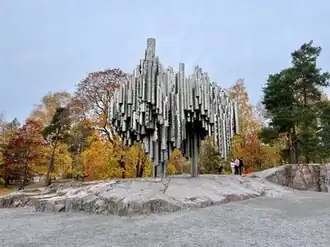
The Sibelius Monument (Finnish: Sibelius-monumentti; Swedish: Sibeliusmonumentet) by Eila Hiltunen is dedicated to the Finnish composer Jean Sibelius (1865–1957). The monument is located in Sibelius Park (Finnish: Sibeliuspuisto; Swedish: Sibeliusparken) in the Töölö district of Helsinki, Finland.
Description
The monument is a sculpture by Finnish artist Eila Hiltunen titled Passio Musicae[1] and was unveiled on 7 September 1967. The sculpture won a competition, organised by the Sibelius Society, following the composer's death in 1957. The competition took two rounds after one early winner was abandoned. Originally it sparked a lively debate about the merits and flaws of abstract art and although the design looked like stylised organ pipes it was known that the composer had created little music for organs. Hiltunen addressed her critics by adding the face of Sibelius which sits beside the main sculpture.[2]
It consists of series of more than 600 hollow steel pipes welded together in a wave-like pattern. The monument weighs 24 tonnes (24 long tons; 26 short tons) and measures 8.5 by 10.5 by 6.5 metres (28 ft × 34 ft × 21 ft). Hiltunen's aim was to capture the essence of the music of Sibelius.
A smaller version of the monument, Homage to Sibelius, is located at the UNESCO headquarters in Paris.[3] A work with a similar concept, also designed by Hiltunen, is located at the grounds of the Headquarters of the United Nations in New York City.[4]
Sibelius Park and Kalevala Monument
In 1939, the Leo and Regina Wainstein Foundation organised a competition for sculptors to design a work that depicted a scene from Finland's national epic The Kalevala, which would be erected in the park. The winner was Aarre Aaltonen (1889–1980) and his work Ilmatar and the Scaup, in bronze, was unveiled in 1946.[5]
Gallery
References
External links
|
|---|
| Buildings | | |
|---|
| Places of worship | |
|---|
Monuments
and memorials |
- Statue of Alexander II
- Aleksis Kivi Memorial
- Statue of Johan Ludvig Runeberg
- Freemason's Grave
- Hietaniemi Cemetery
- Three Smiths Statue
- Equestrian statue of Marshal Mannerheim
- East and West
- Eino Leino Statue
- The Stone of the Empress
- Havis Amanda
- The Lantern Bearers
|
|---|
Parks
and gardens | |
|---|
| Islands | |
|---|
| City squares |
- Eliel Square
- Erottaja
- Hakaniemi Market Square
- Helsinki Railway Square
- Senate Square
- Hietalahdentori
- Market Square
- Tallinnanaukio
- Viiskulma
- Töölöntori
|
|---|
| Streets |
- Aleksanterinkatu
- Bulevardi
- Fredrikinkatu
- Hakaniemenranta
- Hämeentie
- Helsinginkatu
- Hietalahdenranta
- Iso Roobertinkatu
- Kaivokatu
- Keskuskatu
- Korkeavuorenkatu
- Mannerheimintie
- Mikonkatu
- Nordenskiöldinkatu
- Pohjoisranta
- Runeberginkatu
- Sörnäisten rantatie
- Tehtaankatu
- Teollisuuskatu
- Unioninkatu
- Yliopistonkatu
|
|---|
| Tourist attractions | |
|---|
| Hotels |
- Clarion Hotel Helsinki
- Hilton Helsinki Kalastajatorppa
- Hotel Kämp
- Hotel Maria
- Hotel Marski
- Hotel Torni
- Palace Hotel
|
|---|
| Museums | | Art museums |
- Finnish National Gallery
- Amos Rex
- Cygnaeus Gallery
- Didrichsen Art Museum
- Helsinki Art Museum
- Kirpilä Art Collection
- Kunsthalle Helsinki
|
|---|
| Other museums | |
|---|
|
|---|
| Performing arts | | Theatres | |
|---|
| Music venues |
- Helsinki Music Centre
- Finlandia Hall
- Kaivohuone
- Kulttuuritalo
- Tavastia Club
|
|---|
|
|---|
| Other venues |
- Café Ekberg
- Cafe Regatta
- Casino Helsinki
- Helsinki City Library
- Stockmann
- Yrjönkatu Swimming Hall
- Wrede Passage
- Kaapelitehdas
- Teurastamo
- Messukeskus
| Events |
- Christmas Market
- City Marathon
- Helsinki Cup
- Helsinki Festival
- Helsinki Pride
- Samba Carnaval
|
|---|
|
|---|
|
|---|
|
| Symphonies | |
|---|
| Concertante |
- Violin Concerto (1904, rev. 1905)
- Two Serenades (1912–1913)
- Two Serious Melodies (1914–1915)
- Six Humoresques (1917–1918, No. 1 rev. 1940)
- Suite for Violin and String Orchestra (1929)
|
|---|
| Tone poems | |
|---|
| Opera & theatre |
- The Building of the Boat (1893–1894, abandoned)
- The Maiden in the Tower (1896)
- King Christian II (1898)
- Kuolema
- 1903; includes Valse triste
- Pelléas et Mélisande (1905)
- Belshazzar's Feast (1906)
- Swanwhite (1908)
- The Lizard (1909)
- The Language of the Birds (1911)
- Scaramouche (1913)
- Everyman (1916)
- The Tempest (1925)
|
|---|
| Cantatas |
- Cantata for the University Graduation Ceremonies of 1894
- Cantata for the Coronation of Nicholas II (1896)
- Cantata for the University Graduation Ceremonies of 1897
- The Origin of Fire (1902, rev. 1910)
- The Captive Queen (1906)
- My Own Land (1918)
- Song of the Earth (1919)
- Hymn of the Earth (1920)
- Väinämöinen's Song (1926)
|
|---|
| Other voice(s) & orchestra |
- The Rapids-Rider's Brides (1897)
- The Breaking of the Ice on the Oulu River (1899)
- Snöfrid (1900)
- Marjatta (1905, abandoned)
- Impromptu (1902, rev. 1910)
- The Raven (1910, abandoned)
|
|---|
| Other orchestral |
- Overture in E major (1891)
- Ballet Scene (1891)
- Karelia Suite (1893)
- Rakastava (1894, arr. 1912)
- Scènes historiques I (1899, arr. 1911)
- Overture in A minor (1902)
- Romance in C major (1904)
- Cassazione (1904, rev. 1905)
- Pan and Echo (1906)
- In memoriam (1909, rev. 1910)
- Scènes historiques II (1912)
- Suite mignonne (1921)
- Suite champêtre (1922)
- Suite caractéristique (1922)
|
|---|
| String quartets | |
|---|
| Piano trios |
- Piano Trio in A minor, Hafträsk (1886)
- Piano Trio in D major, Korpo (1887)
- Piano Trio in C major, Lovisa (1888)
|
|---|
| Other chamber |
- Water Droplets (c. 1875–1881)
- Pieces for brass septet (1889–1899)
- Piano Quintet (1890)
- Malinconia (1900)
- Violin Sonatina (1915)
|
|---|
| Piano |
- Six Impromptus (1893)
- Piano Sonata (1893)
- Ten Pieces, Op. 24 (1895–1903)
- Kyllikki (1904)
- Three Sonatinas (1912)
- The Bells of Kallio Church (1912, arr. 1912)
- Two Rondinos (1912)
- Five Pieces, The Trees, Op. 75 (1914)
- Five Pieces, The Flowers, Op. 85 (1916–1917)
- Five Esquisses (1929)
|
|---|
| Songs |
- Seven Runeberg Songs, Op. 13 (1891–1892)
- "Serenad", JS 168 (1894–1895)
- Six Songs, Op. 36 (1899–1900)
- Five Songs, Op. 37 (1900–1902)
- Seven Songs, Op. 17 (1891–1904)
- Five Songs, Op. 38 (1903–1904; includes "Höstkväll")
- Six Songs, Op. 50 (1906)
- Two Songs, Op. 35 (1908)
- "Kom nu hit, död", Op. 60/1 (1909, orch. 1957)
- "Arioso", Op. 3 (1911)
- Five Christmas Songs, Op. 1 (1897–1913; includes "Giv mig ej glans, ej guld, ej prakt")
- Six Runeberg Songs, Op. 90 (1917)
|
|---|
| Choral works |
- Hymn, Op. 21 (1896, rev. 1898)
- Songs for Mixed Chorus from the 1897 Promotional Cantata (arr. 1898)
- Finlandia Hymn (1899, arr. 1938–1940)
- Six Partsongs, Op. 18 (1893–1901)
- Song of the Athenians (1899)
- Jäger March (1917)
|
|---|
| Family |
- Ainola (home)
- Aino Sibelius (wife)
- Ruth Snellman (daughter)
- Heidi Blomstedt (daughter)
- Christian Sibelius (brother)
- Aulis Blomstedt (son-in-law)
- Jussi Jalas (son-in-law)
- Jussi Snellman (son-in-law)
- Alexander Järnefelt (father-in-law)
- Elisabeth Järnefelt (mother-in-law)
- Armas Järnefelt (brother-in-law)
- Arvid Järnefelt (brother-in-law)
- Eero Järnefelt (brother-in-law)
- Kasper Järnefelt (brother-in-law)
|
|---|
| Teachers |
- Helsinki Music Institute: Martin Wegelius (theory, composition)
- Mitrofan Vasiliev (violin)
- Hermann Csillag (violin)
- Post-graduate studies: Albert Becker
- Robert Fuchs
- Karl Goldmark
|
|---|
| Pupils | |
|---|
| Colleagues & friends | |
|---|
| Select interpreters | |
|---|
| Select biographers | |
|---|
| Namesakes |
- International Jean Sibelius Violin Competition
- Jean Sibelius Quartet
- Sibelius (2003 film)
- Sibelius (scorewriter)
- Sibelius Academy
- Sibelius Academy Quartet
- Sibelius Glacier
- Sibelius Hall
- Sibelius Medal
- Sibelius Museum
- Sibelius Piano Trio
- Sibelius Society of Finland
- 1405 Sibelius (asteroid)
- Wihuri Sibelius Prize
|
|---|
 Category |
 President Urho Kekkonen and the artist at the unveiling
 Sibelius Park
 World War II Monument in Sibelius Park