State of Law Coalition
State of Law Coalition إئتلاف دولة القانون | |
|---|---|
 | |
| Leader | Nouri al-Maliki |
| Founded | 2009 |
| Ideology | Shia populism[1] Anti-secularism[2] Statism[3][4] Anti-Sunnism[5] |
| Political position | Syncretic[6][7] |
| Religion | Shia Islam |
| National affiliation | National Iraqi Alliance[8] |
| International affiliation | Axis of Resistance[9] |
| Colours | Red |
| Council of Representatives | 38 / 329 |
| Seats in the Governorate Councils | 126 / 440 |
| Governors | 5 / 18 |
| |
The State of Law Coalition (Arabic: إئتلاف دولة القانون I'tilāf Dawlat al-Qānūn), also known as Rule of Law Coalition, is an Iraqi political coalition formed for the 2009 Iraqi governorate elections by the Prime Minister of Iraq at the time, Nouri al-Maliki, of the Islamic Dawa Party.
The name was an emphasis on the improved security situation which Maliki's government had achieved through the Battle of Basra and other operations of the Iraqi Security Forces.
Due to disagreements with the Islamic Supreme Council of Iraq and the Sadrists, the Dawa Party decided not to join the Iraqi National Alliance for the 2010 Iraqi parliamentary election, but run in their own coalition: the State of Law Coalition.
2009 governorate elections
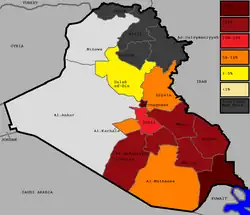
In the 2009 Iraqi governorate elections, the State of Law Coalition was composed of several political blocs:[10]
- Islamic Dawa Party – led by Iraqi Prime Minister Nouri al-Maliki
- Islamic Dawa Party – Iraq Organisation – led by Hashim Al-Mosawy
- Independent Bloc – led by Iraqi Oil Minister Hussain al-Shahristani
- Solidarity Bloc – led by former minister of state and Iraqi MP Qassim Daoud
- Islamic Union of Iraqi Turkoman – led by Iraqi MP Abbas al-Bayati
- Kurdish Feyli Fraternity Movement
- Shaabani Uprising Bloc 1991
- Independents, there were also numerous independent candidates in the list.
Results
The State of Law Coalition came out as the largest list receiving 19.1% of the vote and 126 out of 440 seats.[11][12][13]
| Governorate | Percentage | Seats Won | Total Seats |
|---|---|---|---|
| al-Anbar | - | 0 | 29 |
| Babil | 12.5% | 8 | 30 |
| Baghdad | 38% | 28 | 57 |
| Basra | 37% | 20 | 35 |
| Dhi Qar | 23.1% | 13 | 31 |
| Diyala | 6% | 2 | 29 |
| Karbala | 8.5% | 9 | 27 |
| Maysan | 17.7% | 8 | 27 |
| al-Muthanna | 10.9% | 5 | 26 |
| Najaf | 16.2% | 7 | 28 |
| Ninawa | - | 0 | 37 |
| al-Qadisiyyah | 23.1% | 11 | 28 |
| Salah ad-Din | 3.5% | 2 | 28 |
| Wasit | 15.3% | 13 | 28 |
| Total: | 28.8% | 126 | 440 |
2010 parliamentary election
In the 2010 Iraqi parliamentary election, the following parties were part of the State of Law Coalition:[14]
- Islamic Dawa Party – led by Iraqi Prime Minister Nouri al-Maliki
- Islamic Dawa Party – Iraq Organisation – led by Hashim Al-Mosawy
- Anbar Salvation National Front – led by Sheikh Ali Hatem al-Suleiman
- Independent Arab Movement – led by former Deputy Prime Minister Abid Mutlak al-Jubouri
- United Independent Iraqi Bloc – led by Thaer al-Feyli
- Independent Iraqi Kafaat Gathering – led by government spokesman Ali al-Dabbagh
- The Gathering—Al-Tajamo – led by former Iraqi National List members Mahdi al-Hafez and Safiyah Suheil
- Islamic Union of Iraqi Turkoman – led by Abbas al-Bayati
- "The Independents" led by Iraqi Oil Minister Hussain al-Shahristani
- Independents, there were again numerous independent candidates in the list initially including defence minister Qadir al-Obeidi but he was banned from joining due to Ba'ath party links.
Results
| Governorate | Votes | Seats Won | Total Seats |
|---|---|---|---|
| Anbar | 6,156 | 0 | 14 |
| Babil | 231,939 | 8 | 16 |
| Baghdad | 903,360 | 26 | 68 |
| Basra | 431,217 | 14 | 24 |
| Dhi Qar | 235,446 | 8 | 18 |
| Diyala | 63,969 | 1 | 13 |
| Karbala | 179,517 | 6 | 10 |
| Kirkuk | 11,862 | 0 | 12 |
| Maysan | 102,566 | 4 | 10 |
| Muthanna | 98,998 | 4 | 7 |
| Najaf | 197,377 | 7 | 12 |
| Ninawa | 15,755 | 0 | 31 |
| Qadisiyyah | 133,067 | 4 | 11 |
| Salah ad-Din | 31,026 | 0 | 12 |
| Wasit | 149,828 | 5 | 11 |
| Compensatory seats | - | 2 | 7 |
| Total: | 2,792,083 | 89 | 325 |
2013 governorate elections
In the 2013 Iraqi governorate elections, the State of Law Coalition was composed of several political blocs:[15][16]
- Islamic Dawa Party – led by Iraqi Prime Minister Nouri al-Maliki
- Islamic Dawa Party – Iraq Organisation
- Independent Bloc – led by Iraqi Oil Minister Hussain al-Shahristani
- Badr Organization – led by Hadi Al-Amiri
- National Reform Trend – led by former Iraqi Prime Minister Ibrahim al-Jaafari
- Islamic Virtue Party – led by Abd al-Rahim al-Hasini
- Solidarity Bloc – led by former minister of state and Iraqi MP Qassim Daoud
- Islamic Union of Iraqi Turkoman – led by Iraqi MP Abbas al-Bayati
- White Iraqiya Bloc – led by Hassan Alawi
- Kurdish Feyli Fraternity Movement
- Shaabani Uprising Bloc 1991
- Independents, there were also numerous independent candidates in the list.
Electoral history
| Election year | Leader | Votes | % | Seats | +/– |
|---|---|---|---|---|---|
| 2010 | Nouri al-Maliki | 2,792,083 (#2) | 24.22 | 89 / 325 |
New
|
| 2014 | 3,141,835 (#1) | 24.14 | 92 / 328 |
 3 3 | |
| 2018 | 725,108 (#5) | 6.98 | 25 / 329 |
 67 67 | |
| 2021 | 502,188 (#4) | 5.67 | 33 / 329 |
8 |
See also
- List of Islamic political parties
References
- ^ "Populism, Authoritarianism, and National Security in al-Maliki's Iraq". Archived from the original on 2 October 2014. Retrieved 9 June 2015.
- ^ "مزاج الجمهور تغير.. هل تجد الأحزاب الإسلامية العراقية في "العلمانية" طوق نجاة؟". 7 September 2017. Archived from the original on 15 June 2018. Retrieved 15 June 2018.
- ^ "Statism Blinds Journalist to Horrors of the State – LibertyChat.com". Archived from the original on 16 June 2018. Retrieved 16 June 2018.
- ^ "How Statism Drove Iraqis into the Arms of Terrorists". 18 June 2014. Archived from the original on 16 June 2018. Retrieved 16 June 2018.
- ^ "Iran Update, February 13, 2025". Institute for the Study of War. Retrieved 10 May 2025.
- ^ Bhan, Mona (11 September 2013). Counterinsurgency, Democracy, and the Politics of Identity in India: From Warfare to Welfare?. ISBN 9781134509904.
- ^ Marr, Phebe (15 May 2018). The Modern History of Iraq. ISBN 9780429974069.
- ^ "Iraq: Maliki accused of threatening Shi'a alliance break-up". Asharq Al-Awsat. 3 August 2014. Archived from the original on 9 January 2020. Retrieved 20 October 2014.
- ^ "ظهرت الاحجام السياسية. الان بدأت معركة الأغلبية المطلقة. تشكيل الحكومة أم المعارك || قاسم متيرك". Archived from the original on 15 November 2018. Retrieved 15 November 2018.
- ^ "Iraq Politics and Constitution - سياسة العراق و الدستور العراقي". Archived from the original on 19 July 2011. Retrieved 5 February 2010.
- ^ "Final Election Results". Archived from the original on 12 October 2011. Retrieved 19 February 2015.
- ^ "Preliminary Results" (PDF). Archived from the original (PDF) on 26 March 2009. Retrieved 26 March 2009.
- ^ Joel Wing (24 August 2009). "MUSINGS ON IRAQ". Archived from the original on 7 July 2015. Retrieved 9 June 2015.
- ^ "State of Law Coalition". Archived from the original on 18 July 2013. Retrieved 9 February 2010.
- ^ "As the Deadline for Forming Coalitions Expires, Maliki Creates a Shiite Alliance for Iraq's Local Elections in April 2013". Iraq and Gulf Analysis. 21 December 2012. Archived from the original on 30 June 2015. Retrieved 9 June 2015.
- ^ "Archived copy" (PDF). www.ihec-iq.com. Archived from the original (PDF) on 19 January 2022. Retrieved 30 June 2022.
{{cite web}}: CS1 maint: archived copy as title (link)
Political parties in Iraq  | |
|---|---|
| Major political parties |
|
| Minor political parties |
|
| Reserved Christian seats (5) |
|
| Reserved minority seats (3) |
|
| Unrepresented in parliament |
|
| Banned |
|