The following tables show the frequencies assigned to analog broadcast television channels in various regions of the world, along with the ITU letter designator for the transmission system used. The frequencies shown are for the channel limits and for the analog video and audio carriers. The channel itself usually occupies 6, 7 or 8 megahertz of bandwidth depending on the television transmission system in use. For example, North American channel 1 occupies the spectrum from 44 to 50 MHz. See Broadcast television systems for a table of signal characteristics, including bandwidth, by ITU letter designator. Analog television broadcasts have been phased out in most regions, having been replaced by digital television broadcasts.
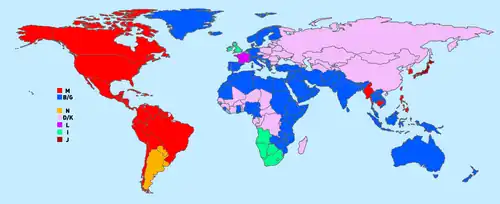
International normalization for analog TV systems
Analog television system by nation
International broadcasting television frequencies are divided in two part of the spectrum; the Very high frequency or "VHF" band and the Ultra high frequency or "UHF" band.
VHF
A plan showing frequency ranges for each television channel used on VHF
Americas (most countries), South Korea, Taiwan, Myanmar, and the Philippines
During World War II, the frequencies originally assigned as channels 13 to 18 were appropriated by the U.S. military, which still uses them to this day. It was also decided to move the allocation for FM radio from the 42-50 MHz band to a larger 88-106 MHz band (later extended to the current 88-108 MHz FM band). This required a reassignment of the VHF channels to the plan currently in use.[1]
FM channel 200, 87.9 MHz, overlaps TV 6. This is used only by K200AA.
TV 6 analog audio can be heard on FM 87.75 on most broadcast radio receivers as well as on a European TV tuned to channel E4A or channel IC, but at lower volume than wideband FM broadcast stations, because of the lower deviation.
Channel 1 audio is the same as European Channel E2 audio and the video is the same as European Channel E2A. Channel 2 video is the same as European Channel E3 video.
VHF high-band (band III)
Channel
Lower edge
ATSC 1 pilot
Video carrier
ISDB-T/Tb center
Audio carrier
Upper edge
7
174
174.31
175.25
177.142857
179.75
180
8
180
180.31
181.25
183.142857
185.75
186
9
186
186.31
187.25
189.142857
191.75
192
10
192
192.31
193.25
195.142857
197.75
198
11
198
198.31
199.25
201.142857
203.75
204
12
204
204.31
205.25
207.142857
209.75
210
13
210
210.31
211.25
213.142857
215.75
216
Japan
The frequency spacing for each channel is 6 MHz as the countries above, except between channels 7 and 8 (which overlap).
Channels 1 through 3 are reallocated for the expansion of the FM band.
Channel A was never used terrestrially. The only System I Band I transmitter on Channel B was RTÉ One from the Maghera, Co. Clare transmitter during 1963–1999. Channel A was initially intended for use at Maghera but Channel B was used instead because of the risk of interference to (overspill) reception of BBC405 line transmissions.[2] It was moved to Channel E due to interference from distant transmitters on channel E3 and Italian channel IA via certain atmospheric conditions and other reasons. Channel C was used by a relay transmitter in Glanmire, Co. Cork.
Channel B video is the same as Italian Channel IA video and Channel C audio is the same as Channel E4 audio.
There are currently no Band I Channels used in Ireland (except on cable TV, and these have mostly been phased out for DOCSIS use) and no plans to resume using them.
Most Irish Cable TV systems do not follow the above channel plan as their analogue (video) carriers are usually at multiples of 8 MHz (i.e. 176, 184, 192 MHz etc. in Band III)
Western Europe; Greenland; and most countries in Asia, Africa, and Oceania
System B 625 lines
Channel
Video carrier (MHz)
DVB-T/T2 (MHz)
Audio carrier (MHz)
E1
41.25
43.5
46.75
E1A
42.25
44.5
47.75
E2
48.25
50.5
53.75
E2A
49.75
52
55.25
E3
55.25
57.5
60.75
E4
62.25
64.5
67.75
E4A
82.25
84.5
87.75
E5
175.25
177.5
180.75
E6
182.25
184.5
187.75
E7
189.25
191.5
194.75
E8
196.25
198.5
201.75
E9
203.25
205.5
208.75
E10
210.25
212.5
215.75
E11
217.25
219.5
222.75
E12
224.25
226.5
229.75
Channels 1 and 1A were used for early experimental broadcasts and are no longer allocated.[3]
Channels 15 and 16 are allocated for use in the African Broadcasting Area only.[4]
Channel 2A was only ever used in Austria for the Sendeturm Jauerling to avoid interferences with neighboring Eastern European TV stations.
Channel 3 in Belgium, RTBF 1 broadcast from the Liège transmitter with 100 kW until the switchover to DVB-T.
Channel 12 was reserved by the military in some countries (like Germany (West Germany only)) so only relay transmitters operated on this frequency.
Channel 4A audio carrier's frequency is very close to US Channel 6 audio carrier and overlaps the FM band in Europe.
France
System E 819 lines (discontinued in 1986)
Channel
Video carrier (MHz)
Audio carrier (MHz)
1
46.00
42.00
2
52.40
41.25
3
56.15
67.30
4
65.55
54.40
5
164.00
175.15
6
173.40
162.25
7
177.15
188.30
8A
185.25
174.10
8
186.55
175.40
9
190.30
201.45
10
199.70
188.55
11
203.45
214.60
12
212.85
201.70
Channel 1 used an earlier 441-line system and was discontinued in 1956.
System L 625 lines
Channel
Video carrier (MHz)
Audio carrier (MHz)
L1
47.75
41.25
L2
55.75
49.25
L3
60.50
54.00
L4
63.75
57.25
L5
176.00
182.50
L6
184.00
190.50
L7
192.00
198.50
L8
200.00
206.50
L9
208.00
214.50
L10
216.00
222.50
French overseas departments and territories and former French African colonies
Channels A through H are indicated in many European TVs as Channels 13–20.
Channels B, C, D, H, H1, and H2 are identical to Channels E4, E4A, E5, E10, E11, and E12, respectively.
Channel A video carrier is the same as Channel E2 audio carrier and thus it used to be common that the audio from a distant TV station on channel E2 received via Sporadic E interferes with Channel A video and vice versa.
Channel C audio carrier's frequency falls into the FM band in Europe, and is also identical to American A6 channel audio.
Eastern Europe, North Korea
Original OIR assignments System D 625 lines
Channel
Video carrier (MHz)
Audio carrier (MHz)
I
41.75
48.25
II
49.75
56.25
III
59.25
65.75
IV
77.25
83.75
1
145.25
151.75
2
153.25
159.75
3
161.25
167.75
4
169.25
175.75
5
177.25
183.75
6
185.25
191.75
7
193.25
199.75
8
201.25
207.75
9
209.25
215.75
Assignments since 1965 System D 625 lines
Channel
Video carrier (MHz)
Audio carrier (MHz)
R1
49.75
56.25
R2
59.25
65.75
R3
77.25
83.75
R4
85.25
91.75
R5
93.25
99.75
R6
175.25
181.75
R7
183.25
189.75
R8
191.25
197.75
R9
199.25
205.75
R10
207.25
213.75
R11
215.25
221.75
R12
223.25
229.75
East Germany (former DDR)
In its very early days DFF made some test transmissions using the D/K standard (6.5 MHz audio) before reverting (around 1957) to System B/G (5.5 MHz audio) but using some unique frequencies.[6]
Channel
Channel limits (MHz)
Vision carrier (MHz)
Main sound carrier (MHz)
Notes
1 (Pre 1957)
41.00–49.00
41.75
48.25
Identical to old OIR Ch I, also overlaps of Australian channel AU0
2 (Pre 1957)
58.50–66.50
59.25
65.75
Identical to old OIR Ch III (Overlaps western channels E3 and E4 and Australian channels AU1 and AU2)
3 (Pre 1957)
99.15–107.15
99.90
106.40
Overlaps part of Western FM radio broadcast band and Australian channels AU4 and AU5
4 (Pre 1957)
144.50–152.50
145.25
151.75
Overlaps 2m Amateur radio band
1 (1957–1960)
58.00–65.00
59.25
64.75
Same video freq as pre-1957 Ch 2 (but 5.5 MHz sound) Overlaps western channels E3 and E4
2 (1957–1960)
144.00–151.00
145.25
150.75
Overlaps 2m Amateur radio band
3 (1957–1960)
154.00–161.00
155.25
160.75
Overlaps Marine VHF radio band
E5
174.00–181.00
175.25
180.75
Identical to western Channel E5, overlaps Australian channel AU6
E6
181.00–188.00
182.25
187.75
Identical to western Channel E6, overlaps Australian channel AU7
E8
195.00–202.00
196.25
201.75
Identical to western Channel E8, overlaps Australian channel AU9
E11
216.00–223.00
217.25
222.75
Identical to western Channel E11, overlaps Australian channel AU11
* Channels 0, 1, 2, 3, 4, 5 and 5A were discontinued with the changeover to digital television.
** With the transition to digital television in 2001, Channels 10 and 11 (209.25 and 216.25 respectively)[8] were moved up by 1 MHz to allow a full 7 MHz separation for a new channel 9A, and Channel 12 was added.
Some existing services were affected, notably AMV11 in the Upper Murray region of Victoria, and VTV-11 in Western Victoria.
New Zealand and Indonesia
System B 625 lines (7 MHz / channel)
Channel
Video carrier (MHz)
Audio carrier (MHz)
G1A
44.25
49.75
G1
45.25
50.75
G2
55.25
60.75
G3
62.25
67.75
G4
175.25
180.75
G5
182.25
187.75
G6
189.25
194.75
G7
196.25
201.75
G8
203.25
208.75
G9
210.25
215.75
G10
217.25
222.75
G11
224.25
229.75
VHF analog TV ceased in New Zealand on 1 December 2013.
Channels 10 and 11 weren't added until the late 1980s.
VHF analog TV channel 1A is only used in Indonesia.
VHF is currently no longer used for television in Indonesia (except in some regions until 2022) and only UHF is used for both analog and digital television, as in the UK.
Angola, Botswana, Lesotho, and South Africa
System I 625 lines
Channel
Video carrier (MHz)
Audio carrier (MHz)
Remarks
1
43.25
49.25
Never used terrestrially
2
52.25
58.25
Never used terrestrially
3
60.25
66.25
Never used terrestrially
4
175.25
181.25
Identical to Irish Channel D
5
183.25
189.25
Identical to Irish Channel E
6
191.25
197.25
Identical to Irish Channel F
7
199.25
205.25
Identical to Irish Channel G
8
207.25
213.25
Identical to Irish Channel H
9
215.25
221.25
Identical to Irish Channel I
10
223.25
229.25
Identical to Irish Channel J
11
231.25
237.25
12
239.25
245.25
Never used terrestrially
13
247.25
253.25
China
Old assignments[9] (1958-1969)[10] System D 625 lines
Americas (most countries), South Korea, Taiwan, Burma (Myanmar) and the Philippines
For frequencies used in the Americas (most countries), South Korea, Taiwan and the Philippines, refer to Pan-American television frequencies.
Notes
The frequencies used by UHF channels 70 through 83 were reallocated to the Land Mobile Radio System (Public Safety and Trunked Radio) and mobile phones in a CCIR worldwide convention in 1982, and thus were never used for digital TV but are highlighted in cyan and listed here for theoretical use.
In certain metropolitan areas of the United States, Channels 14 through 20 have been allocated to Land Mobile Radio (LMR) use.[12]
Channels 52 through 69 in the United States have been reallocated now that conversion to digital TV was completed on June 12, 2009. These channels are highlighted in yellow. Channels 70 through 83 in the United States and Canada were re-allocated to AMPS cellular phone use in 1983.
On August 22, 2011, the United States' Federal Communications Commission announced a freeze on all future applications for broadcast stations requesting to use channel 51,[13] to prevent adjacent-channel interference to the A-Block of the 700 MHz band. Later that year (on December 16, 2011), Industry Canada and the CRTC followed suit in placing a moratorium on future television stations using Channel 51 for broadcast use, to prevent adjacent-channel interference to the A-Block of the 700 MHz band.[14]
Not all countries listed use ATSC, which has a single VSBcarrier wave. Other countries use COFDM modulation for DVB-T (Taiwan, Colombia, Panama) or ISDB-Tb (Philippines and Latin America), which has dozens of carriers within the channel. Burma (Myanmar) uses DVB-T2 on 8 MHz channel spacing on Western Europe / Asia DTV frequency along with Southeast Asian countries (except Philippines).[15]
ISDB-Tb frequency DTV channel 14 uses 473.142857 MHz, but ATSC 3.0, DVB-T/DVB-T2, and DTMB, use 473.0 MHz.
Due to the FCC repack in the United States, all TV stations that had been broadcasting from channels 38 to 51 were required to move on or below channel 36 by July 3, 2020. As a result, channels 38-51 are highlighted in magenta.[16] These frequencies would later be used by U.S. mobile carriers like T-Mobile on Band 71.[17]
System M 525 lines (most countries in the Americas and Caribbean, South Korea, Burma (Myanmar) Taiwan and the Philippines) System N 625 lines (Argentina, Paraguay and Uruguay)
Frequency spacing for each channel in Japan is the same as in the countries listed above, but the channel numbers are 1 lower than in those countries; for example, channel 13 in Japan is on the same frequency as channel 14 in North and South America (most countries), South Korea, Taiwan, and the Philippines.
Channels 13-62 are used for analog and digital TV broadcasting.
System J 525 lines
Ch
Video (MHz)
Audio (MHz)
ISDB-T center
13
471.25
475.75
473.142857
14
477.25
481.75
479.142857
15
483.25
487.75
485.142857
16
489.25
493.75
491.142857
17
495.25
499.75
497.142857
18
501.25
505.75
503.142857
19
507.25
511.75
509.142857
20
513.25
517.75
515.142857
21
519.25
523.75
521.142857
22
525.25
529.75
527.142857
23
531.25
535.75
533.142857
24
537.25
541.75
539.142857
25
543.25
547.75
545.142857
26
549.25
553.75
551.142857
27
555.25
559.75
557.142857
28
561.25
565.75
563.142857
29
567.25
571.75
569.142857
30
573.25
577.75
575.142857
31
579.25
583.75
581.142857
32
585.25
589.75
587.142857
33
591.25
595.75
593.142857
34
597.25
601.75
599.142857
35
603.25
607.75
605.142857
36
609.25
613.75
611.142857
37
615.25
619.75
617.142857
38
621.25
625.75
623.142857
39
627.25
631.75
629.142857
40
633.25
637.75
635.142857
41
639.25
643.75
641.142857
42
645.25
649.75
647.142857
43
651.25
655.75
653.142857
44
657.25
661.75
659.142857
45
663.25
667.75
665.142857
46
669.25
673.75
671.142857
47
675.25
679.75
677.142857
48
681.25
685.75
683.142857
49
687.25
691.75
689.142857
50
693.25
697.75
695.142857
51
699.25
703.75
701.142857
52
705.25
709.75
707.142857
53
711.25
715.75
713.142857
54
717.25
721.75
719.142857
55
723.25
727.75
725.142857
56
729.25
733.75
731.142857
57
735.25
739.75
737.142857
58
741.25
745.75
743.142857
59
747.25
751.75
749.142857
60
753.25
757.75
755.142857
61
759.25
763.75
761.142857
62
765.25
769.75
767.142857
United Kingdom, Ireland, Hong Kong, Macau, Falkland Islands and Southern Africa
System I 625 lines
Channel
Video carrier (MHz)
Audio carrier (MHz)
21
471.25
477.25
22
479.25
485.25
23
487.25
493.25
24
495.25
501.25
25
503.25
509.25
26
511.25
517.25
27
519.25
525.25
28
527.25
533.25
29
535.25
541.25
30
543.25
549.25
31
551.25
557.25
32
559.25
565.25
33
567.25
573.25
34
575.25
581.25
35
583.25
589.25
36
591.25
597.25
37
599.25
605.25
38
607.25
613.25
39
615.25
621.25
40
623.25
629.25
41
631.25
637.25
42
639.25
645.25
43
647.25
653.25
44
655.25
661.25
45
663.25
669.25
46
671.25
677.25
47
679.25
685.25
48
687.25
693.25
49
695.25
701.25
50
703.25
709.25
51
711.25
717.25
52
719.25
725.25
53
727.25
733.25
54
735.25
741.25
55
743.25
749.25
56
751.25
757.25
57
759.25
765.25
58
767.25
773.25
59
775.25
781.25
60
783.25
789.25
61
791.25
797.25
62
799.25
805.25
63
807.25
813.25
64
815.25
821.25
65
823.25
829.25
66
831.25
837.25
67
839.25
845.25
68
847.25
853.25
69
855.25
861.25
Channels 21 to 60 used for DVB-T Digital TV broadcasting in the UK, with the exception of Channel 38, which is used for programme making and special events. Channels 61 to 69 used for 4G LTE.
Channel 69 was not used for TV broadcasting in the UK, it was used by the MOD and until 2012 for programme making and special events.
PAL I was withdrawn from broadcasting use in the UK during 2012 and 2013.
Western Europe, Greenland, most countries in Asia and Africa, and most of Oceania
System G/H 625 lines (8 MHz / channel)
UHF band
Channel
Video carrier (MHz)
Audio carrier (MHz)
21
471.25
476.75
22
479.25
484.75
23
487.25
492.75
24
495.25
500.75
25
503.25
508.75
26
511.25
516.75
27
519.25
524.75
28
527.25
532.75
29
535.25
540.75
30
543.25
548.75
31
551.25
556.75
32
559.25
564.75
33
567.25
572.75
34
575.25
580.75
35
583.25
588.75
36
591.25
596.75
37
599.25
604.75
38
607.25
612.75
39
615.25
620.75
40
623.25
628.75
41
631.25
636.75
42
639.25
644.75
43
647.25
652.75
44
655.25
660.75
45
663.25
668.75
46
671.25
676.75
47
679.25
684.75
48
687.25
692.75
49
695.25
700.75
50
703.25
708.75
51
711.25
716.75
52
719.25
724.75
53
727.25
732.75
54
735.25
740.75
55
743.25
748.75
56
751.25
756.75
57
759.25
764.75
58
767.25
772.75
59
775.25
780.75
60
783.25
788.75
61
791.25
796.75
62
799.25
804.75
63
807.25
812.75
64
815.25
820.75
65
823.25
828.75
66
831.25
836.75
67
839.25
844.75
68
847.25
852.75
69
855.25
860.75
70
863.25
868.75
71
871.25
876.75
72
879.25
884.75
73
887.25
892.75
74
895.25
900.75
75
903.25
908.75
76
911.25
916.75
77
919.25
924.75
78
927.25
932.75
79
935.25
940.75
80
943.25
948.75
81
951.25
956.75
Former channels 14 to 18 renumbered as 21 to 25 in 1961.[18]
Channels 70 to 81 no longer allocated to television. They were only used in Italy.
France, Eastern Europe, Former Soviet Union, French overseas territories and former French colonies in Africa, North Korea, Vietnam
System K 625 lines System L 625 lines
Channel
Video carrier (MHz)
Audio carrier (MHz)
21
471.25
477.75
22
479.25
485.75
23
487.25
493.75
24
495.25
501.75
25
503.25
509.75
26
511.25
517.75
27
519.25
525.75
28
527.25
533.75
29
535.25
541.75
30
543.25
549.75
31
551.25
557.75
32
559.25
565.75
33
567.25
573.75
34
575.25
581.75
35
583.25
589.75
36
591.25
597.75
37
599.25
605.75
38
607.25
613.75
39
615.25
621.75
40
623.25
629.75
41
631.25
637.75
42
639.25
645.75
43
647.25
653.75
44
655.25
661.75
45
663.25
669.75
46
671.25
677.75
47
679.25
685.75
48
687.25
693.75
49
695.25
701.75
50
703.25
709.75
51
711.25
717.75
52
719.25
725.75
53
727.25
733.75
54
735.25
741.75
55
743.25
749.75
56
751.25
757.75
57
759.25
765.75
58
767.25
773.75
59
775.25
781.75
60
783.25
789.75
61
791.25
797.75
62
799.25
805.75
63
807.25
813.75
64
815.25
821.75
65
823.25
829.75
66
831.25
837.75
67
839.25
845.75
68
847.25
853.75
69
855.25
861.75
Some cable television providers in Vietnam may use System G.[19]
DVB-T/DVB-T2/DTMB/ISDB-T Digital television frequencies (Western Europe, Eastern Europe most countries Asia, Africa and Oceania)
Ch
Center frequency
(MHz)
21
474
22
482
23
490
24
498
25
506
26
514
27
522
28
530
29
538
30
546
31
554
32
562
33
570
34
578
35
586
36
594
37
602
38
610
39
618
40
626
41
634
42
642
43
650
44
658
45
666
46
674
47
682
48
690
49
698
50
706
51
714
52
722
53
730
54
738
55
746
56
754
57
762
58
770
59
778
60
786
61
794
62
802
63
810
64
818
65
826
66
834
67
842
68
850
69
858
Australia
System B 625 lines
Channel
Video carrier (MHz)
DVB-T (MHz)
Audio carrier (MHz)
28
527.25
529.5
532.75
29
534.25
536.5
539.75
30
541.25
543.5
546.75
31
548.25
550.5
553.75
32
555.25
557.5
560.75
33
562.25
564.5
567.75
34
569.25
571.5
574.75
35
576.25
578.5
581.75
36
583.25
585.5
588.75
37
590.25
592.5
595.75
38
597.25
599.5
602.75
39
604.25
606.5
609.75
40
611.25
613.5
616.75
41
618.25
620.5
623.75
42
625.25
627.5
630.75
43
632.25
634.5
637.75
44
639.25
641.5
644.75
45
646.25
648.5
651.75
46
653.25
655.5
658.75
47
660.25
662.5
665.75
48
667.25
669.5
672.75
49
674.25
676.5
679.75
50
681.25
683.5
686.75
51
688.25
690.5
693.75
52
695.25
697.5
700.75
53
702.25
704.5
707.75
54
709.25
711.5
714.75
55
716.25
718.5
721.75
56
723.25
725.5
728.75
57
730.25
732.5
735.75
58
737.25
739.5
742.75
59
744.25
746.5
749.75
60
751.25
753.5
756.75
61
758.25
755.5
763.75
62
765.25
767.5
770.75
63
772.25
774.5
777.75
64
779.25
781.5
784.75
65
786.25
788.5
791.75
66
793.25
795.5
798.75
67
800.25
802.5
805.75
68
807.25
809.5
812.75
69
814.25
816.5
819.75
Channels 52–69 had been progressively phased out since the introduction of digital television and rationalisation of the spectrum
Mainland China
Provisional assignments in 1970s[20] System K 625 lines
^ITU, Final Acts of the Regional Administrative Conference for the planning of VHF/UHF Television Broadcasting in the African Broadcasting Area and Neighbouring Countries 1989, ITU, 1990 page 60
^Foreign Broadcast Information Service, Broadcasting Stations of the World (Part IV) 16th Edition 1960, U.S. Government Printing Office, 1960 pages 97-98

 Radio portal


