Timeline of Liverpool
The following is a timeline of the history of the city of Liverpool, England.
Prior to 18th century
| History of England |
|---|
 |
 England portal England portal |
- 1089 – The West Derby Hundred is recorded in the Domesday Book.[1]
- 1150 – Birkenhead Priory, the oldest surviving building on Merseyside and credited with establishing the Mersey Ferry.
- 1207 – 28 August: Liverpool and its market chartered by King John.[2][3][4]
- 1229 – Charter granted by Henry III authorizing a merchants' guild.[4]
- 1237 – Liverpool Castle (1237–1726).[4]
- 1266 – Liverpool passed into the hands of Edmund Crouchback, Earl of Lancaster.[4]
- 1292 – John De More becomes Lord Mayor of Liverpool.
- 1295 – Borough sent two members to the first royal parliament.[4]
- 1298 – Liverpool fair active.[3]
- 1349 – The Black Death plague hits Liverpool.[5]
- 1588 – Borough represented in Parliament by Francis Bacon.[4]
- 1598 – Speke Hall (house) built.
- 1639 – Jeremiah Horrocks, astronomer, is one of the first to observe a Transit of Venus.
- 1662 – Population 775.[6]
- 1644 – Town besieged by forces of Prince Rupert of the Rhine.[7]
- 1674 – Town Hall rebuilt.[6]
- 1684 – Richard Atherton becomes Lord Mayor of Liverpool and secures the surrender of the Liverpool Charter, which was delivered to George Jeffreys, 1st Baron Jeffreys, known as Judge Jeffreys, at Bewsey Old Hall in 1684. The notes on the Liverpool Charters refer to Atherton as the first modern Mayor of Liverpool.
18th century
- 1700
- Liverpool Merchant slave ship begins operating.[8]
- Population: 5,714.[6]
- 1702 – Croxteth Hall (house) built.
- 1704 – Woolton Hall (house) built.
- 1708 – Blue Coat School founded.[6]
- 1715 – opening of the first commercial wet dock Old Dock.[9]
- 1717 – Bluecoat Chambers built.
- 1718 – Blue Coat hospital opens.[4]
- 1720 – Population: 10,446.[10]
- 1722 – Ranelagh Gardens open.
- 1724 – 25 August: Animal painter George Stubbs born.
- 1726
- Liverpool Castle demolished.
- Ye Hole in Ye Wall pub on Hackins Hey opens.[11]
- John Okill ship builder building ships for the Royal Navy between 1740-1780 including the gun boat Hastings.
- 1749 – Royal Infirmary opens.[4]
- 1752 Richard Chaffers pottery manufacturer.
- 1753 – Henry Berry (engineer) opened Salthouse Dock.[7]
- 1754 – Liverpool Town Hall built.[4]
- 1756 – Liverpool Advertiser newspaper begins publication.[12]
- 1758 – Circulating library established.[13]
- 1757 Henry Berry (engineer) open of the Sankey Canal.
- 1766 – City directory published.[14]
- 1770s – Scotland Road laid out.
- 1771
- 1775 - Banastre Tarleton leads the British Legion in the American War of Independence.
- 1776- Robert Morris becomes one of Founding Fathers of the United States.
- 1778/9 – 120 privateers were fitted out in Liverpool, carrying 1986 guns and 8745 men.[4]
- 1779 – Medical Library founded.[6]
- 1784 – Liverpool Musical Festival begins.[15]
- 1785 – Liverpool Georgian Quarter constructed.
- 1785 - Henry Berry (engineer) opens King's Dock, Port of Liverpool
- 1788 – St. Peter's Roman Catholic Church built.
- 1790 - James Maury as the first Consulate of the United States, Liverpool serving the role for 40 years, the first consulate established by the United States.
- Lime Street laid out.
- 1791 – School for the Blind founded.[6]
- 1792 – Holy Trinity Church, Wavertree, consecrated
- 1797 – Liverpool Athenaeum founded.
- 1799 - Edward Smith-Stanley, 14th Earl of Derby was born, three-time Prime Minister of the United Kingdom and the longest serving party leader.
19th century
1800s–1840s
- 1801 – Population: 77,653.[10]
- 1802 – Liverpool Library founded.[16]
- 1803 – Botanical Gardens open.[17]
- 1805 – Extension to Liverpool Town Hall completed providing the main ballroom and council chamber
- 1807
- 185 Liverpool ships were engaged in the slave trade, carrying 49,213 slaves in 1807.[4]
- March – Slave Trade Act in the United Kingdom and Act Prohibiting Importation of Slaves in the United States outlaw the Atlantic slave trade. On 27 July Kitty's Amelia sails on the last legal British slaving voyage.
- Liverpool Cricket Club formed.
- Bibby Line shipping company was formed.
- 1809 – Exchange Buildings constructed.[6]
- 1809 - William Ewart Gladstone Prime Minister of the United Kingdom was born.
_(14598125898).jpg)

- 1810 - the spire of Church of Our Lady and St Nicholas, Liverpool collapsed during morning service killing 25 people including many children from a local orphanage.
- Borough Gaol built.[6]
- Williamson Tunnels started.
- 1815 – Manchester Dock built.
- 1815 - the first steamship Mersey Ferry.
- 1816 – Leeds and Liverpool Canal constructed.[6]
- 1816- Swire is founded with John Samuel Swire taking the reins in 1847.
- 1817 – Liverpool Royal Institution established.[4][18]
- 1819 – SS Savannah completes first steamship transatlantic sailing.
- 1820 - Hannah vessel wrecked located at Hannah Point, Liverpool Beach in Antarctica
- 1822
- Apprentices' Library founded.[6]
- The old St John's Market was designed by John Foster Junior and built.
- 1823 – Marine Humane Society founded.[17]
- 1825 – Liverpool Mechanics' School of Arts[6] and Philomathic Society[12] established.
- 1826
- St James Cemetery laid out.
- Old Dock closed.
- 1827 – Law Society established.[12]
- 1828 – Borough Sessions House built.[6]
- 1829 – Canning Dock opens.[19]
- 1830
- Opening of the Liverpool and Manchester Railway.[6][20][4]
- Crown Street railway station and the first ever train shed opened.
- Wapping Tunnel opened.
- The Liverpool Rubber Company was founded, credited with designing the first rubber-soled sports shoes , attaching canvas as uppers to rubber soles, Theses early shoes , sometimes “ called sand shoes “ are considered by many to be the first sneakers or British trainers.
- Liver Theatre active.[21]
- Opening of the Liverpool and Manchester Railway.[6][20][4]
- 1831 – Population: 165,175.[6]
- 1832 - Kitty Wilkinson public wash house pioneer during the 1826-1837 cholera pandemic.
- Church of St Luke built.
- 1833 – William Fawcett (engineer) of the William Fawcett (paddle steamer) the earliest P&O ship and the SS Royal William credited with the first crossing of the Atlantic Ocean almost entirely under steam power.
- 1835
- City boundaries expand.[4]
- First elected Town Council replaces Common Council.
- 1836
- Literary, Scientific and Commercial Institution[6] and Liverpool Town Borough Police established.
- Liverpool Lime Street railway station opens to the public.
- 1837 – Liverpool Chess Club formed.[22]
- 1838 – Brougham Institute[6] and Polytechnic Society established.[12]
- 1938 - Gustav Christian Schwabe moves to Liverpool financier of Bibby Line, Harland & Wolff and the White Star Line shipping line.
- 1839 - The first British ocean going iron war ship the Nemesis built by John Laird Sons & Company and George Forrester and Company.
- The Grand National was inaugurated at Aintree Racecourse.
- 1840
- 1842
- St. Francis Xavier's College established.[23]
- Robertson Gladstone becomes mayor.
- 1843 – Princes Park laid out.[4]
- 1844
- Canning Half Tide Dock opens.[19]
- Royal Mersey Yacht Club established.
- 1845 - Isambard Kingdom Brunel ship SS Great Britain made its maiden voyage from Liverpool.
- 1845 – Liverpool Observatory built.[12]
- 1846 – Royal Albert Dock opens.[25][4]
- 1848
- Liverpool, Crosby and Southport Railway opened.
- Liverpool Financial Reform Association; Architectural and Archaeological Society;[12][26] and Historic Society of Lancashire and Cheshire formed.[12]
- Cope Bros & Co in business.
- Church of Saint Francis Xavier consecrated.
- 1949 - Gustav Wilhelm Wolff moved to Liverpool at the age of 15 spending most working life in Liverpool co-founding Harland & Wolff ship yard in 1961.
- Philharmonic Hall opens.
- Victoria Tunnel (with largest iron wire rope ever manufactured) and Waterloo Tunnel opened connecting Edge Hill railway station to Liverpool Riverside railway station.
1850s–1890s
- 1850 – Catholic Institute established.[23]
- The Liverpool, New York, and Philadelphia Steamship and Company in business.
- 1851
- Derby Museum opens.
- Balfour Williamson in business.
- 1852
- African Steamship Company in business.
- Liverpool Free Public Library[27] and sailors' home[4] open.
- Hebrews' Educational Institution founded.[12]
- A quarter of the city's population is Irish, a legacy of the Great Irish Famine.
- 1854 – St George's Hall built.[4]
- 1854 - White Star Line RMS Tayleur clipper ship sunk on its maiden voyage from Liverpool killing 370 people.
- 1854 - James Baines launches immigrant ships for Australia including
- Champion of the Seas
- Flying Cloud (clipper)
- James Baines (clipper)
- Lightning (clipper)
- Marco Polo (1851 ship)
- Sovereign of the Seas (clipper)
- 1855
- February: Economic unrest.[17]
- Liverpool Daily Post begins publication.
- 1856 – Lewis's shop in business.
- 1857 – Mersey Docks & Harbour Board established.[28]
- 1859 – Thomas Royden & Sons in business.
- 1860 – William Brown Library and Museum building opens.[27]
- 1860 - Isambard Kingdom Brunel ship SS Great Eastern made its maiden voyage in Liverpool held the title of being the largest ship for forty years.
- 1861 - Old Swan Tramway opened.
- 1862 - William Rathbone VI founded District nursing and established the Queen's Nursing Institute.
- 1863 – Liverpool Amateur Photographic Association founded.[29]
- 1864
- Garston and Liverpool Railway opened.
- Oriel Chambers built.
- 1865 - James Iredell Waddell commander of the Liverpool ship CSS Shenandoah the vessel was surrendered in Liverpool marking the last official surrender of the American Civil War.
- 1866 – Star Music Hall opens.
- 1867 – Alliance Israélite Universelle branch founded.[30]
- 1868
- Elder Dempster and Company in business.
- Newsham Park opens.
- Owen Owen opens his drapery business.
- 1869
- First paternoster lift built in Liverpool.[31]
- West Coast Main Line connecting Liverpool to London bypassing Manchester completed.
- The Conservative local authority builds the first council housing in Europe, St Martin's Cottages (tenement flats) in Ashfield Street, Vauxhall.[32]
- Fowler's Buildings constructed.
- Liverpool Tramways Company opened.[4]
- Royal Liverpool Golf Club was established.
- 1870
- Stanley Park opens.[33]
- Greek Orthodox Church of St Nicholas built.
- Incorporated Society of Liverpool Accountants formed.
- 1871 – North Western Hotel built.
- 1872
- Sefton Park opens.[4]
- Midland Railway Goods Warehouse built.
- 1873
- Liverpool–Manchester lines opened by Cheshire Lines Committee.
- SS Atlantic sailing from Liverpool to New York struck rocks and sank off Nova Scotia killing at least 535 people.
- 1874
- Liverpool Central railway station opens.
- Liverpool Institute High School for Girls established.
- Princes Road Synagogue consecrated.
- ARA Uruguay launched by Laird Brothers.
- 1877 – Walker Art Gallery opens.
- 1878 – Everton football club founded.
- 1879
- Picton Reading Room built.[27]
- Liverpool Echo newspaper begins publication.[34]
- Salvation Army active.[35]
- North Liverpool Extension Line outer rail loop opens.
- 1880
- Liverpool attains city status.
- Aigburth Cricket Ground built.
- 1881 – University College Liverpool chartered.[4]
- Liverpool Central High Level railway station introduced 40 minute journey services to Manchester Central.
- SS Servia, made it’s maiden voyage from Liverpool, she was the first large ocean liner to be built of steal instead of iron, and the first Cunard Line ship to have electric lighting installed.
- 1884
- 1886
- International Exhibition of Navigation, Commerce and Industry.
- Mersey Railway Tunnel opens;[4] Mersey Railway (Birkenhead-Liverpool) begins operating.
- Liverpool and Birkenhead Women's Peace and Arbitration Association organized.[38]
- 1887 – Liverpool Muslim Institute founded.
- Royal Jubilee Exhibition, Liverpool.
- 1888 – Shakespeare Theatre opens.[21]
- 1889 – Liverpool removed from Lancashire as Lancashire County Palatine replaced.
- Florence Institute for Boys established in Dingle.
- 1890
- 1891 - Everton F.C. win the Football League First Division for the first time when Anfield was the home ground for the club.
- 1892
- Goodison Park (athletic field) inaugurated.
- Victoria Building, University of Liverpool constructed.
- Robert Durning Holt becomes mayor.
- Liverpool Football Club formed.
- 1893 – Liverpool Overhead Railway begins operating.
- 1894 - William Ewart Gladstone left office aged 84 as both the oldest person to serve as prime minister and the only prime minister to have served four non-consecutive terms.
- 1895 – City boundaries expand to include West Derby and others.[4]
- 1897 – Gregson Memorial Institute built.[18]
- 1898
- Liverpool School of Tropical Medicine founded.[18]
- White Star Building constructed.
- Liverpool Tramways Company closed.[4]
- 1899 – Liverpool University Press founded.
- 1899–1900 – George's Dock closed and filled in.
- 1900 – Major alternations to Liverpool Town Hall.[4]
20th century
1900s–1940s
- 1901 – Population: 684,958.[4]
- 1901- Sebastian Ziani de Ferranti founded Ferranti the British electrical company built and produced the Ferranti Mark 1 the first electrical commercial computer as well as the Ferranti Pegasus.
- Liverpool F.C. win the Football League First Division, first major honour for the club.
- Stanley Dock Tobacco Warehouse constructed.
- 1902
- City boundaries expand to include Aigburth, Cressington and Grassendale.[4]
- Sefton Park Gazette begins publication.[41]
- 1903 – Worlds first full conversion of steam to electric railway, Mersey Railway.
- 1904 – Foundation stone of the Anglican Cathedral is laid by King Edward VII.[4]
- 1905 - Frank Mason wins the 1905 Grand National on Kirkland owned by Frank Bibby of the Bibby Line.
- 1906 – Liverpool Cotton Exchange Building constructed.
- 1907- Cunard Line ocean liner RMS Mauritania departed’s Liverpool on its maiden voyage, in 1909 Mauritania captured the Blue Riband a transatlantic record that was to stand for more than two decades.
- August: 700th anniversary of city founding.[42]
- Dock Office built.[43]
- Sir William Bowring, 1st Baronet gave Liverpool the first municipal golf course in England in Bowring Park, Merseyside
- 1908
- Meccano Ltd in business.
- Population: 753,203.[4]
- 1909
- June: Catholic-Protestant conflict.[44]
- The world's first Department of Civic Design, which later spawns the town planning movement, is set up at the University of Liverpool.
- 1911
- 1911 Liverpool general transport strike.
- Royal Liver Building constructed.
- Rodewald Concert Society founded.
- 1912 – Lime Street Picture House opens.[45]
- 1912 - Titanic, Sinking of the Titanic Frederick Fleet sights the iceberg, at least 115 crew members with close connections to Liverpool of only 28 Liverpool crew members survived and that figure is understated.
- 1913 – Crane's Music Hall opens.
- 1914 - RMS Empress of Ireland sinks with the crew almost entirely from Merseyside.
- 14 March: Reconstructed Adelphi Hotel is opened by the Midland Railway.[46]
- 30 May: Cunarder RMS Aquitania begins her maiden voyage to New York.
- 27 August: Edward Stanley, 17th Earl of Derby, launches the Liverpool Pals battalions scheme.[47]
- 1915 - RMS Lusitania sinks with captain William Thomas Turner and many of the crew from Liverpool.
- 1916 – 30 July: "Liverpool's blackest day" – 500 men in Liverpool Pals battalions are killed in an attack on Guillemont in the Battle of the Somme[47] (following 200 deaths on the First day on the Somme).
- 1917
- Cunard Building constructed.[18]
- Liverpool Commercial Reference Library opens.[48]
- 1919
- Racial conflict.[49]
- Cunard's luxury liner services moved to Southampton.
- 1922 – African Churches Mission, and African and West Indian Mission organized.[50]
- 1922 - Cammell Laird built the world’s first fully welded ship the SS Fullager.
- 1924–1932 – India Buildings is built.
- 1925 – Empire Theatre opens.
- 1927
- A5058 road Queens Drive ring road completed.
- Woolton Picture House cinema opens.
- 1928 – Everton F.C. win the league title, Dixie Dean scores 60 goals in that season.
- 1930 – Speke Airport, later Liverpool Airport, begins operating.
- 1931 – Population 855,688.[51] This is the peak size of Liverpool's population.
- 1932 – 1932 Summer Olympics gold medal for town planning awarded to John Hughes (architect) for city of Liverpool sports stadium.
- 1933 - Southport and Ainsdale Golf Club hosted the Rider cup.
- 1934
- 18 July: Royal opening of Queensway Tunnel, the A580 road (Liverpool–East Lancashire Road, the UK's first intercity highway) and Walton Hall Park.
- Sir Percy Bates ship owner and chairman of the Cunard-White Star Line oversaw the launch of the Liverpool registered ocean liner the RMS Queen Mary. and the RMS Queen Elizabeth in 1938.
- Paramount Theatre opens.[45]
- 1937 - Dixie Dean plays his last game for Everton F.C. scoring 383 goals in 433 appearance's.
- 1939 – Exchange Flags building completed.
- 1940 – August: Liverpool Blitz: Aerial bombing by German forces begins.
- 1940 - John Lennon was born.
- 1940 - Western Approaches Command Centre for the campaign waged against the German submarine fleet during the Battle of the Atlantic became based at Exchange Flags.
- 1941- Cammell Laird built HMS Ark Royal and HMS Rodney played a major role in the sinking of the German battle ship Bismarck.
- 1942 – January: Liverpool Blitz: Aerial bombing by German forces ends.
- 1942 - Sir Paul McCartney was born.
- 1943 - 1.2 million United States soldiers pass through Liverpool during World War Two- this figure represents a significant proportion of approximate 4.7 million who used the port to prepare for the invasion of Europe.
- 1944 – Merseyside Unity Theatre active.
- 1945 - World War II ends, During the Liverpool Blitz approximately 2736 civilians were killed in Liverpool alone, the total number of deaths across Merseyside was around 4000.
- Liverpool shipowners lost over 3 million tons of shipping, with most losses occurring in the Atlantic Ocean, this equivalent to roughly 630 ships of 5000 tons each, representing about a quarter of all British merchant shipping losses during the war, the Port of Liverpool also handled a massive amount of cargo, over 75 million tons between 1939-1945, with significant portion being war materials.
- 1946 – Liverpool Corporation begins development of Kirkby Industrial Estate on aformer ordnance factory site.
- 1948 – 31 May: Canada Dock Branch railway closed to intermediate passengers.
- 1949 – 19 March: Cameo murder.
1950s–1990s
- 1951 – Ditton dodger train service withdrawn.
- 1952 – City twinned with Cologne, Germany.
- 1953 – Liverpool Muslim Society founded.
- 1955 – Stirling Moss wins the British Grand Prix at Aintree
- 1956 – 30 December: Liverpool Overhead Railway urban rail transit system with fourteen stations last runs amid protest against closure.
- 1957
- 15 January: The Cavern Club opens as a jazz club.
- 6 July: John Lennon and Paul McCartney of The Beatles first meet at a garden fete at St. Peter's Church, Woolton, at which Lennon's skiffle group, The Quarrymen (formed 1956), is playing (and in the graveyard of which an Eleanor Rigby is buried).
- 14 September: Liverpool Corporation Tramways close after the last tram runs in Liverpool, 88 years after the first.
- 1958 – Liverpool Metropolitan Cathedral crypt completed to the design of Edwin Lutyens, but the remainder of his cathedral design is abandoned.
- 1958 - Bill Shankly becomes manager of Liverpool F.C.
- 1960
- January: John Lennon's Liverpool College of Art friend Stu Sutcliffe joins his rock group and suggests they change their name to The Beatles.
- 22 June: Fire in Henderson's department store kills eleven.[52]
- 1961
- 9 February (lunchtime): The Beatles at The Cavern Club: The Beatles perform under this name at The Cavern Club for the first time following their return from Hamburg, George Harrison's first appearance at the venue. On 21 March they play the first of nearly 300 regular performances at the club.
- 6 July: Mersey Beat begins publication.
- 9 November: Future manager Brian Epstein first sees The Beatles at The Cavern Club.
- 1962
- 24 January: Brian Epstein signs a contract to manage The Beatles.
- 16 September: Liverpool and North Wales Steamship Company makes its last sailings.
- 1963 – 3 August: The Beatles perform at The Cavern Club for the final time as they begin a run of chart success.
- 1964
- Everyman Theatre founded.
- 1965 – 1965 Liverpool Vickers Viscount crash.
- 1966 – 24 hours a day, 7 days a week operation and new runway 09/28 suitable for jet aircraft at Liverpool Airport opened by Prince Philip.
- Merseyside Area land use Transportation study (MALTS) project report.
- Liverpool Pullman introduced.
- 1967
- 14 May: Liverpool Metropolitan Cathedral (Roman Catholic) consecrated.
- c. July–August: Liverpool Cotton Exchange Building partially demolished.
- The Mersey Sound anthology of Liverpool poets published.[53]
- 22 November: BBC Radio Merseyside launched.
- HMS Renown (S26) and HMS Revenge (S27) built by Cammell Laird.
- 1968 – 30 January: RMS Franconia makes Cunard Line’s last scheduled voyage from Liverpool.[54]
- Fifteen Guinea Special last mainline passenger steam locomotive service.
- 1969
- Radio City Tower built.
- St. John's Shopping Centre and Clayton Square Shopping Centre in business.
- Merseyside Passenger Transport Executive begins operation.
- Garston extension railway closed.
- HMS Conqueror (S48) built by Cammell Laird.
- 1970
- The last express services to Glasgow ran from Exchange on Sunday 3rd May 1970.
- Harrison Barnard & Co. headquartered in city.
- The Beatles' break up
- 1971
- Ferry service to New Brighton withdrawn.
- Kingsway Tunnel opens.
- 1972
- Albert Dock closed. Seaforth Dock opens near city in the area of Seaforth, Lancashire.
- North Liverpool Extension Line closed after a century's operation and track lifted.
- Waterloo Tunnel/ Victoria Tunnel (Liverpool) (serving Waterloo branch from Edge Hill railway station to Liverpool Riverside railway station) and Wapping Tunnel closed, 123 years after opening.
- Liverpool Central High Level railway station closed.
- Canadian Pacific unit CP Ships are the last transatlantic line to operate from Liverpool.
- 1973 – Prince's Landing Stage at Pier Head demolished.
- 1974
- City becomes a metropolitan borough within the newly created metropolitan county of Merseyside; Merseyside County Council established.
- Post & Echo Building and New Hall Place constructed.
- Al-Rahma Mosque established.
- M57 motorway outer ring road completed and opened.
- Church Street, Liverpool pedestrianised.
- 1976 – M62 motorway junctions 4 to 6 (Tarbock) connecting Leeds and Manchester to Liverpool completed and opened.[55]
- Home and Bargain was founded.
- 1977
- 26 September: Fire at St. John's Shopping Centre.[56]
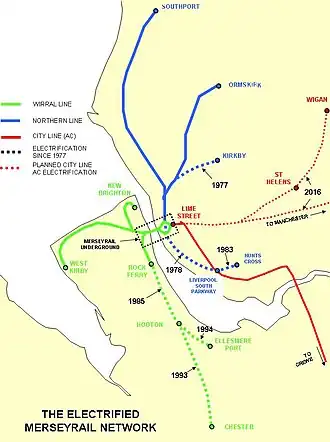
- Merseyrail formed and Liverpool Exchange railway station closed after 127 years and partially turned into a car park. Moorfields railway station opened on new loop Wirral line (3 January 1978) to replace Exchange. Lancashire and Yorkshire Railway branch line severed with buffer at Kirkby ending through trains to Manchester.
- 1978 – 25 October: Construction of the Anglican Liverpool Cathedral is completed after 74 years.
- Garston railway reopened. The Garston line formed the southern portion of Merseyrail's Northern Line.
- Liverpool F.C. win the European Cup becoming the first English club to win back to back European Cup wins after the victory in 1977 and 1978.
- 1979 - Michael Heseltine appointed Minister for Merseyside.
- 1979 – 17/18 December: Fire at St. John's Shopping Centre.[56]
- 1980 – Merseyside Maritime Museum opens in the Albert Dock complex.[57]
- 1980 - MV Derbyshire - Lost during Typhoon Orchard with all 44 hands onboard ( more than a third from the city of Liverpool ) Largest British vessel lost at sea.
- 1981 – July: Toxteth riots.[58] Chancellor Sir Geoffrey Howe circulates a cabinet memo arguing for "managed decline".
- 1982 – Mersey Television formed.
- 1982 - HMS Conqueror (S48) built by Cammell Laird gained notoriety for the sinking of the Argentine cruiser ARA General Belgrano during the Falklands War.
- 1983 – Militant in Liverpool win control of the council.
- 1984 - Liverpool F.C. win the fourth European Cup in eight years and become the first English club to win three major trophies in a single season.
- 1984 – Albert Dock reopened as a leisure attraction. International Garden Festival held.
- 1985
- Militant in Liverpool set illegal council budget.
- May: Liverpool trading floor finally ceases to exist.
- 1986
- Liverpool Airport Southern Terminal opens.
- Silver Blades Ice Rink, Prescot Road closed.
- 1987
- 1988 – Tate Liverpool (modern art museum) opens in the Albert Dock.
- 1989 - Everton Park opened.
- 1989 – 15 April: Hillsborough disaster: 97 Liverpool F.C. supporters are unlawfully killed as the result of a crush at a Sheffield stadium.
- 1991 – Population: 452,450 residents.[60]
- 1992
- Cream (nightclub) begins.
- Africa Oyé music festival begins.
- Liverpool Community College established.
- 1993
- Museum of Liverpool Life opens.
- Liverpool Mathew Street Music Festival begins.[61]
- 1996 – Festival Gardens closes. National Conservation Centre opens.
- 1999 – Liverpool Biennial begins.
21st century
- 2001
- Liverpool Wall of Fame unveiled.
- Liverpool Airport officially renamed after John Lennon.
- 2002 – Liverpool International Tennis Tournament begins.
- 2003 – 4 November: Brookside last broadcast.
- 2004
- Liverpool Maritime Mercantile City registered as a World Heritage Site with UNESCO.
- Liverpool Culture Company formed.
- Homotopia (festival) begins.
- 2006
- Liverpool Urban Area established.[62]
- Liverpool Science Park established.
- Royal Standard art gallery established on Mann St.[63]
- Liverpool South Parkway railway station opened.
- 2007
- Liverpool Cruise Terminal opens.
- International Slavery Museum opens.
- West Tower built.
- Liverpool Shakespeare Festival begins.
- 2008
- City designated a European Capital of Culture.
- Echo Arena Liverpool, BT Convention Centre and Liverpool One open.
- One Park West and Alexandra Tower built.
- A.F.C. Liverpool formed in response to the transfer of ownership of Liverpool F.C..
- 2010 – National Oceanography Centre established.
- 2011 – Museum of Liverpool opens on the waterfront.
- 2012- Prime Minister David Cameron apologise for the cover-up and misinformation to those effected by Britains biggest sporting disaster in 1989 Hillsborough disaster.
- 2013
- 19 December: Liverpool Post last published.
- Cunard Line resume cruising from Liverpool with Queen Mary 2, the largest ocean liner ever built.
- 2014
- Liverpool City Region Combined Authority established including Liverpool, Halton, Knowsley, St Helens, Sefton and Wirral.
- Liverpool TV launched.[64]
- 2015 – City of Liverpool F.C. formed.
- 2016 – Liverpool2 container shipping port opened at Seaforth.
- Great Howard Street bridge was demolished.
- 2017
- 8 May: Metro Mayor of the Liverpool City Region established including Liverpool, Halton, Knowsley, St Helens, Sefton and Wirral. Steve Rotheram is the first person elected to the office.[65]
- Royal Institute of British Architects’ National Architecture Centre opened.
- 2018 - Cammell Laird launched RRS Sir David Attenborough.
- 2019
- First black Lord Mayor of Liverpool, Anna Rothery, appointed.[66]
- Liverpool F.C. win the Champions League for the sixth time.
- 2020
- 23 March: Liverpool goes onto a nationwide lockdown with the rest of the UK due to the COVID-19 pandemic.
- 25 June: Liverpool F.C. win the 2019–20 Premier League, their first victory of the Premier League era.
- 31 July: Woolton Picturehouse announces its closure.[67]
- 6 October: VOI e-scooter-sharing system launched in Liverpool.[68]
- 14 October: COVID-19 pandemic in the United Kingdom: Liverpool moves to the Tier 3 (very high) level of restriction.[69]
- 6 November: First UK covid mass testing piloted in Liverpool.[70]
- 2021
- 30 April: COVID-19 pandemic in the United Kingdom: Liverpool is the venue for a trial indoor music event.[71]
- 6 May: Joanne Anderson is elected city Mayor of Liverpool, the first directly elected black woman mayor of a major British city.[72]
- 21 July: Liverpool Maritime Mercantile City delisted as a World Heritage Site with UNESCO.[73]
- 2022
- 25 March: Yoko Ono Lennon Centre opened by Sean Lennon.
- 12 August: Liverpool shortlisted to host Eurovision 2023.[74]
- 7 October: Liverpool selected to host Eurovision 2023.[75]
- 2023
- 26 April: Visit by King Charles III.
- May: Mayor of Liverpool abolished
- 13 May: Liverpool hosts Eurovision Song Contest 2023.
- 2024
- 17 April: Radio City rebranded Hits Radio Liverpool.
- 14 June: Taylor Swift performs to sold out Anfield Stadium for 3 night residency on first UK dates in her The Eras Tour.
See also
References
- ^ "liverpool domesday book". historyofliverpool.com. Archived from the original on 22 December 2015.
- ^ "King John & Liverpool 1207 Charter – Medieval Liverpool History".
- ^ a b Samantha Letters (2005), "Lancashire", Gazetteer of Markets and Fairs in England and Wales to 1516, Institute of Historical Research, Centre for Metropolitan History
- ^ a b c d e f g h i j k l m n o p q r s t u v w x y z aa ab ac Irvine, William Fergusson (1911). . In Chisholm, Hugh (ed.). Encyclopædia Britannica. Vol. 16 (11th ed.). Cambridge University Press. pp. 804–809.
- ^ "Liverpool and the Black Death Plague. Read the horror of what happened".
- ^ a b c d e f g h i j k l m n o p q r Edwin Butterworth (1841). "Liverpool". Statistical Sketch of the County Palatine of Lancaster. London: Longman & Co.
- ^ a b c "Annals of Liverpool", The Stranger in Liverpool: or, An historical and descriptive view of the town of Liverpool and its environs (10th ed.), Liverpool: Thomas Kaye, 1833, hdl:2027/wu.89032309627
- ^ "Liverpool Slave Trade." International Encyclopedia of the Social Sciences. Ed. William A. Darity, Jr. 2nd ed. Vol. 4. Detroit: Macmillan Reference USA, 2008. 468–469. Gale Virtual Reference Library. Web. 1 Oct. 2013
- ^ "A History of Liverpool". Local Histories. 14 March 2021.
- ^ a b David Brewster, ed. (1832). "Liverpool". Edinburgh Encyclopædia. Philadelphia: Joseph and Edward Parker. hdl:2027/mdp.39015068380875.
- ^ Bona, Emilia (8 October 2017). "You might be surprised at when this Liverpool pub started letting women in". liverpoolecho.
- ^ a b c d e f g h Edward Baines (1870). John Harland (ed.). History of the County Palatine and Duchy of Lancaster. Vol. 2. London: Routledge.
- ^ "Circulating Libraries", All the Year Round, no. 282, 26 May 1894
- ^ A. V. Williams (1913). Development and Growth of City Directories. Cincinnati, USA.
{{cite book}}: CS1 maint: location missing publisher (link) - ^ a b Claude Egerton Lowe (1896). "Chronological Summary of the Chief Events in the History of Music". Chronological Cyclopædia of Musicians and Musical Events. London: Weekes & Co.
- ^ Catalogue of the Liverpool Library, at the Lyceum. Printed by James Smith. 1814.
- ^ a b c George Henry Townsend (1867), "Liverpool", A Manual of Dates (2nd ed.), London: Frederick Warne & Co.
- ^ a b c d University Library. "Collection Descriptions". Special Collections & Archives. University of Liverpool. Retrieved 1 September 2013.
- ^ a b William Farrer, J. Brownbill, ed. (1911), "Liverpool: the Docks", A History of the County of Lancaster, vol. 4, retrieved 2 September 2013
- ^ William Toone (1835). Chronological Historian. Vol. 2 (2nd ed.). London: J. Dowding.
- ^ a b R.J. Broadbent (1908), Annals of the Liverpool Stage, Liverpool: E. Howell, OL 13499031M
- ^ Liverpool Chess Club: a Short Sketch of the Club, 1893
- ^ a b c Michael E. Sadler (1904), Report on Secondary Education in Liverpool, London
{{citation}}: CS1 maint: location missing publisher (link) - ^ "Cunard Steam-Ship Company", New York Times, 25 July 1880
- ^ Edward Baines (1893). "Liverpool Parish". In John Harland (ed.). History of the County Palatine and Duchy of Lancaster. Vol. 5.
- ^ "About the LAS". Liverpool Architectural Society. Archived from the original on 27 September 2013. Retrieved 1 September 2013.
- ^ a b c Cowell, Peter (1903). Liverpool Public Libraries: a History of Fifty years. Liverpool: Free Public Library. OCLC 4319003. OL 7062709M.
- ^ Jarvis, Adrian (1994). "The Port of Liverpool and the shipowners in the late 19th century". The Great Circle. 16. Australian Association for Maritime History. JSTOR 41562879.
- ^ "Photographic Societies of the British Isles and Colonies", International Annual of Anthony's Photographic Bulletin, New York: E. & H. T. Anthony & Company, 1891
- ^ "History of the Liverpool Jewish Community", Jewish World, London, August 1877
- ^ "The Paternoster: A Requiem". Granta. 5 May 2020.
- ^ "Municipal Housing in Liverpool before 1914: the 'first council houses in Europe'". Municipal Dreams. 8 October 2013. Retrieved 28 August 2017.
- ^ Grimsditch, Lee (30 September 2022). "Lost Stanley Park pool that disappeared without trace". Liverpool Echo. Retrieved 14 July 2023.
- ^ "Liverpool", Willing's Press Guide, London: James Willing, Jr., 1904
- ^ Norman H. Murdoch (1992). "Salvation Army Disturbances in Liverpool, England, 1879–1887". Journal of Social History. 25 (3): 575–593. doi:10.1353/jsh/25.3.575. JSTOR 3789029.
- ^ "Anfield: Timeline of Liverpool's famous home". The Independent. 15 October 2012. Archived from the original on 7 May 2022. Retrieved 1 September 2013.
- ^ "Liverpool and Merseyside remembered". Anthony Hogan. Archived from the original on 7 January 2015. Retrieved 15 July 2017.
- ^ Sandi E. Cooper (1991). "Peace Societies". Patriotic Pacifism: Waging War on War in Europe, 1815–1914. Oxford University Press. ISBN 978-0-19-536343-2.
- ^ Emma Latham (2000). "The Liverpool Boys' Association and the Liverpool Union of Youth Clubs: Youth Organizations and Gender, 1940–70". Journal of Contemporary History. 35 (3): 423–437. doi:10.1177/002200940003500306. JSTOR 261029. S2CID 145511369.
- ^ James Lord Bowes (1894), Handbook to the Bowes Museum of Japanese Art-Work, Streatlam Towers, Liverpool, OCLC 27521645, OL 20455863M
- ^ "Liverpool (England) Newspapers". Main Catalogue. British Library. Retrieved 1 September 2013.
- ^ Liverpool's 700th Anniversary Celebrations: Words and Music, 1907
- ^ De Figueiredo, Peter (2003). "Symbols of Empire: The Buildings of the Liverpool Waterfront". Architectural History. 46: 229–254. doi:10.2307/1568808. JSTOR 1568808.
- ^ Coslett, Paul (2009). "The Belfast of England". Liverpool: History. BBC. Retrieved 1 September 2013.
- ^ a b "Movie Theaters in Liverpool". CinemaTreasures.org. Los Angeles: Cinema Treasures LLC. Retrieved 1 September 2013.
- ^ "The New Adelphi Hotel". Liverpool Echo. 13 March 1914. p. 6.
- ^ a b Doyle, Peter (2014). The First World War in 100 Objects. Stroud: The History Press. ISBN 978-0-7524-8811-0.
- ^ Handbook to the Commercial Reference Library, Liverpool, 1920, OL 7136550M
{{citation}}: CS1 maint: location missing publisher (link) - ^ Zack-Williams, Alfred B. (1997). "African Diaspora Conditioning: The Case of Liverpool". Journal of Black Studies. 27 (4): 528–542. doi:10.1177/002193479702700405. JSTOR 2784729. S2CID 143618099.
- ^ Wilson, Carlton E. (1992). "Racism and Private Assistance: The Support of West Indian and African Missions in Liverpool, England, during the Interwar Years". African Studies Review. 35 (2): 55–76. doi:10.2307/524870. JSTOR 524870. S2CID 143732965.
- ^ The Population of Liverpool Exemplified (PDF) (1st ed.), Liverpool John Moores University, 2010
- ^ "Henderson's department store fire, Liverpool". Fire Brigades Union. Retrieved 14 January 2021.
- ^ Gascoigne, Bamber. "Timelines: Liverpool". History World. Retrieved 1 October 2013.
- ^ "Queen Mary 2 to run first Cunard Liverpool sailings in 45 years". Cruise Liverpool. 1 March 2013.
- ^ Philbin, Paul (26 February 2017). "Why does the M62 start at junction 5?". liverpoolecho.
- ^ a b "St. John's Market, Liverpool". Delta 64. Retrieved 16 September 2020.
- ^ Couch, Chris; Farr, Sarah-Jane (2000). "Museums, Galleries, Tourism and Regeneration: Some Experiences from Liverpool". Built Environment. 26 (2): 152–163. JSTOR 23288855.
- ^ "1945 to present". British History Timeline. BBC. Retrieved 12 September 2013.
- ^ Houghton, Alistair (28 January 2018). "Lost landmarks – more Liverpool buildings you wish were still here". liverpoolecho.
- ^ "Census Information Index". City of Liverpool Internet. City of Liverpool. Archived from the original on 11 February 1998. Retrieved 1 September 2013.
- ^ "Mathew Street Festival axed and replaced by new Liverpool International Music Festival". Liverpool Echo. 19 February 2013.
- ^ "Liverpool South Parkway opens". www.bbc.co.uk. Retrieved 14 July 2023.
- ^ "United Kingdom". Art Spaces Directory. New York: New Museum. Archived from the original on 4 March 2016. Retrieved 1 September 2013.
- ^ "Bay TV wins Liverpool local TV licence". Digital Spy. 21 February 2013.
- ^ "Liverpool 'metro mayor' results: Labour's Steve Rotheram elected". BBC News. 5 May 2017.
- ^ "Liverpool: First black mayor succeeds race row councillor". BBC News. 13 August 2019.
- ^ Flaherty, Jess (31 July 2020). "'Devastated' Woolton Picture House to close after 93 years". Liverpool Echo.
- ^ "New way to get around the city centre as e-scooters launch". 6 October 2020.
- ^ Woodcock, Andrew (12 October 2020). "Coronavirus: Liverpool and rest of Merseyside to enter 'very high' tier of lockdown system". The Independent. London. Archived from the original on 7 May 2022. Retrieved 12 October 2020.
- ^ "Liverpool to pioneer UK's first attempt at mass Covid testing". TheGuardian.com. 2 November 2020.
- ^ Butterworth, Benjamin (30 April 2021). "3,000 party at Liverpool club for UK's 'first dance' in major Covid test event". i. Retrieved 1 May 2021.
- ^ Wolfe-Robinson, Maya (7 May 2021). "Liverpool chooses UK's first directly elected black female mayor". The Guardian. London. Retrieved 8 May 2021.
- ^ "Liverpool stripped of Unesco World Heritage status". BBC News. 21 July 2021. Retrieved 21 July 2021.
- ^ "Eurovision 2023: Seven UK cities make shortlist to host song contest". BBC News. 12 August 2022.
- ^ "Liverpool to host Eurovision song contest on behalf of Ukraine | Liverpool | the Guardian". TheGuardian.com.
Further reading
Published in the 18th century
- Liverpool Directory, for the Year 1766. Liverpool: Printed by W. Nevett and Co. for J. Gore.
- William Enfield (1774), An essay towards the history of Leverpool (2nd ed.), London: J. Johnson, OL 23379980M
- W. Bailey (1781). "Liverpool Directory". Bailey's Northern Directory. Warrington: Printed by William Ashton.
- William Moss (1796). Liverpool Guide. Liverpool: Crane and Jones.
- James Wallace (1796), A general and descriptive history of the ancient and present state, of the town of Liverpool, Liverpool: J. McCreery, OL 7197095M
Published in the 19th century
1800s–1840s
- "Liverpool", Kearsley's Traveller's Entertaining Guide through Great Britain, London: George Kearsley, 1803
- John Britton (1807), "Liverpool", Beauties of England and Wales, vol. 9, London: Vernor, Hood & Sharpe, hdl:2027/mdp.39015063565736
- Picture of Liverpool; or, Stranger's Guide (2nd ed.), Liverpool: Printed by Jones and Wright, and sold by Woodward and Alderson, 1808, OL 25319603M
- John Corry (1810), The history of Liverpool, from the earliest authenticated period down to the present time, Liverpool: William Robinson
- "Liverpool". Commercial Directory for 1818-19-20. Manchester: James Pigot. 1818.
- Robert Watt (1824). "Liverpool". Bibliotheca Britannica. Vol. 4. Edinburgh: A. Constable. hdl:2027/mdp.39076005081505. OCLC 961753.
- Henry Smithers (1825), Liverpool, its Commerce, Statistics, and Institutions, Liverpool: Printed by T. Kaye, OCLC 4587553, OL 6920334M
- "Liverpool". Pigot & Co.'s National Commercial Directory for 1828-9. London: James Pigot. 1828.
- "Liverpool", Cities and Principal Towns of the World, Cabinet Cyclopaedia, London: Longman, Rees, Orme, Brown, & Green, 1830, OCLC 2665202
- Stephen Reynolds Clarke (1830), "Liverpool", New Lancashire Gazetteer, London: H. Teesdale and Co., OCLC 6704104
- Gore's Directory and View of Liverpool (PDF). Liverpool: J. and J. Mawdsley. 1834.
- "Liverpool". Cornish's Grand Junction, and the Liverpool and Manchester Railway Companion. Birmingham: J. Cornish. 1837. hdl:2027/wu.89097042907. LCCN n87-896539.
- Picture of Liverpool. Liverpool: T. Taylor. 1837.
- Francis Coghlan (1838). "Liverpool". Iron Road Book and Railway Companion from London to Birmingham, Manchester, and Liverpool. London: A.H. Baily & Co. hdl:2027/wu.89089014146.
- Arthur Freeling (1838), "Liverpool Guide", Freeling's Grand Junction Railway Companion to Liverpool, Manchester, and Birmingham, H. Lacey, LCCN n86-16929
- "Liverpool", Osborne's Guide to the Grand Junction, Or Birmingham, Liverpool, and Manchester Railway, Birmingham: E.C. & W. Osborne, 1838
- "Liverpool", Leigh's New Pocket Road-Book of England and Wales (7th ed.), London: Leigh and Son, 1839
- Liverpool as It Is. 1840.
- Alexander Brown (1843), Smith's Strangers' Guide to Liverpool, Liverpool: Benjamin Smith, OL 23369337M
- John Thomson (1845), "Liverpool", New Universal Gazetteer and Geographical Dictionary, London: H.G. Bohn
- "Liverpool". Slater's National Commercial Directory of Ireland; including ... English Towns of Manchester, Liverpool, Birmingham, West Bromwich, Leeds, Sheffield and Bristol, and in Scotland, those of Glasgow and Paisley. Manchester: I. Slater. 1846. hdl:2027/njp.32101045358296.
- Samuel Lewis (1848), "Liverpool", Topographical Dictionary of England (7th ed.), London: S. Lewis and Co.
1850s–1890s
- Thomas Baines (1852). History of the Commerce and Town of Liverpool. London: Longman, Brown, Green, and Longmans.
- "Liverpool", Black's Picturesque Tourist and Road-book of England and Wales (3rd ed.), Edinburgh: Adam and Charles Black, 1853
- Richard Brooke (1853), Liverpool as it was during the last quarter of the eighteenth century. 1775 to 1800, Liverpool: J. Mawdsley and Son, OCLC 4612147, OL 6928908M
- Thomas Baines (1859), Liverpool in 1859, London: Longman, OL 25464729M
- George Measom (1859), "Liverpool", Official Illustrated Guide to the North-Western Railway, London: W.H. Smith and Son
- Recollections of old Liverpool, Liverpool: J. F. Hughes, 1863, OL 25319604M
- A. Green & Co.'s Directory for Liverpool and Birkenhead, 1870
- James Stonehouse (c. 1870). Streets of Liverpool. Liverpool: E. Howell.
- Black's Guide to Liverpool, Edinburgh: Adam and Charles Black, 1871
- "Liverpool Section". Commercial Directory and Shippers' Guide (3rd ed.). Liverpool: R.E. Fulton & Co. 1871.
- James Picton (1875), Memorials of Liverpool, London: Longmans, Green, OL 7022210M
- "Liverpool", Official Guide and Album of the Cunard Steamship Company, S. Sharpe, 1877
- John Parker Anderson (1881), "Lancashire: Liverpool", Book of British Topography: a Classified Catalogue of the Topographical Works in the Library of the British Museum Relating to Great Britain and Ireland, London: W. Satchell
- Lewis's Handy Guide to Liverpool and Neighbourhood. Liverpool: Lewis's. 1884.
- Liverpool a few years since (3rd ed.), Liverpool: A. Holden, 1885, OL 7239798M
- City of Liverpool: Municipal archives and records, from A. D. 1700 to the passing of the municipal reform act, 1835, Liverpool: G. G. Walmsley, 1886, OL 14000568M
- Frederick Dolman (1895), "Liverpool", Municipalities at Work: the Municipal Policy of Six Great Towns and its Influence on their Social Welfare, London: Methuen & Co., OCLC 8429493
Published in the 20th century
1900s–1940s
- Ramsay Muir (1907), A History of Liverpool (2nd ed.), London: Pub. for the University Press of Liverpool by Williams & Norgate, OL 24434716M
- George T. Shaw; Isabella Shaw, eds. (1907). Liverpool's First Directory. A Reprint of the Names and Addresses from Gore's Directory for 1766. Liverpool: Henry Young & Sons.
- Robert Donald, ed. (1907). "Liverpool". Municipal Year Book of the United Kingdom for 1907. London: Edward Lloyd.
- William Dean Howells (1909), "A Modest Liking for Liverpool", Seven English Cities, New York: Harper & Brothers
- "Liverpool", Great Britain, Baedeker's Great Britain (7th ed.), Leipzig: Karl Baedeker, 1910, hdl:2027/mdp.39015010546516
- Benjamin Vincent (1910), "Liverpool", Haydn's Dictionary of Dates (25th ed.), London: Ward, Lock & Co.
- Irvine, William Fergusson (1911). . Encyclopædia Britannica. Vol. 16 (11th ed.). pp. 804–809.
- William Farrer; J. Brownbill, eds. (1911). "History of the County of Lancaster". Victoria County History. University of London, Institute of Historical Research. (includes Liverpool)
1950s–1990s
- Richard Hawes (1998). "Municipal Regulation of Smoke Pollution in Liverpool, 1853–1866". Environment and History. 4 (1): 75–90. doi:10.3197/096734098779555718. JSTOR 20723060.
Published in the 21st century
- Richard Lawton (2002). "Components of demographic change in a rapidly growing port-city: the case of Liverpool in the nineteenth century". In Richard Lawton and W. Robert Lee (ed.). Population and Society in Western European Port Cities, c.1650–1939. Liverpool University Press. ISBN 978-0-85323-435-7.
- John Belchem (2007). Irish, Catholic and Scouse: The History of the Liverpool-Irish, 1800–1939. Liverpool: Liverpool University Press.
External links

Wikimedia Commons has media related to History of Liverpool.
- "Liverpool". Port Cities UK. UK: New Opportunities Fund. Archived from the original on 15 April 2012.
- Caryl Williams. "History Timeline". Old Liverpool. UK. Archived from the original on 9 January 2010.
- "Lancashire", Historical Directories, UK: University of Leicester, archived from the original on 5 July 2013, retrieved 5 September 2013. Includes digitized directories of Liverpool, various dates
- Digital Public Library of America. Works related to Liverpool, various dates
- "(Liverpool)". Discovering Britain: Walks: North West England. Royal Geographical Society. c. 2013.
|  | |