Timeline of the American Revolution
| Part of a series on the |
| American Revolution |
|---|
%252C_by_John_Trumbull.jpg) |
|
 United States portal United States portal |
Timeline of the American Revolution—timeline of the political upheaval culminating in the 18th century in which Thirteen Colonies in North America joined together for independence from the British Empire, and after victory in the Revolutionary War combined to form the United States of America. The American Revolution includes political, social, and military aspects. The revolutionary era is generally considered to have begun with the passage of the Stamp Act in 1765 and ended with the ratification of the United States Bill of Rights in 1791. The military phase of the revolution, the American Revolutionary War, lasted from 1775 to 1783, but the land war effectively ended with the British surrender at Yorktown, Virginia October 19, 1781. Britain continued the international conflict after Yorktown, fighting naval engagements with France and Spain until the signing of the Peace Treaty of Paris in 1783.
- List of military leaders in the American Revolutionary War
- List of American Revolutionary War battles in chronological order, with location, outcome
1600-1649
1603
- Elizabeth I of England, last Tudor monarch dies (March 24)
- James VI of Scotland succeeds to the throne of England as James I, ruling both. Authored previously The True Law of Free Monarchies, asserting the idea of absolutism and the divine right of kings.
1605
- Gunpowder Plot unsuccessful Catholic plot to kill James VI/I by blowing up the English House of Parliament (November 5)
1606

- Virginia Company established as a corporation to colonize the east coast of North America.
1607

- Jamestown founded (14 May) as the first permanent English settlement in North America by the Virginia Company
1619
- House of Burgesses established, the first representative legislature in the Americas, meeting in Jamestown, Virginia, (July 19)
- First enslaved Africans arrive in Virginia, August
1620

- Mayflower Compact Nov. 21, 1620, founding document of the Plymouth Colony of Pilgrims, signed aboard the ship Mayflower
- Plymouth Colony established as a self-governing settlement of religious refugees; Pilgrims elect William Bradford governor
- James I asserts sovereignty over the Caribbean island of Nevis.
1623
- St. Kitts colonized by the English.
1624
- Virginia becomes a royal colony
1625
- Barbados claimed for James I of England.
1629
- The Cambridge Agreement (August 26, 1629)
1630
- John Winthrop leads Puritan settlers to Massachusetts Bay.
1632

- Maryland founded as a proprietary colony with a charter from Charles I to Lord Baltimore as a refuge for English Catholics.
- Island of Antigua settled by colonists from St. Kitts.
1635
- Roger Williams banished from Massachusetts, founds Rhode Island colony
1636
- Harvard College, Cambridge, Massachusetts founded; oldest institution of higher education in America; Founding Fathers alumni John Adams and his cousin Samuel Adams
- Thomas Hooker departs Massachusetts and helps found the Connecticut colony
1641
- Grand Remonstrance, list of grievances presented to King Charles I of England by the English Long Parliament on 1 December 1641, a key event, precipitating the English Civil War 1642-49.
1642
- English Civil War breaks out, bloody conflict between Royalists supporting Charles I of England and Roundheads supporting Parliament.
1643
- New England Confederation of colonies established during the English Civil War; primary purpose was to unite the Puritan colonies in support of the Congregational church, and for mutual defense against the Native Americans and the Dutch colony of New Netherland; first cooperative effort of English colonies.
1649-1660


.svg.png)
- Trial of Charles I for treason by an ad hoc High Court, found guilty, and publicly executed by beheading. Oliver Cromwell is among those signing the death warrant. 30 January. Charles claimed the court had no jurisdiction to try him, asserting he ruled by divine right. The trial and execution of Charles I remain pivotal events that challenged the traditional ideas of monarchy. Patrick Henry references Charles I's fate in his "Give me liberty or give me death" speech.
- Commonwealth of England, Scotland, and Ireland, republic established 19 May 1649 by Parliament, lasting until 1660, when the monarchy is restored. It was England's first and only republic.
- Maryland Toleration Act 1649, established religious toleration for all Christians, including Catholics. The colony was founded as a refuge for Catholics and protections continued during the Commonwealth.
- Board of Trade established 1650
- Act prohibiting trade with Barbados, Virginia, Bermuda, and Antigua for recognizing Charles II as ruler rather than Parliament. (October 30)
- Navigation Act of 1651, 1652
- Cromwell reforms the navy, increasing the number of ships, promoting officers on merit rather than family connections, and cracking down on embezzlement by suppliers and dockyard staff, thereby positioning England to mount a global challenge to Dutch mercantile dominance.
- First Anglo-Dutch War 1652-53. The Commonwealth challenges the Dutch Republic, seeking to weaken it as a commercial power and carrier of goods.
- Instrument of Government, first written constitution for England, Scotland, Ireland and overseas possessions adopted 15 December 1653. Power was formally split.
- Executive power was held by the Lord Protector. The post was elective, not hereditary, but appointment was to be held for life.
- Legislation was raised in Parliament. These had to be called triennially, with each sitting for at least five months.
- Provision for a standing army was made "of 10,000 horse and dragoons, and 20,000 foot, in England, Scotland and Ireland, for the defense and security thereof" and "a convenient number of ships for guarding of the seas" (XXVII).
- Permanent intolerance of Roman Catholicism.
- First Families of Virginia arrive 1647-60. Major migration of royalists fleeing the Commonwealth of England. Virginia comes to be known as the "Old Dominion" for its loyalty to the crown.
- Battle of the Severn, Maryland, a Puritan force fighting under a Commonwealth flag defeated a Royalist force fighting for Lord Baltimore 25 March 1655
- Jews allowed to resettle in England 1655; banned since 1290.
- Capture of Jamaica from Spain after England's failure to take Hispaniola. May 1655. Jamaica becomes Britain's richest possession, producing sugar with black slave labor.
- Jews allowed to settle in Newport, Rhode Island, a major center of colonial trade. 1658.
- Death of Oliver Cromwell 1658, succession of his ill-prepared son Richard Cromwell as Lord Protector
- Resignation of Richard Cromwell 1659.
1660-1688
1660
.jpg)
- Restoration of the Stuart monarchy, Charles II returns from European exile
- Declaration of Breda (4 April 1660) Charles promises a general pardon for crimes committed during the English Civil War and the Interregnum for all those who recognized Charles as the lawful king; religious toleration; and the payment of arrears to members of the army, and that the army would be recommissioned into service under the crown.
- Royal authority returns to the colonies
1663
- Carolina proprietors receive a royal charter for Carolina colony
1664
- English seize Dutch colony of New Netherland, renaming it New York
- Charles II grants New York to his brother James, Duke of York as proprietor. He subdivides it and creates New Jersey.
1676-77
- Bacon's Rebellion of English frontiersmen Virginia against the royal governor William Berkeley for his failure to drive Native Americans from Virginia
1683
- The Lords of Trade issue quo warranto writs for the charters of several North American colonies, including Massachusetts (June 3)
1684
- Revocation of the Massachusetts Charter by Charles II (June 18)
1685

- Charles II dies with no legitimate offspring; succeeded by his younger brother, James II.
1686
- Disestablishment of the New England Confederation
- Royal Charter arrives in Boston establishing the Dominion of New England in America (May 14), centralizing the administration of formerly separate crown colonies in New England and the Middle colonies during the reign of James II of England
1688

- Ouster of Catholic James II of England as monarch by Protestant royals William IIIJames's nephew and Mary II, James II's daughter, becoming joint monarchs after the Glorious Revolution but with power held by Parliament
1689-1700
1689
- 1689 Boston revolt, Leaders of the former Massachusetts Bay Colony reclaim control of the government. In other colonies, members of governments displaced return to power (April 18)
- Leisler's Rebellion in New York, breaking territory away from the Dominion of New England, ending in 1691.
- Protestant Revolution (Maryland), also known as Coode's rebellion, overthrew the Catholic proprietary government.
1690
- Massachusetts Bay Colony the first to issue paper money, with other colonies following.
1691
- William III and Mary II approve the charter formally establishing the Province of Massachusetts Bay (October 7)
1693
- College of William & Mary founded in Williamsburg, Virginia. Second institution of higher education in the colonies. Founding Fathers Thomas Jefferson and James Monroe attended.
1700–1765
1701
- Yale College, New Haven, Connecticut founded. American Revolutionary War hero alumnus Nathan Hale.
1702
- Queen Anne's War prompts German migration to American colonies.
1706

- Benjamin Franklin born in Boston (January 17), oldest of the Founding Fathers
1722
- Samuel Adams born in Massachusetts (September 27)
1732

- Georgia Colony royal charter granted to James Oglethorpe by George II of Great Britain, to be a buffer zone between the Carolinas as Spanish Florida
- George Washington born in Virginia (February 22)

1733
- Molasses Act passed by Parliament, affecting the colonial molasses trade
1735
- John Adams born in Massachusetts (October 30)
1737
- George II of Great Britain succeeds to the throne.
1739
- Stono Rebellion, South Carolina slave insurrection, largest in the colonial era.
1740
- Negro Act of 1740 passed by the South Carolina Assembly in the wake of the Stono Rebellion
- Plantation Act 1740 by Parliament defined the conditions under which Christian aliens could become naturalized subjects of the British crown.
.jpg)
1743
- Thomas Jefferson born in Virginia, (April 13)
1746
- College of New Jersey, (now Princeton University). Founding Fathers alumni James Madison, Aaron Burr, Benjamin Rush
1747
- Ohio Company of Virginia formed, land speculation company
1748
- Lord Halifax appointed head of the British Board of Trade, the only royal office dealing solely with the American colonies; attempts to end previous royal policy of salutary neglect of colonial affairs, allowing much local autonomy and loose oversight of royal officials. Implementation of a new, unitary and restrictive approach to royal control largely a failure, but renewed in 1763, after the Seven Years' War, called in colonial America the French and Indian War[1]
1751

- James Madison born in Virginia (March 16).
1754

- French and Indian War (1754–1763), a nine-year conflict, the North American portion of the global conflict of the Seven Years' War; colonial militias play a role; Virginia planter, Col. George Washington makes a name for himself as a military leader
- Albany Congress, the first time in the 18th century that American colonial representatives meet to discuss some manner of formal union; attempts to gain Iroquois support (June 18–July 11)
- King's College founded New York City; Founding Fathers alumni Alexander Hamilton, John Jay, Robert R. Livingston, Gouverneur Morris, Hercules Mulligan
1755
- College of Philadelphia later named University of Pennsylvania founded by Benjamin Franklin, who remained a trustee until his death.
1757

- Prime Minister William Pitt commits to all-out effort in the Seven Years' War, incurring massive debt for the royal treasury
- Alexander Hamilton born British Caribbean island of Nevis (January 11)
1759-60

- British Army defeats French Army in New France
- Quebec, capital of New France falls to the British
- Montreal falls to the British
- Pierre de Rigaud, Governor of New France, capitulates to Field Marshal Jeffrey Amherst. This ends most fighting in North America between France and Great Britain in the French and Indian War. Amherst becomes the first British Governor-General of territories that would later become Canada plus lands (Ohio Country and Illinois Country) west of the American Colonies (September 8
1760
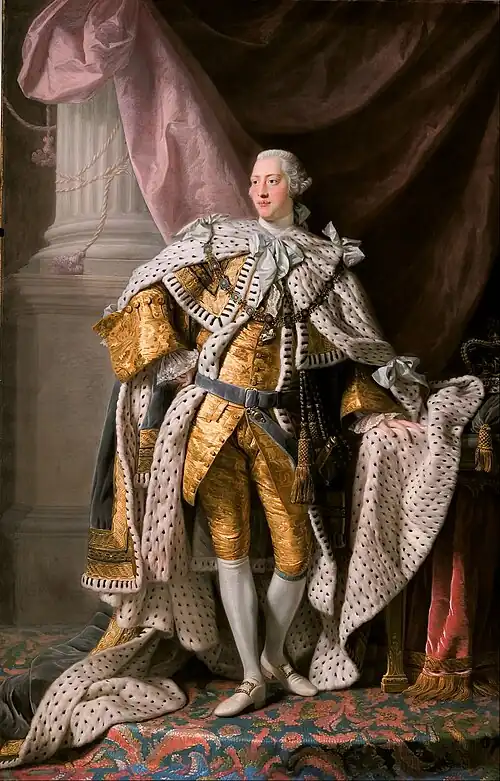
- King George II of Great Britain dies and is succeeded by his grandson George III (October 25)
1763
- The Treaty of Paris (February 10) ends the Seven Years' War (1756–1763), called in North America the French and Indian War (1754–1763). France cedes most of its territories in North America to Great Britain, but Louisiana west of the Mississippi River is ceded to Spain. France also recognized the sovereignty of Britain over the islands of Dominica, Grenada, Saint Vincent and the Grenadines, and Tobago. George III is dissatisfied with the terms of the treaty, which he deems favorable to the losing powers France and Spain rather than the winner, Great Britain.
- George Grenville becomes Prime Minister (April 16) - a hardliner, who implemented policies to make the colonies contribute to paying off the massive debt from the Seven Years' War and assert Parliament's authority over the colonies.


- Pontiac's War is launched by a Native American confederation in the Great Lakes region under the overall command of the eponymous Ottawa chief. Previously allied with France, they were dissatisfied by the policies of the British under Amherst (April 25, 1763 – July 25, 1766)
- Royal Proclamation of 1763 establishes royal control in territories newly ceded by France, land to which some English colonies claim. To prevent further violence between White settlers and Native Americans, the Proclamation sets a western boundary on the American colonies (October 7). American colonies view this as a limitation on their previous rights to continue expansion westward that encroached on Native American territory.
- Navigation Acts re-enforced by George Grenville as a part of his attempt to reassert unified economic control over the British Empire following the Seven Years' War
1764
- Sugar Act also known as uthe American Duties Act (April 5), intended to raise revenues, and the Currency Act (September 1), prohibiting the colonies from issuing paper money, are passed by Parliament. These Acts, coming during the economic slump that followed the French and Indian War, required that colonists contribute to paying off the war debt and lead to colonial protests.
1765–1774
1765

- Bankruptcy of Boston private banker and military contractor Nathaniel Wheelwright, who fled to Guadaloupe, leaving £170,000 in unpaid debts resulting in financial disaster for Boston's economy.[2]
%252C_The_Bostonians_Paying_the_Excise-man%252C_or_Tarring_and_Feathering_(1774)_-_02.jpg)
- Stamp Act enacted by Parliament (March 22) to impose control and help defray the cost of keeping troops in America to control the colonists, imposing a tax on many types of printed materials used in the colonies. Seen as a violation of rights, the Act sparks violent demonstrations in several Colonies. In May, Virginia's House of Burgesses Patrick Henry sponsors the Virginia Resolves claiming that, under British law, Virginians could be taxed only by an assembly to which they had elected representatives
- Quartering Act (March 24), act of Parliament requiring the Colonies to provide housing, food, and other provisions to British troops. The act is resisted or circumvented in most of the colonies. In 1767 and again in 1769, Parliament suspended the governor and legislature of New York for failure to comply

- Virginia Resolves (May 29) passed by the House of Burgesses, mainly authored by Patrick Henry, defends colonial rights against Parliament's action; widely disseminated in the colonies.
- Sons of Liberty created in Boston with Samuel Adams prominent
- Stamp Act Congress, gathering of delegates from 9 colonies which adopts (October 19) a Declaration of Rights and Grievances and petitions Parliament and the king to repeal the Act
1766

- William Pitt, 1st Earl of Chatham becomes Prime Minister (July 31), serving until 1768.
- Stamp Act repealed by Parliament; Declaratory Act simultaneously issued asserting Parliament's "full power and authority to make laws and statutes ... to bind the colonies and people of America ... in all cases whatsoever"; designed to overrule actions by the legislative assemblies of each colony, which had traditionally held authority (March 18)
- Liberty pole erected in New York City commons in celebration of the Stamp Act repeal (May 21). An intermittent skirmish with the British garrison over the removal of this and other poles, and their replacement by the Sons of Liberty, rages until the Province of New York is under the control of the revolutionary New York Provincial Congress in 1775
1767

- Townshend Acts - renewed Parliament assertion of its right to tax the American colonies after the repeal of the Stamp Act, placing duties on many items imported into America, including tea (June 29). The American colonists, who were denied any representation in Parliament, strongly condemned the Acts as an egregious abuse of power.
- Letters from a Farmer in Pennsylvania by John Dickinson responds to the Townshend Acts
1768

- Massachusetts Circular Letter (February) by Samuel Adams asserts the Townshend Acts are unconstitutional. British Secretary of State for the Colonies orders colonial governors to stop their own assemblies from endorsing the letter; he also orders the governor of Massachusetts to dissolve the General Court if the colonial assembly does not revoke the letter. By month's end, the assemblies of New Hampshire, Connecticut and New Jersey have endorsed the letter.
_(cropped).jpg)
- Liberty Riot (June 10) Mob violence in Boston attacking customs officials seizing the ship Liberty of John Hancock for smuggling. British send a warship armed with 50 cannons to occupy Boston harbor to impose order.

- Royal governor of Massachusetts dissolves the assembly (July) after the legislature defies his order to revoke Samuel Adams's circular letter. In August, in Boston and New York, merchants agree to boycott most British goods until the Townshend Acts are repealed. In September, at a town meeting in Boston, residents are urged to arm themselves. Later in September, more British warships sail into Boston Harbor; two regiments of British regular infantry land in Boston and set up permanent military occupation.
- France sends military officer Johann de Kalb on a covert mission to assess American resistance to the British; he later becomes a general in the Continental Army, dies in combat
1769
- To the Betrayed Inhabitants of the City and Colony of New York broadside published anonymously by local Son of Liberty Alexander McDougall (December 16)
- Hancock’s confiscated ship was refitted in Rhode Island to serve as a Royal Navy ship, renamed HMS Liberty, and then used to patrol off Rhode Island for customs violations. On 19 July 1769, the crew of Liberty under Captain William Reid accosted Joseph Packwood, a New London captain, and seized and towed two Connecticut ships into Newport. In retribution, Packwood and a mob of Rhode Islanders confronted Reid, then boarded, scuttled, and later burned the ship on the north end of Goat Island in Newport harbor as one of the first overt American acts of defiance against the British Crown.
1770

- Golden Hill incident in New York involving the Sons of Liberty; British troops wound civilians, including one death (January 19)
- Lord North becomes Prime Minister of Great Britain (January 28), serving until 1782, essentially the entire span of the war
- Shooting of Christopher Seider (February 22)
- Boston Massacre (March 5), a small number of British soldiers harassed by a crowd of 300-400 Bostonians fired upon the civilians, killing 5
1771
- Battle of Alamance in North Carolina (May 16)
1772
- Samuel Adams organizes the Committees of Correspondence
- Pine Tree Riot (April 13–14), New Hampshire colonists' resistance to royal regulations on the cutting of pine trees
- The Watauga Association in what would become Tennessee declares itself independent (May)
- Gaspee Affair (June 9)
1773

- James Rivington's New-York Gazetteer begins publication (April 22)
- Tea Act passed by Parliament, requiring the colonies to buy tea solely from the East India Company rather than a variety of sources now deemed illegal (May 10)
- Association of the Sons of Liberty in New York published by local Sons of Liberty (December 15)
- Colonists in all major ports refuse to allow tea to be landed
- Boston Tea Party (December 16)
1774
- Benjamin Franklin, Massachusetts' agent in London, is ridiculed before Parliament (January 29)[3]
- Lord Dunmore's War (May–October)
- General Thomas Gage appointed military governor of Massachusetts (May 13), replacing civilian governor Thomas Hutchinson
- British Parliament passes Intolerable Acts, including:

- Boston Port Act (March 31) - closing the port
- Administration of Justice Act (May 20)
- Massachusetts Government Act (May 20)
- A second Quartering Act (June 2)
- Quebec Act (June 22) set the terms for the governance of territory won from France in the French and Indian War; continuation of French civil law and governmental, and toleration of Catholicism; the territorial boundaries extended through the Ohio Valley, which Virginia, Pennsylvania, and Connecticut colonies expected to develop themselves.

- Powder Alarm, General Gage's secret raid on the Cambridge powder magazine (September 1)
- First Continental Congress, (September 5 – October 26); 12 colonies send delegates; major actions:
- Joseph Galloway's Plan of Union debated September 1774, calling for the creation of a Grand Council for the American colonies, with each having representation and hold and exercise power within the British Empire; rejected by the Continental Congress.[4]
- Declaration and Resolves of the First Continental Congress, also known as Declaration of Rights (October 14)[5]
- Continental Association created (October 20)[6]
- Petition to the King (October 26) to repeal the Intolerable Acts; addressed to George III, but since 1688 the monarch could not act independently of Parliament, which had passed the acts
- Suffolk Resolves, Suffolk County, Massachusetts (September 9)
- Burning of the Peggy Stewart (October 19) in Annapolis, Maryland for contravening calls to boycott British tea landings, "the Annapolis teaparty"
- Capture of Fort William and Mary (December 14)
- Greenwich Tea Party (December 22)
American Revolutionary War, 1775-1783
1775

- Conciliatory Resolution (February 27) in Parliament
- Restraining Acts 1775 (March 30) designed to divide the colonies, restricted New England colonies from trading with any but Britain and Ireland; restricted New Englanders' access to fishing
- Paul Revere's Midnight Ride (April 18)
- Battles of Lexington and Concord, (April 19) skirmishes between British regular troops and Massachusetts citizen militias, outbreak of armed conflict of the American Revolutionary War
- Siege of Boston (19 April 1775 - 17 March 1776), American blockade of British forces in the port of Boston, garnering other colonies' support, ending with British withdrawal.
- Gunpowder Incident, Virginia (April 21)
- New York Armory Raid (April 23)
- Skenesboro, New York (now Whitehall, New York) captured by Lieutenant Samuel Herrick (May 9)
- Fort Ticonderoga captured in upstate New York by Ethan Allen, Benedict Arnold, and the Green Mountain Boys (May 10), American victory, major boost psychologically, but importantly the cannons they capture there are moved to Boston and are crucial to forcing the British to evacuate Boston and redeploy to New York City.
- Second Continental Congress meets (May 10)
- Battle of Chelsea Creek, Massachusetts (May 27-28). American victory, first capture of a British naval vessel by Colonial forces.
- Battle of Machias (June 11–12)
- Continental Army created by Congress with George Washington of Virginia as commanding general (June 14)

- Battle of Bunker Hill, Boston (June 17), pyrrhic British victory with large

- Washington arrives in Cambridge, Massachusetts to take command of the Continental Army (July 2)
- Declaration of the Causes and Necessity of Taking Up Arms issued (July 6)
- Olive Branch Petition adopted by the Second Continental Congress and sent to King George III (July 8), last ditch effort for peace.
- King George III issues the Proclamation of Rebellion (August 23), de facto royal response to the Olive Branch Petition
- Continental Navy established by the Second Continental Congress (October 13)
- Snow Campaign (November–December)
- Dunmore's Proclamation issued by Virginia royal governor Lord Dunmore, offering freedom to enslaved men held by rebel masters if they fight for the British (November 7)
- Continental Marines established by Continental Congress. They would become the modern day United States Marine Corps (November 10)
- Battle of Kemp's Landing (November 15)
- Siege of Savage's Old Fields (November 19–21)
- Henry Knox transported fifty-nine captured cannons (taken from Fort Ticonderoga and Fort Crown Point) from upstate New York to Boston, Massachusetts; took 56 days to complete (December 5, 1775 – January 24, 1776)
- Battle of Great Bridge (December 9)
- Battle of Quebec (December 31, 1775) major British victory; American Gen. Richard Montgomery killed, Gen. Benedict Arnold (then fighting for the Americans) wounded. French Canadians do not support the American invasion.
1776
- Burning of Norfolk, Virginia (January 1)
- New Hampshire ratifies the first state constitution (January 5)
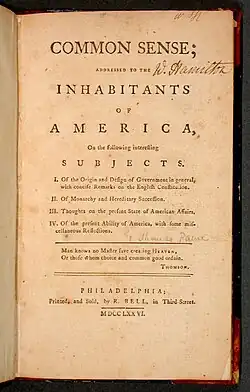
- Publication of Common Sense by Thomas Paine (January 10). It becomes a runaway bestseller, convincing many colonists that independence was the only course
- David Mathews appointed Mayor of New York, the highest ranking civilian officer for English North America for the duration of the Revolution
- Battle of Moore's Creek Bridge, North Carolina (February 27) North Carolina militia victory
- Battle of the Rice Boats, Georgia (March 2–3)
- Battle of Nassau (March 3–4)
.jpg)
- Fortification of Dorchester Heights results in British forces evacuating Boston (March 4–5)
- British evacuate Boston (March 17), end of the successful American yearlong Siege of Boston
_-001.jpg)
- Silas Deane sent to France by the Continental Congress as a purchasing agent for the Continental Army (March). Beginning of covert French financial aid to the Americans.
- Roderigue Hortalez and Company founded in May in Paris to coordinate clandestine financial and military aid from France and Spain to the American rebels to weaken their rival, Britain.
- The Continental Army departs its first winter encampment at Cambridge, Massachusetts (April 4)
- Congress opens American ports to trade with all other nations except Britain (April 6)
- Oliver Cromwell, a 20-gun corvette, launched in Connecticut (June 13). Named after the Puritan military and political leader, signatory of the death warrant of Charles I in 1649, Lord Protector of the Commonwealth of England until his death in office.
- Pennsylvania Provincial Conference (June 18–25) declares Pennsylvania's independence; mobilizes the Pennsylvania militia; organized elections for delegates to a constitutional convention that framed the Pennsylvania Constitution of 1776
- Battle of Sullivan's Island (June 28)
- Thomas Hickey hanged for role in plot to assassinate George Washington (June 28). British Colonial Loyalist New York Mayor David Mathews previously arrested in Flatbush, Brooklyn for his role in the plot (June 22)
- Battle of Turtle Gut Inlet (June 29), American naval victory
- Declaration of Independence - Second Continental Congress enacts (July 2) a resolution declaring independence from the British Empire (July 2)
- Largest assembly of British naval fleet in history commences off the coasts of Staten Island, Brooklyn and New Jersey (July 3)
- Proclamation of the Declaration of Independence by the Second Continental Congress (July 4)
- Sons of Liberty topple the statue of King George III in Bowling Green (July 9)
- Battle of Long Island, a.k.a. Battle of Brooklyn (August 27) - British victory; British occupation of New York for the duration of the war; Washington's largely intact forces escape capture, a repeated strategy in the war
- British prison ships begin in Wallabout Bay, New York
- Staten Island Peace Conference (September 11) unsuccessful meeting between British authorities and members of the Continental Congress (Ben Franklin, John Adams) to end armed hostilities
- Landing at Kip's Bay (September 15)
- Battle of Harlem Heights (September 16)
- Great Fire of New York (September 21–22)
- Nathan Hale captured and executed for espionage (September 22)
- Battle of Valcour Island (October 11) British victory
- Battle of Pell's Point, New York (October 18)
- Battle of White Plains, New York (October 29) British victory
- Battle of Fort Cumberland (November 10–29)
- Battle of Fort Washington (November 16)
- Battle of Fort Lee (November 20)
- Battle of Iron Works Hill (December 23–26)

- Battle of Trenton (December 26) Washington's surprise attack on Hessian mercenaries and victory. The crossing of the Delaware River the night before is an iconic image.
- Thomas Paine publishes The American Crisis, inspiring Americans to continue in their struggle. (1776 - 1777)
1777
Battles and skirmishes fought all year.
- Battle of the Assunpink Creek, also known as the Second Battle of Trenton (January 2)
- Battle of Princeton, New Jersy (January 3)
- Continental Army enters second winter encampment of the war at Morristown (January 6)
- Forage War (January–March), New Jersy:
- Battle of Millstone (January 20)
- Battle of Drake's Farm (February 1)
- Battle of Quibbletown (February 8)
- Battle of Spanktown (February 23)
- Battle of Bound Brook (April 13)
- British regulars, under Major General William Tryon, burn and loot Danbury, Connecticut (April 26)
- Battle of Ridgefield (April 27)
- Battle of Thomas Creek (May 17)
- Meigs Raid (May 23)
- First Middlebrook encampment (May 28 – July 2)
- Battle of Short Hills (June 26)
- Fort Ticonderoga abandoned by the Americans due to advancing British troops placing cannon on Mount Defiance (July 5)
- British retake Fort Ticonderoga, New York (July 6)
- Battle of Hubbardton (July 7)
- Delegates in Vermont, which was not one of the Thirteen Colonies, establish a republic and adopt a constitution, the first in what is now the territory of the United States to prohibit slavery (July 8)
- Battle of Fort Anne (July 8)
- Siege of Fort Stanwix (August 2–23)
- Battle of Oriskany (August 6)
- Battle of Machias (1777) (August 13–14)
- Battle of Bennington, Vermont (August 16)
- Battle of Staten Island, New York (August 22)
- Siege of Fort Henry (September 1)
- Battle of Cooch's Bridge (September 3)

- Battle of Brandywine (September 11), major British victory in Pennsylvania over George Washington's army in a set-piece battle of nearly equal forces.
- Battle of the Clouds (September 16)
- Battle of Paoli (Paoli Massacre) (September 20)
- British occupation of Philadelphia, the American capital (September 26)
- Battle of Germantown (October 4)

- Battle of Forts Clinton and Montgomery (October 6)
- Battle of Saratoga (September 19 and October 7); surrender of the British army under General Burgoyne. Major American victory, demonstrating to France that the Americans could win in battle, helping lead to the French formally allying with the Americans in 1778.
- Battle of Red Bank (October 22)

- Articles of Confederation, formal legal framework for governance of the U.S. until 1787, adopted by the Second Continental Congress (November 15)
- Capture of Fort Mifflin, (November 16) and Fort Mercer, (November 18)
- Battle of Gloucester (1777) (November 25)

- Battle of White Marsh (December 5 – December 8)
- Battle of Matson's Ford (December 11)
- Continental Army in third winter quarters at Valley Forge (December 19, 1777 – June 19, 1778)
1778

- American treaties of alliance with France with Treaty of Amity and Commerce and Treaty of Alliance (February 6). The full weight of the France, Britain's longstanding rival, provides crucial support (money, army and naval forces, war materiel) to the Americans. France is the first foreign country to recognise the flag of the United States, on the ship of John Paul Jones (February 14)
- France declares war on Great Britain, starting the Anglo-French War (1778–1783) and formally allying with the United States (March 17) The war is transformed from an insurgency within the British Empire and one of its component parts into a global conflict between Britain and France, which seeks to undermine British dominance. Britain must rethink its war strategy since its lucrative Caribbean colonies of Jamaica and Barbados and others and India are now vulnerable to the French and Britain itself could be invaded. British decrease its army in North America, believing it can rely on Loyalists. The British over-estimate the number of Loyalists and their willingness to take up arms.
- Battle of Quinton's Bridge (March 18)
- John Paul Jones, in command of the Ranger, attacks Whitehaven in England, America's first naval engagement outside North America (April 20)
- The Great Chain across the Hudson is completed (April 30)
- Battle of Crooked Billet (May 1)
- Battle of Barren Hill (May 20)
- Battle of Cobleskill (May 30)
- British troops evacuate from Philadelphia, redeploy to New York City (June 18)
- Whaleboat attack on Flatbush, Brooklyn to kidnap New York Mayor David Mathews and other British and Loyalist figures partially succeeds in securing Captain James Moncrief and Theophylact Bache, President of the New York Chamber of Commerce, for future prisoner exchange (June)
- Battle of Monmouth (June 28)
- Battle of Wyoming (July 3)
- Battle of Ushant (July 27)
- Battle of Rhode Island (August 29)
- Baylor Massacre (September 27)
- Culper Spy Ring is begun (October)
- Battle of Chestnut Neck (October 6)
- Affair at Little Egg Harbor (October 15)
- Cherry Valley massacre (November 11)
- Capture of Savannah, British victory, launching their southern strategy (December 29)
- Majority of Continental Army in fourth winter quarters at Middlebrook Cantonment (November 30, 1778 – June 3, 1779)
- Major General Israel Putnam chooses Redding, Connecticut as his winter encampment to keep an eye on the storehouses in Danbury, Connecticut (1778–1779)
1779
- USS Bonhomme Richard given by France to the Continental Navy. (February)
- Battle of Beaufort (February 3, 1779)
- Battle of Kettle Creek, Georgia (February 14) American victory over Loyalist forces.
- Siege of Fort Vincennes (February 23–25)
- Chesapeake raid (May 10–24)
- Battle of Stono Ferry (June 20)
.svg.png)
- Spain declares war on Great Britain in alliance with France but not in alliance with the U.S. to recover Gibraltar and Minorca; gives material and logistical support to the American Revolution (June 21)
- Tryon's raid (July 3–14)
- Tryon's division lands in East Haven, Connecticut, met with resistance from a band of local militia, take Black Rock Fort (July 5)
- Battle of Fairfield destroying public and private property (July 7)
- Battle of Norwalk weakly opposed by about 50 local militia, easily dispersed. The destruction of the village and its commercial infrastructure destroyed (July 11)
- Battle of Stony Point (July 16)
- Battle of Minisink (July 22)
- Penobscot Expedition (July 24 – August 14)
- Battle of Paulus Hook (August 19)
- Sullivan Expedition (June 18 – October 3)
- Battle of Newtown (August 29)
- Capture of Fort Bute (September 7)
- Siege of Savannah (September 16 – October 18)
- Battle of Baton Rouge (September 21)
- Battle of Flamborough Head (September 23)
- Continental Army in fifth winter quarters at Morristown (December 1779 – May 1780)
1780
- Congress establishes the Court of Appeals in Cases of Capture to provide for final adjudication of appeals from state court prize cases involving disposition of ships and cargo allegedly seized from the British (January 15)
- Battle of Cape St. Vincent (January 16)
- A stockade known as Fort Nashborough is founded on the banks of the Cumberland River (January 28). Two years later, the site is renamed Nashville
- Some 8,000 British forces under General Henry Clinton arrive in Charleston, South Carolina, from New York (February 1)
- New York cedes to Congress its western claims, including territory west of Lake Ontario (February 1). In 1792, New York will sell the Erie Triangle to Pennsylvania
- Battle of Young's House (February 3) (In the north)
- Battle of Fort Charlotte (March 2–14)

- Spanish success against the British - Bombardment of Fort Charlotte, after a two-week siege, Spanish general, colonial governor of Louisiana, and Viceroy of New Spain Bernardo de Gálvez captures Fort Charlotte, taking the port of Mobile (in present-day Alabama) from the British (March 14). Fort Charlotte was the last remaining British frontier post capable of threatening New Orleans in Spanish Louisiana. Its fall drove the British from the western reaches of West Florida and reduced the British military presence in West Florida to its capital, Pensacola.
- Siege of Charleston (March 29 – May 12). Successful British siege of the major southern colonial port.
- British Army troops under General Henry Clinton and naval forces under Admiral Mariot Arbuthnot besiege Charleston, South Carolina. British ships sail past Fort Moultrie on Sullivan's Island to occupy Charleston Harbor (April 8)
- Battle of Monck's Corner (April 14)
- Battle of Lenud's Ferry (May 6)
- Fort Moultrie falls to the British (May 7)
- American General Benjamin Lincoln surrenders Charleston to the British. The British lose 255 men while capturing a large American garrison (May 12)
- Bird's invasion of Kentucky (May 25 – August 4) (In the west)
- Battle of Waxhaws; a clash between Continental Army forces under Abraham Buford and a mainly Loyalist force led by Banastre Tarleton occurs near Lancaster, South Carolina in the Waxhaws area (close to present-day Buford). The British destroyed the American forces (May 29)
- Alexander's Old Field in Beckhamville, South Carolina (June 6)
- Battle of Connecticut Farms (June 7) (In the north)
- Battle of Mobley's Meeting House (June 10)
- Battle of Ramsour's Mill (June 20)
- Battle of Springfield; with the attempted British invasion of New Jersey stopped at Connecticut Farms and Springfield, major fighting in the North ends (June 23)
- Robert Morris is appointed Superintendent of Finance, a post akin to Prime Minister, by Congress (June 27)
- First French troops arrive in Rhode Island under Rochambeau (July 11).
- Battle of Williamson's Plantation (AKA Huck's Defeat) (July 12)
- Battle of Bull's Ferry (July 20–21) (In the north)
- Battle of Colson's Mill (July 21)
- Battle of Rocky Mount (August 1)
- Battle of Hanging Rock (August 6)
- Battle of Piqua (August 8) (In the west)
- John Adams arrives in the Dutch Republic to secure loans and bring the Dutch into the war, lessening the American dependence on France (August 10)

- Battle of Camden, major British victory over the Americans in South Carolina. General Cornwallis defeats Gates (August 16)
- Battle of Fishing Creek (August 18)
- Battle of Musgrove Mill (August 18)
- Battle of Black Mingo (August 28)
- Battle of Wahab's Plantation (September 21)
- Major John André captured and the treason of Benedict Arnold is exposed (September 23)
- Battle of Charlotte (September 26)
- John André executed as a spy (October 2)
- Battle of Kings Mountain (October 7)
- Royalton Raid (October 16)
- Battle of Klock's Field (October 19)
- Battle of Fishdam Ford (November 9)
- Battle of Blackstock's Farm (November 20)
- Continental Army enters sixth winter with encampments in New York's Hudson Highlands, Pompton, and Morristown, New Jersey (December)
1781
- The future King William IV, the only active member of the British Royal Family to visit the former 13 colonies, takes up residence in the Rose and Crown Tavern on Staten Island.
- Pennsylvania Line Mutiny (January 1–29)
- Raid on Richmond (January 1–19)
- Battle of Cowpens (January 17)
- Pompton Mutiny (January 20)
- Battle of Cowan's Ford (February 1)
- Pyle's Massacre (February 24)
- Articles of Confederation ratified (March 1)
- Siege of Pensacola culminates Spain's conquest of West Florida (March 9 - May 10)
- Battle of Guilford Court House (March 15)
- Battle of Cape Henry (March 16)
- Siege of Fort Watson (April 15 - April 23)
- Battle of Blandford (April 25)
- Battle of Hobkirk's Hill (April 25)
- Action at Osborne's (April 27)
- Siege of Fort Motte (May 8–12)
- Siege of Pensacola (March 9 to May 10)
- Siege of Augusta, Georgia by British (May 22 – June 6)
- Siege of Ninety-Six (May 22 – June 19)
- Raid of Point of Fork (June 5)
- Washington–Rochambeau Revolutionary march. Joint French-American military campaign (June 10 – September 22)
- Battle of Green Spring, Virginia. British victory over the Franco-American forces; last major land battle before Yorktown (July 6)

- Francisco's Fight (July 9–24)
- Battle of the Chesapeake, huge French naval victory over the British navy; France can now prevent the relief of Cornwallis in Yorktown and he is forced to surrender his army to the joint American-French army (September 5)
- Battle of Groton Heights (September 6)
- Battle of Eutaw Springs (September 8)
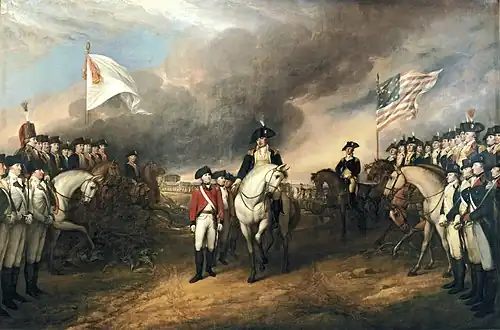
- The British surrender at Yorktown, effective end of the land war in North America. (Oct. 19) Joint French-American armies of Washington and Rochambeau and the French navy trap Cornwallis and force the surrender of his entire army. War continues on other fronts until the Peace Treaty of 1783.
- Continental Army returns to Hudson Highlands and Morristown New Jersey for its seventh winter encampment (December)
- Bank of North America chartered (December 31)
1782
- The British House of Commons votes against further war, informally recognizing American independence (February 27)
- Gnadenhutten massacre (March 8)
- Battle of Little Mountain (March 22)
- Newburgh letter sent to George Washington by Lewis Nicola (May 22)
- Crawford expedition (May 25 – June 12)
- Siege of Bryan Station (August 15–17)
- Battle of Blue Licks (August 19)
- Battle of the Combahee River (August 27)
- Siege of Fort Henry (1782) (September 11–13)
- Continental Army moves into its eighth and final winter quarters, at the New Windsor Cantonment and in the Hudson Highlands (November)
- Preliminary Articles of Peace are signed by British negotiator Richard Oswald and representatives of the United States of America (November 30)
- British evacuate Charleston, South Carolina (December 14)
- Last skirmish of the conflict takes place near Cedar Bridge Tavern in Barnegat Township, New Jersey (December 27)
1782-1783
- George Washington, citing a clause in the preliminary treaty, insisted on the return of any present or former slaves. As part of documenting and evacuation of former slaves to British North America, the Book of Negroes was compiled in New York City.
- Enslaved Africans in America who escaped to the British during the American Revolutionary War became the first settlement of Black Nova Scotians and Black Canadians.
1783


- Newburgh Conspiracy (March 10–15)
- Pennsylvania Mutiny of 1783 (June 20–24)
- The Treaty of Paris (1783) (September 3) signed between the representatives of the United States and Great Britain, ending the American Revolutionary War; ratification in early 1784
- The British evacuate New York, marking the end of British rule.
- British loyalist refugees retreat to Quebec and Nova Scotia. General George Washington triumphantly returns with the Continental Army (November 25).
- George Washington resigns as commander-in-chief of the Continental Army and returns to civilian life at Mount Vernon. (December 23)
- Exodus of Loyalists to Britain, Nova Scotia, and elsewhere, but many remain in their home communities.
1784–1787
1784
- The Treaty of Paris is ratified by the Congress (January 14)
- Jay–Gardoqui Treaty with Spain fails to be ratified. Negotiations continued until 1786
- The Treaty of Paris is ratified by the British (April 9)
- Ratified treaties are exchanged in Paris between the two nations (May 12)
- "The State of Frankland," later known as Franklin, secedes from North Carolina (August 23)
- Robert Morris resigns as Superintendent of Finance and is not replaced (November 1)
1785
- Congress refuses admission of the State of Franklin to the Union (May 16)
- Treaty of Hopewell (November 28)
1786
- Shays's Rebellion (August 29 – June 1787)
- Annapolis Convention fails (September 11–14)
1787
- Northwest Ordinance enacted (July 13)

_-_02.jpg)
- Constitutional Convention in Philadelphia (May 25 - September 17)
- The Federalist Papers, essays written anonymously by Alexander Hamilton, James Madison, and John Jay under the pen-name "Publius", give reasons for ratifying the Constitution (October 1787 - May 1788)
- Delaware (December 7), Pennsylvania (December 12), and New Jersey (December 18) ratify the Constitution
1788–1797
1788
- North Carolina reasserted it claim to its Overmountain region, at which time Franklin ceases to exist
- Georgia, Connecticut, Massachusetts, Maryland, South Carolina, New Hampshire, Virginia and New York ratify the Constitution
- United States Constitution ratified (June 21)
- Cyrus Griffin resigns as "President of the United States in Congress Assembled" (November 2), and with the exceptions of John Jay and John Knox remaining as Secretaries of Foreign Affairs and War respectively; and Michael Hillegas remaining as Treasurer, the United States of America temporarily ceases to exist.
- The first federal elections for the House of Representatives begin
- 1788–89 United States presidential election (December 15, 1788 – January 10, 1789). George Washington is elected president, and John Adams is elected vice president.
1789
- Philip Pell, only member in attendance, adjourns the Congress of the Confederation sine die (March 2)
- Members of the 1st United States Congress begin to take their seats at Federal Hall, New York (March 4)
- House of Representatives first achieves a quorum and elects its officers (April 1)
- Senate first achieves a quorum and elects its officers (April 6)
- Joint session of Congress counts the Electoral College ballots, certifies that George Washington has been unanimously elected President of the United States (April 6)
- Adams becomes the first vice president (April 21)
- Washington becomes the first president, at Federal Hall in New York City (April 30)
- The Tariff Act of 1789 is signed into law (July 4)
- Charles Thomson resigns as secretary of Congress and hands over the Great Seal, bringing an end to the Confederation Congress (July)
- French Revolution begins (July)
- Judiciary Act of 1789 (September 24)
- Congress approves twelve articles of amendment to the Constitution, the Bill of Rights (September 25)
- North Carolina becomes the 12th state to ratify the Constitution, with a vote of 194–77 (November 21)
1790
- (May 29) Rhode Island becomes the 13th state to ratify the Constitution, with a vote of 34 to 32
- Treasury Secretary Alexander Hamilton's plans for funding the Federal government and assuming states' debts approved.
- Federal government moves from New York City to Philadelphia.
1791
- Bill of Rights ratified (December 15).
- Bank of the United States chartered by Congress.
- Congress passes whiskey tax to pay off war debt; citizen resistance.
- Haitian Revolution begins.
1792
- 1792 United States presidential election: George Washington reelected president, John Adams reelected vice president.
1793
- President Washington and Vice President Adams begin their second terms (March 4).
- Napoleonic Wars break out between France and Britain.
- Neutrality Proclamation issued by Washington, leaving its alliance with France (April 22).
1794
- Whiskey Rebellion, a violent tax protest in western Pennsylvania, suppressed by the Federal government.
1795
- Jay's Treaty ratified in June toward resolving post Revolution tensions between the United States and Great Britain. First use of arbitration in modern diplomatic history for Canada–United States border disputes.
1796
- Six Northwest Territory forts and two Upstate New York forts that remained under British control are ceded to the United States.
- 1796 United States presidential election: John Adams is elected president, Thomas Jefferson elected vice president.
1797
- Adams becomes the second president, Jefferson becomes the second vice president (March 4).
1798
- Irish Rebellion of 1798 (May 24 - October 12). Uprising by Irish nationalists against the British government.
1800s
1800
- Thomas Jefferson elected third President.
1804
- Aaron Burr, Vice President of the U.S. kills Alexander Hamilton in a duel.(July 11)
1825
- John Quincy Adams son of John Adams becomes sixth president.
See also
- List of American Revolutionary War battles
- List of George Washington articles
- Territorial evolution of the British Empire
- Timeline of Colonial America
- Timeline of Canadian history
References
- ^ Green, Jack, "The Origins of the New Colonial Policy, 1748–1763" in The Blackwell Encyclopedia of the American Revolution. Cambridge: Basil Blackwell 1991, 95-106
- ^ Anderson, Fred. Crucible of War: The Seven Years' War and the Fate of Empire in British North America , 1754–1766. New York: Vintage Books 2000, 668-69, 824
- ^ "Founders Online: The Final Hearing before the Privy Council Committee for Plant …".
- ^ Jasanoff, Maya, Liberty's Exiles: American Loyalists in the Revolutionary World, New York: Vintage Press 2011, 25-27
- ^ Declaration and Resolves of the First Continental Congress, New Haven, Connecticut: Lillian Goldman Law Library, Yale Law School: Avalon Project, October 14, 1774, retrieved January 10, 2022
- ^ Continental Congress (October 20, 1774). "Continental Association (Articles of Association)". Founders Online (founders.archives.gov). National Archives. Retrieved January 10, 2022.
Further reading
- Cullen, Joseph P. (1972). The Concise Illustrated History of the American Revolution. For secondary schools, 136pp
- Fremont-Barnes, Gregory, and Richard Alan Ryerson, eds. (2006). The Encyclopedia of the American Revolutionary War: A Political, Social, and Military History (5 vol.)
- George, Lynn (2002). A Timeline of the American Revolution. 24pp; for middle schools
- Morris, Richard B. (7th ed., 1996). Encyclopedia of American History, detailed timeline
External links
