The Lion Sleeps Tonight

"The Lion Sleeps Tonight" is a song originally written and first recorded in 1939 by Solomon Linda under the title "Mbube", through South African Gallo Record Company. In 1961, a version adapted into English by the doo-wop group the Tokens became a number-one hit in the United States. It earned millions in royalties from cover versions and film licensing. Lyrics of Linda's original version were written in Zulu, while those from the Tokens' adaptation were written by George David Weiss.
The song has been adapted and covered internationally by many pop and folk artists. It was first recorded in the United States by the Weavers in November 1951, and published under the title "Wimoweh" by a branch of Folkways Records in December of the same year.[1] The pop group Tight Fit made a cover of the song in 1982, reaching number one hit in the UK.
History
Solomon Linda and "Mbube"
First the Zulu man made the magic. Then the white man made the money.
Solomon Linda, born in rural Natal,[3] was a migrant worker.[4] He held various jobs during the 1930s, including in kitchens and a furniture shop.[5] A beer hall singer,[6] he was also a member of a short-lived choir named the Evening Birds, which dissolved in the mid-1930s. Soon after, Linda formed a new group based in Johannesburg under the same name, with himself as soprano, Gilbert Madondo as alto, Boy Sibiya as tenor, and Samuel Mlangeni, Gideon Mkhize, and Owen Sikhakhane as basses.[7] They performed a cappella in the weekends and quickly grew a following.[8] It was not long before a talent scout at Eric Gallo's Johannesburg record-pressing plant, the first in sub-Saharan Africa and, at the time, the only one in black Africa,[9] noticed the Evening Birds and invited them to the recording studio.[10] Back then, record firms fastened upon Zulu close-harmony vocal music, which appealed to migrant mineworkers.[11]
The Evening Birds recorded multiple songs at Gallo's studio, and during their second session, in 1939, they achieved their breakthrough.[12] The song, "Mbube"[a], was finished without prior rehearsal after three takes.[15] Performed in four-part harmony,[16] with Mlangeni, Mkhize, and Sikhakhane on bass, Madondo and Sibiya on middle tones, and Linda on a "soaring" soprano,[17] it is sung in a call and response format: the phrases of each section overlap with each other. It follows a cyclical structure.[16] The melody comprises three chords,[15] and the chord progression borrows from the marabi harmonic cycle predominant in twentieth-century South African music (I-IV-I6/4-V7-I).[16] Simon Lafraniere describes the melody as "tender … almost childish in its simplicity."[18] According to Rian Malan, "'Mbube' wasn't the most remarkable tune, but there was something terribly compelling about the underlying chant, a dense meshing of low male voices above which Linda yodeled and howled for two minutes, mostly making it up as he went along."[15]
The lyrics, written in Zulu,[19] are said to document an episode of Linda's childhood when he chased a lion while herding cattle.[20][b]
Yekela yanini, yebo liyaduma amathamsanqa. |
Leave it, indeed it thunders blessings. |
| —as listed in Veit Erlmann's Nightsong[22] |
Marketed to black audiences, "Mbube" became a hit and Linda a star throughout South Africa. By 1948, the song had sold over 100,000 copies in Africa and among black South African immigrants in Great Britain. Linda's song also gave the name to a style of African a cappella music that evolved into Isicathamiya (also called Mbube music), popularized by the group Ladysmith Black Mambazo.
Pete Seeger and "Wimoweh"

In 1949 Alan Lomax, then working as folk music director for Decca Records, brought Solomon Linda's 78-rpm recording to the attention of his friend Pete Seeger, leader of the folk group The Weavers. In November 1951, after having performed the song for at least a year in their concerts, The Weavers recorded an adapted version with brass, string orchestra and chorus and released it as a 78-rpm single titled "Wimoweh", a mishearing of the original song's chorus of "Uyimbube" ("You are a lion" in Zulu). Their version contained the chanting chorus "Wimoweh" and Linda's improvised line. The Weavers credited the song as "Oral tradition", with arrangement by "Paul Campbell", later found to be a pseudonym used by The Weavers in order to claim royalties. It reached Billboard's top ten and became a staple of The Weavers' live repertoire, achieving further exposure on their best-selling The Weavers at Carnegie Hall LP album, recorded in 1955 and released in 1957.
The song was recorded extensively by other folk revival groups such as the Kingston Trio, who released it in 1958. Miriam Makeba also covered the song in 1960, with the original title "Mbube" and giving writing credits to "J. Linda".
George Weiss, the Tokens, and "The Lion Sleeps Tonight"
In 1961, two RCA Records producers, Hugo Peretti and Luigi Creatore, hired Weiss to arrange a Doo-wop and Rhythm and blues cover of "Wimoweh" for the B-side of a 45-rpm single called "Tina", sung by group The Tokens. Weiss wrote the English lines "In the jungle, the mighty jungle, The lion sleeps tonight..." and "Hush, my darling, don't fear, my darling...".[26] "The Lion Sleeps Tonight" was issued by RCA in that year, and it rocketed to number one on the Billboard Hot 100. Weiss' "Abilene Music, Inc." was the publisher of this arrangement, and listed "Albert Stanton" (a pseudonym for "Al Brackman", the business partner of Pete Seeger's music publisher, Howie Richmond) as one of the song's writers or arrangers.[27]
Later developments and impact
In 2000, South African journalist Rian Malan wrote a feature article for Rolling Stone in which he recounted Linda's story and estimated that the song had earned $15 million for its use in the Disney 1994 movie The Lion King alone. The piece prompted filmmaker François Verster to create the Emmy-winning documentary A Lion's Trail, released in 2002, which tells Linda's story while incidentally exposing the workings of the multi-million dollar corporate music publishing industry.
Copyright issues
Howie Richmond's claim of author's copyright could secure both the songwriter's royalties and his company's publishing share of the song earnings.[28]
Although Solomon Linda was listed as a performer on the record itself, The Weavers thought they had recorded a traditional Zulu song. Their managers, the publisher, and their attorneys knew otherwise because they had been contacted by — and had reached an agreement with — Eric Gallo of Gallo Record Company in South Africa. The Americans maintained, however, that South African copyrights were not valid because South Africa was not a signatory to U.S. copyright law. In the 1950s, after Linda's authorship was made clear, Pete Seeger sent $1000 to the South African artist. The folk singer also said he instructed TRO/Folkways to henceforth pay his share of authors' earnings to Linda. Seeger apparently trusted his publisher's word of honor and either saw no need, or was unable, to make sure these instructions were carried out.[28]
In July 2004, as a result of the publicity generated by Malan's article and the subsequent documentary, the song became the subject of a lawsuit between Linda's estate and Disney, claiming that the latter owed $1.6 million in royalties for the use of "The Lion Sleeps Tonight" in the film and musical stage productions of The Lion King. At the same time, the Richmond Organization began to pay $3,000 annually to Linda's estate. In February 2006, the South African singer's descendants reached a legal settlement with Abilene Music Publishers, who held the worldwide rights and had licensed the song to Disney, to place the earnings of the song in a trust.[29]
In 2012, "Mbube" fell into the public domain, owing to the copyright law of South Africa, while "The Lion Sleeps Tonight" is still in copyright. The copyright issues were also treated in the 2019 movie ReMastered: The Lion's Share.
| "Mbube" | |
|---|---|
.jpg) | |
| Single by Solomon Linda's Original Evening Birds | |
| B-side | "Ngi Hambiki" |
| Released | 1939 |
| Recorded | 1939 |
| Studio | Gallo Recording Studios |
| Genre |
|
| Length | 2:44 |
| Label | Gallo Record Company |
| Songwriter(s) | |
| Audio | |
| Mbube (Audio) on YouTube | |
| "The Lion Sleeps Tonight" | |
|---|---|
 | |
| Single by the Tokens | |
| from the album The Lion Sleeps Tonight | |
| A-side | "Tina" |
| Released | October 1961[30] |
| Recorded | 1961 |
| Genre | |
| Length | 2:41 |
| Label | RCA Victor |
| Songwriter(s) |
|
| Audio | |
| The Lion Sleeps Tonight (Wimoweh) (Audio) on YouTube | |
| "The Lion Sleeps Tonight" | ||||
|---|---|---|---|---|
 | ||||
| Single by Robert John | ||||
| from the album Robert John | ||||
| B-side | "Janet" | |||
| Released | December 1971 | |||
| Genre | ||||
| Label | Atlantic | |||
| Songwriter(s) |
| |||
| Producer(s) | Hank Medress and Dave Appell | |||
| Robert John singles chronology | ||||
| ||||
| "The Lion Sleeps Tonight" | ||||
|---|---|---|---|---|
 | ||||
| Single by Tight Fit | ||||
| from the album Tight Fit | ||||
| B-side | "Rhythm, Movement And Throbbing" | |||
| Released | January 1982 | |||
| Recorded | 1981 | |||
| Genre | Pop | |||
| Length | 3:18 | |||
| Label | Jive | |||
| Songwriter(s) |
| |||
| Producer(s) | Tim Friese-Greene[33] | |||
| Tight Fit singles chronology | ||||
| ||||
| Music video | ||||
| "The Lion Sleeps Tonight" on YouTube | ||||
Charted singles
The Tokens
Weekly charts
|
Year-end charts
|
Certifications
| Region | Certification | Certified units/sales |
|---|---|---|
| New Zealand (RMNZ)[43] | Gold | 15,000‡ |
| United States (RIAA)[44] | Gold | 1,000,000^ |
|
^ Shipments figures based on certification alone. | ||
Robert John
Weekly charts
|
Year-end charts
|
Certifications
| Region | Certification | Certified units/sales |
|---|---|---|
| United States (RIAA)[55] | Gold | 1,000,000^ |
|
^ Shipments figures based on certification alone. | ||
Tight Fit
Weekly charts
|
Year-end charts
|
Certifications
| Region | Certification | Certified units/sales |
|---|---|---|
| United Kingdom (BPI)[74] | Gold | 500,000^ |
|
^ Shipments figures based on certification alone. | ||
R.E.M.
References
Notes
- ^ Zulu for "lion,"[13] or "the lion."[14]
- ^ Rian Malan presents a slightly different interpretation: that the lyrics refer to an lion-hunting incident in the Evening Birds' collective memory, not just in Linda's.[15] Veit Erlmann follows a similar lyrical interpretation but argues that "Mbube" was based on an older wedding song, in the same vein as many early isicathamiya songs.[21]
- ^ Some sources indicate "uyimbube" instead of "wembube,"[23] and one indicates "uyimbube-wo."[24]
- ^ Sources which write "uyimbube" instead of "wembube" translate it as "you're a lion."[25]
Citations
- ^ Library of Congress. Copyright Office. (1952). Catalog of Copyright Entries 1952 Published Music Jan-Dec 3D Ser Vol 6 Pt 5A. United States Copyright Office. U.S. Govt. Print. Off.
- ^ Malan 2012, p. 57
- ^ Erlmann 1996, p. 60
- ^ BBC 2006; Connor 2018; Muller 2008, p. 6
- ^ Erlmann 1996, p. 61; Malan 2012, p. 59
- ^ Blair 2004; Lafraniere 2006
- ^ Erlmann 1996, p. 61
- ^ Malan 2012, p. 59
- ^ Malan 2012, pp. 57, 60
- ^ Erlmann 1996, p. 61; Malan 2012, p. 60; Phillips 2023
- ^ Ansell 2005, p. 50
- ^ Malan 2012, pp. 61–62
- ^ Muller 2008, p. 5; Phillips 2023
- ^ Lafraniere 2006; Malan 2012, p. 61
- ^ a b c d Malan 2012, p. 61
- ^ a b c Muller 2008, p. 7
- ^ Phillips 2023
- ^ Lafraniere 2006
- ^ Connor 2018
- ^ Contreras 2006; Muller 2008, p. 5
- ^ Erlmann 1996, pp. 61–62
- ^ Erlmann 1996, p. 62
- ^ Malan 2012, p. 63; Phillips 2023; Wilberforce 2020
- ^ Khumalo 2004
- ^ Malan 2012, p. 61; Phillips 2023; Wilberforce 2020
- ^ Laing, Dave (24 August 2010), "George David Weiss obituary", The Guardian, ISSN 0261-3077, retrieved 21 May 2024
- ^ Malan 2012, p. 74
- ^ a b Malan 2012
- ^ Robinson 2004
- ^ "Special Merit Singles". Billboard. 23 October 1961.
- ^ Stanley, Bob (2022). "Revival: Trad Jazz and Folk". Let's Do It - The Birth of Pop Music: A History. New York: Pegasus Books. p. 477.
- ^ Breihan, Tom (19 February 2020). "The Number Ones: Robert John's "Sad Eyes"". Stereogum. Retrieved 12 July 2023.
In 1972, John recorded an adult-contempo cover of the Tokens' "The Lion Sleeps Tonight"...
- ^ Rice, Jo (1982). The Guinness Book of 500 Number One Hits (1st ed.). Enfield, Middlesex: Guinness Superlatives Ltd. p. 222. ISBN 0-85112-250-7.
- ^ "The Tokens – The Lion Sleeps Tonight" (in Dutch). Ultratop 50. Retrieved 15 June 2018.
- ^ "The Tokens – The Lion Sleeps Tonight" (in French). Ultratop 50. Retrieved 15 June 2018.
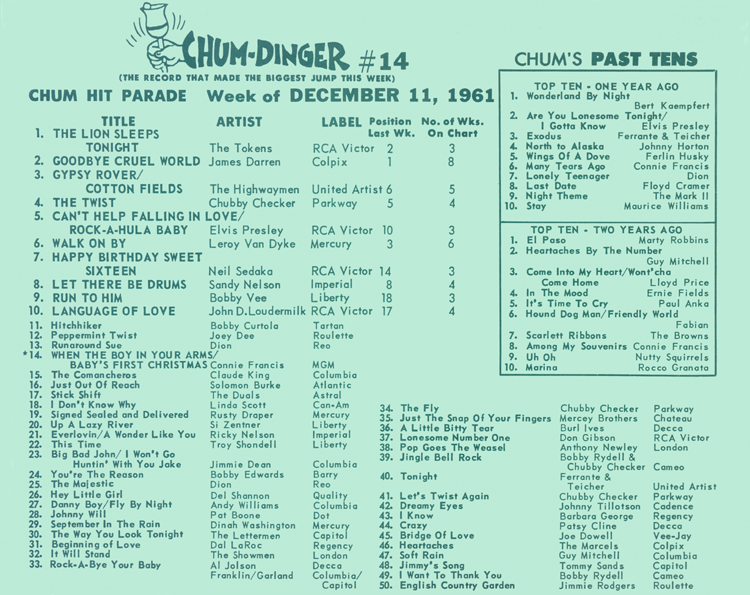
- ^ "CHUM Hit Parade - December 11, 1961".
- ^ "flavour of new zealand - Lever hit parades". Flavourofnz.co.nz. Archived from the original on 6 April 2023. Retrieved 1 May 2019.
- ^ "Tokens: Artist Chart History". Official Charts Company. Retrieved 15 June 2018.
- ^ "The Tokens Chart History (Hot 100)". Billboard. Retrieved 15 June 2018.
- ^ "The Tokens Chart History (Hot R&B/Hip-Hop Songs)". Billboard. Retrieved 15 June 2018.
- ^ "Offiziellecharts.de – The Tokens – The Lion Sleeps Tonight" (in German). GfK Entertainment charts. Retrieved 15 June 2018. To see peak chart position, click "TITEL VON The Tokens"
- ^ [1]
- ^ "New Zealand single certifications – The Tokens – The Lion Sleeps Tonight". Radioscope. Type The Lion Sleeps Tonight in the "Search:" field.
- ^ "American single certifications – The Tokens – The Lion Sleeps". Recording Industry Association of America.
- ^ Kent, David (1993). Australian Chart Book 1970-1992. St Ives, N.S.W.: Australian Chart Book. ISBN 0-646-11917-6.
- ^ "Top RPM Singles: Issue 7602." RPM. Library and Archives Canada. Retrieved 25 November 2020.
- ^ "Top RPM Adult Contemporary: Issue 5318." RPM. Library and Archives Canada. Retrieved 25 November 2020.
- ^ "SA Charts 1965–March 1989". Retrieved 5 September 2018.
- ^ "Robert John Chart History (Hot 100)". Billboard. Retrieved 25 November 2020.
- ^ "Robert John Chart History (Adult Contemporary)". Billboard. Retrieved 25 November 2020.
- ^ "Cash Box Top 100 3/18/72". Tropicalglen.com. Archived from the original on 23 October 2016. Retrieved 21 March 2018.
- ^ "Offiziellecharts.de – Robert John – The Lion Sleeps Tonight" (in German). GfK Entertainment charts. Retrieved 25 November 2020. To see peak chart position, click "TITEL VON Robert John"
- ^ "Top 100 Hits of 1972/Top 100 Songs of 1972". Musicoutfitters.com. Archived from the original on 27 April 2017. Retrieved 1 December 2017.
- ^ "Cash Box YE Pop Singles - 1972". Tropicalglen.com. Archived from the original on 28 September 2018. Retrieved 1 May 2019.
- ^ "American single certifications – Robert John – The Lion Sleeps Tonight". Recording Industry Association of America.
- ^ Kent, David (1993). Australian Chart Book 1970–1992 (illustrated ed.). St Ives, N.S.W.: Australian Chart Book. p. 310. ISBN 0-646-11917-6.
- ^ "Tight Fit – The Lion Sleeps Tonight" (in German). Ö3 Austria Top 40. Retrieved 25 November 2020.
- ^ "Tight Fit – The Lion Sleeps Tonight" (in Dutch). Ultratop 50. Retrieved 25 November 2020.
- ^ "Tight Fit – The Lion Sleeps Tonight". Tracklisten. Retrieved 25 November 2020.
- ^ "The Irish Charts – Search Results – Lion Sleeps Tonight". Irish Singles Chart. Retrieved 25 November 2020.
- ^ "Nederlandse Top 40 – week 17, 1982" (in Dutch). Dutch Top 40. Retrieved 9 November 2021.
- ^ "Tight Fit – The Lion Sleeps Tonight" (in Dutch). Single Top 100. Retrieved 25 November 2020.
- ^ "Tight Fit – The Lion Sleeps Tonight". Top 40 Singles. Retrieved 25 November 2020.
- ^ "Tight Fit – The Lion Sleeps Tonight". Singles Top 100. Retrieved 25 November 2020.
- ^ "Tight Fit – The Lion Sleeps Tonight". Swiss Singles Chart. Retrieved 25 November 2020.
- ^ "Official Singles Chart Top 100". Official Charts Company. Retrieved 25 November 2020.
- ^ "Offiziellecharts.de – Tight Fit – The Lion Sleeps Tonight" (in German). GfK Entertainment charts. Retrieved 25 November 2020.
- ^ "Archívum – Slágerlisták – MAHASZ" (in Hungarian). Single (track) Top 40 lista. Magyar Hanglemezkiadók Szövetsége. Retrieved 30 March 2023.
- ^ "National Top 100 Singles for 1982". Kent Music Report. 3 January 1983. Retrieved 22 January 2023 – via Imgur.
- ^ "Jaaroverzichten 1982". Ultratop. Retrieved 9 November 2021.
- ^ "Top 100-Jaaroverzicht van 1982". Dutch Top 40. Retrieved 9 November 2021.
- ^ "Jaaroverzichten – Single 1982". dutchcharts.nl. Retrieved 9 November 2021.
- ^ "Top 100 Single-Jahrescharts". GfK Entertainment (in German). offiziellecharts.de. Retrieved 9 November 2021.
- ^ "British single certifications – Tight Fit – The Lion Sleeps Tonight". British Phonographic Industry.
- ^ "Íslenski Listinn Topp 40 (2.–8. apríl)". Dagblaðið Vísir (in Icelandic). 1 April 1993. p. 29. Retrieved 24 January 2021.
- ^ "Árslistinn 1993". Dagblaðið Vísir (in Icelandic). 4 January 1994. p. 17. Retrieved 24 January 2021.


Bibliography
Books and academic papers
- Ansell, Gwen (2005). Soweto Blues: Jazz, Popular Music, and Politics in South Africa. New York City, New York: Continuum International Publishing Group. ISBN 0-8264-1753-1.
- Childs, Marti Smiley; March, Jeff (2011). "Chapter III: The Lion Sleeps Tonight, The Tokens". Echoes of the Sixties. United States: EditPros LLC. ISBN 978-1-937317-02-7.
- Erlmann, Veit (1996). "The History of Isicathamiya, 1891–1991". Nightsong: Performance, Power, and Practice in South Africa. Chicago, Illinois: The University of Chicago Press. ISBN 0-226-21721-3.
- Malan, Rian (2012). "In the Jungle". The Lion Sleeps Tonight and Other Stories of Africa. New York City, New York: Grove Atlantic. ISBN 978-0-8021-1990-2.
- Muller, Carol A. (2008). Focus: Music of South Africa (2 ed.). New York City, New York: Routledge. ISBN 978-0-415-96071-7.
- Ovesen, Håvard; Haupt, Adam (October 2011). "Vindicating Capital: Heroes and Villains in A Lion's Trail". Ilha do Desterro (61): 73–107. doi:10.5007/2175-8026.2011n61p073.
News articles
- Blair, David (30 October 2004). "Penniless singer's family sue Disney for Lion King royalties". The Telegraph. Archived from the original on 1 June 2025. Retrieved 2 August 2025.
- Browne, David (7 November 2019). "'The Lion Sleeps Tonight': The Ongoing Saga of Pop's Most Contentious Song". Rolling Stone. Archived from the original on 27 May 2025. Retrieved 2 August 2025.
- Connor, Alan (3 July 2018). "The Lion Sleeps Tonight — written by a Zulu migrant worker, made famous by Disney". Financial Times. Archived from the original on 12 February 2025. Retrieved 2 August 2025.
- Chanda, Abhik Kumar (2 August 2004). "SA family to go ahead with Disney lawsuit" (PDF). Sunday Times. Archived from the original (PDF) on 8 April 2024. Retrieved 2 August 2025 – via Stellenbosch University.
- Contreras, Felix (24 March 2006). "Family of 'Lion Sleeps Tonight' Writer to Get Millions". NPR. Archived from the original on 23 June 2025. Retrieved 2 August 2025.
- Khumalo, Fred (2 July 2004). "Wimoweh royalties start to roll" (PDF). The Toronto Star. Archived from the original (PDF) on 8 April 2024. Retrieved 2 August 2025 – via Stellenbosch University.
- Lafraniere, Sharon (22 March 2006). "In the Jungle, the Unjust Jungle, a Small Victory". The New York Times. Archived from the original on 2 August 2025. Retrieved 2 August 2025.
- Lewis, Randy (14 May 2019). "Who wrote 'The Lion Sleeps Tonight'? A Netflix film seeks answers, and closure". Los Angeles Times. Archived from the original on 22 July 2025. Retrieved 2 August 2025.
- Phillips, Lior (8 May 2023). "The Lion Sleeps Tonight: one song's journey from 1930s South Africa to Disney money-spinner". The Guardian. Archived from the original on 2 August 2025. Retrieved 2 August 2025.
- Robinson, Simon (25 October 2004). "It's a Lawsuit, a Mighty Lawsuit". Time. Archived from the original on 2 August 2025. Retrieved 2 August 2025.
- Vincent, Roger (3 July 2004). "A Legal Uproar Over Song in 'Lion King'". Los Angeles Times. Archived from the original on 2 August 2025. Retrieved 2 August 2025.
- Wilberforce, Mark (29 December 2020). "Seeking justice for Lion Sleeps Tonight composer". BBC News. Archived from the original on 24 July 2025. Retrieved 2 August 2025.
- "Disney denies liability in lion song dispute" (PDF). Toronto Star. 7 July 2004. Archived from the original (PDF) on 8 April 2024. Retrieved 2 August 2025 – via Stellenbosch University.
- "Disney rebuffs Lion song claim". BBC News. 7 July 2004. Archived from the original on 2 August 2025. Retrieved 2 August 2025.
- "Disney settles Lion song dispute". BBC News. 16 February 2006. Archived from the original on 26 January 2025. Retrieved 2 August 2025.
- "Family of Wimoweh songwriter should sleep well tonight — the lion must wait" (PDF). Toronto Star. 28 September 2004. Archived from the original (PDF) on 8 April 2024. Retrieved 2 August 2025 – via Stellenbosch University.
- "Family sues Disney over Lion song". BBC News. 5 July 2004. Archived from the original on 26 January 2025. Retrieved 2 August 2025.
- "'Lion Sleeps Tonight' royalty row". BBC News. 18 June 2003. Archived from the original on 2 August 2025. Retrieved 2 August 2025.
- "Lion song settlement nears" (PDF). The Citizen. 28 September 2004. Archived from the original (PDF) on 8 April 2024. Retrieved 2 August 2025 – via Stellenbosch University.
External links
Recordings
- "Mbube", performed by Solomon Linda and the Evening Birds
- "Wimoweh", performed live by the Weavers
- "The Lion Sleeps Tonight", performed by the Tokens
- YouTube tribute channel FLORENCOM, containing over 200 iterations of "Mbube", "Wimoweh", and "The Lion Sleeps Tonight"
Commentary
- Commentary on "The Lion Sleeps Tonight" and the legal dispute and settlement surrounding it, by Richard Silverstein
- 2010 BBC podcast on "The Lion Sleeps Tonight", hosted by Paul Gambaccini
- Video comparing "Mbube" and "The Lion Sleeps Tonight" by VYIMBVBE
- Documentary on Solomon Linda by VYIMBVBE