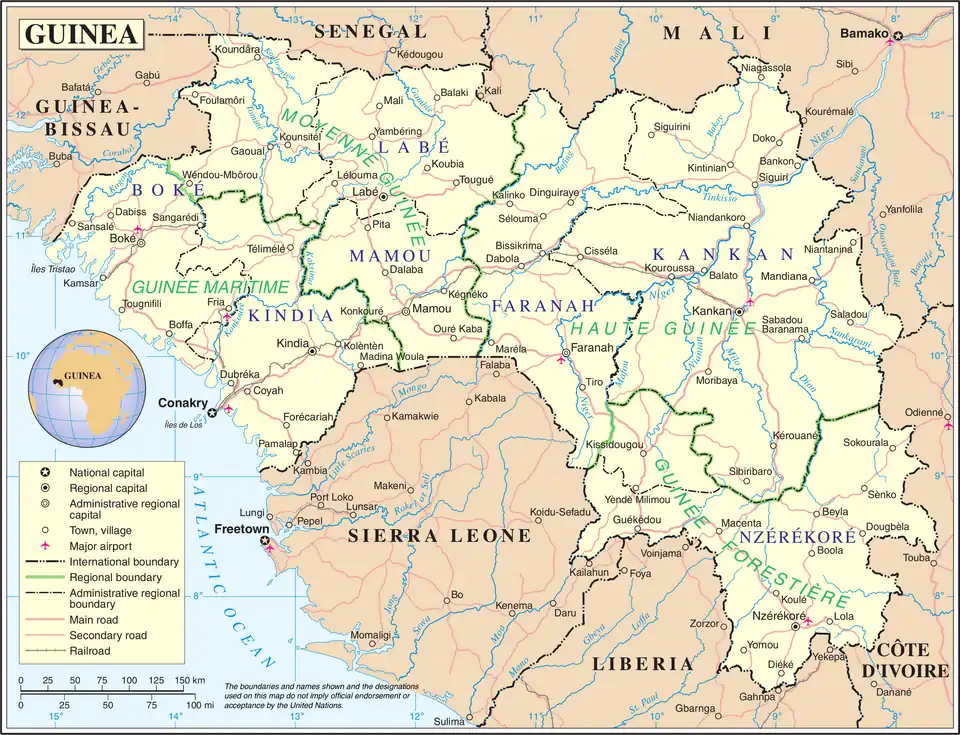
Guinea's natural regions of Maritime, Middle, Upper, and Forested.
Guinea is divided into four natural regions with distinct human, geographic, and climatic characteristics:
Maritime Guinea (La Guinée Maritime) covers 34% of the country
Middle Guinea (La Moyenne-Guinée) covers 20% of the country
Upper Guinea (La Haute-Guinée) covers 38% of the country
Forested Guinea (Guinée Forestière) covers 23% of the country, and is both forested and mountainous
Government divisions
Regions
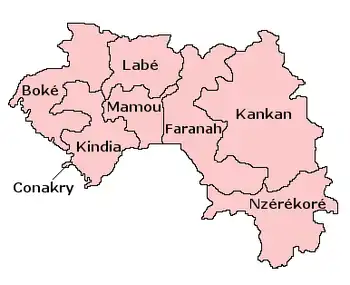
Regions of Guinea.
Guinea is divided into seven administrative regions. The national capital, Conakry, ranks as a special zone.
Region
Capital
Area (km2)
Population (2014 census)
Conakry Region
Conakry
450
1,660,973
Nzérékoré Region
Nzérékoré
37,658
1,527,030
Kankan Region
Kankan
72,145
1,972,537
Kindia Region
Kindia
28,873
1,561,374
Boké Region
Boké
31,186
1,083,147
Labé Region
Labé
22,869
994,458
Faranah Region
Faranah
35,581
941,554
Mamou Region
Mamou
17,074
731,188
The capital Conakry with a population of 1,660,973 ranks as a special zone.
Prefectures
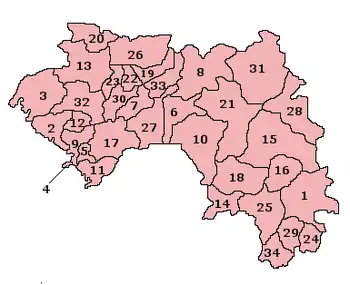
Guinea's regions are subdivided into thirty-three prefectures and one special zone, Conakry.
Prefectures of Guinea.
Beyla
Boffa
Boké
Conakry
Coyah
Dabola
Dalaba
Dinguiraye
Dubréka
Faranah
Forécariah
Fria
Gaoual
Guéckédou
Kankan
Kérouané
Kindia
Kissidougou
Koubia
Koundara
Kouroussa
Labé
Lélouma
Lola
Macenta
Mali
Mamou
Mandiana
Nzérékoré
Pita
Siguiri
Télimélé
Tougué
Yomou
Sub-prefectures
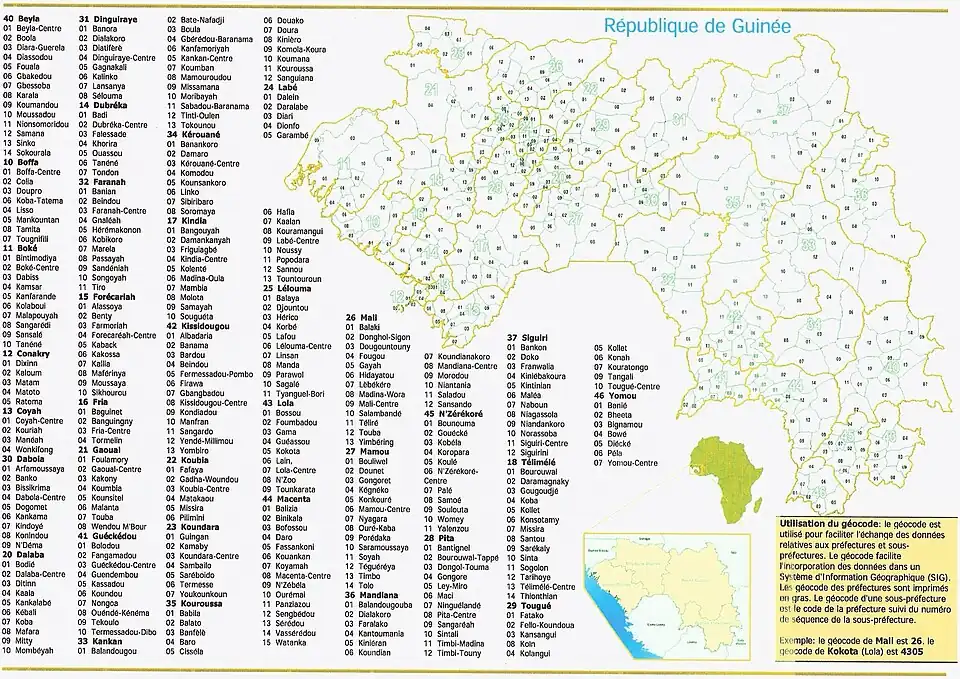
The Communes of Guinea or sub prefectures, known in French as sous-prefectures, are the third-level administrative divisions in Guinea. As of 2009 there were 303 rural communes of Guinea and 38 urban communes, 5 of which compose the Conakry greater urban area.