Landslide victory
A landslide victory is an election result in which the winning candidate or party achieves a decisive victory by an overwhelming margin, securing a very large majority of votes or seats far beyond the typical competitive outcome.[1][2][3][4] The term became popular in the 1800s to describe a victory in which the opposition is "buried",[1] similar to the way in which a geological landslide buries whatever is in its path. A landslide victory for one party is often accompanied by an electoral wipeout for the opposition, as the overwhelming support for the winning side inflicts a decisive loss on its rivals. What qualifies as a landslide victory can vary depending on the type of electoral system, as the term does not entail a precise, technical, or universally agreed-upon measurement. Instead, it is used informally in everyday language, making it subject to interpretation. Even within a single electoral system, there is no consensus on the exact margin that constitutes a landslide victory.[1]
A landslide victory implies a powerful expression of popular will and a ringing endorsement by the electorate for the winner’s political platform. Such a decisive outcome can lead the winner to interpret it as a mandate or a tacit authorization from the public to implement their proposed policies and pursue their agenda with confidence. Emboldened by the result, the winner may undertake ambitious reforms or significant policy shifts to reflect the electorate’s desire for meaningful change.[5]
A combination of factors–such as charismatic leadership, a favorable shift in public sentiment driven by dissatisfaction with or support for the status quo, strategic electoral campaigning and a positive media portrayal–can create the conditions necessary for a landslide victory. Such a victory may fundamentally reshape the political landscape of a country, for example Franklin D. Roosevelt's election as US president in 1932.[6] In this imbalanced landscape, the winning party could implement policies more easily, facing little resistance, while the severely weakened opposition may struggle to perform essential checks and balances.
Notable examples
Australia
Local and mayoral elections:
- 2008 Brisbane City Council election – The Liberal Party won a landslide victory over the Labor Party. Campbell Newman was re-elected Lord Mayor of Brisbane with 66.1% of the two-party-preferred vote, with a swing of 13.7%.[7] The LNP won 16 of the 26 wards. Newman later became Premier of Queensland in a landslide victory at the 2012 state election.
- 2021 Mandurah City Council election – Rhys Williams was re-elected Mayor of Mandurah with 85% of the vote.[8]
State and territory elections:
- 2021 Western Australian state election – Mark McGowan led the Labor Party to win 53 out of the 59 seats in the lower house. The Labor Party had a primary vote of 59.92% and a two-party-preferred vote of 69.68%. The National Party won 4 seats and the Liberal Party won 2 seats, making the National Party the official opposition, the first time they had held this status since the 1940s. To date, the election is the most decisive result at any Australian state or federal election since Federation, in terms of both percentage of lower house seats controlled by the governing party (89.8%) and two-party preferred margin.[9][10]

- 2011 New South Wales state election – Barry O'Farrell led the Liberal–National Coalition to a landslide victory defeating the incumbent Labor Party Premier, Kristina Keneally with 64.22% of the two-party-preferred vote. The incoming government received 69 of the 93 seats in the New South Wales Legislative Assembly. The Labor Party by contrast lost more than half of their seat total.
- 1978 New South Wales state election – Neville Wran led the Labor Party to a landslide victory with a primary vote of 57.77%. the largest primary vote for any party in a century.
Federal elections:
- 1929 – The Labor Party won 47 seats while the Coalition won just 24 seats.
- 1943 – The Labor Party won 49 seats while the Coalition won just 23 seats.
- 1966 – The Coalition won 82 seats while the Labor Party won just 41 seats.
- 1975 – The Coalition won 91 seats while the Labor Party won just 36 seats.
- 1996 – The Coalition won 94 seats while the Labor Party won just 49 seats.
- 2013 – The Coalition won 90 seats while the Labor Party won just 55 seats.
- 2025 – The Labor Party won 94 seats while the Coalition won just 43 seats.
Barbados
In Barbadian general elections, a landslide victory involves a large swing from one party to another as well as one party winning a large majority in parliament. Landslide victories have usually occurred after a long period of government from one particular party and a change in the popular mood.
- 1986 Barbadian general election – The Democratic Labour Party led by Opposition Leader Errol Barrow won 24 out of 27 seats House of Assembly and 59.45% of the popular vote
- 1999 Barbadian general election – The Barbados Labour Party led by Prime Minister Owen Arthur won 28 out of 30 seats in the House of Assembly and 64.87% of the popular vote.
- 2018 Barbadian general election – The Barbados Labour Party led by Opposition Leader Mia Mottley won all 30 seats in the House of Assembly and 74.6% of the popular vote.
- 2022 Barbadian general election – The Barbados Labour Party led by Prime Minister Mia Mottley won all 30 seats in the House of Assembly and 69.0% of the popular vote.
Brazil

- 2010 Pernambuco gubernatorial election – candidate Eduardo Campos wins 82.84% over Jarbas 14,06%.
Canada


In a Canadian federal election, a landslide victory occurs when a political party gains a significant majority of the House of Commons of Canada.
Landslide victories may also occur during provincial elections, and territorial elections in Yukon. Landslide victories are not possible for territorial elections in the Northwest Territories, and Nunavut, as its members are elected without reference to political parties, operating as a consensus government.
National landslide victories
The following Canadian federal elections resulted in landslide victories:[11]
- 1874 – The Liberals won 133 seats while the Conservatives won just 73 seats.
- 1878 – The Conservatives won 137 seats while the Liberals won just 69 seats.
- 1882 – The Conservatives won 139 seats while the Liberals won just 71 seats.
- 1917 – The Conservatives won 153 seats while the Liberals won just 82.
- 1935 – The Liberals won 171 seats while the Conservatives won just 39.
- 1940 – The Liberals won 178 seats while the Progressive Conservatives won just 39.
- 1949 – The Liberals won 191 seats while the Progressive Conservatives won just 41.
- 1953 – The Liberals won 171 seats while the Progressive Conservatives won just 51.
- 1958 – The Progressive Conservatives won 208 seats while the Liberals won just 48.
- 1968 – The Liberals won 155 seats while the Progressive Conservatives won just 72.
- 1984 – The Progressive Conservatives won 211 seats while the Liberals won just 40.
- 1993 – The Liberals won 177 seats while the Bloc Québecois, which ran only in Quebec, won 54. The ruling Progressive Conservatives dropped from 154 to 2.
Provincial examples
- 1935 Prince Edward Island general election – The Prince Edward Island Liberal Party, led by Walter Lea defeated the incumbent Progressive Conservative Party of Prince Edward Island, led by Premier William J. P. MacMillan, with the Liberals winning every seat in the election.
- 1987 New Brunswick general election – Frank McKenna's New Brunswick Liberal Association defeated the incumbent majority government of Richard Hatfield and the Progressive Conservative Party of New Brunswick, with the Liberals winning every seat in the election.
- 2001 British Columbia general election – The Gordon Campbell-led British Columbia Liberal Party won all but two seats, defeating the sitting British Columbia New Democratic Party government.
- 1973 Quebec general election – The incumbent Quebec Liberal Party led by Robert Bourassa won 102 of the 110 seats winning the largest number and share of seats in the province's history with the Parti Québécois and the Parti créditiste winning respectively six and two seats and the Union nationale losing all of their seats.
- 2007 Newfoundland and Labrador general election – The Progressive Conservative's, led by Danny Williams, won 44 of the 48 available seats in the House of Assembly. However, the largest landslide in Newfoundland history was in 1932, this was before Confederation.
Costa Rica
- 1919 – Julio Acosta García, leader of the recently victorious anti-Tinoco opposition wins with 89% of the votes over Tinoquista José María Soto.
- 1940 – Republican Rafael Ángel Calderón Guardia wins with 84%, his two only rivals were Communist leader Manuel Mora (9%) and Virgilio Salazar from a local Guanacaste party.
- 1944 – Republican Teodoro Picado Michalski wins 75% of the votes over Democratic candidate León Cortes Castro. Republican candidate Calderón re-election in the next year sparks the third and last Costa Rican Civil War.
- 1953 – First election after the Civil War, war caudillo José Figueres Ferrer wins 67% of the votes over Democratic candidate Fernando Castro Cervantes, after this Costa Rica enters a pretty stable two-party system.
- 2014 – In second round PAC's candidate Luis Guillermo Solís wins 77% votes over PLN's Johnny Araya Monge, first ever candidate in reach more than a million votes.
Croatia

- 1997 Croatian presidential election - The Croatian Democratic Union (HDZ) candidate, Franjo Tuđman, the incumbent and first president of Croatia, won a landslide victory against Vlado Gotovac of the Croatian Social Liberal Party (HSLS), and Zdravko Tomac of the Social Democratic Party (SDP), winning more than 61% of the vote and all but one of the 21 Croatian counties.
- 2024-25 Croatian presidential election - Incumbent president and SDP-backed candidate Zoran Milanović won re-election by a landslide against HDZ-backed Dragan Primorac, winning 75% of the vote in the second round and sweeping every single county.
Dominica
- 1980 Dominican general election The Dominica Freedom Party led by Opposition Leader Eugenia Charles won 17 out of 21 seats and 51.34% of the popular vote.
- 2009 Dominican general election The Dominica Labour Party led by Prime Minister Roosevelt Skerrit won 18 out of 21 seats and 61.13% of the popular vote.
- 2019 Dominican general election The Dominica Labour Party led by Prime Minister Roosevelt Skerrit won 18 out of 21 seats and 61.34% of the popular vote.
- 2022 Dominican general election The Dominica Labour Party led by Prime Minister Roosevelt Skerrit won 19 out of 21 seats and 58.95% of the popular vote.
Finland
- 1978 Finnish presidential election saw incumbent Urho Kekkonen win 82.41 % of the popular vote and 260 of 300 electoral votes.
- 2018 Finnish presidential election was won by incumbent Sauli Niinistö with 62.64 % of the votes.
France
Only include those after 1958.
- 1968 – The Gaullist UDR party, led by future president Georges Pompidou, wins 354 of 487 seats.
- 1993 – The liberal conservative coalition RPR–UDF wins 485 or 84% of the 577 seats.
- 2002 – Jacques Chirac wins the presidency with 82.1% of the popular vote. His party, the UMP, also won 357 out of 577 seats in the following month’s legislative election.
- 2017 – Emmanuel Macron won with 66% of the vote, while Marine Le Pen got 33% of the vote.
French Polynesia
- 2023 – the one-term incumbent Tāpura Huiraʻatira government, led by Édouard Fritch, was defeated by the Tāvini Huiraʻatira opposition, led by Moetai Brotherson, in a landslide. Tāvini Huiraʻatira won 38 seats (an increase of 30), Tāpura Huiraʻatira won 15 (a decrease of 15), the new A here ia Porinetia party won three seats and Tāhōʻēraʻa Huiraʻatira won just one seat (a decrease of 10).
Grenada
In Grenadian general elections, a landslide victory involves a large swing from one party to another as well as one party winning a large majority in parliament. Landslide victories have usually occurred after a long period of government from one particular party and a change in the popular mood.
- 1999 – The New National Party led by Prime Minister Keith Mitchell won all 15 seats in the House of Representatives and 62.5% of the popular vote.
- 2013 – The New National Party led by Opposition Leader Keith Mitchell won all 15 seats in the House of Representatives and 58.7% of the popular vote.
- 2018 – The New National Party led by Prime Minister Keith Mitchell won all 15 seats in the House of Representatives and 58.9% of the popular vote.
Hong Kong
Legislative Council elections:
- 1991 – The pro-democracy camp won 16 of the 18 directly elected geographical constituency seats, with a coalition of the United Democrats of Hong Kong and the Meeting Point taking 14 of the seats.
- 1995 – The pro-democracy camp swept 16 of the 20 directly elected geographical constituency seats in which the Democratic Party alone took 12 directly elected seats.
- 2021 – The pro-Beijing camp took 89 out of 90 seats in the Legislative Council. Many democratic candidates had been barred from running, and turnout was extremely low.
Local elections:
- 2019 – The pro-democracy camp seized control of 17 of the 18 District Councils, tripling their seats from about 124 to 389. The pro-Beijing parties and independents won only 61 seats, a loss of 242 seats, received their largest defeat in history.
Hungary
- 2010 – Fidesz–KDNP won 262 of the 386 seats thus being the first party to win a super-majority since 1990.
- 2022 – Despite an electoral alliance of almost all opposition parties, Fidesz–KDNP won 135 of the 199 seats thus winning a super-majority for the fourth time in a row.
India
- In the 1967 Kerala Legislative Assembly election, the CPI(M) led alliance won 113 of the 133 seats it contested.
- In the 1977 Kerala Legislative Assembly election, the Indian National Congress (INC) led alliance won 111 of the 140 seats it contested.
- In the 1991 Tamil Nadu Legislative Assembly election the AIADMK led alliance won 225 of the 234 seats it contested.
- In the 1996 Tamil Nadu Legislative Assembly election the DMK led United Front won 221 of the 234 seats it contested.
- In the 2001 Tamil Nadu Legislative Assembly election the AIADMK led alliance won 196 of the 234 seats it contested.
- In the 2011 Tamil Nadu Legislative Assembly election the AIADMK led alliance won 203 of the 234 seats it contested.
- In the 2014 Indian general election the BJP itself, won 282 seats which was almost 7 times that of the second largest party, the Indian National Congress.
- In the 2019 Indian general election the BJP itself, won 303 seats which was almost 6 times that of the second largest party, the Indian National Congress.
- In the 2019 Andhra Pradesh Legislative Assembly, the YSR Congress Party won 151 seats out of 175 seats it contested.
- In the 2022 Gujarat Legislative Assembly election the BJP won 156 seats out of 182 seats which was the highest ever in any Gujarat Legislative Assembly election.
- In the 2023 Nagaland Legislative Assembly election the BJP led National Democratic Alliance won all of the 60 seats.
- In the 2024 Maharashtra Legislative Assembly election the BJP led Maha Yuti alliance won 237 of the 288 seats.
- In the 2024 Andhra Pradesh Legislative Assembly election the TDP led Kutami as a part of National Democratic Alliance won 164 seats out of 175 seats it contested.
Italy
- 2005 Italian regional elections – The Union centre-left coalition won the presidency in 12 out of 14 regions that were holding elections that year. After this election the centre-left controlled the presidency in 16 out of Italy's 20 regions.
- 2020 Venetian regional election – Incumbent president of Veneto Luca Zaia (Lega) won carrying 76.79% of the vote, five times as many as his main opponent Arturo Lorenzoni's (PD) 15.72%.
Jamaica
In Jamaican elections, a landslide victory involves a large swing from one party to another as well as one party winning a large majority in parliament. Landslide victories have usually occurred after a long period of government from one particular party and a change in the popular mood.
- 1983 Jamaican general election – The Jamaica Labour Party led by Prime Minister Edward Seaga won all 60 seats in the House of Representatives and 89.7% of the popular vote. The opposition People's National Party boycotted this election.
- 1993 Jamaican general election -The People's National Party (PNP) led by P. J. Patterson secured 52 of the 60 seats and 59.98% of the popular vote.
- 1997 Jamaican general election -The People's National Party (PNP) led by P. J. Patterson secured 50 of the 60 seats and 56.20% of the popular vote.
- 2020 Jamaican general election – The Jamaica Labour Party led by Andrew Holness was re-elected after winning a supermajority in Parliament.[12]
Malaysia
Federal election

- 2004 Malaysian general election – Ruling coalition Barisan Nasional (BN), led by Prime Minister Abdullah Ahmad Badawi won 198 out of 219 seats in the Dewan Rakyat and 63.8% of the popular vote, controlling almost all seats in the state assemblies. Abdullah had only been in office for four months after taking over the post of Prime Minister from Mahathir Mohamad, who had served for 22 years.
State elections
- 2008 Penang state election
- 2021 Malacca state election
- 2021 Sarawak state election
- 2022 Johor state election
- 2022 Perlis state election
- 2023 Terengganu state election – Ahmad Samsuri Mokhtar led the coalition Perikatan Nasional (PN) to win all out of the 33 seats in the state assembly. The Perikatan Nasional had a popular vote of 68.44%. The Barisan Nasional (BN) – Pakatan Harapan (PH) electoral pact did not win any seats, with BN losing all its previous 10 seats, leaving the state assembly with no elected opposition representative since 1978.
- 2023 Kedah state election – Muhammad Sanusi Md Nor led the coalition Perikatan Nasional (PN) to win 33 out of the 36 seats in the state assembly. The Perikatan Nasional had a popular vote of 68.88%. The Barisan Nasional (BN) – Pakatan Harapan (PH) electoral pact won the remaining 3 seats, with PH capturing all 3 seats. For the first time in the state's history, BN did not have any representation in the state assembly, allowing PH to take BN's place as the state's main opposition.
- 2023 Kelantan state election
Monaco
Monaco is traditionally dominated by conservative parties with only two cases in which left-of-centre parties won any seats (1963 and 1973).
- 1968 – The governing National and Democratic Union, led by August Médecin, won a landslide victory, winning 18 seats on the National Council.
- Between 1978 and 1988 - The governing National and Democratic Union hold all 18 seats on the National Council.
- 1998 – The governing National and Democratic Union, led by Jean-Louis Campora, won a landslide victory, winning all 18 seats on the National Council.
- 2023 – The governing Monegasque National Union, led by Brigitte Boccone-Pagès, won a landslide victory, winning all 24 seats on the National Council.
New Zealand
Until 1993, New Zealand used the traditional first-past-the-post system as in the U.K. to determine representation in its Parliament. Thus, landslide elections at that time were defined in an identical fashion, i.e. where one party got an overwhelming majority of the seats. Since 1996, New Zealand has used the mixed member proportional system as in Germany, making landslides much less likely.[13]
First past the post
- 1893 election – The Liberals won 51 seats and 57.8% of the vote while the Conservatives won 13 seats and just 24.5% of the vote.[14]
- 1899 election – The Liberals won 49 seats and 52.7% of the vote while the Conservatives won 19 seats and just 36.6% of the vote.[14]
- 1905 election – The Liberals won 58 seats and 53.1% of the vote while the Conservatives won 16 seats and just 29.7% of the vote.[14]
- 1925 election – The Reform Party won 55 seats while the Labour & Liberal parties won just 23 seats combined.[14]
- 1935 election – The Labour Party won 53 seats while the Coalition won just 19 seats.[14]
- 1938 election – The Labour Party won 53 seats while the National Party won just 25 seats.[14]
- 1990 election – The National Party won 67 seats while the Labour Party won just 29 seats.[14]
Philippines

In 1941, the Nacionalista Party won the presidency, vice presidency, all seats in the Senate, and all but 3 seats in the House of Representatives. This was the biggest landslide in Philippine history. The legislators didn't serve until 1945 though, due to World War II.
Starting in 1987, the Philippines evolved into a multi-party system, and coupled with the introduction of party-list elections in 1998, no party was able to win a landslide, much less a majority of seats, in the House of Representatives since then. This has also meant, until 2022, that no presidential and vice presidential election winner won a majority of votes, although, in 1998, the winners were described as having landslide victories, despite winning less than a majority of votes, due to large winning margins. Senatorial landslides are more possible though in midterm elections, as voters are usually presented with two distinct choices. The 2022 presidential election was the first landslide since 1987.
Presidential and vice presidential elections
In the Philippines, while there are presidential tickets, the positions of president and vice president are elected separately.
- 1935 – Manuel L. Quezon won with 68% of the vote. His running mate, Sergio Osmeña, won with 86% of the vote. Their second placers had 18% and 8% of the vote, respectively.
- 1941 – Manuel L. Quezon won with 80% of the vote. His running mate, Sergio Osmeña, won with 90% of the vote. The second placers had 18% and 8% of the vote, respectively. This was the biggest landslide in an election where major opposition parties participated.
- 1953 – Ramon Magsaysay won with 69% of the vote. His running mate, Carlos P. Garcia, won with 63% of the vote. Their opponents had 31% and 37% of the vote, respectively.
- 1981 – Ferdinand Marcos won with 89% of the vote, and won in every province, with the main opposition coalition boycotting the election. This is the largest landslide in history.
Senate
- 1941 – Nacionalista Party won all 24 seats in the Senate. This was the only time that the Senate had no members from the opposition.
- 1949 – The Liberal Party won all 8 seats contested.
- 1951 – The Nacionalista Party won all 9 seats contested.
- 1955 – The Nacionalista Party won all 9 seats contested. The Nacionalistas then had 21 of the 24 seats in the Senate, leaving the Liberals with none.
- 1987 – Lakas ng Bayan won 22 of 24 seats. Their main opponents, the Grand Alliance for Democracy, won 2.
- 2019 – The ruling party, Hugpong ng Pagbabago won 9 of the 12 seats contested. Their main opponents, Otso Diretso won no seats. The other 3 seats went to other parties.
House of Representatives
- 1907 – The Nacionalista Party won 59 of 80 seats. The Progresista Party won 16. From 1907 to 1919, the Nacionalistas won every election in large margins, as they advocated Philippine independence from the United States, over their opponents' more conservative approach to the issue. From 1922 to 1935, the Nacionalistas were split into factions, until they were reunited in time for the 1938 election.
- 1938 – The Nacionalista Party won all 98 seats. This was the only time that the House of Representatives had no members from the opposition.
- 1941 – The Nacionalista Party won 95 seats. The other 3 seats were won by independents.
- 1957 – The Nacionalista Party won 82 seats. The Liberal Party won just 19.
- 1969 – The Nacionalista Party won 88 seats. The Liberal Party won just 18.
- 1978 – The Kilusang Bagong Lipunan won 150 seats. Their opposition Lakas ng Bayan, won no seats. Minor and regional parties won the remaining 15 seats.
Portugal
- Legislative Elections


- 1979 – The centre-right Democratic Alliance (AD), a coalition between the Social Democratic Party, the Democratic and Social Centre and the People's Monarchist Party, led by Francisco Sá Carneiro, won 128 out of the 250 seats and 45.3% of the popular vote. The second most voted party, the Socialist Party received 27.3% of the total voting, 18 percentage points behind the winners.
- 1980 – Following their win one year earlier, Democratic Alliance (AD), led by Francisco Sá Carneiro, won 134 out of the 250 seats and 47.6% of the popular vote. The Socialist Party, the second most voted party, received just 27.8% of the total voting, nearly 20 points behind the AD.
- 1987 – The centre-right Social Democratic Party led by Cavaco Silva won 148 out of the 250 seats and 50.2% of the popular vote. The second most voted party, the Socialist Party would receive just 22.2% of the total voting, falling 28 percentage points behind the winners.
- 1991 – Following the success attained in the previous legislative elections, the Social Democratic Party led by Cavaco Silva won 135 out of the 230 seats and 50.6% of the popular vote. The Socialist Party would also rise in voting, receiving 29.1% of the votes, but would still be far short of the Social Democrats.
- 2005 – The centre-left Socialist Party led by José Sócrates won 121 out of the 230 seats and 45% of the popular vote. The second most voted party, the Social Democratic Party received just 28.8% of the total voting and 75 seats, thus polling 16 percentage points behind the Socialists.
- 2022 – The Socialist Party led by António Costa gathered 120 out of the 230 seats and 41.4% of the popular vote. The second most voted party, the Social Democratic Party polled at 29.1% of the total voting, 12.3 percentage points behind the Socialists, and only won two electoral districts out of twenty two.
- Presidential Elections
- 1976 – António Ramalho Eanes, supported by the center-right and center-left political parties secured 61.6% of the total vote, while the second most voted candidate, FP-25 leader Otelo Saraiva de Carvalho, got 16.5% of the vote.
- 1991 – Incumbent president Mário Soares, supported by both the socialists and the social democrats achieved 70.3% of the total votes, while the second most voted candidate, Basilio Horta secured only 14.2% of the votes.
- 2006 – Aníbal Cavaco Silva, supported by the center-right parties, secured 50.5% of the votes in the first turn. Second most voted candidate, socialist Manuel Alegre would only secure 20.7%.
- 2011 – Incumbent president, Aníbal Cavaco Silva, supported by the center-right parties achieved 53% of the total voting, the second most voted candidate, socialist Manuel Alegre would only score 19.7%.
- 2016 — Marcelo Rebelo de Sousa, supported by the center-right parties and benefiting from bigger media exposure than the rest of the candidates secured 52% of the votes in the first turn. Second most voted candidate António Sampaio da Nóvoa would only score 23% of voting.
- 2021 – Incumbent president, Marcelo Rebelo de Sousa, would renew his term receiving 60.6% of the total voting, whilst the second most voted candidate, socialist MEP Ana Gomes received only 13% of the votes. Rebelo de Sousa became the first presidential candidate to win in all the municipalities.
- Azorean Regional Elections
- 1980 Azorean regional election – Social Democratic Party led by Mota Amaral took 30 of the 43 seats and 57.4% of the votes, the Socialist Party would only score 27.2%
- 1984 Azorean regional election – Social Democratic Party led by incumbent Azorean regional government president Mota Amaral took 28 of the 43 seats and 56.4% of the votes, the Socialist Party would only score 24.2%
- Madeiran Regional Elections
Alberto João Jardim, member of the Social Democratic Party (PSD) was the president of the Madeira region from 1978 to 2015. During this period of time, landslide victories for the Social Democrats were the norm. In 2015, the party, now led by Miguel Albuquerque, also achieved a landslide victory.
| Year | % of votes for the PSD |
2nd most voted party | ||
|---|---|---|---|---|
| Name | % of votes | Margin | ||
| 1976 election | 59.6% | Socialist Party | 22.3% | 37.3% |
| 1980 election | 65.3% | Socialist Party | 15.0% | 50.3% |
| 1984 election | 67.8% | Socialist Party | 15.3% | 52.5% |
| 1988 election | 62.3% | Socialist Party | 16.8% | 45.5% |
| 1992 election | 56.9% | Socialist Party | 22.6% | 34.3% |
| 1996 election | 56.9% | Socialist Party | 24.8% | 32.1% |
| 2000 election | 56.0% | Socialist Party | 21.0% | 35.0% |
| 2004 election | 53.7% | Socialist Party | 27.4% | 26.3% |
| 2007 election | 64.2% | Socialist Party | 15.4% | 48.8% |
| 2011 election | 48.6% | CDS – People's Party | 17.6% | 31.0% |
| 2015 election | 44.4% | CDS – People's Party | 13.7% | 30.7% |
Saint Vincent and the Grenadines
A landslide victory in the elections of St. Vincent and the Grenadines involves a large swing from one party to another as well as one party winning a large majority in parliament. Landslide victories have usually occurred after a long period of government from one particular party and a change in the popular mood.
- 1989 – The New Democratic Party led by Prime Minister James Fitz-Allen Mitchell won all 15 seats in the House of Assembly and 66.3% of the popular vote.
Samoa
.svg.png)
- 2006 – The Human Rights Protection Party, led by Tuilaʻepa Saʻilele Malielegaoi, won a landslide victory, winning 33 seats, an increase of ten. The main opposition party, the new Samoa Democratic United Party, won 10 seats.[15]
- 2016 – The Human Rights Protection Party, led by Tuilaʻepa Saʻilele Malielegaoi, won by a landslide victory, winning 35 of the 49 seats in the Legislative Assembly, gaining six seats. The main opposition party, the Tautua Samoa Party (led by Palusalue Faʻapo II) only won two seats, losing 11 seats. Independents won 13 seats.[16]
Slovakia

- 2012 – Direction – Social Democracy won an absolute majority of 83 out of 150 seats. It was the first time since the Velvet Revolution that a single party formed the government. The early elections followed the fall of Prime Minister Iveta Radičová's Slovak Democratic and Christian Union – Democratic Party-led coalition in October 2011 over a no confidence vote, which her government had lost because of its support for the European Financial Stability Fund.
Sri Lanka
Parliamentary
- 1977 – The United National Party led by Opposition Leader J. R. Jayewardene won 140 out of 168 seats in the National State Assembly and 50.92% of the popular vote.
- 2010 – The United People's Freedom Alliance led by President Mahinda Rajapaksa won 144 out of 225 seats in the Parliament of Sri Lanka and 60.33% of the popular vote.
- 2020 – The Sri Lanka People's Freedom Alliance led by Prime Minister Mahinda Rajapaksa won 145 out of 225 seats in the Parliament of Sri Lanka and 59.09% of the popular vote.
- 2024 – The National People's Power led by President Anura Kumara Dissanayake won 159 out of 225 seats in the Parliament of Sri Lanka and 61.56% of the popular vote.
Presidential
- 1994 – SLFP candidate Chandrika Kumaratunga won 62.28% of the popular vote while UNP candidate Srima Dissanayake won only 35.91%.
- 2010 – SLFP candidate Mahinda Rajapaksa won 57.88% of the popular vote while NDF candidate Sarath Fonseka won only 40.15%.
Taiwan

- 1996 presidential election – As the first direct presidential election in Taiwan, the incumbent president Lee Teng-hui of Kuomintang won 54% of the votes while Peng Ming-min of the Democratic Progressive Party took only 21.1%.
- 2008 legislative election – Kuomintang won 81 seats while the Democratic Progressive Party won 27 seats.
- 2008 presidential election – Ma Ying-jeou of Kuomintang won 58.5% of the votes while Frank Hsieh took only 41.5%.
Presidential and Legislative Election held on the same day
- 2016 – Tsai Ing-wen representing for the Democratic Progressive Party won 56.1% of the votes while Eric Chu of the Kuomintang took 31%. In the legislative election, Democratic Progressive Party won 68 seats while Kuomintang won 35 seats.
- 2020 – Tsai Ing-wen won a record 8.17 million votes for her second term, representing 57.1% of the popular vote, while Han Kuo-yu of Kuomintang took 38.6%. In the legislative election, the ruling party Democratic Progressive Party won 61 seats while Kuomintang won 38 seats.
Trinidad and Tobago
In Trinidad and Tobago's elections, a landslide victory involves a large swing from one party to another as well as one party winning a large majority in parliament. Landslide victories have usually occurred after a long period of government from one particular party and a change in the popular mood. Party politics and the political structure in Trinidad and Tobago has generally run along ethnic lines with most Afro-Trinidadians supporting the People's National Movement (PNM) and most Indo-Trinidadians supporting various Indian-majority parties, such as the current United National Congress (UNC) or its predecessors.
- 1971 – The People's National Movement led by Prime Minister Eric Williams won all 41 seats in the House of Representatives and 84.1% of the popular vote. Major opposition parties boycotted this election.
- 2010 – The People's Partnership led by Kamla Persad-Bissessar won 29 of the 41 seats in the House of Representatives. The election victory marked a change where the incumbent People's National Movement party led by Prime Minister Patrick Manning were voted out of power.
Tobago
- 2013 Tobago House of Assembly election – The Tobago Council of the People's National Movement led by Chief Secretary Orville London won all 12 seats in the Tobago House of Assembly and 61.4% of the popular vote.
Ukraine
- 2019 Ukrainian presidential election – Volodymyr Zelenskyy won all regions but one and 73.22% of the popular vote in the second round of the election, unseating incumbent Petro Poroshenko, who received 24.45% of the popular vote.
United Kingdom


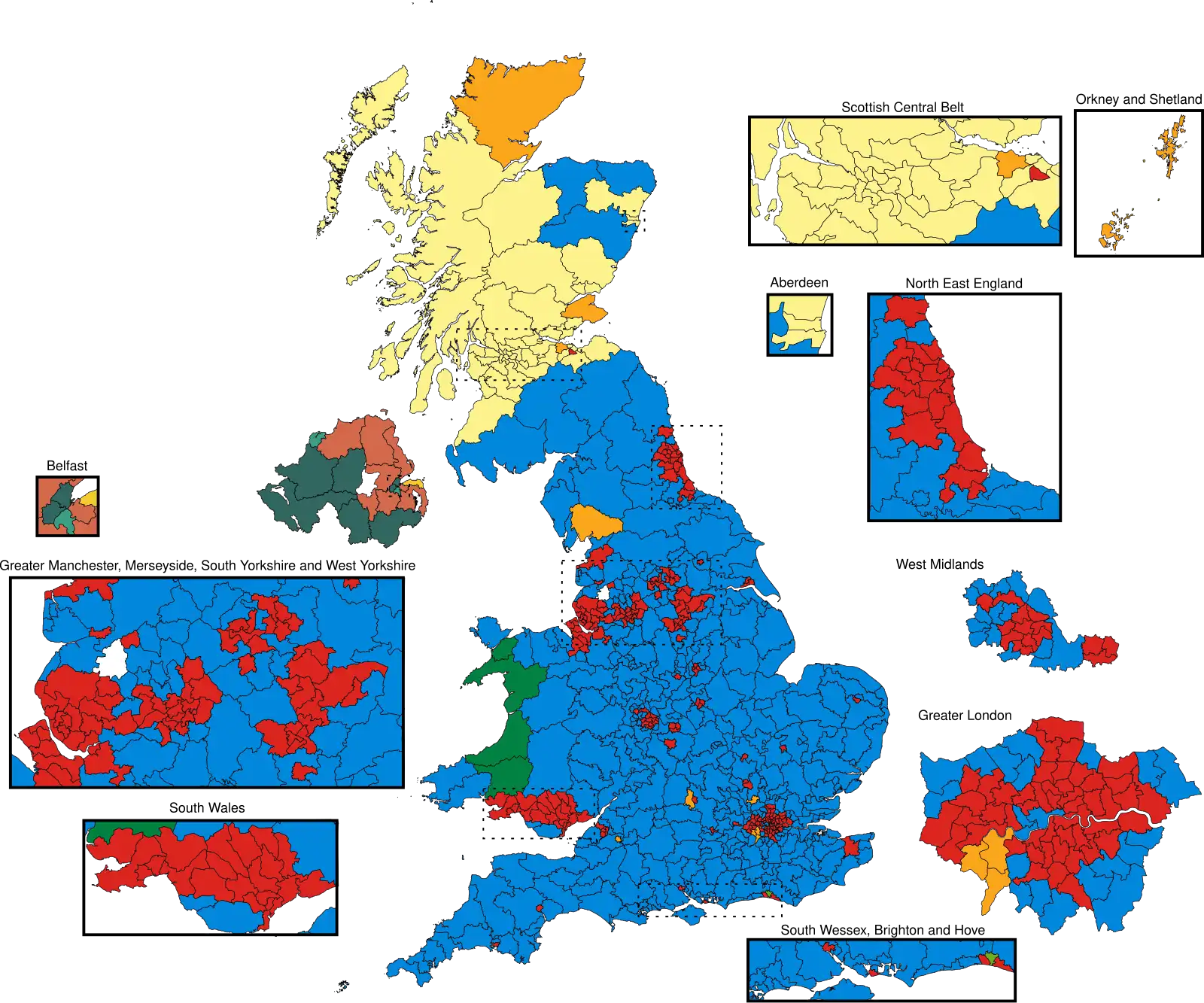

In UK General Elections, a landslide victory involves winning a large majority in parliament and often goes with a large swing from one party to another as well. Landslide victories have usually occurred after a long period of government from one particular party and a change in the popular mood. In the past a majority of over 100 was regarded as the technical hurdle to be defined as a landslide, as that allows the government freedom to easily enact its policies in parliament. In more recent times, the label 'landslide' has been applied in numerous press articles to victories which would not previously have been regarded as such, for example the Conservative Party majority of 80 in 2019. Its current usage is more as political commentary rather than technical definition and is a reflection of the strength of the party's ability to put its programme through parliament.[17][18][19][20]
Large majorities, however, are not always the advantage they appear: Anthony Seldon gives a number of examples of the infighting arising from large majorities, claim a sweet spot of 35-50 which is enough to protect from by-elections and still comfortably pass legislation.[21]
The largest landslide by any single party in the UK parliament, since universal suffrage was introduced, was the majority of 179 won by Tony Blair's Labour Party in 1997.
Notable landslide election results
- 1906 – Henry Campbell-Bannerman led his Liberal Party to victory over Arthur Balfour's Conservative Party who lost more than half their seats, including his own seat in Manchester East, as a result of the large national swing to the Liberal Party (The 5.4% swing from the Conservatives to Liberals was at the time the highest ever achieved). The Liberal Party won 397 seats (an increase of 214) while the Conservative Party were left with 156 seats (a decrease of 246).[22][23]
- 1945 – Clement Attlee led his Labour Party to victory over Winston Churchill's Conservative Party, a 12.0% swing from the Conservatives to Labour. Labour won 393 seats (an increase of 239) while the Conservative Party were left with 197 (a decrease of 190).[24]
- 1966 – Harold Wilson led the Labour Party to win 364 seats (an increase of 47) and gained an overall majority of 98 while the Conservative Party won 253 seats (a decrease of 51).
- 1983 – Margaret Thatcher led the Conservative Party to win a first landslide victory (her second term in office) with 397 seats (an increase of 38 seats) and gained an overall majority of 144 while the Labour Party led by Michael Foot won 209 seats (a decrease of 52).
- 1987 – Margaret Thatcher led the Conservative Party to win a second landslide victory (her third term in office) with 376 seats (a decrease of 21 seats) and gained an overall majority of 102 while the Labour Party led by Neil Kinnock won 229 seats (an increase of 20).
- 1997 – Tony Blair led the Labour Party to win a first landslide victory with 418 seats (an increase of 145) and gained an overall majority of 179 while the Conservative Party led by John Major won 165 seats (a decrease of 178). The swing from the Conservatives to Labour was 10.2% and was the second biggest general election victory of the 20th Century after 1931.[25]
- 2001 – Tony Blair led the Labour Party to win a second landslide victory with 412 seats (a decrease of 6) and gained an overall majority of 167 while the Conservative Party led by William Hague won 166 seats (an increase of 1), making Tony Blair the first Labour Prime Minister to serve two consecutive full terms in office.[26]
- 2015 – In Scotland the Scottish National Party won 56 of the 59 Scottish seats.
- 2019 – Boris Johnson led the Conservative Party to win a landslide victory (his second term in office) with 365 seats (an increase of 48, the party's highest seat count since 1987) and a majority of 80 seats, while the Labour Party led by Jeremy Corbyn won 202 seats (a decrease of 60, the party's worst result since 1935). The election led to 54 Labour seats changing to Conservative predominantly in the Midlands and Northern England – some of which had been held by Labour since the first half of the 20th century.[27]
- 2024 – Keir Starmer led the Labour Party to win a landslide victory with 411 seats (an increase of 209, the party's highest seat count since 2001) and a majority of 172 seats, while the Conservative Party led by Rishi Sunak won 121 seats (a decrease of 244, the party's worst ever result, exceeding the previous worst defeat of 1906.[28])
United States


A landslide victory in US Presidential elections occurs when a candidate has an overwhelming majority in the Electoral College.
- 1804 – Thomas Jefferson (D-R) received 162 (92%) of the electoral votes while Charles Cotesworth Pinckney (Federalist) received only 14 (8%). Jefferson won 72.8% of the popular vote, the highest margin of victory in any presidential election with multiple major candidates, although several states did not record the popular vote.
- 1816 – James Monroe (D-R) received 183 (83.9%) of the electoral votes while Rufus King (Federalist) received only 34 (15.6%). Additionally, Monroe received 72.9% of the popular vote.
- 1832 – Andrew Jackson (D) received 219 (76.6%) of the electoral votes while Henry Clay (National Republican) received 49 (17.1%), John Floyd (Nullifier) received 11 (3.9%), and William Wirt (Anti-Masonic) received only 7 (2.5%).
- 1840 – William Henry Harrison (Whig) received 234 (79.6%) of the electoral votes while Martin Van Buren (D) received only 60 (20.4%).
- 1852 – Franklin Pierce (D) received 254 (85.8%) of the electoral votes while Winfield Scott (Whig) received only 42 (14.2%).
- 1864 – Abraham Lincoln (R) received 212 (90.6%) of the electoral votes while George B. McClellan (D) received only 21 (9%).
- 1868 – Ulysses S. Grant (R) received 214 (72.8%) of the electoral votes while Horatio Seymour (D) received only 80 (27.2%).
- 1872 – Ulysses S. Grant (R) received 286 (81.9%) of the electoral votes while four candidates split the remaining 66 due to the death of Horace Greeley (D).
- 1904 – Theodore Roosevelt (R) received 336 (70.6%) of the electoral votes while Alton B. Parker (D) received only 140 (29.4%).
- 1912 – Woodrow Wilson (D) received 435 (81.9%) of the electoral votes while Theodore Roosevelt (Progressive) received 88 (16.6%) and William Howard Taft (R) received only 8 (1.5%)—the worst showing ever by an incumbent president. Wilson won just 41.8% of the popular vote in the three-way race, compared to 27.4% for Roosevelt and 23.2% for Taft.
- 1920 – Warren G. Harding (R) received 404 electoral votes, (76.08%) of the electoral vote. James M. Cox (D) only received 127 (23.92%). Additionally, Harding received 60.4% of the popular vote.
- 1924 – Calvin Coolidge (R) received 382 electoral votes, (71.94%) of the electoral vote. John W. Davis (D) only received 136 (25.61%) and Robert M. La Follette (Progressive) received only 13 (2.45%).
- 1928 – Herbert Hoover (R) received 444 (83.6%) of the electoral votes while Al Smith (D) received only 87 (16.4%).
- 1932 – Franklin D. Roosevelt (D) received 472 (88.9%) of the electoral votes while Herbert Hoover (R) received only 59 (11.1%).
- 1936 – Franklin D. Roosevelt (D) received 523 (98.5%) of the electoral votes—the largest share since 1820 and the largest in a non-unanimous election—while Alf Landon (R) received only 8 (1.5%). Additionally, Roosevelt received 60.8% of the popular vote.
- 1940 – Franklin D. Roosevelt (D) received 449 (84.6%) of the electoral votes while Wendell Willkie (R) received only 82 (15.4%).
- 1944 – Franklin D. Roosevelt (D) received 432 (81.4%) of the electoral votes while Thomas E. Dewey (R) received only 99 (18.6%).
- 1952 – Dwight D. Eisenhower (R) received 442 (83.2%) of the electoral votes while Adlai Stevenson II (D) received only 89 (16.8%).
- 1956 – Dwight D. Eisenhower (R) received 457 (86.1%) of the electoral votes while Adlai Stevenson II (D) received only 73 (13.7%).
- 1964 – Lyndon B. Johnson (D) received 486 (90.3%) of the electoral votes while Barry Goldwater (R) received only 52 (9.7%). Additionally, Johnson received 61.1% of the popular vote.
- 1972 – Richard Nixon (R) received 520 (96.7%) of the electoral votes while George McGovern (D) received only 17 (3.2%). One Republican elector voted for John Hospers of the Libertarian Party. Additionally, Nixon received 60.7% of the popular vote.
- 1980 – Ronald Reagan (R) received 489 (90.9%) of the electoral votes while Jimmy Carter (D) received only 49 (9.1%).
- 1984 – Ronald Reagan (R) received 525 (97.6%) of the electoral votes while Walter Mondale (D) received only 13 (2.4%).
- 1988 – George H. W. Bush (R) received 426 (79.2%) of the electoral votes while Michael Dukakis (D) received only 111 (20.8%). This is considered the most recent landslide US presidential election.
See also
- Wipeout (elections)
- Realigning election
- Wave elections in the United States
- Blowout (sports)
- Landslide (board game)
- Paper candidate
References
- ^ a b c Murse, Tom (8 October 2020). "Landslide Victory: Definition in Elections". ThoughtCo. Retrieved 18 October 2020.
- ^ "Landslide". Merriam-Webster.com Dictionary. Merriam-Webster. Retrieved 7 November 2024.
- ^ "Landslide". Cambridge Dictionaries (Online). Cambridge University Press. n.d. Retrieved 7 November 2024.
- ^ "Landslide". Collins English Dictionary. HarperCollins. Retrieved 7 November 2024.
- ^ James H Fowler; Oleg Smirnov (2009), Mandates, Parties, and Voters: How Elections Shape the Future, p. 15
- ^ Jason D. Mycoff; Joseph August Pika (2008), Confrontation and Compromise: Presidential and Congressional Leadership, 2001-2006, Rowman & Littlefield Publishers, p. 11
- ^ "Newman wins Brisbane election landslide". ABC News. 15 March 2008.
- ^ "The Mayor that was re-elected in a landslide, collecting 85 per cent of the votes". 20 October 2021.
- ^ "Biggest State Election Landslides". Armarium Interreta. 12 March 2021. Archived from the original on 12 March 2021. Retrieved 7 April 2021.
- ^ "Mark McGowan claims WA election victory as Liberals all but wiped out". The New Daily. 14 March 2021.
- ^ "Party Standings in the House of Commons (1867-date)". PARLINFO. Library of Parliament. 24 March 2016. Retrieved 5 April 2016.
- ^ "Political Tsunami turns Jamaica green with massive JLP victory". Retrieved 20 November 2020.
- ^ Electoral Commission (17 July 2014). Mixed Member Proportional Representation in New Zealand (Video). Wellington.
- ^ a b c d e f g "1890–1993 general elections". Electoral Commission New Zealand. Archived from the original on 8 April 2023. Retrieved 9 July 2023.
- ^ "Elections in 2006". Inter-Parliamentary Union. Archived from the original on 17 March 2022. Retrieved 26 September 2023.
- ^ "Legislative Assembly (Fono)". Inter-Parliamentary Union. Archived from the original on 1 September 2022. Retrieved 26 September 2023.
- ^ Bush, Stephen (8 June 2021). "Despite all reports, the election wasn't a landslide – and Johnson may be about to discover that reality". New Statesman. Retrieved 19 December 2022.
- ^ "Election results 2019: Boris Johnson returns to power with big majority". BBC News. 12 December 2019. Retrieved 19 December 2022.
- ^ Holder, Josh; Voce, Antonio; Barr, Caelainn; Holder, Josh; Voce, Antonio; Barr, Caelainn. "How did Boris Johnson achieve his landslide victory? A visual guide". The Guardian. ISSN 0261-3077. Retrieved 19 December 2022.
- ^ "Inside the landslide: Thatcher's personal papers for 1983 opened to the public". University of Cambridge. 10 October 2013. Retrieved 19 December 2022.
- ^ Seldon, Anthony (8 June 2017). "Politicians dream of landslide victories – but they are a curse, not a blessing". The Guardian.
- ^ "1906: The Liberal landslide". 9 February 2006 – via bbc.co.uk.
- ^ Liberal Landslide: The General Election of 1906.
- ^ Labour Landslide, July 5-19, 1945.
- ^ Labour's Landslide: The British General Election 1997.
- ^ "The rise and fall of New Labour". BBC News. 3 August 2010. Retrieved 30 December 2021.
- ^ "Boris Johnson must fulfil his One Nation pledge". Financial Times. 13 December 2019. Retrieved 14 December 2019.
- ^ "UK election results 2024". BBC. 6 July 2024. Retrieved 6 July 2024.