Former football teams in New Orleans include the New Orleans Breakers of the United States Football League (1984) (which became the Portland Breakers), New Orleans Breakers of the United States Football League (2022–2023), New Orleans Night of the Arena Football League (1991–1992), the New Orleans Thunder of the Regional Football League (1999), the Louisiana Jazz of the Women's Football Alliance (2002–2014), the New Orleans VooDoo of the Arena Football League (2004–2005, 2007–2008, and 2010–2015), the New Orleans Jazz football club of the Stars Football League (2011) and New Orleans Krewe of the US Women's Football League (2016).
Former college football teams in New Orleans include the Dillard Bleu Devils (1935–1965), the Loyola Wolf Pack (1921–1939) and the Xavier Gold Rush (1925–1960).
Special Football Games
Tulane Stadium was New Orleans' main venue for big games before the construction of the Louisiana Superdome (1979 photo)
1976 Pro Bowl -- The 1976 Pro Bowl was the NFL's 26th annual all-star game. The game was played on Monday, January 26, 1976, at the Louisiana Superdome.[7]
Sugar Bowl -- New Orleans has been home to the annual Sugar Bowl since 1935. Originally played at Tulane Stadium, it has been played in Caesars Superdome since 1975.
New Orleans Bowl -- New Orleans has been home to the annual New Orleans Bowl since 2001 in Caesars Superdome.
Pelican Bowl -- The Pelican Bowl was an NCAA Division II bowl game played in New Orleans in 1974 and 1975 that pitted the conference champions from the Mid-Eastern Athletic Conference (MEAC) and the Southwestern Athletic Conference (SWAC) to determine the black college football national championship.[8]
East–West Shrine Game -- The 18th annual East–West Shrine post-season college football all-star game was held in New Orleans on January 1, 1943, due to WWII travel restrictions on the West Coast.[9]
ArenaBowl -- New Orleans played host to the AFL's championship game in 2007, 2008 and 2012 hosting all games in the New Orleans Arena.
Former professional basketball teams in New Orleans include the New Orleans Jazz of the NBA (1974–1979) (which became the Utah Jazz) and the New Orleans Buccaneers of the American Basketball Association (1967–1970) (which became the Memphis Pros). Other professional basketball teams include the New Orleans Hurricanes of the Professional Basketball League of America (1947), New Orleans Sports of the Southern Basketball League (1948–1949), New Orleans Pride of the Women's Professional Basketball League (1979–1981) and New Orleans Cougars of the American Basketball Association. The NBA's Atlanta Hawks played 12 special "home" games in New Orleans during the 1984–85 season.
Collegiate
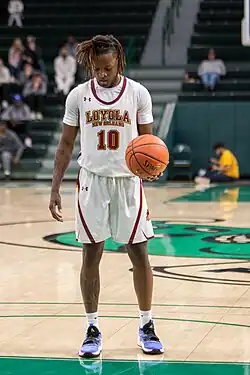
Loyola Wolf Pack guard Brandon Davis prepares to shoot a free throw on March 12, 2022. One of his 19 points along with 11 assist, which helped to prevail the Wolf Pack into the NAIA Round of 16.
Dillard Bleu Devils -- The Dillard Bleu Devils men's basketball team and Dillard Lady Bleu Devils women's basketball team represents Dillard University in the NAIA.
SUNO Knights -- The SUNO Knights men's basketball team and SUNO Lady Knights women's basketball team represents Southern University at New Orleans in the NAIA.
Xavier Gold Rush -- The Xavier Gold Rush men's basketball team and Xavier Gold Nuggets women's basketball team represents Xavier University of Louisiana in the NAIA.
Women's Final Four -- The Women's Final Four has been held in New Orleans in 1991, 2004 and 2013. The New Orleans Arena hosted the Women's Final Four in 2004 and 2013. Lakefront Arena hosted the women's Final Four in 1991.
Baseball was first played in New Orleans as early as 1859. In that year, amateur baseball leagues played games on the grounds of Delachaise Estates in Uptown New Orleans and the Lone Star Base Ball Club was organized.[10]
There were many innovations in baseball that originated in New Orleans. The first spring training was held in New Orleans in 1870 as the Chicago White Stockings (now Chicago Cubs) traveled to the city to play the Cincinnati Red Stockings, but stayed several weeks to train.[10] The practice of covering the infield with a modified canvas tarpaulin on rainy days was first used in New Orleans in 1887.[10] On April 29, 1887, a recurring Ladies' Day was established to create an environment in the stands free of unsavory characters and conduct, as well as to make baseball a family oriented event.[10] In 1889, issuing "rain checks" for rained out games using a perforated ticket stub was invented in New Orleans by Abner Powell.[11]
Major League Baseball Urban Youth Academy -- The Major League Baseball Urban Youth Academy has a location in New Orleans at Wesley Barrow Stadium. It is a 650-seat baseball stadium and includes a grass tee-ball and softball field.
Wally Pontiff Jr. Classic -- College baseball game held annually at Zephyr Field from 2004–present.[28] The LSU Tigers baseball team plays an opponent in the game to honor former LSU Baseball player and Oakland A's draftee, Wally Pontiff Jr., who died at the age of 21 from a genetic heart disorder. In 2004, LSU won the first game of the series vs. Southeastern Louisiana, 9–3. Wally Pontiff Playground in Jefferson Parish, Louisiana is also named after the player.
Bowling
Professional
Professional Bowling tournaments -- New Orleans played host to PBA Tour events in 1963, 1964, 1966–1978 and 1988–1990. A PBA Tour sponsored exhibition tournament took place in 2009 and 2010.
On May 10, 1870, in the New Orleans suburb of Kennerville, "Gypsy" Jem Mace defeated Tom Allen for what is claimed to be the 1870 heavyweight championship of the bare-knuckle boxing era. This fight is considered by some boxing historians to be the first world heavyweight championship bout. A monument in present-day Kenner, Louisiana marks the spot of the fight near the Mississippi River.[29]
The 1892 world heavyweight championship match between John L. Sullivan and Gentleman Jim Corbett is sometimes considered the start of the modern era of boxing. In contrast to earlier bare-knuckle fights held out of doors, the match was held using boxing gloves according to the Marquis of Queensbury rules, indoors at night in the electrically illuminated Olympic Club Arena - called "the epicenter of professional boxing" in the mid-1880s-late 1890s era.[30]
The Louisiana Superdome hosted the 1978 Leon Spinks vs. Muhammad Ali II fight some called "The Ali rematch" where Muhammad Ali defeated Leon Spinks in front of a crowd of 65,000; it was Ali's last professional win.
Sugar Ray Leonard vs. Roberto Durán II, also known as the No Más Fight, is one of the most famous fights in boxing history. Taking place on November 25, 1980, at the Louisiana Superdome, it was the second of three bouts between Sugar Ray Leonard and Roberto Durán. In the match, Leonard defeated Duran to regain the WBC Welterweight Championship. The match gained its famous appellation in the end of the eighth round when Durán turned away from Leonard, towards the referee and quit by saying "No más" (Spanish for "No more").
The Carnival of Champions was held on December 3, 1982, at the Louisiana Superdome. In the first of two co-main events, Wilfredo Gómez would defend his WBC world Jr Featherweight championship against WBC's world Bantamweight champion Lupe Pintor. In the second, Wilfred Benítez defended his WBC world Jr Middleweight championship against the former WBA Welterweight champion of the world Thomas Hearns.[35]
On September 9, 2000, the New Orleans Arena hosted a light heavyweight title fight between Roy Jones Jr. and Eric Harding. Jones won by TKO in the 10th round.
Collegiate
Former college boxing teams in New Orleans include the Loyola Wolf Pack.
Cross country
Collegiate
Dillard Bleu Devils -- The Dillard Bleu Devils men's cross country team and Dillard Lady Bleu Devils women's cross country team represents Dillard University in the NAIA.
Tulane Green Wave -- The Tulane Green Wave men's cross country team and Tulane Green Wave women's cross country team represents Tulane University in NCAA Division I college cross country.
Xavier Gold Rush -- The Xavier Gold Rush men's cross country team and Xavier Gold Nuggets women's cross country team represents Xavier University of Louisiana in the NAIA.
New Orleans is home to the Fair Grounds Race Course, the nation's third-oldest thoroughbred track. The most prestigious race held at the track is the Louisiana Derby, a Grade II stakes prep for the Kentucky Derby. The race course opened in 1852 as the Union Racetrack and later became the Creole Racetrack.
Former horse racing tracks in the New Orleans area include Eclipse Race Course (opened 1837), Metairie Course (1838–1872), Bingaman Race Track, City Park Race Track (1905–1920), Jefferson Park Race Track (1918–1934) and Jefferson Downs Racetrack (1959–1992).[40]
Ice hockey
Professional
New Orleans Brass -- The New Orleans Brass was a former ice hockey team in New Orleans from 1997 to 2002.
Ironman 70.3
Ochsner Ironman 70.3 New Orleans -- The Ochsner Ironman 70.3 New Orleans, also known as a Half-Ironman or a 70.3 (miles), is one of a series of middle-distance triathlon races organized by the World Triathlon Corporation (WTC). The event comprises a 1.2 mile swim, a 56-mile bike ride and 13.1 mile run.
Lacrosse
The Allstate Sugar Bowl Collegiate Lacrosse Series was held at Pan American Stadium from 2011 to 2015.[41][42][43][44][45][46]
The Allstate Sugar Bowl High School Lacrosse Classic first held in 2007 has been played at multiple locations in the New Orleans metropolitan area such as City Park, Lafreniere Park, LaSalle Park and Pan American Stadium.[47][48][49]
UFC 16 -- UFC 16 took place on March 13, 1998, at the Pontchartrain Center in the New Orleans suburb of Kenner, Louisiana. It featured the first ever UFC Lightweight tournament (for fighters under 170 lb), as well as a Middleweight Championship bout, a Heavyweight and a Middleweight Superfight, and two alternate bouts in case of tournament injury.
UFC 18 -- UFC 18 took place on January 8, 1999, at the Pontchartrain Center in the New Orleans suburb of Kenner, Louisiana. The event featured a UFC Lightweight Championship (now known as the Welterweight Championship) bout and six other bouts. UFC 18 was technically part two of what the UFC called "The Road To The Heavyweight Title", a tournament, spanning four events, held to crown the new UFC Heavyweight Champion after the title was vacated by Randy Couture.
UFC 27 -- UFC 27 took place on September 22, 2000, at the Lakefront Arena in the New Orleans. The event featured UFC legend Dan "The Beast" Severn returning to the promotion after more than 3 years on the independent scene to face off against top heavyweight contender Pedro Rizzo. Severn was the fan favorite, but he submitted to leg kicks from "The Rock" in the first round. Also, former UFC Heavyweight ChampionMaurice Smith took on the first KOTC Heavyweight Champion Bobby Hoffman. Smith won via majority decision. There were 2 preliminary fights and 6 main card fights.
The NOLA Motorsports Park is a road race track in Avondale, Louisiana, approximately twenty minutes from downtown New Orleans. The north track circuit and kart circuit opened in 2011.
Grand Prix du Mardi Gras—In 1991, 1992, and 1995, New Orleans was home to the Grand Prix du Mardi Gras. The IMSA sports car races took place on two street circuits downtown. In 1991, streets near the riverfront were used for the race course. In 1992 and 1995, a course that ran around the Superdome was used.[59]
Big Easy Rollergirls -- The Big Easy Rollergirls is the name of a female roller derby league in New Orleans. The league plays at the Human Performance Center.
New Orleans Brass Roller Derby -- New Orleans Brass Roller Derby is the name of a male roller derby team in New Orleans.
New Orleans Rugby Football Club (NORFC) -- The New Orleans Rugby Football Club, founded in 1973, is a men's rugby union club serving the greater New Orleans area. NORFC competes in Division I of the Deep South Rugby Football Union of USA Rugby.[63] NORFC has won two club rugby national championships.
New Orleans Halfmoons -- The New Orleans Halfmoons is a women's rugby team and member of USA Rugby. It is one of the oldest women's teams in the United States,[64] and has hosted the annual "Throw Me Something, Rugger!" Mardi Gras Rugby tournament the weekend before Fat Tuesday since 1980. The team practices at the City Park Practice Track.[65]
Crescent City Classic -- The Crescent City Classic is a 10k race held every April.
Crescent City Fall Classic -- The Crescent City Classic is a 5k race held every November.
Crescent Connection Bridge Run -- The Crescent Connection Bridge Run is a 4-mile race held in June.
Rock 'n' Roll Mardi Gras Marathon -- The Rock 'n' Roll Mardi Gras Marathon (formerly the Mardi Gras Marathon) is held in February.
Soccer
New Orleans was one of the first cities in the world where modern soccer was played.[66] Beginning in 1858 as a community sport, the sport became popular among many athletic clubs in the late 19th century. A semi-professional league consisting of some of the best players in the world, several of whom later played for first division teams in England and Scotland, briefly used the old grounds on what would become Pelican Stadium.[66]
Former professional soccer teams in New Orleans include the New Orleans Storm of the USL A-League (1993–1999) and FC New Orleans of the National Premier Soccer League as a provisional member (2012).[67]
Amateur/Semi-Pro
Leagues
ISLANO -- The International Soccer League Association New Orleans (ISLANO) is a men's semi-professional soccer league and part of the Louisiana Soccer Association.
Teams
Motagua New Orleans competes in the Gulf Coast Premier League and ISLANO.
Former amateur/semi-pro soccer teams in New Orleans include the Louisiana Fire of the Gulf Coast Premier League (2016–2017).
New Orleans Sun Belt Nets—The New Orleans Sun Belt Nets were a franchise of World Team Tennis (WTT). The Nets moved to New Orleans for the 1978 season and played their home matches in the Louisiana Superdome. Following the 1978 season, the Nets announced that the team would fold.
Tulane Green Wave -- The Tulane Green Wave men's tennis team and Tulane Green Wave women's tennis team represents Tulane University in NCAA Division I college tennis.
Xavier Gold Rush -- The Xavier Gold Rush men's tennis team and Xavier Gold Nuggets women's tennis team represents Xavier University of Louisiana in the NAIA.
Special Tennis Matches
New Orleans Grand Prix—The New Orleans Grand Prix was a men's tennis tournament played in New Orleans from 1978 to 1980. The event was part of the Grand Prix tennis circuit.
Virginia Slims of New Orleans—New Orleans played host to the Virginia Slims Women's Tennis Association (WTA) tournament in 1984 through 1988.
Dillard Bleu Devils -- The Dillard Bleu Devils men's track and field team and Dillard Lady Bleu Devils women's track and field team represents Dillard University in the NAIA.
SUNO Knights -- The SUNO Knights men's track and field team and SUNO Lady Knights women's track and field team represents Southern University at New Orleans in the NAIA.
Tulane Green Wave -- The Tulane Green Wave men's track and field team and Tulane Green Wave women's track and field team represents Tulane University in NCAA Division I college track and field.
Xavier Gold Rush -- The Xavier Gold Rush men's track and field team and Xavier Gold Nuggets women's track and field team represents Xavier University of Louisiana in the NAIA.
Special Track and Field Meets
1992 United States Olympic track and field trials—The 1992 United States Olympic track and field trials were held at Tad Gormley Stadium from June 19–28. It was organised by USA Track and Field and served as the national championships in track and field for the United States. The results of the event determined qualification for the United States at the 1992 Summer Olympics held in Barcelona, Spain.
Tulane Green Wave -- The Tulane Green Wave women's volleyball team represents Tulane University in NCAA Division I. The school also has a women's beach volleyball team; the NCAA holds a single national championship in that sport for members of all three of its divisions.
AVP New Orleans Open—The AVP Pro Beach Volleyball Tour held the men's and women's New Orleans Open in 2015 and 2016. The AVP Pro Beach Volleyball Tour held the men's New Orleans Open in 1989, 1990, 1992 and 1999.[71]
WPVA New Orleans—The WPVA Pro Beach Volleyball Tour held women's tournaments in New Orleans in 1993, 1994 and 1995.[71]
Indoor volleyball
Women's Volleyball Final Four—The 2002 NCAA Division I Women's Volleyball final four was held at the New Orleans Arena in December 2002.
Water sports
Fishing tournaments
Bassmaster Classic — is a fishing tournament that was held in the New Orleans area in 1999, 2001, 2003 and 2011.
City Park Big Bass Fishing Rodeo — is a fishing tournament founded in 1946. It is held annually in New Orleans' City Park and is the country's oldest freshwater fishing tournament.[72]
Powerboat racing
Offshore powerboat racing has had a long history in New Orleans, Louisiana. Races have been held in either Lake Pontchartrain or on the Mississippi River. The most commonly held race was the Popeyes Offshore Grand Prix held annually from 1983 to 1991. Other powerboat races took place in 1980, 1981, 1982, 2002, 2003 and 2008.
New Orleans was also the home port for the Popeyes Offshore race team from 1980 to 1990. The race team was formed by Al Copeland Sr., the founder of Popeyes Fried Chicken Restaurants and Copeland's Restaurants.[73] He was a six-time U.S. national champion and world champion in 1985 and 1986.
Yachting
Southern Yacht Club
New Orleans is home to the New Orleans Yacht Club and Southern Yacht Club, both of which are located at West End on the shore of Lake Pontchartrain. Southern Yacht Club was established in 1849 and is the second oldest yacht club in the United States.[74]
Regattas include:
Mardi Gras Race Week — New Orleans Yacht Club large One Design regatta held on Lake Pontchartrain.
Race to the Coast — Southern Yacht Club Regatta since 1849. Oldest continuously running point to point regatta in the Western Hemisphere United States.[75]
Sugar Bowl Regatta — has been held since 1934. The sailing competition is divided into two separate phases, over four two-day periods, beginning in late November and concluding on New Year's Eve.[76]
^At the time of the bowl's creation in 1972, the NCAA was divided into the "University Division" and "College Division". The current three-division setup was established in 1973. The conferences that participated in this game eventually became Division I conferences, and their members' football programs now compete in the Football Championship Subdivision.

 New Orleans Saints, Image is the logo for the professional NFL football team based in New Orleans
.jpg) Interior of the Caesars Superdome, Home of the New Orleans Saints
Interior of the Caesars Superdome, Home of the New Orleans Saints Former New Orleans Saints quarterback, Drew Brees
 The New Orleans Saints take on the Dallas Cowboys
 New Orleans Pelicans, Image is the wordmark for the professional NBA basketball team based in New Orleans
 Interior of the Smoothie King Center, Home of the New Orleans Pelicans
.jpg) New Orleans Pelicans players Zion Williamson and Brandon Ingram
New Orleans Pelicans players Zion Williamson and Brandon Ingram New Orleans Pelicans huddle pregame before taking on the Memphis Grizzlies on January 31, 2020
 Gold Mine on Airline, Home of the New Orleans Gold, Major League Rugby team
_Main_Entrance.jpg) Pan American Stadium, Home of the New Orleans Jesters, National Premier Soccer League team
Pan American Stadium, Home of the New Orleans Jesters, National Premier Soccer League team.jpg)
 TPC Louisiana clubhouse




_-_Away_Grandstand.jpg)


