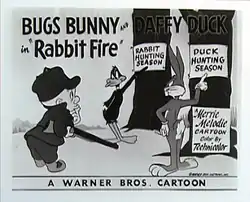
Rabbit Fire is a 1951 Looney Tunes cartoon starring Bugs Bunny, Daffy Duck, and Elmer Fudd.[1] Directed by Chuck Jones and written by Michael Maltese,[2] the cartoon is the first in Jones' "hunting trilogy"—the other two cartoons following it being Rabbit Seasoning and Duck! Rabbit, Duck! It is also the first cartoon to feature a feud between Bugs and Daffy. Produced by Edward Selzer for Warner Bros. Cartoons, the short was released to theaters on May 19, 1951 by Warner Bros. Pictures and is often considered among Jones' best and most important films.
The film marks a significant shift in Daffy's personality, going from being the insane "screwball" character who (like Bugs) overwhelmed his adversaries, to a much more flawed individual, full of greed and vanity and desire for attention under the spotlight. This personality change, which was previously explored by Jones in You Were Never Duckier and Daffy Dilly, and even earlier in Friz Freleng's You Ought to Be in Pictures, was done in order for Daffy to better serve as Bugs' foil. This was fueled by Bugs' popularity surpassing Daffy's quickly over the years, increasing the desire of the studio's animators to pair the two together. Since then, Daffy's earlier screwball personality has been revisited in newer Looney Tunes media such as Looney Tunes Cartoons.
Plot
Daffy Duck orchestrates a ruse to lure Elmer Fudd to Bugs Bunny's burrow, initiating a cycle of mistaken identity. Initially, Daffy incites Elmer to target Bugs under the false pretense of rabbit season, only for Bugs to counter that it is duck season. Daffy, indignant, engages in a verbal duel with Bugs, unwittingly validating Bugs' assertions and prompting Elmer to fire upon him repeatedly.
Subsequently, Daffy's attempt to reverse the verbal game results in his repeated defeat, culminating in his apparent demise at the hands of Elmer. However, Daffy's resilience persists as he cunningly disguises himself as Bugs, leading to a further escalation of the hunting season debate. Through a series of costume changes and sign manipulations, Bugs and Daffy perpetuate the confusion, ultimately turning the tables on Elmer and subjecting him to their own brand of humor.
As tensions escalate, Elmer's patience wanes, prompting a final confrontation where Bugs and Daffy adopt various personas to outwit him. The climax unfolds as they inundate Elmer with a barrage of "Rabbit Season" and "Duck Season" signs, ultimately declaring it to be "Elmer Season." With Elmer now in the crosshairs, Bugs and Daffy assume the role of hunters and stalk Elmer with shotguns in hand.
Voice cast
Reception
Rabbit Fire is generally considered among Chuck Jones and Michael Maltese's best works, and is noted for its use of dialogue gags in lieu of the physical gags more typical in animation.[3] Besides the two sequels to this film, a number of other Jones shorts, including Beanstalk Bunny and Ali Baba Bunny, paired quick-witted Bugs and self-serving Daffy with (or rather against) each other.
It is also worth noting that in this episode, Mel Blanc showcased his ability to make one character imitate another character's voice, in this case, Daffy Duck impersonating Bugs Bunny and vice versa. Actor and voice actor Hank Azaria pointed out that as a voice actor, it is almost impossible to accomplish. At one point, he tried to do that in The Simpsons, along with the other cast members, but none of them could do it.[4]
The "rabbit season/duck season" argument from this short became one of the references in the Looney Tunes franchise to have been analyzed both by scholars and by Jones himself (although this gag was actually used by Daffy against Porky six years earlier in the cartoon Duck Soup to Nuts). According to an essay by Darragh O'Donoghue, Rabbit Fire "stands in close relation to human experience, striving and generally failing to grasp an elusive quarry or goal."[5] Richard Thompson said that in the film, there is "the clearest definition of character roles: Elmer never knows what's going on; Bugs always knows what's going on and is in control of things; Daffy is bright enough to understand how to be in control, but never quite makes it." Jones himself refers to Rabbit Fire as a "corner" picture, among his works that, "as in turning a corner in a strange city, reveal new and enchanting vistas."
The short earned an honorable mention for animation historian Jerry Beck's list of The Fifty Greatest Cartoons: As Selected by 1000 Animation Professionals. Its 1952 sequel, Rabbit Seasoning, made the actual list at number 30. The style, setup, and plot of Rabbit Fire were adapted into the opening sequence of Warner Bros.' 2003 film Looney Tunes: Back in Action.
The non sequitur elephant character based on Joe Besser was the inspiration for Horatio the Elephant, a recurring character on PBS' Sesame Street.
The Elephant from The Major Lied 'Til Dawn reappeared, but was redesigned.
Rabbit Fire is one of several shorts where Bugs Bunny performs drag to trick his enemies. Multiple scholars analyze Rabbit Fire to argue that Bugs Bunny’s drag performances demonstrate the cultural construction of gender,[6] [7] [8][9] as well as animation’s ability to expose “the constructedness of gender and sexuality through parodic redeployment.”[6]
Production details
- In two interviews conducted years after this cartoon was first released, director Chuck Jones fondly recalled voice artist Mel Blanc improvising hilariously as Daffy when he was trying to think of another word besides "despicable". However, in the finished film, only the words from the original dialogue script Archived 2012-02-07 at the Wayback Machine actually appear. Historians believe that Blanc did indeed improvise, as Jones remembered, but then Jones had decided instead to use what was originally written.[10]
- Rabbit Fire and its two sequels often have two characters in the same frame for some length of time — an atypical aspect of the "Hunting" trilogy. In order to keep budgets under control, most Warner Bros. cartoons would cut back and forth between characters, rather than put two or more in the same shot. Or, at least, both characters might be in the same shot, but only one would actually be animated.[11]
- Although the film is introduced by the Looney Tunes music The Merry-Go-Round Broke Down, the opening card indicates a Merrie Melodies "Blue Ribbon" release from 1960, and the end card is Merrie Melodies, replacing the original orange-red Looney Tunes title sequences.
- It marked the first cartoon where Bugs and Daffy starred and appeared together. While Bugs had made a cameo in Porky Pig's Feat (which co-starred Daffy and Porky Pig), this was the first where both were the stars.
- Although this is the first cartoon with Daffy's selfish side replacing his screwball side, he still hollers "hoo-hoo", a catchphrase from his screwball personality.
- The title of this short is a pun on "rapid fire".
This cartoon is available on the Looney Tunes Golden Collection: Volume 1, Disc 2, The Essential Bugs Bunny, Disc 1, the Looney Tunes Platinum Collection: Volume 2, Disc 2, and the Bugs Bunny 80th Anniversary Collection, Disc 2.
References
- ^ Beck, Jerry; Friedwald, Will (1989). Looney Tunes and Merrie Melodies: A Complete Illustrated Guide to the Warner Bros. Cartoons. Henry Holt and Co. p. 223. ISBN 0-8050-0894-2.
- ^ Lenburg, Jeff (1999). The Encyclopedia of Animated Cartoons. Checkmark Books. pp. 60–61. ISBN 0-8160-3831-7. Retrieved June 6, 2020.
- ^ Beck, Jerry, ed. (2020). The 100 Greatest Looney Tunes Cartoons. Insight Editions. pp. 146–149. ISBN 978-1-64722-137-9.
- ^ YouTube (April 13, 2012). "Mel Blanc did over a 1000 different Voices in over 5000 CARTOONS ! - UNIQUE GENIUS". YouTube. Archived from the original on February 8, 2018. Retrieved March 1, 2018.
- ^ Darragh O'Donoghue's review Archived 2005-07-02 at the Wayback Machine of What's Opera, Doc?, Rabbit Fire, and Feline Frameup. sensesofcinema.com
- ^ a b Griffin, Sean (December 31, 2017), Samer, Roxanne; Whittington, William (eds.), "ELEVEN Pronoun Trouble: The "Queerness" of Animation", Spectatorship, University of Texas Press, p. 180, doi:10.7560/313497-013, ISBN 978-1-4773-1377-0, retrieved June 17, 2025
- ^ Abel, Sam (1995). "The Rabbit in Drag: Camp and Gender Construction in the American Animated Cartoon". The Journal of Popular Culture. 29 (3): 183–202. doi:10.1111/j.0022-3840.1995.00183.x. ISSN 1540-5931.
- ^ Savoy, Eric (1995). "The Signifying Rabbit". Narrative. 3 (2): 188–209. ISSN 1063-3685. JSTOR 20107053.
- ^ Sandler, Kevin S. (1998). "Gendered Evasion: Bugs Bunny in Drag". Reading the Rabbit: Explorations in Warner Bros. Animation. New Brunswick, N.J: Rutgers University Press. pp. 154–171. ISBN 9780813525389.
- ^ "You're Despicable!" Archived 2013-06-16 at the Wayback Machine – michaelbarrier.com. Retrieved 2008-01-16.
- ^ Michael Barrier's audio commentary for Disc One of Looney Tunes Golden Collection: Volume 1 (2005).
Sources
- Jones, Chuck (1989). Chuck Amuck: The Life and Times of an Animated Cartoonist. New York: Farrar Straus & Giroux. ISBN 0-374-12348-9.
- Jones, Chuck (1996). Chuck Reducks: Drawing from the Fun Side of Life. New York: Warner Books. ISBN 0-446-51893-X.
- Thompson, Richard (January–February 1975). Film Comment.
External links
|
|---|
|
Looney Tunes
short films | | 1930s | |
|---|
| 1940s |
- Patient Porky (1940; cameo)
- Porky Pig's Feat (1943; cameo)
- Buckaroo Bugs (1944)
- Hare Conditioned (1945)
- Hare Tonic (1945)
- Baseball Bugs (1946)
- Acrobatty Bunny (1946)
- Racketeer Rabbit (1946)
- The Big Snooze (1946)
- Rabbit Transit (1947)
- Easter Yeggs (1947)
- Gorilla My Dreams (1948)
- A Feather in His Hare (1948)
- Buccaneer Bunny (1948)
- Haredevil Hare (1948)
- A-Lad-In His Lamp (1948)
- Mississippi Hare (1949)
- High Diving Hare (1949)
- Long-Haired Hare (1949)
- The Grey Hounded Hare (1949)
- The Windblown Hare (1949)
- Rabbit Hood (1949)
|
|---|
| 1950s | |
|---|
| 1960s |
- Horse Hare (1960)
- Rabbit's Feat (1960)
- The Abominable Snow Rabbit (1961)
- Prince Violent (1961)
- Wet Hare (1962)
- Shishkabugs (1962)
- The Million Hare (1963)
- Hare-Breadth Hurry (1963)
- Dumb Patrol (1964)
- The Iceman Ducketh (1964)
- False Hare (1964)
|
|---|
| 1990s | |
|---|
|
|---|
Merrie Melodies
short films | | 1930s |
- Prest-O Change-O (1939)
- Hare-um Scare-um (1939)
|
|---|
| 1940s | |
|---|
| 1950s |
- Hurdy-Gurdy Hare (1950)
- Homeless Hare (1950)
- Hillbilly Hare (1950)
- Bunker Hill Bunny (1950)
- Hare We Go (1951)
- Bunny Hugged (1951)
- French Rarebit (1951)
- Ballot Box Bunny (1951)
- Big Top Bunny (1951)
- Foxy by Proxy (1952)
- Oily Hare (1952)
- Rabbit Seasoning (1952)
- Rabbit's Kin (1952)
- Duck Amuck (1953; cameo)
- Upswept Hare (1953)
- Hare Trimmed (1953)
- Duck! Rabbit, Duck! (1953)
- Captain Hareblower (1954)
- Baby Buggy Bunny (1954)
- Beanstalk Bunny (1955)
- Hare Brush (1955)
- This Is a Life? (1955)
- Knight-mare Hare (1955)
- Bugs' Bonnets (1956)
- Napoleon Bunny-Part (1956)
- Half-Fare Hare (1956)
- Wideo Wabbit (1956)
- To Hare Is Human (1956)
- Ali Baba Bunny (1957)
- Bedevilled Rabbit (1957)
- What's Opera, Doc? (1957)
- Rabbit Romeo (1957)
- Hare-Less Wolf (1958)
- Hare-Abian Nights (1959)
- Apes of Wrath (1959)
- Backwoods Bunny (1959)
- Bonanza Bunny (1959)
- People Are Bunny (1959)
|
|---|
| 1960s |
- Person to Bunny (1960)
- From Hare to Heir (1960)
- Lighter Than Hare (1960)
- Compressed Hare (1961)
- Bill of Hare (1962)
- Devil's Feud Cake (1963)
- The Unmentionables (1963)
- Mad as a Mars Hare (1963)
- Transylvania 6-5000 (1963)
- Dr. Devil and Mr. Hare (1964)
|
|---|
| 1990s | |
|---|
|
|---|
| Other short films | |
|---|
| Feature films | | Theatrical | |
|---|
| Direct-to-video | |
|---|
|
|---|
| TV series | |
|---|
| TV specials | |
|---|
|
|---|
|
Looney Tunes
short films | | 1930s |
- Porky's Duck Hunt (1937)
- What Price Porky (1938)
- Porky & Daffy (1938)
- The Daffy Doc (1938)
- Scalp Trouble (1939)
- Wise Quacks (1939)
- Naughty Neighbors (1939)
|
|---|
| 1940s |
- Porky's Last Stand (1940)
- You Ought to Be in Pictures (1940)
- A Coy Decoy (1941)
- The Henpecked Duck (1941)
- Daffy's Southern Exposure (1942)
- The Impatient Patient (1942)
- The Daffy Duckaroo (1942)
- My Favorite Duck (1942)
- To Duck or Not to Duck (1943)
- The Wise Quacking Duck (1943)
- Yankee Doodle Daffy (1943)
- Porky Pig's Feat (1943)
- Scrap Happy Daffy (1943)
- Daffy – The Commando (1943)
- Tom Turk and Daffy (1944)
- Tick Tock Tuckered (1944)
- Duck Soup to Nuts (1944)
- Plane Daffy (1944)
- The Stupid Cupid (1944)
- Draftee Daffy (1945)
- Ain't That Ducky (1945)
- Book Revue (1946)
- Baby Bottleneck (1946)
- Daffy Doodles (1946)
- The Great Piggy Bank Robbery (1946)
- Birth of a Notion (1947)
- Along Came Daffy (1947)
- Mexican Joyride (1947)
- What Makes Daffy Duck (1948)
- The Up-Standing Sitter (1948)
- The Stupor Salesman (1948)
- Riff Raffy Daffy (1948)
- Wise Quackers (1949)
- Daffy Duck Hunt (1949)
|
|---|
| 1950s |
- Boobs in the Woods (1950)
- The Scarlet Pumpernickel (1950)
- The Ducksters (1950)
- (1951)
- The Prize Pest (1951)
- Thumb Fun (1952)
- The Super Snooper (1952)
- Fool Coverage (1952)
- Design for Leaving (1954)
- Sahara Hare (1955; cameo)
- Dime to Retire (1955)
- Stupor Duck (1956)
- A Star Is Bored (1956)
- Deduce, You Say! (1956)
- Boston Quackie (1957)
- Show Biz Bugs (1957)
- China Jones (1959)
|
|---|
| 1960s | |
|---|
| 1980s | |
|---|
| 1990s | |
|---|
| 2000s | |
|---|
| 2010s | |
|---|
|
|---|
Merrie Melodies
short films | | 1930s | |
|---|
| 1940s |
- Conrad the Sailor (1942)
- A Corny Concerto (1943)
- Slightly Daffy (1944)
- Nasty Quacks (1945)
- Hollywood Daffy (1946)
- A Pest in the House (1947)
- Daffy Duck Slept Here (1948)
- You Were Never Duckier (1948)
- Daffy Dilly (1948)
- Holiday for Drumsticks (1949)
|
|---|
| 1950s | |
|---|
| 1960s |
- Person to Bunny (1960)
- Quackodile Tears (1962)
- Fast Buck Duck (1963)
- Aqua Duck (1963)
- Assault and Peppered (1965)
- Corn on the Cop (1965)
- Go Go Amigo (1965)
- Mucho Locos (1966)
- Mexican Mousepiece (1966)
- Snow Excuse (1966)
- Feather Finger (1966)
- A Taste of Catnip (1966)
- Daffy's Diner (1967)
- The Music Mice-Tro (1967)
- Speedy Ghost to Town (1967)
- Go Away Stowaway (1967)
|
|---|
| 1980s | |
|---|
| 1990s | |
|---|
|
|---|
| Other short films | |
|---|
| Feature films | | Theatrical | |
|---|
| Direct-to-video | |
|---|
|
|---|
| TV series | |
|---|
| TV specials | |
|---|
|
|---|
|
| Short films | | 1930s |
- Little Red Walking Hood (1937; early version)
- The Isle of Pingo Pongo (1938; early version)
- Cinderella Meets Fella (1938; early version)
- A Feud There Was (1938; early version)
- Johnny Smith and Poker-Huntas (1938; early version)
- Hamateur Night (1939; early version)
- A Day at the Zoo (1939; early version)
- Believe It or Else (1939; early version)
|
|---|
| 1940s | |
|---|
| 1950s | |
|---|
| 1960s |
- Person to Bunny (1960)
- Dog Gone People (1960)
- What's My Lion? (1961)
- Crows' Feat (1962)
|
|---|
| 1970s | |
|---|
| 1990s | |
|---|
| 2010s | |
|---|
|
|---|
| Feature films | | Theatrical | |
|---|
| Direct-to-video | |
|---|
|
|---|
| TV series | |
|---|
| TV specials | |
|---|
|
|---|
| Short subjects | | 1930s |
- The Night Watchman (1938)
- Dog Gone Modern (1939)
- Robin Hood Makes Good (1939)
- Prest-O Change-O (1939)
- Daffy Duck and the Dinosaur (1939)
- Naughty but Mice (1939)
- Old Glory (1939)
- Snowman's Land (1939)
- Little Brother Rat (1939)
- The Little Lion Hunter (1939)
- The Good Egg (1939)
- Sniffles and the Bookworm (1939)
- The Curious Puppy (1939)
|
|---|
| 1940s |
- Mighty Hunters (1940)
- Elmer's Candid Camera (1940)
- Sniffles Takes a Trip (1940)
- Tom Thumb in Trouble (1940)
- The Egg Collector (1940)
- Ghost Wanted (1940)
- Stage Fright (1940)
- Good Night Elmer (1940)
- Bedtime for Sniffles (1940)
- Elmer's Pet Rabbit (1941)
- Sniffles Bells the Cat (1941)
- Joe Glow, the Firefly (1941)
- Porky's Ant (1941)
- Toy Trouble (1941)
- Porky's Prize Pony (1941)
- Inki and the Lion (1941)
- Snow Time for Comedy (1941)
- The Brave Little Bat (1941)
- Saddle Silly (1941)
- Porky's Midnight Matinee (1941)
- The Bird Came C.O.D. (1942)
- Porky's Cafe (1942)
- Conrad the Sailor (1942)
- Dog Tired (1942)
- The Draft Horse (1942)
- Hold the Lion, Please (1942)
- The Squawkin' Hawk (1942)
- Fox Pop (1942)
- The Dover Boys at Pimento University; or, The Rivals of Roquefort Hall (1942)
- My Favorite Duck (1942)
- Case of the Missing Hare (1942)
- To Duck or Not to Duck (1943)
- Flop Goes the Weasel (1943)
- Super-Rabbit (1943)
- The Unbearable Bear (1943)
- The Aristo-Cat (1943)
- Coming!! Snafu (1943)
- Wackiki Wabbit (1943)
- Spies (1943)
- The Infantry Blues (1943)
- Fin'n Catty (1943)
- Inki and the Minah Bird (1943)
- Point Rationing of Foods (1943)
- Tom Turk and Daffy (1944)
- Bugs Bunny and the Three Bears (1944)
- Private Snafu vs. Malaria Mike (1944)
- The Weakly Reporter (1944)
- A Lecture on Camouflage (1944)
- Going Home (1944, unreleased)
- Gas (1944)
- Angel Puss (1944)
- Outpost (1944)
- From Hand to Mouse (1944)
- Lost and Foundling (1944)
- Hell-Bent for Election (1944)
- Odor-able Kitty (1945)
- Private Snafu in The Aleutians—Isles of Enchantment (Oh Brother!) (1945)
- Trap Happy Porky (1945)
- It's Murder She Says (1945)
- Hare Conditioned (1945)
- Fresh Airedale (1945)
- No Buddy Atoll (1945)
- Hare Tonic (1945)
- Secrets of the Caribbean (1945)
- Quentin Quail (1946)
- Hush My Mouse (1946)
- Hair-Raising Hare (1946)
- Fair and Worm-er (1946)
- Roughly Squeaking (1946)
- Scent-imental Over You (1947)
- Inki at the Circus (1947)
- A Pest in the House (1947)
- House Hunting Mice (1947)
- Little Orphan Airedale (1947)
- A Feather in His Hare (1948)
- What's Brewin', Bruin? (1948)
- Rabbit Punch (1948)
- Haredevil Hare (1948)
- You Were Never Duckier (1948)
- Daffy Dilly (1948)
- My Bunny Lies over the Sea (1948)
- Scaredy Cat (1948)
- So Much for So Little (1949)
- Awful Orphan (1949)
- Mississippi Hare (1949)
- Mouse Wreckers (1949)
- The Bee-Deviled Bruin (1949)
- Long-Haired Hare (1949)
- Often an Orphan (1949)
- Fast and Furry-ous (1949)
- Frigid Hare (1949)
- For Scent-imental Reasons (1949)
- Bear Feat (1949)
- Rabbit Hood (1949)
|
|---|
| 1950s |
- The Scarlet Pumpernickel (1950)
- The Ducksters (1950)
- Dog Gone South (1950)
- 8 Ball Bunny (1950)
- The Hypo-Chondri-Cat (1950)
- Homeless Hare (1950)
- Caveman Inki (1950)
- Rabbit of Seville (1950)
- Two's A Crowd (1950)
- Bunny Hugged (1951)
- Scent-imental Romeo (1951)
- A Hound for Trouble (1951)
- (1951)
- Chow Hound (1951)
- The Wearing of the Grin (1951)
- Cheese Chasers (1951)
- A Bear for Punishment (1951)
- Drip-Along Daffy (1951)
- Operation: Rabbit (1952)
- Feed the Kitty (1952)
- Little Beau Pepé (1952)
- Water, Water Every Hare (1952)
- Beep, Beep (1952)
- The Hasty Hare (1952)
- Going! Going! Gosh! (1952)
- Mouse-Warming (1952)
- Rabbit Seasoning (1952)
- Terrier Stricken (1952)
- Orange Blossoms for Violet (1952)
- Don't Give Up the Sheep (1953)
- Forward March Hare (1953)
- Kiss Me Cat (1953)
- Duck Amuck (1953)
- Much Ado About Nutting (1953)
- Wild Over You (1953)
- Duck Dodgers in the 24½th Century (1953)
- Bully for Bugs (1953)
- Zipping Along (1953)
- Lumber Jack-Rabbit (1953)
- Duck! Rabbit, Duck! (1953)
- Punch Trunk (1953)
- Feline Frame-Up (1954)
- No Barking (1954)
- The Cat's Bah (1954)
- Claws for Alarm (1954)
- Bewitched Bunny (1954)
- Stop! Look! And Hasten! (1954)
- From A to Z-Z-Z-Z (1954)
- My Little Duckaroo (1954)
- Sheep Ahoy (1954)
- Baby Buggy Bunny (1954)
- Beanstalk Bunny (1955)
- Ready, Set, Zoom! (1955)
- Past Perfumance (1955)
- Rabbit Rampage (1955)
- Double or Mutton (1955)
- Jumpin' Jupiter (1955)
- Knight-mare Hare (1955)
- Two Scent's Worth (1955)
- Guided Muscle (1955)
- One Froggy Evening (1955)
- 90 Day Wondering (1956)
- Bugs' Bonnets (1956)
- Broom-Stick Bunny (1956)
- Rocket Squad (1956)
- Heaven Scent (1956)
- Gee Whiz-z-z-z-z-z-z (1956)
- Barbary Coast Bunny (1956)
- Rocket-Bye Baby (1956)
- Deduce, You Say! (1956)
- There They Go-Go-Go! (1956)
- To Hare Is Human (1956)
- Scrambled Aches (1957)
- Ali Baba Bunny (1957)
- Go Fly a Kit (1957)
- Boyhood Daze (1957)
- Steal Wool (1957)
- What's Opera, Doc? (1957)
- Zoom and Bored (1957)
- Touché and Go (1957)
- Drafty, Isn't It? (1957)
- Robin Hood Daffy (1958)
- Hare-Way to the Stars (1958)
- Whoa, Be-Gone! (1958)
- To Itch His Own (1958)
- Hook, Line and Stinker (1958)
- Hip Hip-Hurry! (1958)
- Cat Feud (1958)
- Baton Bunny (1959)
- Hot-Rod and Reel! (1959)
- Wild About Hurry (1959)
|
|---|
| 1960s |
- Fastest with the Mostest (1960)
- Who Scent You? (1960)
- Rabbit's Feat (1960)
- Ready, Woolen and Able (1960)
- Hopalong Casualty (1960)
- High Note (1960)
- Zip 'N Snort (1961)
- The Mouse on 57th Street (1961)
- The Abominable Snow Rabbit (1961)
- Lickety-Splat (1961)
- A Scent of the Matterhorn (1961)
- Compressed Hare (1961)
- Beep Prepared (1961)
- Nelly's Folly (1961)
- A Sheep in the Deep (1962)
- Zoom at the Top (1962)
- Louvre Come Back to Me! (1962)
- Martian Through Georgia (1962)
- I Was a Teenage Thumb (1963)
- Now Hear This (1963)
- Hare-Breadth Hurry (1963)
- Mad as a Mars Hare (1963)
- Transylvania 6-5000 (1963)
- To Beep or Not to Beep (1963)
- Tom and Jerry (cartoon shorts, 1963–1967)
- War and Pieces (1964)
- Zip Zip Hooray! (1965)
- Road Runner a Go-Go (1965)
- The Dot and the Line: A Romance in Lower Mathematics (1965)
- The Bear That Wasn't (1967)
|
|---|
| 1980s |
- Spaced Out Bunny (1980)
- Soup or Sonic (1980)
|
|---|
| 1990s | |
|---|
|
|---|
Television
specials | |
|---|
| Feature films | |
|---|
| Television series | |
|---|
| Books |
- Daffy Duck for President (1997)
|
|---|
| Characters | |
|---|
| Other works |
- Chuck Amuck: The Movie
- Chuck Jones: Extremes & Inbetweens – A Life in Animation
|
|---|
| Related |
- Hare-abian Nights (1959)
- Really Scent (1959)
- A Witch's Tangled Hare (1959)
- The Iceman Ducketh (1964)
|
|---|