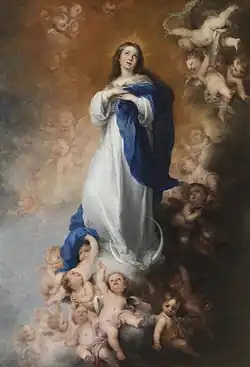
The Immaculate Conception of Los Venerables or The Immaculate Conception of Soult (original titles La Inmaculada Concepción de los Venerables or La Inmaculada Concepción de Soult) is an oil painting by the Spanish artist Bartolomé Esteban Murillo.[1] It was painted c. 1678 and measures 274 cm × 190 cm (108 in × 75 in).[1] Looted by Marshal Jean-de-Dieu Soult in 1813 and taken to France, it was bought by the Louvre in 1852. It has been held by the Museo del Prado, Madrid, since 1941.
Provenance
According to Juan Agustín Ceán Bermúdez, the work was commissioned from Bartolomé Esteban Murillo by Justino de Neve (1625–1685). De Neve was a canon of Seville Cathedral and ecclesiastical president of the Hospital de los Venerables in Seville. He commissioned the painting for his personal collection, and donated it to the chapel at the hospital in 1686. Belief in the Immaculate Conception had been on the rise in Spain since the 16th century and the country became its main defender, even fighting for it to be recognized as an official dogma of the Catholic Church, a goal that was eventually realized in 1854. The Immaculate Conception became a very important cultural symbol during this period, featured in many works of art.[2]
In 1813,[2][3] during the Peninsular War, the painting was looted by Marshal Jean-de-Dieu Soult and taken to France. Soult left behind the painting's frame which remains in the hospital to this day.[2] The painting remained in Soult's possession until his death in 1851; the painting's alternative name is derived from his.[4]
The painting was auctioned in 1852, and acquired by the Louvre Museum for 615,300 francs; reputedly the largest sum ever paid for a painting at that time.[5] It was exhibited there until 1941, during which time Murillo's art fell out of fashion; as a result the Vichy Regime agreed to return it to Spain's Francisco Franco in an exchange of artwork, along with the Lady of Elche and several pieces of the Treasure of Guarrazar. In exchange, Spain's Museo del Prado gave the Louvre the Portrait of Mariana of Austria by Diego Velázquez.[5] In 1981, the Prado's restoration specialist, Antonio Fernández Sevilla, carried out a careful superficial restoration of The Immaculate Conception of Los Venerables, in preparation for an exhibition dedicated to Murillo. A more in-depth restoration was carried out in 2007.[3]
Description
Murillo painted around two dozen versions of the Immaculate Conception, possibly the most of any Spanish painter at that time.[2][5] In the majority, the Virgin Mary appears dressed in a white robe with a blue mantle, her hands crossed over her chest, with a crescent moon at her feet, and eyes upraised towards Heaven.[1][2] Her contrapposto stance, with her right knee bent and her weight shifted to her left leg, adds to the undulating rhythm of the composition. A delicate sliver of a crescent moon is set at an angle for visual interest, and it encircles her foot, which is concealed for the sake of decorum beneath the pooling layers of white fabric.3 The Immaculate Conception of Los Venerables stands out from Murillo's others due to its triumphant tone. This effect is achieved through Murillo's use of light which creates a sense of movement from the bottom right to the top left of the painting.[5] This upward movement, and the symbolism associated with the clouds and angels surrounding the principal figure, create a visual reference to the Assumption, connecting Mary's purity with her status as Christ's mother.[1][2] In this composition, Murillo did not include several traditional elements of the Virgin's iconography—such as the Tower of David, the sealed fountain, or palm and cypress trees—possibly because these symbols were already featured in the painting's original frame in the Los Venerables Hospital, as described by Fernando de la Torre Farfán in the 18th century.[2]
References
External links
|
|---|
| Immaculate Conceptions |
- San Vicente (c. 1640–1650)
- La Colasal (1645–1655)
- Esquilache (1645–1655)
- El Escorial (1660–1665)
- Museo Soumaya (c. 1670)
- Aranjuez (c. 1675)
- (c. 1678)
- Walpole (c. 1680)
|
|---|
| Other religious works |
- The Vision of Fray Lauterio (c. 1640)
- Joseph and Potiphar's Wife (1640–1645)
- Saint Francis of Assisi at Prayer (c. 1645–1650)
- The Angels' Kitchen (1646)
- The Flight into Egypt (1647–1650)
- Adoration of the Shepherds (Madrid; c. 1650)
- The Holy Family with a Little Bird (1650)
- Our Lady of the Rosary (1650–1655)
- Saint Roderick (c. 1650–1655)
- Rebecca and Eleazar (1652)
- The Vision of Saint Anthony of Padua (1656)
- The Good Shepherd (c. 1660)
- The Birth of the Virgin (1661)
- Christ after the Flagellation (Boston; c. 1665)
- Rest on the Flight into Egypt (c. 1665)
- The Apparition of the Virgin to Saint Bernard (c. 1665)
- Mater Dolorosa (1665)
- The Patrician's Dream (1665)
- Saint Anthony with the Christ Child (1665–1666, 1668–1669)
- Liberation of Saint Peter (1665–1667)
- Isaac Blessing Jacob (1665–1670)
- Saint Justa and Saint Rufina (c. 1666)
- Madonna and Child of the Napkin (c. 1666)
- Christ Healing the Paralytic at the Pool of Bethesda (c. 1667–1670)
- Christ on the Cross (San Diego; c. 1667–1670)
- The Return of the Prodigal Son (c. 1667–1670)
- The Miracle of the Loaves and Fishes (Edinburgh; c. 1667–1682)
- Adoration of the Shepherds (London; c. 1668)
- Saint Thomas of Villanova Giving Alms (c. 1668)
- Saint Francis Embracing Christ on the Cross (1668–1669)
- Holy Family with the Infant Saint John the Baptist (c. 1668–1670)
- The Miracle of the Loaves and Fishes (Seville; c. 1669–1674)
- Moses at the Rock of Horeb (c. 1669–1674)
- Christ after the Flagellation (Champaign; c. 1670)
- Abraham and the Three Angels (c. 1670–1674)
- The Christ Child and the Infant John the Baptist with a Shell (1670–1675)
- Saint Elizabeth of Hungary Curing the Sick (1672)
- Saint John of God Carrying a Sick Man (1672)
- Ecce Homo (c. 1672–1678)
- Christ on the Cross (New York; c. 1675)
- The Martyrdom of Saint Andrew (1675–1682)
- Christ on the Cross (Madrid; c. 1675)
- Saint Thomas of Villanova Healing a Lame Man (c. 1675)
- The Conversion of Saint Paul (c. 1675–1680)
- Christ on the Cross (Madrid; c. 1677)
- The Christ Child Distributing Bread to Pilgrims (1678)
- The Heavenly and Earthly Trinities (c. 1680)
|
|---|
| Genre works |
- The Young Beggar (1645–1650)
- Children Eating Grapes and a Melon (1645–1650)
- Four Figures on a Step (c. 1655–1660)
- Boy with a Dog (1655–1660)
- Two Women at a Window (1665–1675)
- The Little Fruitseller (c. 1670–1675)
- Children Eating a Tart (1670–1675)
- The Flower Girl (c. 1675–1680)
|
|---|
| Portraits |
- Portrait of Diego Ortiz de Zúñiga (c. 1653)
- Portrait of Íñigo Melchor Fernandez de Velasco (1658–1659)
|
|---|
| Related | |
|---|
|
|---|
|
Paintings |
|---|
| Spanish |
- Esquivel: José de Espronceda
- Gisbert: Execution of Torrijos and his Companions on the Beach at Málaga
- Goya: Allegory of Industry – Asmodea – Atropos – Blind Man's Bluff – Boys Playing Soldiers – Charles IV of Spain and His Family – Los caprichos – Christ Crucified – The Clothed Maja – The Colossus – The Countess of Chinchon – Los disparates – The Dog – The Drunk Mason – The Duchess of Alba and la Beata – Fight with Cudgels – Josefa Bayeu – Judith and Holofernes – La Leocadia – Man Mocked by Two Women – La novillada – Portrait of the Marchioness of Santa Cruz – Men Reading – The Milkmaid of Bordeaux – The Naked Maja – The Parasol – A Pilgrimage to San Isidro – Pilgrimage to the Fountain of San Isidro – Saturn Devouring His Son – The Second of May 1808 – Self-Portrait at 69 years – Summer – The Third of May 1808 – Two Old Men – Two Old Ones Eating Soup – The Victorious Hannibal Seeing Italy from the Alps for the First Time – Witches' Flight – Witches' Sabbath (The Great He-Goat)
- El Greco: The Nobleman with his Hand on his Chest – Adoration of the Shepherds – Doña María de Aragón Altarpiece – Annunciation – Christ Carrying the Cross – The Fable – The Flight into Egypt – Holy Face of Jesus – Holy Trinity – Julián Romero and Saint Julian – Portrait of a Doctor – Portrait of a Gentleman – Portrait of a Young Nobleman – Portrait of an Elderly Man – Portrait of an Unknown Gentleman – Portrait of Jerónimo de Cevallos – Portrait of Rodrigo Vázquez de Arce – Saint Andrew and Saint Francis – Saint Anthony of Padua – Saint Bernardino of Siena [1] – Saint James the Great – Saint John the Evangelist – Saint Paul – Saint Sebastian – Saint Thomas the Apostle – Holy Trinity – The Saviour – Virgin Mary
- Luna: The Death of Cleopatra
- Maíno: Adoration of the Magi – Portrait of a Gentleman – The Recovery of Bahía de Todos los Santos
- Murillo: Adoration of the Shepherds (1650) – Aranjuez Immaculate Conception – The Christ Child and the Infant John the Baptist with a Shell – Christ on the Cross (1675, 1677) – The Conversion of Saint Paul – The Good Shepherd – The Holy Family with a Little Bird – The Immaculate Conception of El Escorial – – The Martyrdom of Saint Andrew – Our Lady of the Rosary – The Patrician's Dream – Rebecca and Eleazar
- Pradilla: Doña Joanna the Mad
- Ribera: Jacob's Dream – Democritus – Isaac and Jacob – Ixion – Tityos – The Martyrdom of Saint Philip – The Blind Sculptor
- Sánchez Gallque: The Mulattos of Esmeraldas [2]
- Velázquez: Las Meninas – The Triumph of Bacchus – Las Hilanderas – The Surrender of Breda – Mars Resting – Equestrian Portrait of Philip IV – Equestrian Portrait of Elisabeth of France – Equestrian Portrait of Prince Balthasar Charles – Equestrian Portrait of Philip III – Equestrian Portrait of Margarita of Austria – Equestrian Portrait of the Count-Duke of Olivares – Adoration of the Magi – Apollo in the Forge of Vulcan – Christ Crucified – Coronation of the Virgin – View of the Garden of the Villa Medici – Prince Balthasar Charles as a Hunter – Portrait of the Infante Don Carlos – Doña Antonia de Ipeñarrieta y Galdós and Her Son Don Luis – The Jester Barbarroja – The Jester Calabacillas – The Jester Don Diego de Acedo – The Jester Don John of Austria – Portrait of Francisco Lezcano – Infanta Margarita Teresa in a Pink Dress – Portrait of Maria Anna – Portrait of Juan Martínez Montañés – The Nun Jerónima de la Fuente – Portrait of Pablo de Valladolid – Portrait of Philip IV in Armour – Portrait of Mariana of Austria – Portrait of Sebastián de Morra
- Zurbarán: Agnus Dei – The Death of Hercules – The Defence of Cádiz Against the English – Hercules and the Hydra – Hercules Separates Mounts Calpe and Abylla – Hercules Fighting the Nemean Lion – Saint Elizabeth of Portugal – Saint Luke Painting the Crucifixion – Saint Peter Nolasco's Vision of Saint Peter the Apostle – Still Life with Pots – The Vision of Saint Peter Nolasco
|
|---|
Dutch,
Flemish,
German | |
|---|
| Italian |
- Fra Angelico: Annunciation
- Anguissola: Portrait of Elisabeth of Valois – Portrait of Infanta Isabella Clara Eugenia [3] – Portrait of Giovanni Battista Caselli
- Barocci: Nativity
- Bellini: Madonna and Child with Saint Mary Magdalene and Saint Ursula
- Botticelli: The Story of Nastagio Degli Onesti, part one
- Caravaggio: David and Goliath
- Carracci: Assumption of the Virgin – Mural Paintings from the Herrera Chapel – Venus, Adonis and Cupid
- Correggio: Noli me tangere – Madonna and Child with the Infant John the Baptist
- A. Gentileschi: The Birth of Saint John the Baptist
- O. Gentileschi: The Finding of Moses (1633)
- Leonardo: Mona Lisa (by his studio)
- Lotto: Portrait of Marsilio Cassotti and His Bride Faustina
- Mantegna: Death of the Virgin
- Parmigianino: Holy Family with Angels – Portrait of Camilla Gonzaga and Her Three Sons – Portrait of Pier Maria Rossi di San Secondo – Saint Barbara
- Raphael: Portrait of a Cardinal – Christ Falling on the Way to Calvary – Madonna of the Rose – Visitation – La Perla (with Romano)
- Romano: Holy Family under an Oak Tree
- Andrea del Sarto: Sacrifice of Isaac
- Tintoretto: Christ Washing the Disciples' Feet – Joseph and Potiphar's Wife – Judith and Holofernes (by his studio) – The Washing of the Feet
- Tiepolo: The Immaculate Conception
- Titian: The Bacchanal of the Andrians – Equestrian Portrait of Charles V – The Fall of Man – Alfonso d'Avalos Addressing his Troops – Danaë Receiving the Golden Rain (1565) – The Entombment – La Gloria – Virgin and Child Between Saints Anthony of Padua and Roch – Mater Dolorosa with Clasped Hands – Philip II in Armour – Portrait of Charles V with a Dog – Portrait of Federico II Gonzaga – Portrait of Isabella of Portugal – Sisyphus – Tityus – Religion saved by Spain – Salome - Self-Portrait (1567) – Saint Margaret and the Dragon – Venus and Adonis (1554) – Venus and Musician (1550, 1555) – The Virgin and Child with Saint George and Saint Dorothy – The Worship of Venus
- Veronese: Venus and Adonis – Christ Among the Doctors – The Finding of Moses
|
|---|
| French |
- Anonymous: Agony in the Garden
- Baudry: The Pearl and the Wave
- van Loo: The Family of Philip V (1743)
- Lorrain: Landscape with St Paula of Rome Embarking at Ostia – The Ford – Landscape with St María de Cervelló – Landscape with the Burial of St Serapia – Landscape with the Finding of Moses – Landscape with the Temptation of St Anthony – Landscape with Tobias and Raphael
- Poussin: Parnassus – Landscape with Three Figures – Saint Cecilia
- Ranc: The Family of Philip V (1723) – Portrait of Ferdinand VI as a Boy
- Watteau: Marriage Contract and Country Dancing
- Vouet: Time Defeated by Love, Beauty and Hope
|
|---|
| Other | |
|---|
|
|
Sculptures |
|---|
| Rome |
- The Apotheosis of Claudius
- Castor and Pollux
|
|---|
|
|
- [1] On display at El Greco Museum in Toledo
- [2] On display at Museo de América in Madrid
- [3] On display at the Spanish Embassy in Paris
 Category Category
|
 Media related to The Immaculate Conception of Los Venerables at Wikimedia Commons