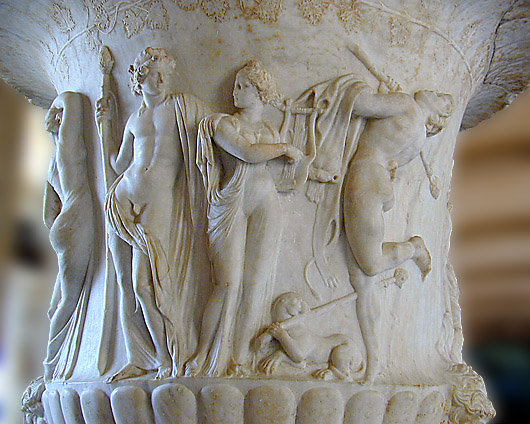
The Borghese Vase in the Daru Gallery, Louvre Museum
The Borghese Vase is a monumental bell-shaped krater sculpted in Athens from Pentelic marble in the second half of the 1st century BC as a garden ornament for the Roman market;[1] it is now in the Louvre Museum.[2]
Original
Iconography
Standing 1.72 metres tall and with a diameter of 1.35 m., the vase has a deep frieze with bas-reliefs and an everted gadrooned lip over a gadrooned lower section, where paired satyrs' heads mark the former placement of loop handles;[3] it stands on a spreading fluted stem with a cabled motif round its base, on a low octagonalplinth.
The frieze depicts the thiasus, an ecstatic Bacchanalian procession accompanying Dionysus, draped with the panther skin and playing the aulos, and Ariadne. However, the accompanying figures, often said to be satyrs, have neither the common characteristics of cloven feet nor equine tails flowing to the floor as typically shown on Greek pottery; some references identify the figures as sileni. The draped figures are often said to be Maenads but are clearly not: Maenads are women who accompany Dionysus but on the vase a draped male figure is depicted. One of the figures is shown being anointed, typically a symbolic act of divinity, leading to the interpretation of some of the figures as Apollo and Dionysus rescuing Silenus who is shown falling down reaching for a spilled flagon of wine. This scene on the vase corresponds to the saying "The Gods look after children and drunken men" which has been passed down orally through many generations. Many copies of the vase do not correctly depict the scene, replacing Dionysus with a female figure on the wrongful assumption that a sexual act is in progress.
The vase was rediscovered in a Roman garden that occupied part of the site of the gardens of Sallust[4] in 1566 and acquired by the Borghese family. Napoleon bought it from his brother-in-law Camillo Borghese in 1808, and it has been displayed in the Louvre since 1811.
In his capriccio shown below, the French artist Hubert Robert embellished and enlarged the Borghese Vase for dramatic effect and set it, in atmospherically ruinous condition, on the Aventine overlooking the Colosseum, a position it never occupied. Robert also painted it in several other settings, including the gardens of Versailles (L'entrée du Tapis Vert) with Marie Antoinette and Louis XVI.[5]
Copies
Capriccio: draughtsman sketching the Borghese Vase, red chalk, Hubert Robert, c. 1775
Often paired and rescaled to balance the slightly smaller Medici Vase, it is one of the most admired and influential marble vases from antiquity, forms that satisfied the Baroque and neoclassical approach to classical art alike. Three pairs were copied for the Bassin de Latone in the gardens of Versailles; alabaster pairs stand in the Great Hall at Houghton Hall, Norfolk; and bronze ones at Osterley Park, Middlesex. On a reduced scale, the vases made admirable wine coolers in silver, or in silver-gilt, as Paul Storr delivered them to the Prince Regent in 1808 (Haskell and Penny 1981:315). John Flaxman based a bas-relief on the frieze of the Borghese Vase (Sir John Soane's Museum, London). As decorative objects they have been reproduced through the eighteenth and nineteenth centuries[6] and remain popular subjects for imitation in bronze or porcelain, for example in Coade stone (a reduced-size Coade stone example dating from 1770-1771 stands in the Temple of Flora at Stourhead),[7][8] and also in jasper ware by Josiah Wedgwood (c. 1790), who adapted the form of the Medici Vase for the bas-reliefs and provided it with a lid and a neoclassical drum pedestal.
References
^Two further versions of the vase were found among other marbles in the wreck of a ship bound from Athens in the time of Sulla (Haskell and Penny 1981:315).
^The form of the bell krater with its upturned loop handles had been standardized in Attic pottery since the fifth century. The similar Medici Vase retains its handles springing up from the heads.
^In the garden of Carlo Muti, where it was found together with the Silenus with the Infant Bacchus, according to notes compiled by Flaminio Vacca in 1594, noted by Haskell and Penny.
^Grasselli, Margaret Morgan, Yuriko Jackall, et al., Hubert Robert, The National Gallery of Art, Washington, 2016.
Chardin: The Attributes of Civilian and Military Music; The Attributes of Music, the Arts and the Sciences; Boy with a Spinning-Top; The Buffet; The Ray; Saying Grace
La Tour: The Adoration of the Shepherds; The Card Sharp with the Ace of Diamonds; Joseph the Carpenter; Magdalene with the Smoking Flame; Saint Sebastian Tended by Saint Irene
Poussin: Camillus Handing the Falerian Schoolmaster over to his Pupils; Et in Arcadia ego; The Four Seasons; The Funeral of Phocion; The Inspiration of the Poet; Landscape with Orpheus and Eurydice
Quarton: Pietà of Villeneuve-lès-Avignon
Robert: Principal Monuments of France; Project for the Transformation of the Grande Galerie du Louvre
Scheffer: Francesca da Rimini and Paolo Malatesta Appraised by Dante and Virgil
Vernet C.: A Mediterranean Port
Vernet H.Raphael at the Vatican
Vigée Le Brun: Peace Bringing Back Abundance; Portrait of Joseph Vernet; Self-Portrait with Julie (Self-Portrait à la Grecque); Self-Portrait with Julie (Maternal Tenderness)
Bellini: Christ Blessing; Madonna and Child with Saint Peter and Saint Sebastian; Portrait of a Young Man
Botticelli: Three Scenes from the Life of Esther; Venus and the Three Graces Presenting Gifts to a Young Woman; A Young Man Being Introduced to the Seven Liberal Arts
Perugino: Apollo and Daphnis; The Battle Between Love and Chastity; Madonna and Child with St John the Baptist and St Catherine of Alexandria; Madonna and Child with St Rose and St Catherine (with Ingegno); St Sebastian; Young Saint with a Sword
Piero della Francesca: Portrait of Sigismondo Pandolfo Malatesta
Romano: Portrait of Doña Isabel de Requesens y Enríquez de Cardona-Anglesola (with Raphael)
Salviati: The Incredulity of Saint Thomas
Savoldo: Portrait of a Clad Warrior
Signorelli: Adoration of the Magi; Birth of John the Baptist
Tintoretto: Self Portrait
Titian: Allegory of Marriage; The Crowning with Thorns; The Entombment of Christ; Madonna of the Rabbit; Man with a Glove; Pardo Venus; Pastoral Concert (also attributed to Giorgione); Pilgrims at Emmaus; Saint Jerome in Penitence; Virgin and Child with Saints Stephen, Jerome and Maurice; Woman with a Mirror
Rembrandt: The Archangel Raphael Leaving Tobias' Family; Bathsheba at Her Bath; Landscape with a Castle; Pendant portraits of Marten Soolmans and Oopjen Coppit; Philosopher in Meditation; Saint Matthew and the Angel; Self-Portrait; Slaughtered Ox
Rubens: Helena Fourment with a Carriage; Helena Fourment with Children; Hercules and Omphale; Ixion, King of the Lapiths, Deceived by Juno, Who He Wished to Seduce; Marie de' Medici cycle; The Village Fête; The Virgin and Child Surrounded by the Holy Innocents
Ruisdael: Dune Landscape near Haarlem; The Ray of Light; Storm Off a Sea Coast
Scheffer: Francesca da Rimini and Paolo Malatesta Appraised by Dante and Virgil