In about 1494, Peeter Scheyfve (-1507) and Agnes de Gramme (?-about 1497) commissioned this altarpiece. They were wealthy burghers in Antwerp.[2] The painting was in the El Escorial monastery, and was mentioned in 1605 as an "Epiphany without any extravaganza" by Fra Jose de Siguenza, and its being unlike Bosch's other work there.[3] It has been at the Prado since 1839. The latest dendrochronological investigation (2016) has determined that the panels were produced after 1472 and most probably after 1474.[4]
Description
The closed triptych.
Shutters
When closed, the triptych shutters showed externally a grisaille painting, depicting the Mass of Saint Gregory in a single scene: it features Gregory the Great kneeling at an altar in front of Christ. The latter is surrounded by an arch with flying angels. The two characters in color are a later addition, and are the painting's donors.
The frame contains scenes of the Life of Jesus: from the lower left, the Prayer in the Garden, The Arrest, Christ in Front of Pilatus, the Flagellation, the Coronation of Thorns, the Via Crucis and, finally, the Crucifixion. In the sky around the cross are a flying angel and a devil, with a red halo around his head, who is drawing Judas Iscariot's soul away. Judas is also visible hanging at the mountain's right edge, while a man is pointing at him.
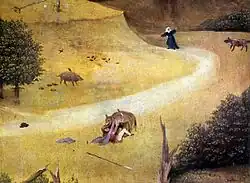
Detail of the beast attacking people in the right panel.
Side panels
The left panel depicts St. Peter and one donor, identified as Peeter Scheyfve by the presence of his coat of arms, with the motto "Een voer al" ("One for all"). In the background, a man sits on a basket under a makeshift roofing: he is likely St. Joseph who heats Jesus' diapers (nappies).[1]
In the right panel is St. Agnes and the eponymous donor, Agnes de Gramme, also accompanied by her coat of arms. In the background, a bear and a wolf attack some people.
Central panel
The central panel shows the Adoration of the Magi, depicted in accordance with traditional Early Netherlandish iconography. A monumental Mary sits outside a precarious hut, with the Child held at her womb. Melchior, the eldest of the Magi, is kneeling at her feet, with his gift before him: a sculpture of gold with the Sacrifice of Isaac, a forecast of Jesus' Passion. Below the object are several toads, symbols of heresy. Melchior's crown lies on the ground, an allusion to the powerlessness of earthly power against the celestial.
Detail of the central panel with the Magi.
Caspar stands to the rear, with a depiction of the Visit of Queen Sheba to Solomon on his mantle. He brings frankincense on a vessel. Finally, the last of the Magi, the dark-skinned Balthazar, has white garments decorated by an embroidery resembling thorny leaves: brings a spherical pix whose reliefs depict the Offer of Water to King David, and which contains myrrh. Balthasar is accompanied by a dark-skinned servant.
An unusual element is represented by the partially naked figure at the hut's entrance, surrounded by other grotesque ones and characterized by a red mantle, a tiara with metallic twigs in the hand, and by a wheal at the left ankle, protected by a glass structure. This has been variously interpreted as either another prefiguration of the Passion, or as a symbol of the heresy looming the followers, or as the Judaic messiah which, after having been struck by leper, has become the Antichrist.[1]
Other figures include the shepherds crawling the hut, a traditional element in Italian contemporary Adorations of the Magi; the armies running in the far background and the quasi-anthropomorphic constructions.
Painting materials
The pigments employed by the artist are consistent with his other works.[5] He painted the triptych with ochres, lead-tin-yellow, vermilion, carmine and azurite. The sole rather unusual pigment is natural ultramarine used in small quantities in Virgin's robe.[6]
^For more than 100 years, this triptych was identified to another triptych (now lost) belonged to Jan van Casembroot. The inventory when Fernando Álvarez de Toledo, 3rd Duke of Alba confiscated the fortune of Jan van Casembroot recorded it. The inventory also recorded Bronchorst and Boschuysen coat of arms on the outer wings. Marianne Renson(2001) denied Peter van Bronchorst and Agnes van Boschuysen donation. They never existed. Xavier Duquenne (2004) discovered the true donors
^Luuk Hoogstede, Ron Spronk, Matthijs Ilsink, Robert G. Erdmann, Jos Koldeweij, Rik Klein Gotink, Hieronymus Bosch, Painter and Draughtsman: Technical Studies, Yale University Press, 2016, p.156
^Luuk Hoogstede, Ron Spronk, Matthijs Ilsink, Robert G. Erdmann, Jos Koldeweij, Rik Klein Gotink, Hieronymus Bosch, Painter and Draughtsman: Technical Studies, Yale University Press, 2016, pp. 154 – 171
Fra Jose de Siguenza, History of the Order of ST. Jerome, 1605(Extract translation) in Bosch in Perspective, edited by James Snyder, 1973, USA
Marianne Renson, Genealogical Information Concerning The Bronchorst Boschuysen triptych, 2001, Rotterdam
Xavier, Duquenne, ≪ La famille Scheyfve et Jerome Bosch ≫, L’intermediaire des genealogistes, janvier-fevrier 2004, p. 1-19
Matthijs Ilsink, Jos Koldeweij, Hieronymus Bosch: Painter and Draughtsman – Catalogue raisonné, Yale University Press, New Haven and London 2016, pp 198–215.
El Greco: The Nobleman with his Hand on his Chest – Adoration of the Shepherds – Doña María de Aragón Altarpiece – Annunciation – Christ Carrying the Cross – The Fable – The Flight into Egypt – Holy Face of Jesus – Holy Trinity – Julián Romero and Saint Julian – Portrait of a Doctor – Portrait of a Gentleman – Portrait of a Young Nobleman – Portrait of an Elderly Man – Portrait of an Unknown Gentleman – Portrait of Jerónimo de Cevallos – Portrait of Rodrigo Vázquez de Arce – Saint Andrew and Saint Francis – Saint Anthony of Padua – Saint Bernardino of Siena[1] – Saint James the Great – Saint John the Evangelist – Saint Paul – Saint Sebastian – Saint Thomas the Apostle – Holy Trinity – The Saviour – Virgin Mary
Luna: The Death of Cleopatra
Maíno: Adoration of the Magi – Portrait of a Gentleman – The Recovery of Bahía de Todos los Santos
Murillo: Adoration of the Shepherds(1650) – Aranjuez Immaculate Conception – The Christ Child and the Infant John the Baptist with a Shell – Christ on the Cross(1675, 1677) – The Conversion of Saint Paul – The Good Shepherd – The Holy Family with a Little Bird – The Immaculate Conception of El Escorial – The Immaculate Conception of Los Venerables – The Martyrdom of Saint Andrew – Our Lady of the Rosary – The Patrician's Dream – Rebecca and Eleazar
Pradilla: Doña Joanna the Mad
Ribera: Jacob's Dream – Democritus – Isaac and Jacob – Ixion – Tityos – The Martyrdom of Saint Philip – The Blind Sculptor
Sánchez Gallque: The Mulattos of Esmeraldas[2]
Velázquez: Las Meninas – The Triumph of Bacchus – Las Hilanderas – The Surrender of Breda – Mars Resting – Equestrian Portrait of Philip IV – Equestrian Portrait of Elisabeth of France – Equestrian Portrait of Prince Balthasar Charles – Equestrian Portrait of Philip III – Equestrian Portrait of Margarita of Austria – Equestrian Portrait of the Count-Duke of Olivares – Adoration of the Magi – Apollo in the Forge of Vulcan – Christ Crucified – Coronation of the Virgin – View of the Garden of the Villa Medici – Prince Balthasar Charles as a Hunter – Portrait of the Infante Don Carlos – Doña Antonia de Ipeñarrieta y Galdós and Her Son Don Luis – The Jester Barbarroja – The Jester Calabacillas – The Jester Don Diego de Acedo – The Jester Don John of Austria – Portrait of Francisco Lezcano – Infanta Margarita Teresa in a Pink Dress – Portrait of Maria Anna – Portrait of Juan Martínez Montañés – The Nun Jerónima de la Fuente – Portrait of Pablo de Valladolid – Portrait of Philip IV in Armour – Portrait of Mariana of Austria – Portrait of Sebastián de Morra
Zurbarán: Agnus Dei – The Death of Hercules – The Defence of Cádiz Against the English – Hercules and the Hydra – Hercules Separates Mounts Calpe and Abylla – Hercules Fighting the Nemean Lion – Saint Elizabeth of Portugal – Saint Luke Painting the Crucifixion – Saint Peter Nolasco's Vision of Saint Peter the Apostle – Still Life with Pots – The Vision of Saint Peter Nolasco
Bouts: Triptych with Scenes from the Life of the Virgin
Bruegel the Elder: The Triumph of Death – The Wine of Saint Martin's Day – Excursion in the Countryside of Infanta Isabel Clara Eugenia – Life in the Countryside – The Infanta Isabel Clara Eugenia in the Mariemont Park(with de Momper) – Landscape(with de Momper) – The Five Senses(with Rubens)
van Dyck: Self-portrait with Sir Endymion Porter – The Betrayal of Christ – The Brazen Serpent – Diana and a Nymph Surprised by a Satyr – Saint Rosalia – The Crowning with Thorns
van Hemessen: The Surgeon
Francken the Younger: The Sciences and the Arts
Jordaens: Apollo as Victor over Pan – Meleager and Atalanta – The Painter's Family
Memling: Adoration of the Magi
Mengs: Portrait of José Nicolás de Azara
de Momper: Landscape with Sea and Mountains – A Farm – Flemish Market and Washing Place – Landscape with Skaters – The Infanta Isabel Clara Eugenia in the Mariemont Park(with Brueghel the Elder) – Landscape(with Brueghel the Elder)
Rubens: The Judgement of Paris(1638) – The Three Graces – Adoration of the Magi – The Dance of the Villagers – Diana and Callisto – Equestrian Portrait of the Duke of Lerma – The Fall of Man – The Garden of Love – The Birth of the Milky Way – The Rape of Europa – The Rape of Ganymede – Saint George and the Dragon – Saturn – The Triumph of the Church – Deucalion and Pyrrha – The Five Senses(with Brueghel the Elder)
Lorrain: Landscape with St Paula of Rome Embarking at Ostia – The Ford – Landscape with St María de Cervelló – Landscape with the Burial of St Serapia – Landscape with the Finding of Moses – Landscape with the Temptation of St Anthony – Landscape with Tobias and Raphael
Poussin: Parnassus – Landscape with Three Figures – Saint Cecilia