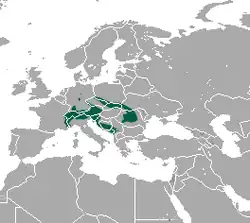
The alpine shrew (Sorex alpinus) is a species of mammal in the family Soricidae. It is found in the alpine meadows and coniferous forests of central and southern European mountain ranges.
Description
The Alpine shrew is 6 to 7.7 centimetres (2.4 to 3.0 in) in length, not including a tail as long as its body, and weighs between 5.5 and 11.5 g (0.2 and 0.4 oz). It is a uniform greyish-black on its dorsal (upper) surface and greyish-brown on its underparts. The tips of its teeth are reddish-brown and it has a long pointed snout, small black eyes and rounded pink ears. Its legs and feet are white and the underside of its hairy tail is yellowish.[2] Juveniles are somewhat paler than adults.[3] It shares its range with the common shrew Sorex araneus and the Eurasian pygmy shrew Sorex minutus but is distinguishable from these by its darker fur and longer tail.[2]
Distribution and habitat
The Alpine shrew is found in the mountains and uplands of Central and Eastern Europe and parts of France. Its range includes the Alps, the Black Forest, the Jura Mountains, the mountains of southern Germany, the Giant Mountains, the Beskids, the Tatra Mountains, the Carpathian Mountains, the Transylvanian Alps, the uplands of Vosges and the mountains of the former Yugoslavia. The Alpine shrew is found in Alpine meadows and in coniferous woodland at elevations between about 200 and 2,500 metres (660 and 8,200 ft).[3] It sometimes occurs above the tree line but more normally favours damp pastures and swampy ground near small streams in areas with dwarf sparse conifers near the upper limit of tree cover.[3] It tends to lurk in dense vegetation, occupies rock crevices and lives under boulders or fallen branches and often occurs near mountain huts.[3]
The Alpine shrew was recorded in the Spanish Pyrenees in the early 20th century. It is presumed locally extinct due to the lack of modern sightings.[4]
Behaviour
The Alpine shrew is nocturnal and is a skilled climber, using its tail for balance. It uses scent glands on its flanks to mark its territory. Like other shrew species, it has a high metabolic rate and needs to feed frequently. It eats insects, spiders, snails and earthworms and is in turn the prey of foxes, weasels, domestic cats and tawny owls.[2]
Status
The Alpine shrew is listed as "Near Threatened" in the IUCN's Red List of Threatened Species. This is because it occupies a number of separate, disjunct mountain regions and seems to be slowly declining in numbers. It may be threatened by habitat destruction as hydro-electric schemes and increased tourism impact its environment. It used to be present in the Pyrenees but has not been seen there for many years and may be extinct there, nor has it been seen recently in the Harz Mountain region of Germany.[1]
References
- ^ a b Meinig, H.; Bertolino, S.; zima, j. (2020). "Sorex alpinus". IUCN Red List of Threatened Species. 2020: e.T29660A114024313. doi:10.2305/IUCN.UK.2020-2.RLTS.T29660A114024313.en. Retrieved 16 November 2021.
- ^ a b c Burke, Felicity (2011). "Sorex alpinus: Alpine shrew". Animal Diversity Web. University of Michigan. Retrieved 2013-08-21.
- ^ a b c d Konig, Claus (1973). Mammals. Collins & Co. pp. 22–23. ISBN 978-0-00-212080-7.
- ^ Palomo, L. J., Gisbert, J., & Blanco, J. C. (Eds.). (2007). Atlas y libro rojo de los mamíferos terrestres de España. Madrid: Organismo Autónomo de Parques Nacionales.
|
|---|
|
|
|
|
|
|---|
| Diplomesodon | |
|---|
| Feroculus | |
|---|
| Palawanosorex |
- Palawan moss shrew (P. muscorum)
|
|---|
Paracrocidura
(Large-headed
shrews) |
- Grauer's large-headed shrew (P. graueri)
- Greater large-headed shrew (P. maxima)
- Lesser large-headed shrew (P. schoutedeni)
|
|---|
| Ruwenzorisorex | |
|---|
| Scutisorex | |
|---|
| Solisorex | |
|---|
| Suncus |
- Taita shrew (S. aequatorius)
- Black shrew (S. ater)
- Day's shrew (S. dayi)
- Etruscan shrew (S. etruscus)
- Sri Lankan shrew (S. fellowesgordoni)
- Bornean pygmy shrew (S. hosei)
- Least dwarf shrew (S. infinitesimus)
- Greater dwarf shrew (S. lixus)
- Madagascan pygmy shrew (S. madagascariensis)
- Malayan pygmy shrew (S. malayanus)
- Climbing shrew (S. megalura)
- Flores shrew (S. mertensi)
- Asian highland shrew (S. montanus)
- Asian house shrew (S. murinus)
- Remy's pygmy shrew (S. remyi)
- Anderson's shrew (S. stoliczkanus)
- Lesser dwarf shrew (S. varilla)
- Jungle shrew (S. zeylanicus)
|
|---|
Sylvisorex
(Forest shrews) |
- Dudu Akaibe's pygmy shrew (S. akaibei)
- Cameroonian forest shrew (S. cameruniensis)
- Corbet's forest shrew (S. corbeti)
- Grant's forest shrew (S. granti)
- Howell's forest shrew (S. howelli)
- Bioko forest shrew (S. isabellae)
- Johnston's forest shrew (S. johnstoni)
- Kongana shrew (S. konganensis)
- Moon forest shrew (S. lunaris)
- Mount Cameroon forest shrew (S. morio)
- Greater forest shrew (S. ollula)
- Lesser forest shrew (S. oriundus)
- Rain forest shrew (S. pluvialis)
- Volcano shrew (S. vulcanorum)
|
|---|
|
|
|
|---|
| Anourosoricini | |
|---|
| Blarinellini | Blarinella
(some Asiatic short-tailed
shrews) |
- Asiatic short-tailed shrew (B. quadraticauda)
- Burmese short-tailed shrew (B. wardi)
|
|---|
Parablarinella
(some Asiatic short-tailed
shrews) |
- Indochinese short-tailed shrew (P. griselda)
- Anhui short-tailed shrew (P. latimaxillata)
|
|---|
|
|---|
| Blarinini | Blarina
(American short-tailed
shrews) | |
|---|
Cryptotis
(Small-eared
shrews) |
- C. mexicana group
- Mexican small-eared shrew (C. mexicana)
- Nelson's small-eared shrew (C. nelsoni)
- Grizzled Mexican small-eared shrew (C. obscura)
- Phillips' small-eared shrew (C. phillipsii)
- C. goldmani set
- Central Mexican broad-clawed shrew (C. alticola)
- Goldman's broad-clawed shrew (C. goldmani)
- Goodwin's broad-clawed shrew (C. goodwini)
- Guatemalan broad-clawed shrew (C. griseoventris)
- C. lacertosus
- C. mam
- Oaxacan broad-clawed shrew (C. peregrina)
- C. nigrescens group
- Eastern Cordillera small-footed shrew (C. brachyonyx)
- Colombian small-eared shrew (C. colombiana)
- Honduran small-eared shrew (C. hondurensis)
- Yucatan small-eared shrew (C. mayensis)
- Darién small-eared shrew (C. mera)
- Merriam's small-eared shrew (C. merriami)
- Blackish small-eared shrew (C. nigrescens)
- C. thomasi group
- Southern Colombian small-eared shrew (C. andinus)
- Ecuadorian small-eared shrew (C. equatoris)
- Rainer's small-eared shrew (C. huttereri)
- Medellín small-eared shrew (C. medellinia)
- Merida small-eared shrew (C. meridensis)
- Wandering small-eared shrew (C. montivaga)
- Peruvian small-eared shrew (C. peruviensis)
- Scaly-footed small-eared shrew (C. squaipes)
- Tamá small-eared shrew (C. tamensis)
- Thomas's small-eared shrew (C. thomasi)
- C. parva group
- Central American least shrew (C. orophila)
- North American least shrew (C. parva)
- Tropical small-eared shrew (C. tropicalis)
- Ungrouped / relict
- Enders's small-eared shrew (C. endersi)
- Talamancan small-eared shrew (C. gracilis)
- Big Mexican small-eared shrew (C. magna)
|
|---|
|
|---|
| Nectogalini | Chimarrogale
(Asiatic water
shrews) | |
|---|
| Chodsigoa |
- Van Sung's shrew (C. caovansunga)
- De Winton's shrew (C. hypsibia)
- Lamulate shrew (C. lamula)
- Lowe's shrew (C. parca)
- Pygmy brown-toothed shrew (C. parva)
- Salenski's shrew (C. salenskii)
- Smith's shrew (C. smithii)
- Lesser Taiwanese shrew (C. sodalis)
|
|---|
| Episoriculus | |
|---|
| Nectogale | |
|---|
| Neomys | |
|---|
| Soriculus | |
|---|
|
|---|
| Notiosoricini | |
|---|
|
|
|
|
|---|
Congosorex
(Congo shrews) |
- Phillips's shrew (C. phillipsorum)
- Greater Congo shrew (C. polli)
- Lesser Congo shrew (C. verheyeni)
|
|---|
Myosorex
(Mouse shrews) |
- Babault's mouse shrew (M. babaulti)
- Montane mouse shrew (M. blarina)
- Bururi forest shrew (M. bururiensis)
- Dark-footed mouse shrew (M. cafer)
- Eisentraut's mouse shrew (M. eisentrauti)
- Geata mouse shrew (M. geata)
- Nyika mouse shrew (M. gnoskei)
- Kihaule's mouse shrew (M. kihaulei)
- Long-tailed forest shrew (M. longicaudatus)
- Oku mouse shrew (M. okuensis)
- Rumpi mouse shrew (M. rumpii)
- Schaller's mouse shrew (M. schalleri)
- Sclater's mouse shrew (M. sclateri)
- Thin mouse shrew (M. tenuis)
- Forest shrew (M. varius)
- Kilimanjaro mouse shrew (M. zinki)
|
|---|
Surdisorex
(African mole
shrews) |
- Aberdare mole shrew (S. norae)
- Mount Kenya mole shrew (S. polulus)
|
|---|
|
|
|
|
Taxon identifiers |
|---|
| Sorex alpinus | |
|---|