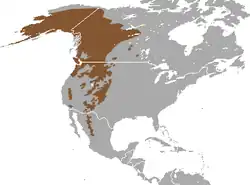
The montane shrew (Sorex monticolus) is a species of mammal in the family Soricidae commonly known as the dusky shrew. Monticolus is derived from the Latin root word mons meaning mountain. It is found in Alaska, western Canada, the western United States in Washington, Idaho, Montana, Utah, Colorado, New Mexico, Arizona, Oregon, Nevada, and California, as well as in Mexico.[1]
Habitat
Montane shrews occupy vast niches of moist grassy areas such as meadows and river banks. They are also found in coniferous forests, including taiga and high mountain subalpine and montane forests, with a large amount of ground litter used for coverage with acidic soils, as well as boreal and temperate rain forests.
Morphology
The upper incisors of Sorex monticolus are commonly larger, more robust, and harder than that of its sister taxa group as well having a larger cranial size from the nose to the base of the skull ranging from 16.1 to 17.7 mm (0.63 to 0.70 in) in length and a larger palate length. They have five or six paired frictional pads on their hind feet. Its pelage is commonly brown or grey, molted twice a year during September and October with males and females having different molting periods. The color and molting period also depends upon the elevation and location of their niche.
Reproduction
During reproduction sweat and sebaceous glands enlarge in males to indicate male maturity and the odor of pheromones they produce is thought to attract available females. Males increase in size by 50% during and in preparation for reproduction events. After mating females may have up to three to four litters and remain in the breeding site and their territory after mating but males leave, indicating no parental care.
Disease
Montane shrews live in habitats containing other species of shrews and competition for resources such as food and nesting material result in vicious fighting. Wounds procured from this may spread the disease hantavirus through shrew species that compete.
References
Erratum. (n.d.). Molecular Ecology 535-535.
Zwolak, R. & Foresman, K. (2007). Effects Of A Stand-replacing Fire On Small-mammal Communities In Montane Forest. Canadian Journal of Zoology 85(7): 815–822.
Demboski, J. & Cook, J. (2001). Phylogeography of the dusky shrew, Sorex monticolus (Insectivora, Soricidae): Insight into deep and shallow history in northwestern North America. Molecular Ecology 10(5): 1227–1240.
Smith, M. & Belk, M. (1996). Sorex monticolus. Mammalian Species, 1-1.
|
|---|
|
|
|
|
|
|---|
| Diplomesodon | |
|---|
| Feroculus | |
|---|
| Palawanosorex |
- Palawan moss shrew (P. muscorum)
|
|---|
Paracrocidura
(Large-headed
shrews) |
- Grauer's large-headed shrew (P. graueri)
- Greater large-headed shrew (P. maxima)
- Lesser large-headed shrew (P. schoutedeni)
|
|---|
| Ruwenzorisorex | |
|---|
| Scutisorex | |
|---|
| Solisorex | |
|---|
| Suncus |
- Taita shrew (S. aequatorius)
- Black shrew (S. ater)
- Day's shrew (S. dayi)
- Etruscan shrew (S. etruscus)
- Sri Lankan shrew (S. fellowesgordoni)
- Bornean pygmy shrew (S. hosei)
- Least dwarf shrew (S. infinitesimus)
- Greater dwarf shrew (S. lixus)
- Madagascan pygmy shrew (S. madagascariensis)
- Malayan pygmy shrew (S. malayanus)
- Climbing shrew (S. megalura)
- Flores shrew (S. mertensi)
- Asian highland shrew (S. montanus)
- Asian house shrew (S. murinus)
- Remy's pygmy shrew (S. remyi)
- Anderson's shrew (S. stoliczkanus)
- Lesser dwarf shrew (S. varilla)
- Jungle shrew (S. zeylanicus)
|
|---|
Sylvisorex
(Forest shrews) |
- Dudu Akaibe's pygmy shrew (S. akaibei)
- Cameroonian forest shrew (S. cameruniensis)
- Corbet's forest shrew (S. corbeti)
- Grant's forest shrew (S. granti)
- Howell's forest shrew (S. howelli)
- Bioko forest shrew (S. isabellae)
- Johnston's forest shrew (S. johnstoni)
- Kongana shrew (S. konganensis)
- Moon forest shrew (S. lunaris)
- Mount Cameroon forest shrew (S. morio)
- Greater forest shrew (S. ollula)
- Lesser forest shrew (S. oriundus)
- Rain forest shrew (S. pluvialis)
- Volcano shrew (S. vulcanorum)
|
|---|
|
|
|
|---|
| Anourosoricini | |
|---|
| Blarinellini | Blarinella
(some Asiatic short-tailed
shrews) |
- Asiatic short-tailed shrew (B. quadraticauda)
- Burmese short-tailed shrew (B. wardi)
|
|---|
Parablarinella
(some Asiatic short-tailed
shrews) |
- Indochinese short-tailed shrew (P. griselda)
- Anhui short-tailed shrew (P. latimaxillata)
|
|---|
|
|---|
| Blarinini | Blarina
(American short-tailed
shrews) | |
|---|
Cryptotis
(Small-eared
shrews) |
- C. mexicana group
- Mexican small-eared shrew (C. mexicana)
- Nelson's small-eared shrew (C. nelsoni)
- Grizzled Mexican small-eared shrew (C. obscura)
- Phillips' small-eared shrew (C. phillipsii)
- C. goldmani set
- Central Mexican broad-clawed shrew (C. alticola)
- Goldman's broad-clawed shrew (C. goldmani)
- Goodwin's broad-clawed shrew (C. goodwini)
- Guatemalan broad-clawed shrew (C. griseoventris)
- C. lacertosus
- C. mam
- Oaxacan broad-clawed shrew (C. peregrina)
- C. nigrescens group
- Eastern Cordillera small-footed shrew (C. brachyonyx)
- Colombian small-eared shrew (C. colombiana)
- Honduran small-eared shrew (C. hondurensis)
- Yucatan small-eared shrew (C. mayensis)
- Darién small-eared shrew (C. mera)
- Merriam's small-eared shrew (C. merriami)
- Blackish small-eared shrew (C. nigrescens)
- C. thomasi group
- Southern Colombian small-eared shrew (C. andinus)
- Ecuadorian small-eared shrew (C. equatoris)
- Rainer's small-eared shrew (C. huttereri)
- Medellín small-eared shrew (C. medellinia)
- Merida small-eared shrew (C. meridensis)
- Wandering small-eared shrew (C. montivaga)
- Peruvian small-eared shrew (C. peruviensis)
- Scaly-footed small-eared shrew (C. squaipes)
- Tamá small-eared shrew (C. tamensis)
- Thomas's small-eared shrew (C. thomasi)
- C. parva group
- Central American least shrew (C. orophila)
- North American least shrew (C. parva)
- Tropical small-eared shrew (C. tropicalis)
- Ungrouped / relict
- Enders's small-eared shrew (C. endersi)
- Talamancan small-eared shrew (C. gracilis)
- Big Mexican small-eared shrew (C. magna)
|
|---|
|
|---|
| Nectogalini | Chimarrogale
(Asiatic water
shrews) | |
|---|
| Chodsigoa |
- Van Sung's shrew (C. caovansunga)
- De Winton's shrew (C. hypsibia)
- Lamulate shrew (C. lamula)
- Lowe's shrew (C. parca)
- Pygmy brown-toothed shrew (C. parva)
- Salenski's shrew (C. salenskii)
- Smith's shrew (C. smithii)
- Lesser Taiwanese shrew (C. sodalis)
|
|---|
| Episoriculus | |
|---|
| Nectogale | |
|---|
| Neomys | |
|---|
| Soriculus | |
|---|
|
|---|
| Notiosoricini | |
|---|
|
|
|
|
|---|
Congosorex
(Congo shrews) |
- Phillips's shrew (C. phillipsorum)
- Greater Congo shrew (C. polli)
- Lesser Congo shrew (C. verheyeni)
|
|---|
Myosorex
(Mouse shrews) |
- Babault's mouse shrew (M. babaulti)
- Montane mouse shrew (M. blarina)
- Bururi forest shrew (M. bururiensis)
- Dark-footed mouse shrew (M. cafer)
- Eisentraut's mouse shrew (M. eisentrauti)
- Geata mouse shrew (M. geata)
- Nyika mouse shrew (M. gnoskei)
- Kihaule's mouse shrew (M. kihaulei)
- Long-tailed forest shrew (M. longicaudatus)
- Oku mouse shrew (M. okuensis)
- Rumpi mouse shrew (M. rumpii)
- Schaller's mouse shrew (M. schalleri)
- Sclater's mouse shrew (M. sclateri)
- Thin mouse shrew (M. tenuis)
- Forest shrew (M. varius)
- Kilimanjaro mouse shrew (M. zinki)
|
|---|
Surdisorex
(African mole
shrews) |
- Aberdare mole shrew (S. norae)
- Mount Kenya mole shrew (S. polulus)
|
|---|
|
|
|
|
Taxon identifiers |
|---|
| Sorex monticolus | |
|---|
Authority control databases |
|---|
| National | |
|---|
| Other | |
|---|