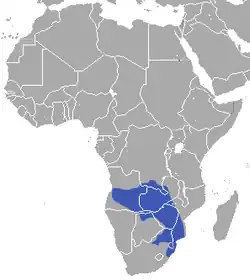
The swamp musk shrew (Crocidura mariquensis), or musk shrew,[2] is a species of mammal in the family Soricidae. It occurs in Angola, Botswana, Democratic Republic of the Congo, Mozambique, Namibia, South Africa, Eswatini, Zambia and Zimbabwe. Its natural habitat is swamps, and it is a common species in suitable habitats, with the International Union for Conservation of Nature listing it as being of "least concern".[1]
Description
This is a moderate-sized shrew growing to a head-and-body length of about 80 mm (3 in) with a tail of around 60 mm (2.4 in), males being slightly larger than females. The head is long and narrow, with a sharply pointed snout, small eyes and rounded ears. The dorsal pelage is blackish-brown tinged with rust, the individual hairs having greyish bases, brownish bands and brownish-black tips. The ventral surface is paler greyish-brown, there being no clear demarcation between dorsal and ventral fur. The tail is about 70% of the head-and-body length, and is partially haired and some shade of brown, sometimes paler below. Both fore and hind feet are yellowish-brown, reddish-brown or dark brown, and the digits of the hind feet splay apart when the animal is walking. There is considerable variation in colouring over the shrew's range.[2]
Distribution and habitat
The musk shrew is native to southern Africa, where its range extends from Angola and the southern Democratic Republic of the Congo, through Zambia, northeastern Namibia and northern Botswana, to Zimbabwe, southern Mozambique, Eswatini and northeastern South Africa. It has a requirement for a wetland habitat and occurs in reed beds and semi-aquatic vegetation, in the vicinity of rivers and lakes and in seasonally flooded areas, with a marked preference for marshes and swamps.[1]
Ecology
The musk shrew is mainly nocturnal, although it may occasionally be active during the day.[2] It clambers around among the aquatic vegetation with agility; it is not aggressive to other members of its species and does not scent mark its surroundings. In captivity it will feed on snails and termites, but does not dig into the ground to forage. In its natural surroundings, nests have been observed in grass tussocks and in debris above the surface of the ground. Breeding mostly takes place in the wet season, with litters averaging three to four young. It is predated upon by the southern fiscal, the barn owl and the African grass owl.[2]
Conservation status
This shrew was classified as "near threatened" in 2016 by South African National Bioinformatics Institute;[3] however, it has a wide range, is presumed to have a stable and large total population, and faces no particular threats, so the International Union for Conservation of Nature has assessed its conservation status as being of "least concern".[1]
References
|
|---|
|
|
|
|
|
|---|
| Diplomesodon | |
|---|
| Feroculus | |
|---|
| Palawanosorex |
- Palawan moss shrew (P. muscorum)
|
|---|
Paracrocidura
(Large-headed
shrews) |
- Grauer's large-headed shrew (P. graueri)
- Greater large-headed shrew (P. maxima)
- Lesser large-headed shrew (P. schoutedeni)
|
|---|
| Ruwenzorisorex | |
|---|
| Scutisorex | |
|---|
| Solisorex | |
|---|
| Suncus |
- Taita shrew (S. aequatorius)
- Black shrew (S. ater)
- Day's shrew (S. dayi)
- Etruscan shrew (S. etruscus)
- Sri Lankan shrew (S. fellowesgordoni)
- Bornean pygmy shrew (S. hosei)
- Least dwarf shrew (S. infinitesimus)
- Greater dwarf shrew (S. lixus)
- Madagascan pygmy shrew (S. madagascariensis)
- Malayan pygmy shrew (S. malayanus)
- Climbing shrew (S. megalura)
- Flores shrew (S. mertensi)
- Asian highland shrew (S. montanus)
- Asian house shrew (S. murinus)
- Remy's pygmy shrew (S. remyi)
- Anderson's shrew (S. stoliczkanus)
- Lesser dwarf shrew (S. varilla)
- Jungle shrew (S. zeylanicus)
|
|---|
Sylvisorex
(Forest shrews) |
- Dudu Akaibe's pygmy shrew (S. akaibei)
- Cameroonian forest shrew (S. cameruniensis)
- Corbet's forest shrew (S. corbeti)
- Grant's forest shrew (S. granti)
- Howell's forest shrew (S. howelli)
- Bioko forest shrew (S. isabellae)
- Johnston's forest shrew (S. johnstoni)
- Kongana shrew (S. konganensis)
- Moon forest shrew (S. lunaris)
- Mount Cameroon forest shrew (S. morio)
- Greater forest shrew (S. ollula)
- Lesser forest shrew (S. oriundus)
- Rain forest shrew (S. pluvialis)
- Volcano shrew (S. vulcanorum)
|
|---|
|
|
|
|---|
| Anourosoricini | |
|---|
| Blarinellini | Blarinella
(some Asiatic short-tailed
shrews) |
- Asiatic short-tailed shrew (B. quadraticauda)
- Burmese short-tailed shrew (B. wardi)
|
|---|
Parablarinella
(some Asiatic short-tailed
shrews) |
- Indochinese short-tailed shrew (P. griselda)
- Anhui short-tailed shrew (P. latimaxillata)
|
|---|
|
|---|
| Blarinini | Blarina
(American short-tailed
shrews) | |
|---|
Cryptotis
(Small-eared
shrews) |
- C. mexicana group
- Mexican small-eared shrew (C. mexicana)
- Nelson's small-eared shrew (C. nelsoni)
- Grizzled Mexican small-eared shrew (C. obscura)
- Phillips' small-eared shrew (C. phillipsii)
- C. goldmani set
- Central Mexican broad-clawed shrew (C. alticola)
- Goldman's broad-clawed shrew (C. goldmani)
- Goodwin's broad-clawed shrew (C. goodwini)
- Guatemalan broad-clawed shrew (C. griseoventris)
- C. lacertosus
- C. mam
- Oaxacan broad-clawed shrew (C. peregrina)
- C. nigrescens group
- Eastern Cordillera small-footed shrew (C. brachyonyx)
- Colombian small-eared shrew (C. colombiana)
- Honduran small-eared shrew (C. hondurensis)
- Yucatan small-eared shrew (C. mayensis)
- Darién small-eared shrew (C. mera)
- Merriam's small-eared shrew (C. merriami)
- Blackish small-eared shrew (C. nigrescens)
- C. thomasi group
- Southern Colombian small-eared shrew (C. andinus)
- Ecuadorian small-eared shrew (C. equatoris)
- Rainer's small-eared shrew (C. huttereri)
- Medellín small-eared shrew (C. medellinia)
- Merida small-eared shrew (C. meridensis)
- Wandering small-eared shrew (C. montivaga)
- Peruvian small-eared shrew (C. peruviensis)
- Scaly-footed small-eared shrew (C. squaipes)
- Tamá small-eared shrew (C. tamensis)
- Thomas's small-eared shrew (C. thomasi)
- C. parva group
- Central American least shrew (C. orophila)
- North American least shrew (C. parva)
- Tropical small-eared shrew (C. tropicalis)
- Ungrouped / relict
- Enders's small-eared shrew (C. endersi)
- Talamancan small-eared shrew (C. gracilis)
- Big Mexican small-eared shrew (C. magna)
|
|---|
|
|---|
| Nectogalini | Chimarrogale
(Asiatic water
shrews) | |
|---|
| Chodsigoa |
- Van Sung's shrew (C. caovansunga)
- De Winton's shrew (C. hypsibia)
- Lamulate shrew (C. lamula)
- Lowe's shrew (C. parca)
- Pygmy brown-toothed shrew (C. parva)
- Salenski's shrew (C. salenskii)
- Smith's shrew (C. smithii)
- Lesser Taiwanese shrew (C. sodalis)
|
|---|
| Episoriculus | |
|---|
| Nectogale | |
|---|
| Neomys | |
|---|
| Soriculus | |
|---|
|
|---|
| Notiosoricini | |
|---|
|
|
|
|
|---|
Congosorex
(Congo shrews) |
- Phillips's shrew (C. phillipsorum)
- Greater Congo shrew (C. polli)
- Lesser Congo shrew (C. verheyeni)
|
|---|
Myosorex
(Mouse shrews) |
- Babault's mouse shrew (M. babaulti)
- Montane mouse shrew (M. blarina)
- Bururi forest shrew (M. bururiensis)
- Dark-footed mouse shrew (M. cafer)
- Eisentraut's mouse shrew (M. eisentrauti)
- Geata mouse shrew (M. geata)
- Nyika mouse shrew (M. gnoskei)
- Kihaule's mouse shrew (M. kihaulei)
- Long-tailed forest shrew (M. longicaudatus)
- Oku mouse shrew (M. okuensis)
- Rumpi mouse shrew (M. rumpii)
- Schaller's mouse shrew (M. schalleri)
- Sclater's mouse shrew (M. sclateri)
- Thin mouse shrew (M. tenuis)
- Forest shrew (M. varius)
- Kilimanjaro mouse shrew (M. zinki)
|
|---|
Surdisorex
(African mole
shrews) |
- Aberdare mole shrew (S. norae)
- Mount Kenya mole shrew (S. polulus)
|
|---|
|
|
|
|
Taxon identifiers |
|---|
| Crocidura mariquensis | |
|---|