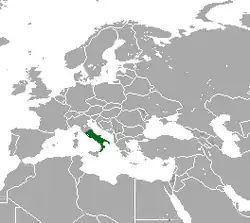
The Roman mole (Talpa romana) is a species of mammal in the family Talpidae. It is endemic to central-southern Italy (from the province of Grosseto to the province of Ancona, south to southern Calabria). It was last recorded on Sicily in 1885. There is also an unconfirmed report about an isolated subpopulation in the Vars region of southern France.
Taxonomy
Several subspecies of the Roman mole have been described based on differences in skull size: T. r. montana (found in Abruzzo and Molise), T. r. aenigmatica (formerly found in Sicily and now extinct), T. r. adamoi (found in south-central Calabria), and T. r. brachycrania (found in Lucania). However, the size of the skull appears to vary clinally from large in the north to smaller in the south, suggesting that the taxonomy of the species needs to be revised to more accurately understand geographic variation in its morphology.[2]
Description
The Roman mole is fairly large compared to other moles, with adults weighing up to 125 g.[1]
Distribution and habitat
The Roman mole is endemic to Italy, where it is found in the central and southern parts of the peninsula. It is locally extinct in Sicily, where it was last seen in 1885. The status of the population rumored to live in Vars in southern France is unconfirmed.[1][3][4] The species is found in a wide variety of habitats, including dense forests, woodland, fields, pastures, grasslands, and olive groves, from sea level up to an elevation of 2,000 m.[1][2]
Biology
Like other moles, Roman moles live entirely underground in individual tunnel systems that they defend territorially.[2][1] Males defend territories of 2–3 square kilometres normally and up to 7 square kilometres during the breeding season. Females defend territories of 1–2 square kilometres on average.[1]
It feeds mainly on earthworms and insect larvae.[1]
Conservation
The Roman mole is listed as being of least concern on the IUCN Red List as it is fairly common throughout its range and is not thought to be declining fast enough to qualify for a threatened listing. It is less common than it was previously and may be experiencing local population declines in areas with heavy agricultural cultivation. It is also listed on Italy's national list of pests and persecuted widely, but this is unlikely to threaten the species. However, it is threatened by overuse of biocides and chemicals, as well as increasingly severe droughts caused by climate change, which can cause starvation. Previously the Roman mole was hunted for its fur, which was used to make gloves and raincoats, and hunting for this purpose continues. It inhabits several protected areas within its range.[1][2]
References
- ^ a b c d e f g h Gazzard, A.; Loy, A. (2024). "Talpa romana". IUCN Red List of Threatened Species. 2024: e.T41484A226866928. doi:10.2305/IUCN.UK.2024-2.RLTS.T41484A226866928.en. Retrieved 8 April 2025.
- ^ a b c d Mitchell-Jones, Tony J. (1999). The atlas of European mammals. Poyser natural history series. Societas europaea mammalogica. London: T. & A. D. Poyser Academic press, on behalf of the Societas Europaea mammalogica. p. 86. ISBN 978-0-85661-130-8.
- ^ Beolchini, Francesca; Rebecchi, Lorena; Bertolani, Roberto; Capanna, Ernesto (2003). "The gametogenetic cycle of two syntopic populations of moles: Talpa romana and Talpa europaea (Mammalia, Insectívora, Talpidae)". Italian Journal of Zoology. 70 (2): 109–113. doi:10.1080/11250000309356503. hdl:11380/308000. ISSN 1125-0003.
- ^ Sánchez, Antonio; Bullejos, Mónica; Burgos, Miguel; Hera, Concepción; Stamatopoulos, Costas; de la Guardia, Rafael Díaz; Jiménez, Rafael (1996). "Females of four mole species of genusTalpa (Insectivora, mammalia) are true hermaphrodites with ovotestes". Molecular Reproduction and Development. 44 (3): 289–294. doi:10.1002/(SICI)1098-2795(199607)44:3<289::AID-MRD2>3.0.CO;2-I. ISSN 1040-452X.
|
|---|
|
|
|
|
|
|---|
| Diplomesodon | |
|---|
| Feroculus | |
|---|
| Palawanosorex |
- Palawan moss shrew (P. muscorum)
|
|---|
Paracrocidura
(Large-headed
shrews) |
- Grauer's large-headed shrew (P. graueri)
- Greater large-headed shrew (P. maxima)
- Lesser large-headed shrew (P. schoutedeni)
|
|---|
| Ruwenzorisorex | |
|---|
| Scutisorex | |
|---|
| Solisorex | |
|---|
| Suncus |
- Taita shrew (S. aequatorius)
- Black shrew (S. ater)
- Day's shrew (S. dayi)
- Etruscan shrew (S. etruscus)
- Sri Lankan shrew (S. fellowesgordoni)
- Bornean pygmy shrew (S. hosei)
- Least dwarf shrew (S. infinitesimus)
- Greater dwarf shrew (S. lixus)
- Madagascan pygmy shrew (S. madagascariensis)
- Malayan pygmy shrew (S. malayanus)
- Climbing shrew (S. megalura)
- Flores shrew (S. mertensi)
- Asian highland shrew (S. montanus)
- Asian house shrew (S. murinus)
- Remy's pygmy shrew (S. remyi)
- Anderson's shrew (S. stoliczkanus)
- Lesser dwarf shrew (S. varilla)
- Jungle shrew (S. zeylanicus)
|
|---|
Sylvisorex
(Forest shrews) |
- Dudu Akaibe's pygmy shrew (S. akaibei)
- Cameroonian forest shrew (S. cameruniensis)
- Corbet's forest shrew (S. corbeti)
- Grant's forest shrew (S. granti)
- Howell's forest shrew (S. howelli)
- Bioko forest shrew (S. isabellae)
- Johnston's forest shrew (S. johnstoni)
- Kongana shrew (S. konganensis)
- Moon forest shrew (S. lunaris)
- Mount Cameroon forest shrew (S. morio)
- Greater forest shrew (S. ollula)
- Lesser forest shrew (S. oriundus)
- Rain forest shrew (S. pluvialis)
- Volcano shrew (S. vulcanorum)
|
|---|
|
|
|
|---|
| Anourosoricini | |
|---|
| Blarinellini | Blarinella
(some Asiatic short-tailed
shrews) |
- Asiatic short-tailed shrew (B. quadraticauda)
- Burmese short-tailed shrew (B. wardi)
|
|---|
Parablarinella
(some Asiatic short-tailed
shrews) |
- Indochinese short-tailed shrew (P. griselda)
- Anhui short-tailed shrew (P. latimaxillata)
|
|---|
|
|---|
| Blarinini | Blarina
(American short-tailed
shrews) | |
|---|
Cryptotis
(Small-eared
shrews) |
- C. mexicana group
- Mexican small-eared shrew (C. mexicana)
- Nelson's small-eared shrew (C. nelsoni)
- Grizzled Mexican small-eared shrew (C. obscura)
- Phillips' small-eared shrew (C. phillipsii)
- C. goldmani set
- Central Mexican broad-clawed shrew (C. alticola)
- Goldman's broad-clawed shrew (C. goldmani)
- Goodwin's broad-clawed shrew (C. goodwini)
- Guatemalan broad-clawed shrew (C. griseoventris)
- C. lacertosus
- C. mam
- Oaxacan broad-clawed shrew (C. peregrina)
- C. nigrescens group
- Eastern Cordillera small-footed shrew (C. brachyonyx)
- Colombian small-eared shrew (C. colombiana)
- Honduran small-eared shrew (C. hondurensis)
- Yucatan small-eared shrew (C. mayensis)
- Darién small-eared shrew (C. mera)
- Merriam's small-eared shrew (C. merriami)
- Blackish small-eared shrew (C. nigrescens)
- C. thomasi group
- Southern Colombian small-eared shrew (C. andinus)
- Ecuadorian small-eared shrew (C. equatoris)
- Rainer's small-eared shrew (C. huttereri)
- Medellín small-eared shrew (C. medellinia)
- Merida small-eared shrew (C. meridensis)
- Wandering small-eared shrew (C. montivaga)
- Peruvian small-eared shrew (C. peruviensis)
- Scaly-footed small-eared shrew (C. squaipes)
- Tamá small-eared shrew (C. tamensis)
- Thomas's small-eared shrew (C. thomasi)
- C. parva group
- Central American least shrew (C. orophila)
- North American least shrew (C. parva)
- Tropical small-eared shrew (C. tropicalis)
- Ungrouped / relict
- Enders's small-eared shrew (C. endersi)
- Talamancan small-eared shrew (C. gracilis)
- Big Mexican small-eared shrew (C. magna)
|
|---|
|
|---|
| Nectogalini | Chimarrogale
(Asiatic water
shrews) | |
|---|
| Chodsigoa |
- Van Sung's shrew (C. caovansunga)
- De Winton's shrew (C. hypsibia)
- Lamulate shrew (C. lamula)
- Lowe's shrew (C. parca)
- Pygmy brown-toothed shrew (C. parva)
- Salenski's shrew (C. salenskii)
- Smith's shrew (C. smithii)
- Lesser Taiwanese shrew (C. sodalis)
|
|---|
| Episoriculus | |
|---|
| Nectogale | |
|---|
| Neomys | |
|---|
| Soriculus | |
|---|
|
|---|
| Notiosoricini | |
|---|
|
|
|
|
|---|
Congosorex
(Congo shrews) |
- Phillips's shrew (C. phillipsorum)
- Greater Congo shrew (C. polli)
- Lesser Congo shrew (C. verheyeni)
|
|---|
Myosorex
(Mouse shrews) |
- Babault's mouse shrew (M. babaulti)
- Montane mouse shrew (M. blarina)
- Bururi forest shrew (M. bururiensis)
- Dark-footed mouse shrew (M. cafer)
- Eisentraut's mouse shrew (M. eisentrauti)
- Geata mouse shrew (M. geata)
- Nyika mouse shrew (M. gnoskei)
- Kihaule's mouse shrew (M. kihaulei)
- Long-tailed forest shrew (M. longicaudatus)
- Oku mouse shrew (M. okuensis)
- Rumpi mouse shrew (M. rumpii)
- Schaller's mouse shrew (M. schalleri)
- Sclater's mouse shrew (M. sclateri)
- Thin mouse shrew (M. tenuis)
- Forest shrew (M. varius)
- Kilimanjaro mouse shrew (M. zinki)
|
|---|
Surdisorex
(African mole
shrews) |
- Aberdare mole shrew (S. norae)
- Mount Kenya mole shrew (S. polulus)
|
|---|
|
|
|
|
Taxon identifiers |
|---|
| Talpa romana | |
|---|
.jpg)