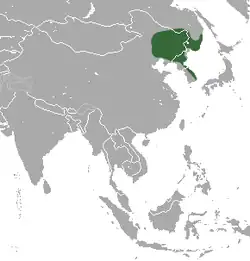
The Ussuri mole[2] or large mole[1] (Mogera robusta), is a species of mammal in the family Talpidae, formerly treated as a subspecies of the Japanese mole.[3] It is found in China, North Korea, South Korea, and Russia and lives in a long burrow, seldom emerging on the surface of the ground during the day.
Description
This mole grows to a total length of 154 to 172 mm (6 to 7 in) with a tail of about 20 mm (0.8 in). It is adapted for underground life; the body is cylindrical, the fore-feet are spade-like, the nails are flattened and the eyes are small.[2] The short, dense, dorsal pelage is brownish-grey with a metallic sheen and the underparts are silvery-yellow, with a grey patch on the chest. The bare skin on the muzzle and the feet is yellowish. The short tail is well-covered with hair.[4]
Distribution and habitat
The Ussuri mole occurs in northeastern China, the Korean peninsula and southeastern Russia. Its typical habitat is montane forest and woodland, pasture and agricultural land but it is seldom found on steep rocky slopes.[1]
Ecology
This mole is solitary and mainly nocturnal, but is sometimes active on cloudy or rainy days. It feeds mainly on earthworms, insects, spiders, slugs and snails. It excavates feeding passages about 10 cm (4 in) below the surface of the soil, periodically throwing up a "mole hill", a pile of soil on the surface. Main passages may have a total length of 450 m (1,500 ft) and be at least 30 cm (12 in) below the surface; they connect feeding areas with drinking places and the nest. The breeding chamber contains a globular nest of leaves and grasses. The litter size is from 2 to 6 young with a gestation period of 28 days. Ussuri moles live for up to four years, but sometimes fall prey to owls, snakes and weasels.[1][2]
Conservation status
Mogera robusta has a wide range and is said to be abundant in some areas and common in others. Although it used to be hunted for its pelt, this is no longer the case and it now faces no particular threats. The International Union for Conservation of Nature has rated its conservation status as being of "least concern" because, although its population may be in slow decline, this is not at a fast enough rate to warrant listing it in a more threatened category.[1]
References
|
|---|
|
|
|
|
|
|---|
| Diplomesodon | |
|---|
| Feroculus | |
|---|
| Palawanosorex |
- Palawan moss shrew (P. muscorum)
|
|---|
Paracrocidura
(Large-headed
shrews) |
- Grauer's large-headed shrew (P. graueri)
- Greater large-headed shrew (P. maxima)
- Lesser large-headed shrew (P. schoutedeni)
|
|---|
| Ruwenzorisorex | |
|---|
| Scutisorex | |
|---|
| Solisorex | |
|---|
| Suncus |
- Taita shrew (S. aequatorius)
- Black shrew (S. ater)
- Day's shrew (S. dayi)
- Etruscan shrew (S. etruscus)
- Sri Lankan shrew (S. fellowesgordoni)
- Bornean pygmy shrew (S. hosei)
- Least dwarf shrew (S. infinitesimus)
- Greater dwarf shrew (S. lixus)
- Madagascan pygmy shrew (S. madagascariensis)
- Malayan pygmy shrew (S. malayanus)
- Climbing shrew (S. megalura)
- Flores shrew (S. mertensi)
- Asian highland shrew (S. montanus)
- Asian house shrew (S. murinus)
- Remy's pygmy shrew (S. remyi)
- Anderson's shrew (S. stoliczkanus)
- Lesser dwarf shrew (S. varilla)
- Jungle shrew (S. zeylanicus)
|
|---|
Sylvisorex
(Forest shrews) |
- Dudu Akaibe's pygmy shrew (S. akaibei)
- Cameroonian forest shrew (S. cameruniensis)
- Corbet's forest shrew (S. corbeti)
- Grant's forest shrew (S. granti)
- Howell's forest shrew (S. howelli)
- Bioko forest shrew (S. isabellae)
- Johnston's forest shrew (S. johnstoni)
- Kongana shrew (S. konganensis)
- Moon forest shrew (S. lunaris)
- Mount Cameroon forest shrew (S. morio)
- Greater forest shrew (S. ollula)
- Lesser forest shrew (S. oriundus)
- Rain forest shrew (S. pluvialis)
- Volcano shrew (S. vulcanorum)
|
|---|
|
|
|
|---|
| Anourosoricini | |
|---|
| Blarinellini | Blarinella
(some Asiatic short-tailed
shrews) |
- Asiatic short-tailed shrew (B. quadraticauda)
- Burmese short-tailed shrew (B. wardi)
|
|---|
Parablarinella
(some Asiatic short-tailed
shrews) |
- Indochinese short-tailed shrew (P. griselda)
- Anhui short-tailed shrew (P. latimaxillata)
|
|---|
|
|---|
| Blarinini | Blarina
(American short-tailed
shrews) | |
|---|
Cryptotis
(Small-eared
shrews) |
- C. mexicana group
- Mexican small-eared shrew (C. mexicana)
- Nelson's small-eared shrew (C. nelsoni)
- Grizzled Mexican small-eared shrew (C. obscura)
- Phillips' small-eared shrew (C. phillipsii)
- C. goldmani set
- Central Mexican broad-clawed shrew (C. alticola)
- Goldman's broad-clawed shrew (C. goldmani)
- Goodwin's broad-clawed shrew (C. goodwini)
- Guatemalan broad-clawed shrew (C. griseoventris)
- C. lacertosus
- C. mam
- Oaxacan broad-clawed shrew (C. peregrina)
- C. nigrescens group
- Eastern Cordillera small-footed shrew (C. brachyonyx)
- Colombian small-eared shrew (C. colombiana)
- Honduran small-eared shrew (C. hondurensis)
- Yucatan small-eared shrew (C. mayensis)
- Darién small-eared shrew (C. mera)
- Merriam's small-eared shrew (C. merriami)
- Blackish small-eared shrew (C. nigrescens)
- C. thomasi group
- Southern Colombian small-eared shrew (C. andinus)
- Ecuadorian small-eared shrew (C. equatoris)
- Rainer's small-eared shrew (C. huttereri)
- Medellín small-eared shrew (C. medellinia)
- Merida small-eared shrew (C. meridensis)
- Wandering small-eared shrew (C. montivaga)
- Peruvian small-eared shrew (C. peruviensis)
- Scaly-footed small-eared shrew (C. squaipes)
- Tamá small-eared shrew (C. tamensis)
- Thomas's small-eared shrew (C. thomasi)
- C. parva group
- Central American least shrew (C. orophila)
- North American least shrew (C. parva)
- Tropical small-eared shrew (C. tropicalis)
- Ungrouped / relict
- Enders's small-eared shrew (C. endersi)
- Talamancan small-eared shrew (C. gracilis)
- Big Mexican small-eared shrew (C. magna)
|
|---|
|
|---|
| Nectogalini | Chimarrogale
(Asiatic water
shrews) | |
|---|
| Chodsigoa |
- Van Sung's shrew (C. caovansunga)
- De Winton's shrew (C. hypsibia)
- Lamulate shrew (C. lamula)
- Lowe's shrew (C. parca)
- Pygmy brown-toothed shrew (C. parva)
- Salenski's shrew (C. salenskii)
- Smith's shrew (C. smithii)
- Lesser Taiwanese shrew (C. sodalis)
|
|---|
| Episoriculus | |
|---|
| Nectogale | |
|---|
| Neomys | |
|---|
| Soriculus | |
|---|
|
|---|
| Notiosoricini | |
|---|
|
|
|
|
|---|
Congosorex
(Congo shrews) |
- Phillips's shrew (C. phillipsorum)
- Greater Congo shrew (C. polli)
- Lesser Congo shrew (C. verheyeni)
|
|---|
Myosorex
(Mouse shrews) |
- Babault's mouse shrew (M. babaulti)
- Montane mouse shrew (M. blarina)
- Bururi forest shrew (M. bururiensis)
- Dark-footed mouse shrew (M. cafer)
- Eisentraut's mouse shrew (M. eisentrauti)
- Geata mouse shrew (M. geata)
- Nyika mouse shrew (M. gnoskei)
- Kihaule's mouse shrew (M. kihaulei)
- Long-tailed forest shrew (M. longicaudatus)
- Oku mouse shrew (M. okuensis)
- Rumpi mouse shrew (M. rumpii)
- Schaller's mouse shrew (M. schalleri)
- Sclater's mouse shrew (M. sclateri)
- Thin mouse shrew (M. tenuis)
- Forest shrew (M. varius)
- Kilimanjaro mouse shrew (M. zinki)
|
|---|
Surdisorex
(African mole
shrews) |
- Aberdare mole shrew (S. norae)
- Mount Kenya mole shrew (S. polulus)
|
|---|
|
|
|
|
Taxon identifiers |
|---|
| Mogera robusta | |
|---|