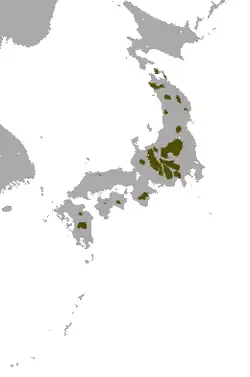
True's shrew mole (Dymecodon pilirostris) is a species of mammal in the family Talpidae. It is endemic to Japan (Honshu, Shikoku and Kyushu) and is a common species above 1000 meters in grassland, shrubland and forest.[1] Sometimes this species is called the lesser Japanese shrew mole and another species, Urotrichus talpoides, is called the "greater Japanese shrew mole".[2]
It is the only species in the genus Dymecodon. It has sometimes been considered belonging to the genus Urotrichus.
Etymology
The genus name is the compound of δύο (duo) "two", μήκος (mekos) "size", and όδούς (odous) "tooth", so "two size teeth", because of the alternation in size of the teeth in the lower jaw.[3]
Description
D. pilirostris is a mole resembling the Japanese shrew mole, with a head-body length of about 6½ cm covered in thick, 5 mm long, darkbrown fur with a strong greenish metallic lustre, and a tail of about 3½ cm, covered with dark hair of about 7 mm. The palms and soles are covered in darkbrown scales. It differs somewhat from Urotrichus in overall size (smaller) and the relative size of its body parts (such as a relatively longer tail). Its dentition however differs remarkably. The first incisor in the upper jaw is low and broad, the broadest of all teeth in front of the true molars. The second is nearly as broad and comparable in shape. The third incisor and the canine are simple and rounded and about ¼ of the other incisors. The teeth in the lower jaw compare to those in the upper jaw, but the second incisor has an additional conic cusp at its back, there is no third incisor and the canine is minute.[3]
References
- ^ a b Laginha Pinto Correia, D. (2016). "Dymecodon pilirostris". IUCN Red List of Threatened Species. 2016: e.T41488A22323252. doi:10.2305/IUCN.UK.2016-1.RLTS.T41488A22323252.en. Retrieved 11 November 2021.
- ^ Kawada, Shin-Ichiro; Li, Song; Wang, Ying-xiang; Mock, Orin; Oda, Sen-Ichi; Campbell, Kevin (2008). "Karyotype Evolution of Shrew Moles (Soricomorpha: Talpidae)". Journal of Mammalogy. 89 (6): 1428–1434. doi:10.1644/07-MAMM-A-105.1. S2CID 52088189.
- ^ a b True, Frederik W. (1886). "Description of a new genus and species of mole, Dymecodon pilirostris, from Japan". Proceedings of the United States National Museum. 9 (557): 97–98. doi:10.5479/si.00963801.557.97.
|
|---|
|
|
|
|
|
|---|
| Diplomesodon | |
|---|
| Feroculus | |
|---|
| Palawanosorex |
- Palawan moss shrew (P. muscorum)
|
|---|
Paracrocidura
(Large-headed
shrews) |
- Grauer's large-headed shrew (P. graueri)
- Greater large-headed shrew (P. maxima)
- Lesser large-headed shrew (P. schoutedeni)
|
|---|
| Ruwenzorisorex | |
|---|
| Scutisorex | |
|---|
| Solisorex | |
|---|
| Suncus |
- Taita shrew (S. aequatorius)
- Black shrew (S. ater)
- Day's shrew (S. dayi)
- Etruscan shrew (S. etruscus)
- Sri Lankan shrew (S. fellowesgordoni)
- Bornean pygmy shrew (S. hosei)
- Least dwarf shrew (S. infinitesimus)
- Greater dwarf shrew (S. lixus)
- Madagascan pygmy shrew (S. madagascariensis)
- Malayan pygmy shrew (S. malayanus)
- Climbing shrew (S. megalura)
- Flores shrew (S. mertensi)
- Asian highland shrew (S. montanus)
- Asian house shrew (S. murinus)
- Remy's pygmy shrew (S. remyi)
- Anderson's shrew (S. stoliczkanus)
- Lesser dwarf shrew (S. varilla)
- Jungle shrew (S. zeylanicus)
|
|---|
Sylvisorex
(Forest shrews) |
- Dudu Akaibe's pygmy shrew (S. akaibei)
- Cameroonian forest shrew (S. cameruniensis)
- Corbet's forest shrew (S. corbeti)
- Grant's forest shrew (S. granti)
- Howell's forest shrew (S. howelli)
- Bioko forest shrew (S. isabellae)
- Johnston's forest shrew (S. johnstoni)
- Kongana shrew (S. konganensis)
- Moon forest shrew (S. lunaris)
- Mount Cameroon forest shrew (S. morio)
- Greater forest shrew (S. ollula)
- Lesser forest shrew (S. oriundus)
- Rain forest shrew (S. pluvialis)
- Volcano shrew (S. vulcanorum)
|
|---|
|
|
|
|---|
| Anourosoricini | |
|---|
| Blarinellini | Blarinella
(some Asiatic short-tailed
shrews) |
- Asiatic short-tailed shrew (B. quadraticauda)
- Burmese short-tailed shrew (B. wardi)
|
|---|
Parablarinella
(some Asiatic short-tailed
shrews) |
- Indochinese short-tailed shrew (P. griselda)
- Anhui short-tailed shrew (P. latimaxillata)
|
|---|
|
|---|
| Blarinini | Blarina
(American short-tailed
shrews) | |
|---|
Cryptotis
(Small-eared
shrews) |
- C. mexicana group
- Mexican small-eared shrew (C. mexicana)
- Nelson's small-eared shrew (C. nelsoni)
- Grizzled Mexican small-eared shrew (C. obscura)
- Phillips' small-eared shrew (C. phillipsii)
- C. goldmani set
- Central Mexican broad-clawed shrew (C. alticola)
- Goldman's broad-clawed shrew (C. goldmani)
- Goodwin's broad-clawed shrew (C. goodwini)
- Guatemalan broad-clawed shrew (C. griseoventris)
- C. lacertosus
- C. mam
- Oaxacan broad-clawed shrew (C. peregrina)
- C. nigrescens group
- Eastern Cordillera small-footed shrew (C. brachyonyx)
- Colombian small-eared shrew (C. colombiana)
- Honduran small-eared shrew (C. hondurensis)
- Yucatan small-eared shrew (C. mayensis)
- Darién small-eared shrew (C. mera)
- Merriam's small-eared shrew (C. merriami)
- Blackish small-eared shrew (C. nigrescens)
- C. thomasi group
- Southern Colombian small-eared shrew (C. andinus)
- Ecuadorian small-eared shrew (C. equatoris)
- Rainer's small-eared shrew (C. huttereri)
- Medellín small-eared shrew (C. medellinia)
- Merida small-eared shrew (C. meridensis)
- Wandering small-eared shrew (C. montivaga)
- Peruvian small-eared shrew (C. peruviensis)
- Scaly-footed small-eared shrew (C. squaipes)
- Tamá small-eared shrew (C. tamensis)
- Thomas's small-eared shrew (C. thomasi)
- C. parva group
- Central American least shrew (C. orophila)
- North American least shrew (C. parva)
- Tropical small-eared shrew (C. tropicalis)
- Ungrouped / relict
- Enders's small-eared shrew (C. endersi)
- Talamancan small-eared shrew (C. gracilis)
- Big Mexican small-eared shrew (C. magna)
|
|---|
|
|---|
| Nectogalini | Chimarrogale
(Asiatic water
shrews) | |
|---|
| Chodsigoa |
- Van Sung's shrew (C. caovansunga)
- De Winton's shrew (C. hypsibia)
- Lamulate shrew (C. lamula)
- Lowe's shrew (C. parca)
- Pygmy brown-toothed shrew (C. parva)
- Salenski's shrew (C. salenskii)
- Smith's shrew (C. smithii)
- Lesser Taiwanese shrew (C. sodalis)
|
|---|
| Episoriculus | |
|---|
| Nectogale | |
|---|
| Neomys | |
|---|
| Soriculus | |
|---|
|
|---|
| Notiosoricini | |
|---|
|
|
|
|
|---|
Congosorex
(Congo shrews) |
- Phillips's shrew (C. phillipsorum)
- Greater Congo shrew (C. polli)
- Lesser Congo shrew (C. verheyeni)
|
|---|
Myosorex
(Mouse shrews) |
- Babault's mouse shrew (M. babaulti)
- Montane mouse shrew (M. blarina)
- Bururi forest shrew (M. bururiensis)
- Dark-footed mouse shrew (M. cafer)
- Eisentraut's mouse shrew (M. eisentrauti)
- Geata mouse shrew (M. geata)
- Nyika mouse shrew (M. gnoskei)
- Kihaule's mouse shrew (M. kihaulei)
- Long-tailed forest shrew (M. longicaudatus)
- Oku mouse shrew (M. okuensis)
- Rumpi mouse shrew (M. rumpii)
- Schaller's mouse shrew (M. schalleri)
- Sclater's mouse shrew (M. sclateri)
- Thin mouse shrew (M. tenuis)
- Forest shrew (M. varius)
- Kilimanjaro mouse shrew (M. zinki)
|
|---|
Surdisorex
(African mole
shrews) |
- Aberdare mole shrew (S. norae)
- Mount Kenya mole shrew (S. polulus)
|
|---|
|
|
|
|
Taxon identifiers |
|---|
| Dymecodon pilirostris | |
|---|